![Why does my chip keep slipping out? | The maker reports no universal fix [OK Prostate Chip]](/img/a/T0129/eyecatch.svg)
This page is based on entries from "ok-lab's diary" (https://ok-lab.hatenablog.com/), the Japanese development diary written by Mr. Okada, founder of OK Lab, a small company in Japan (Okada Comfortable Life Laboratory). Only the entries about "chip slipping out" are summarized here, in order of publication. Past prices and sizes are as written at the time. Current prices come from the official product list (retrieved September 4, 2026). Quotations are translated from Japanese.
Note: This page is a personal reading log by someone with no connection to the maker or the seller. It reflects the source entries as of their publication dates and makes no guarantee of accuracy or safety. The product is not a medical device; talk to a doctor about any health decision. Check the official site for current information. This page contains advertising.
In short
Chips can shift toward the opening during movement or urination, according to the diary.
Mr. Okada discusses shape and supporting parts, but reports no universally reliable fix.
Related products remain listed, while the diary’s later reports still describe individual differences in fit.
If you see blood in your urine, even a small amount or for the first time, do not wait and see. See a urologist right away.
If you suddenly cannot urinate, or the device cannot be removed, do not try to fix it yourself. Go to a medical facility, including emergency care, immediately.
About this product

The OK Prostate Chip is a small device that is placed in the urethra (the urine passage) so that it acts on the prostate; the maker sells it in several shapes, sizes and materials. It is made and sold by OK Lab (Okada Comfortable Life Laboratory), a small company in Japan, through its own online store, and prices are in Japanese yen (JPY). The maker's development diary, "ok-lab's diary", is written in Japanese. This page is an English summary of it, and every quotation is translated. OK Lab ships internationally, so readers outside Japan can order (see "Buying from outside Japan" below). Product names on this page are plain-English descriptions. The official Japanese product name is shown once in the product table so you can find the same item in the store.
Before you read: key terms
| Term | Plain-English meaning |
|---|---|
| Urethra | The urine passage; it carries urine and is where the chip is placed. |
| Sphincters | Muscles described as opening during urination; the maker discusses their grip as a way to hold chips. |
| Bulbar urethra | The wider urine passage outside the external sphincter, where the diary describes displaced chips settling. |
| Auxiliary chip | A secondary piece attached to the main chip, proposed as support to reduce movement. |
| Sphincter stopper | A supporting part intended to limit movement toward the bladder; it may not prevent outward movement. |
| Pre-ejaculate | The fluid called Cowper’s fluid in the diary; Mr. Okada discusses its lubricating effect on chip movement. |
| Chipless design | Wire loops replace the solid main chip, providing the contact and support discussed by the maker. |
| Nitinol loop | A wire loop used with an auxiliary chip for support near the urethral opening. |
What happens: chip slipping out
The OK Prostate Chip is a small device placed in the urethra to act on the prostate. Here, slipping out means movement toward the urethral opening, which can begin while the chip remains inside the body. The diary describes chips leaving their intended position near the prostate and settling in a wider section of the urine passage. The maker discusses longer shapes, supporting parts, and wire loops intended to limit that movement.
A paired chip still needed support against slipping out during urination
In an entry published in January 2018, a customer asked how to prevent a paired chip escaping during urination. Mr. Okada said paired chips could gradually move into the bulbar urethra (the wider passage outside the external sphincter). The customer reported urinating without expelling the chip. Mr. Okada’s suggested measure was support during urination.
(Source: ok-lab's diary, published January 2018)
https://ok-lab.hatenablog.com/entry/20180130/1517311002
Glass designs differed in how readily they kept slipping out
In an entry published in May 2018, a customer wanted their glass semi-long chip to remain positioned longer. Mr. Okada described glass as more slippery than resin and partial downward movement as usual for that semi-long design. He considered the paired design relatively more stable among the short, paired, and semi-long glass models.
The diary does not record whether the customer achieved longer retention. For stable positioning in glass, Mr. Okada identified only the long design.
(Source: ok-lab's diary, published May 2018)
https://ok-lab.hatenablog.com/entry/20180519/1526708081
Friction-based anchoring failed to prevent the chip from slipping out
In an entry published in May 2019, a customer asked to test a prototype relying on friction to stay put. Mr. Okada declined because he remained dissatisfied with its ability to stay positioned. He said heavy secretions could make the friction-based approach fail completely, and development had been suspended. He did not recommend customer testing.
(Source: ok-lab's diary, published May 2019)
https://ok-lab.hatenablog.com/entry/2019/05/25/144939
Auxiliary supports did not always stop a chip slipping out
In an entry published in April 2021, a customer reported outward movement with both short and semi-long chips. Mr. Okada reviewed their purchases and found that most had been chips without supporting parts. He said outward movement with a chip alone was common among his customers.
He reported gradual slipping with supporting parts in his own use. His suggestions included an auxiliary chip (a secondary supporting piece), stronger curves, or more pronounced projections.
(Source: ok-lab's diary, published April 2021)
https://ok-lab.hatenablog.com/entry/2021/04/17/125959
Repeated chip movement appeared in an account involving bleeding
In an entry published in May 2021, a customer described recurring outward movement of a ceramic version-4 contoured chip. The account also reported bleeding with a screw-shaped auxiliary chip and stopper. Mr. Okada suspected friction or tissue caught between parts, but the diary contains no confirmed diagnosis. He warned that force against resistance could cause bleeding.
(Source: ok-lab's diary, published May 2021)
https://ok-lab.hatenablog.com/entry/2021/05/29/125928
Chip movement remained possible with the curved long design
In an entry published in February 2024, a customer asked whether a curved long chip required a stopper to remain positioned. Mr. Okada reported that his own chip shifted downward even after initially reaching a deeper position. He distinguished partial retention near the prostate from remaining completely motionless.
He considered complete immobility difficult. He cautioned that a sphincter stopper (a part intended to limit bladderward movement) might not stop movement toward the opening.
(Source: ok-lab's diary, published February 2024)
https://ok-lab.hatenablog.com/entry/2024/02/03/123017
Wire loops limited expulsion without stopping every instance of chip movement
In an entry published in January 2025, Mr. Okada reported testing a ceramic chip supported by loops at both ends. During urination or exercise, it moved outward by about 1cm, although the loops prevented it flying out in his test. He considered it less stable than the comparable all-wire design. He regarded the choice between these designs as a matter of personal preference.
(Source: ok-lab's diary, published January 2025)
https://ok-lab.hatenablog.com/entry/2025/01/04/122911
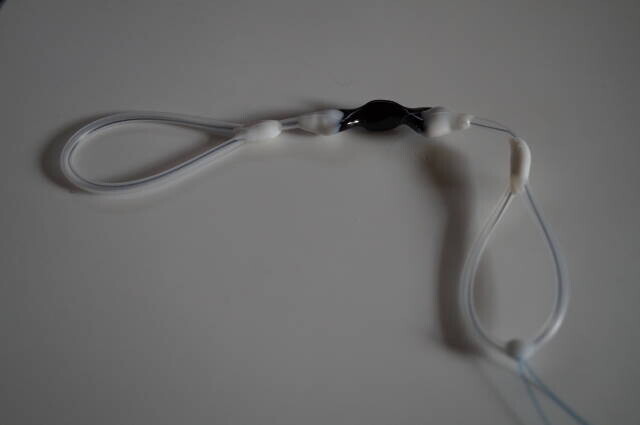
Different bodies prevented a universal answer for chips slipping out
In an entry published in November 2025, a customer reported a contoured chip slipping out after about 10 minutes. They requested a ceramic long four-point twist chip; the diary does not record their results with that purchase. Mr. Okada replied that prostate and sphincter positions and sizes differed between people, preventing a general ranking of shapes.
He said he had not achieved a definitive structure for stable retention. His strongest proposal used opposing support from a nitinol loop (a supporting wire loop) and screw-shaped auxiliary chip near the urethral opening.
(Source: ok-lab's diary, published November 2025)
https://ok-lab.hatenablog.com/entry/2025/11/01/122937
The maker's answer to chip slipping out
The maker explored longer shapes and supporting structures, but continued to report limits.
Long designs were the maker’s early answer to chips slipping out
In an entry published in July 2018, a customer said minor movements displaced both their paired short chip and semi-long chip. Mr. Okada considered fixation difficult without a long design held between the internal and external sphincters (muscles described as gripping the device). The diary does not record whether his suggestions helped this customer. He suggested considering supporting parts or a design with a crossed narrowing.
(Source: ok-lab's diary, published July 2018)
https://ok-lab.hatenablog.com/entry/20180721/1532152353
A rear indentation mattered more than depth for chip movement
In an entry published in December 2020, a customer followed up about their version-4 contoured ceramic chip shifting outward. Mr. Okada’s answer focused on the relationship between its rear indentation and the external sphincter. He considered that contact more stable than having the whole chip beyond the muscle. His advice was to account for individual differences in anatomy and muscle grip.
(Source: ok-lab's diary, published December 2020)
https://ok-lab.hatenablog.com/entry/2020/12/12/124126
Jointed cables alone lacked protection against a vibrating chip slipping out
In an entry published in May 2023, a customer asked about alterations because their vibrating assembly came out during use. Mr. Okada said its jointed 2-wire cable had no structure intended to prevent slipping. He explained that the assembly could move inward or outward while vibrating.
The diary does not record a successful alteration. Mr. Okada’s proposed measure was support outside the body.
(Source: ok-lab's diary, published May 2023)
https://ok-lab.hatenablog.com/entry/2023/05/27/122912
External cable support improved chip movement control in short testing
In an entry published in October 2023, Mr. Okada described a side-entry external cable holder combined with soft parallel cables. Earlier thread-only arrangements had shifted outward. He reported that the newer combination maintained its supported position while remaining flexible, based on testing over only a few days. He limited his recommendation to experienced users of the associated support garments.
(Source: ok-lab's diary, published October 2023)
https://ok-lab.hatenablog.com/entry/2023/10/21/123054
A shorter rear shaft was favored for limiting chip movement
In an entry published in May 2025, Mr. Okada described a chipless design (wire loops instead of a solid main chip). The petal-loop version cost ¥7,000, (about $45 at ¥156 = $1, rate as of 2026-09-04) tax excluded, as published that month.
He reported some outward movement when the petals acted as a sphincter stopper. He attributed this to opposing forces between the petals and sphincter. For better stability, he favored a shorter shaft behind the petals.
(Source: ok-lab's diary, published May 2025)
https://ok-lab.hatenablog.com/entry/2025/05/24/122958
If you see blood in your urine, even a small amount or for the first time, do not wait and see. See a urologist right away.
If you suddenly cannot urinate, or the device cannot be removed, do not try to fix it yourself. Go to a medical facility, including emergency care, immediately.
How chip slipping out changed over time
| Published | What the diary said then |
|---|---|
| Jun 2018 | A stopper failed to prevent bladderward movement in a reported test. |
| Sep 2019 | Mr. Okada considered stronger curves, but saw no absolute solution. |
| Nov 2019 | A customer reported stable positioning with a twisted chip while turning over. |
| Feb 2020 | Mr. Okada considered vibrating chips more prone to movement. |
| Jan 2021 | Mr. Okada reported steel-ring chips slipping despite supporting parts. |
| Mar 2024 | A wire-connected ceramic pair reached the opening; Mr. Okada discouraged the design. |
| May 2025 | Apparent petal-supported stability might follow unnoticed displacement, Mr. Okada suggested. |
| Apr 2026 | A customer favored support on both sides after smaller chips slipped outward. |
OK Prostate Chip products related to chip slipping out
Related products remain listed, without a guaranteed fit established by these accounts.
Products that appear in these entries
| Product (official name) | Price incl. tax | Relation to this topic |
|---|---|---|
| Glass semi-long chip (OKプロステートチップ ガラス素材セミロングタイプ) | ¥4,400 (about $28 at ¥156 = $1, rate as of 2026-09-04) | In May 2018, a customer reported this slipping down more readily than their paired resin chip. |
| Ceramic long four-point twist chip (OKプロステートチップ 陶器素材ロングタイプ 4点ツイスト) | ¥7,700 (about $49 at ¥156 = $1, rate as of 2026-09-04) | In November 2025, a customer requested this after their contoured chip repeatedly slipped out; results were not recorded. |
(Source: ok-lab's diary, published May 2018)
https://ok-lab.hatenablog.com/entry/20180519/1526708081
(Source: ok-lab's diary, published November 2025)
https://ok-lab.hatenablog.com/entry/2025/11/01/122937
Products the diary mentioned as alternatives
| Product (official name) | Price incl. tax | Relation to this topic |
|---|---|---|
| Long glass chip (OKプロステートチップ ロングタイプ) | ¥6,600 (about $42 at ¥156 = $1, rate as of 2026-09-04) | In May 2018, Mr. Okada identified this as his stable glass alternative when the semi-long design slipped down. |
| Screw-shaped auxiliary chip (スクリュー型補助チップ追加オプション) | ¥3,300 (about $21 at ¥156 = $1, rate as of 2026-09-04) | In December 2019, Mr. Okada proposed this support for a customer concerned about expulsion during urination. |
(Source: ok-lab's diary, published May 2018)
https://ok-lab.hatenablog.com/entry/20180519/1526708081
(Source: ok-lab's diary, published December 2019)
https://ok-lab.hatenablog.com/entry/2019/12/14/151232
Historical builds discussed here include the anchor prototype, contoured ceramic version 4, wire-supported ceramic builds, jointed cable assembly, side-entry holder, and petal-loop design. No matching product can be confirmed on the current list.
Common worries about chip slipping out
The diary’s replies discuss secretions, urination, and individual fit without establishing a single reliable remedy.
"Can slippery fluid explain a chip slipping out?"
In an entry published in May 2018, a glass-chip buyer asked whether material or slippery secretions explained repeated slipping. Mr. Okada said pre-ejaculate (the fluid called Cowper’s fluid) could make even resin chips slip. He did not consider a fixed position achievable under those conditions.
The diary does not record whether the customer found a lasting solution. He suggested that a shape gripping around the sphincter might hold somewhat better.
(Source: ok-lab's diary, published May 2018)
https://ok-lab.hatenablog.com/entry/20180524/1527153380
"Can chip slipping out during urination be prevented?"
In an entry published in November 2019, a glass single-chip buyer asked about longer retention after their chip came out during urination. Mr. Okada said urination opens the sphincters, so he expected some downward movement with any chip. His answer described repositioning as necessary afterward.
The diary does not record whether this customer later achieved longer retention. He cautioned against force when the chip resisted movement.
(Source: ok-lab's diary, published November 2019)
https://ok-lab.hatenablog.com/entry/2019/11/09/132111
"Can loop shape explain chip movement in either direction?"
In an entry published in August 2025, a customer asked why a wire-loop device settled farther toward the bladder. Mr. Okada proposed that a compressed loop might move toward an area where it could expand more easily. He separately suggested outward movement could occur with a wider bulbar urethra and weaker sphincter grip.
The diary does not record a confirmed cause. His proposed measures for that customer’s inward movement included a petal stopper or more pronounced wire curvature.
(Source: ok-lab's diary, published August 2025)
https://ok-lab.hatenablog.com/entry/2025/08/16/122934
Buying from outside Japan

OK Lab ships internationally to countries covered by Japan Post's EMS courier service. Overseas orders are paid in advance by PayPal. Each order carries a ¥400 (about $3 at ¥156 = $1, rate as of 2026-09-04) handling fee, and EMS shipping is charged on top. These terms come from OK Lab's official sales-terms page (written here as plain text, not a link: ok-lab.net/docs/law), checked on September 7, 2026; confirm them on the official store before you order, because they can change.
Summary of this article
| What you wanted to know | The answer |
|---|---|
| What is the short answer? | The diary reports outward movement and no universally reliable fix. |
| What is the product? | A urethral device made by OK Lab in Japan, priced in Japanese yen. |
| Which terms matter? | Displaced chips can settle in the bulbar urethra; supporting parts have different roles. |
| What happened in the cases? | Several designs slipped; one account also reported bleeding. |
| What did the maker propose? | Longer shapes, rear indentations, auxiliary parts, and external or wire-loop support. |
| What changed over time? | Later designs added support; reports of movement continued. |
| Which products are listed today? | The tables show related items and tax-inclusive prices. |
| What do the questions establish? | Fluid, urination, and fit mattered in the maker’s replies. |
| How do overseas orders work? | EMS shipping and advance PayPal payment, with a ¥400 (about $3 at ¥156 = $1, rate as of 2026-09-04) handling fee plus shipping. |
| What is the overall conclusion? | No shape was identified as staying fixed for everyone. |
Source: ok-lab's diary (Okada Comfortable Life Laboratory). The original entries are in Japanese; quotations on this page are translated. Photos and videos are on the original entries.
This article is a summary of the maker's development diary. The product is not a medical device and no result is guaranteed. If anything feels wrong or worries you, see a doctor. Prices, specifications and cautions change, so confirm the latest information on the official blog and the official site. Questions about ordering and shipping go to the seller.