![My chip moves when I get an erection | The diary records movement in both directions [OK Prostate Chip]](/img/a/T0128/eyecatch.svg)
This page is based on entries from "ok-lab's diary" (https://ok-lab.hatenablog.com/), the Japanese development diary written by Mr. Okada, founder of OK Lab, a small company in Japan (Okada Comfortable Life Laboratory). Only entries about "the chip moving during erections or body movements" are summarized here, in publication order. Past prices and sizes are as written at the time. Current prices come from the official product list (retrieved September 4, 2026). Quotations are translated from Japanese.
Note: This page is a personal reading log by someone with no connection to the maker or the seller. It reflects the source entries as of their publication dates and makes no guarantee of accuracy or safety. The product is not a medical device; talk to a doctor about any health decision. Check the official site for current information. This page contains advertising.
In short
- OK Lab, a small company in Japan, reports chips moving inward during erections, sometimes taking auxiliary parts with them.
- The maker discusses longer threads, flexible connections, and stoppers, while acknowledging limits and individual differences.
- Current products include models discussed in these entries; August 2026 reports still describe painful inward movement.
If you see blood in your urine, even a small amount or for the first time, do not wait and see. See a urologist right away. If you suddenly cannot urinate, or the device cannot be removed, do not try to fix it yourself. Go to a medical facility, including emergency care, immediately.
About this product

The OK Prostate Chip is a small device that is placed in the urethra (the urine passage) so that it acts on the prostate; the maker sells it in several shapes, sizes and materials. It is made and sold by OK Lab (Okada Comfortable Life Laboratory), a small company in Japan, through its own online store, and prices are in Japanese yen (JPY). The maker's development diary, "ok-lab's diary", is written in Japanese. This page is an English summary of it, and every quotation is translated. OK Lab ships internationally, so readers outside Japan can order (see "Buying from outside Japan" below). Product names on this page are plain-English descriptions. The official Japanese product name is shown once in the product table so you can find the same item in the store.
Before you read: key terms
| Term | Plain-English meaning |
|---|---|
| Urethra | The urine passage; the chip occupies part of this route to act on the prostate. |
| Retrieval thread | Thread connected to the main chip, intended to help retrieve it. |
| Auxiliary chip | An additional piece connected behind the main chip, intended to assist handling or limit movement. |
| Safety chip | A small thread-mounted component intended to help prevent the thread from disappearing inward. |
| Sphincter | A closing muscle; the diary describes its grip as helping hold the chip. |
| Sphincter stopper | An attachment intended to resist inward movement past that muscle. |
| Tube tail | A silicone cover over part of the retrieval thread, intended to reduce contact from bare thread. |
| Urethral sound | A rod placed in the urethra; the diary's S-shaped prototypes were intended to support chip positioning. |
What happens: chip movement during erections
The OK Prostate Chip is a small urethral device intended to act on the prostate. This topic concerns changes in its position during erections or body movements, including movement toward the bladder and toward the outside. Early designs had a retrieval thread (thread intended to help recover the device) and an auxiliary chip (an additional piece behind the main chip). The diary describes these attachments as helping with handling and limiting movement.
An auxiliary chip moves during erections in the maker's early explanation
In an entry published in October 2017, Mr. Okada explained that an erection could draw the auxiliary chip farther into the urethra. He linked this to changes in penile length. The explanation concerned the smaller connected part.
(Source: ok-lab's diary, published October 2017)
https://ok-lab.hatenablog.com/entry/20171008/1507448709
A curved chip moving during erections caused one customer urethral pain
In an entry published in May 2018, a customer described initial experiences with a long glass chip. During an erection, its curve made alignment difficult; the customer reported that it turned sideways and caused some urethral pain. The account also described the chip coming out during urination. Mr. Okada's reply offered thanks, without specific advice about the sideways movement.
(Source: ok-lab's diary, published May 2018)
https://ok-lab.hatenablog.com/entry/20180524/1527153380
Chip movement during erections reached the bladder in a vibrating model
In an entry published in May 2020, a customer reported on a revised vibrating chip that remained painful to insert. The customer said it reached the bladder when an erection and muscle tightening occurred together. Mr. Okada suggested erection strength might explain why customers' experiences differed.
(Source: ok-lab's diary, published May 2020)
https://ok-lab.hatenablog.com/entry/2020/05/16/131332
Bleeding during morning erections worsened around one customer's shallowly positioned chip
In an entry published in July 2020, a customer described a 70mm chip positioned relatively shallowly. Morning erections brought intense tightening against its rear section, followed by bleeding. The bleeding worsened, and the customer stopped leaving the chip in place.
The customer requested a shorter custom design. Mr. Okada agreed, and the entry records design work. The diary does not record recovery or results with a replacement.
(Source: ok-lab's diary, published July 2020)
https://ok-lab.hatenablog.com/entry/2020/07/11/123235
Chip movement during shrinkage made an internal-wire prototype difficult to remove
In an entry published in January 2021, Mr. Okada described a prototype with surplus connecting wire inside the urethra. He reported that penile shrinkage drove the leading chip into the bladder. Removal became difficult. Mr. Okada rejected that configuration and warned against surplus wire inside.
(Source: ok-lab's diary, published January 2021)
https://ok-lab.hatenablog.com/entry/2021/01/30/122153
Chip slipping out during urination damaged a pure-silver test piece
In an entry published in May 2021, Mr. Okada suspected that erections during sleep had shifted a pure-silver chip. He reported that it then shot out during urination in 1 second, before he could react. It struck the toilet rim, and later inspection revealed scratches.
(Source: ok-lab's diary, published May 2021)
https://ok-lab.hatenablog.com/entry/2021/05/01/130245
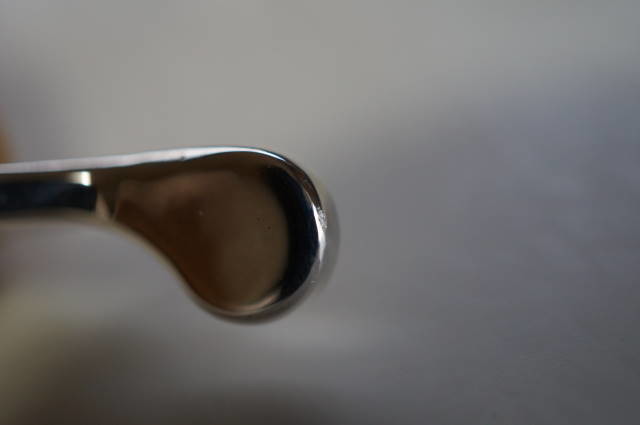
A chip moving during erections drew its auxiliary part completely inward
In an entry published in August 2021, a customer reported that an erection drew a medium-length chip and its auxiliary part completely inward. The device was recovered after the erection subsided, but fear prevented further use. Mr. Okada confirmed thread replacement was offered after the customer asked. He cautioned about erections after the whole chip passed the sphincter (the closing muscle described as gripping it).
(Source: ok-lab's diary, published August 2021)
https://ok-lab.hatenablog.com/entry/2021/08/28/125823
A missing chip after sleep raised concerns about inward movement
In an entry published in December 2021, a customer could no longer locate a custom linked assembly after sleeping. Mr. Okada relayed a possible explanation: a sleeping erection could push it bladderward after the screw attachment had crossed the sphincter. The diary does not record whether the device was recovered. Mr. Okada agreed that searching inside the bladder with wire was dangerous.
(Source: ok-lab's diary, published December 2021)
https://ok-lab.hatenablog.com/entry/2021/12/18/123756
Chip movement during erections prompted concern about a rigid supporting rod
In an entry published in June 2023, Mr. Okada described testing an S-shaped urethral sound (a rod intended here to support chip positioning). He believed the rigid rod had entered about halfway into the prostate region. He attributed excessive strain to erections pulling against this arrangement.
Mr. Okada writes that he experienced heart failure and had difficulty removing the rod. He reported improvement after its removal.
(Source: ok-lab's diary, published June 2023)
https://ok-lab.hatenablog.com/entry/2023/06/03/121955
The maker's answer to chip movement during erections
The diary describes changes to thread length, connection flexibility, and stalk length, with limits attached to each approach.
Longer retrieval threads addressed one report of a chip moving deeper
In an entry published in January 2018, a customer wanted a longer retrieval thread because muscle contractions drew a custom chip inward. The existing maximum of 25cm had proved insufficient for that customer. A note in the entry says lengths beyond 25cm could subsequently be requested in the order remarks.
The diary does not record how a longer replacement performed for this customer. Mr. Okada cautioned that the account described an individual's experience and that responses varied.
(Source: ok-lab's diary, published January 2018)
https://ok-lab.hatenablog.com/entry/20180118/1516263011
Flexible connections reduced chip movement from penile bending in one test
In an entry published in April 2021, Mr. Okada described a linked assembly whose stiff connection transmitted penile bending to the prostate-side chip. He reported improved stability after changing the relevant connection to a softer construction. His recommendation concerned long assemblies reaching the penile urethra; shorter assemblies did not require that softer connection in his tests.
(Source: ok-lab's diary, published April 2021)
https://ok-lab.hatenablog.com/entry/2021/04/03/130518
Flexible tube tails accommodated chip movement during erections in the maker's tests
In an entry published in December 2023, Mr. Okada described a 2.5mm tube tail (a silicone cover around part of the retrieval thread). In his tests, it bent as the urethra shortened and straightened during an erection. The test assemblies included screw-shaped attachments.
The published price was ¥2,000 (about $13 at ¥156 = $1, rate as of 2026-09-04) excluding tax for lengths up to 15cm, or ¥3,000 (about $19 at ¥156 = $1, rate as of 2026-09-04) excluding tax for 16-25cm. These were December 2023 prices. Mr. Okada did not recommend the multiple-screw test arrangement for general users.
(Source: ok-lab's diary, published December 2023)
https://ok-lab.hatenablog.com/entry/2023/12/09/123055
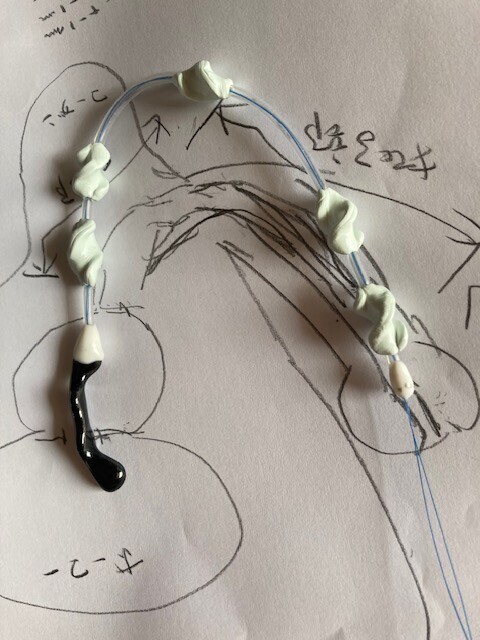
Mr. Okada favored shorter stalks after painful chip movement with an arrowhead prototype
In an entry published in February 2024, Mr. Okada described an arrowhead-shaped prototype with a long rear stalk. He reported that changes in penile position moved the whole device and caused sphincter pain. He preferred a shorter stalk for prolonged placement, then tested a version with a tube tail replacing the stalk.
He also described considerable difficulty removing the arrowhead design. Mr. Okada called the design dangerous and warned that removal could cause bleeding.
(Source: ok-lab's diary, published February 2024)
https://ok-lab.hatenablog.com/entry/2024/02/10/123023
If you see blood in your urine, even a small amount or for the first time, do not wait and see. See a urologist right away. If you suddenly cannot urinate, or the device cannot be removed, do not try to fix it yourself. Go to a medical facility, including emergency care, immediately.
How chip movement during erections changed over time
| Published | What the diary said then |
|---|---|
| Mar 2018 | A customer linked disappearing thread to changes in how it followed urethral curves. |
| Apr 2019 | A customer reported inward movement during shrinkage and a return toward the sphincter during erections. |
| Apr 2022 | A sliding cable arrangement was introduced to accommodate changes in penile length. |
| Feb 2024 | Mr. Okada distinguished some remaining prostate contact from completely motionless placement. |
| Oct 2024 | Mr. Okada chose 2mm silicone covering after pain with bare 0.3mm wire. |
| Dec 2024 | Thread remained standard because staff said stiffer wire transmitted penile movement to the device. |
| Jul 2025 | An adjustable connector addressed length differences between relaxed and erect states. |
| Jul 2026 | A customer in Austria received a warning about gradual bladderward movement during prolonged wear. |
OK Prostate Chip products related to chip movement during erections
The current list includes the resin chip and screw attachment discussed in an April 2026 positioning question.
Products that appear in these entries
| Product (official name) | Price incl. tax | Relation to this topic |
|---|---|---|
| Medium-length second-generation resin chip (OKプロステートチップ セミロングタイプ(第二世代生体適合樹脂)) | ¥6,050 (about $39 at ¥156 = $1, rate as of 2026-09-04) | In April 2026, a customer using this chip asked about inward thread movement and poor urine flow. |
| Second-generation resin screw attachment (スクリュー型補助チップ追加オプション(第二世代生体適合樹脂)) | ¥3,500 (about $22 at ¥156 = $1, rate as of 2026-09-04) | In April 2026, this attachment was part of the same customer's setup and positioning question. |
The medium-length second-generation resin chip is listed in OK Lab's own online store.

(Source: ok-lab's diary, published April 2026)
https://ok-lab.hatenablog.com/entry/2026/04/18/122906
Products the diary mentioned as alternatives
The diary names no alternative.
Custom short chip, revised vibrating chip, internal-wire assembly, pure-silver test chip: No matching product can be confirmed on the current list.
Linked screw assembly, flexible connection, S-shaped sound, tube tail, arrowhead prototype: No matching product can be confirmed on the current list.
August 2026 adjustable locking-loop and spiral custom builds: No matching product can be confirmed on the current list.
Common worries about chip movement during erections
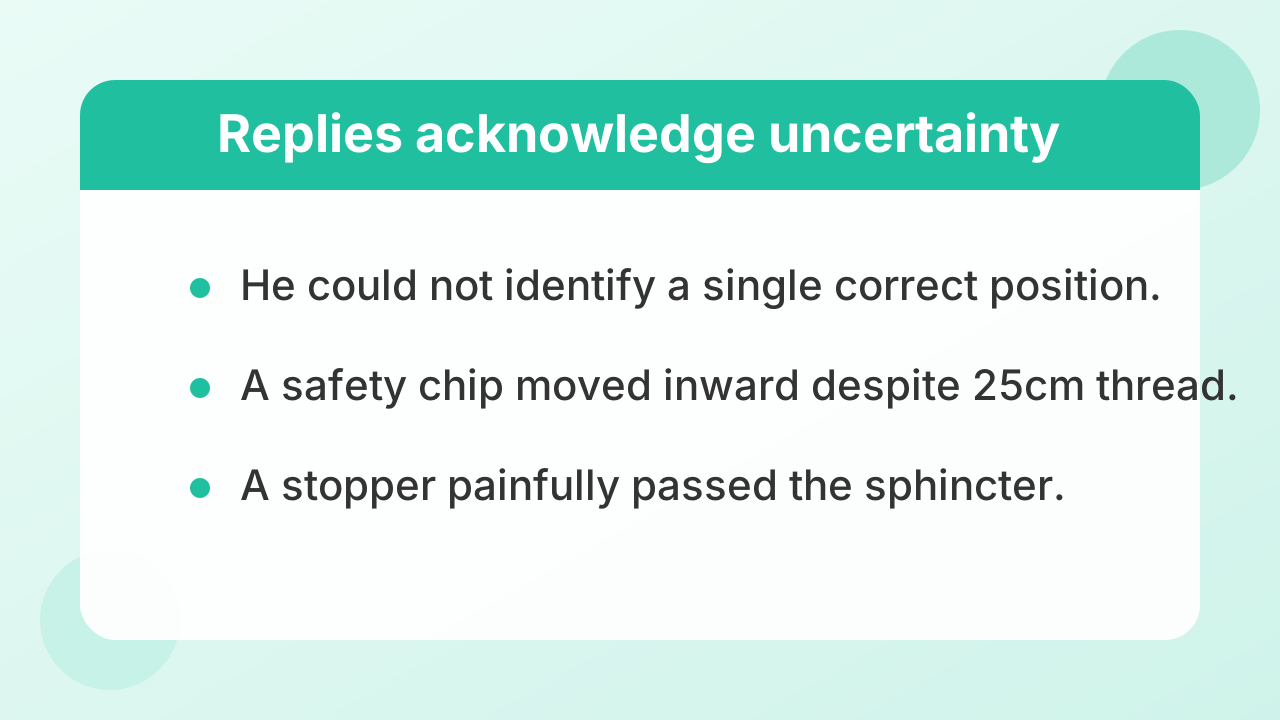
In these replies, inward movement alone did not settle questions about exact position or the effectiveness of a stopper.
"Does a chip moving deeper prove it is correctly positioned?"
In an entry published in April 2018, a customer asked whether repeated inward movement meant correct placement. Mr. Okada initially said this suggested at least half, or all, of the first chip had reached the urethra within the prostate. The customer then clarified a concern about going too far.
Mr. Okada acknowledged that he could not identify a single correct position. He also cautioned against deeper testing to establish location.
(Source: ok-lab's diary, published April 2018)
https://ok-lab.hatenablog.com/entry/20180414/1523697398
"Can erections pull in the safety chip despite 25cm thread?"
In an entry published in February 2020, a customer reported an erection drawing in the safety chip (a thread-mounted safeguard), with urethral discomfort. Their thread was 25cm, and they were considering roughly 30cm. They asked whether the thread could be replaced.
OK Lab offered replacement for ¥1,000 (about $6 at ¥156 = $1, rate as of 2026-09-04) excluding tax, with additional charges for threads carrying auxiliary parts. The diary does not record whether the replacement was completed or relieved the discomfort.
(Source: ok-lab's diary, published February 2020)
https://ok-lab.hatenablog.com/entry/2020/02/01/151232
"Does a chip moving deeper explain weak urine flow?"
In an entry published in April 2026, a customer using the second-generation resin chip and screw attachment asked about inward movement and weak urine flow. Mr. Okada suggested that the attachment's position could also be involved. He said closing-muscle action could move the chip either way. His reply emphasized individual differences rather than providing a universal interpretation of the reported sensations.
(Source: ok-lab's diary, published April 2026)
https://ok-lab.hatenablog.com/entry/2026/04/18/122906
"Can sphincter stoppers prevent a chip moving deeper?"
In entries published in August 2026, a customer asked about inward movement despite a sphincter stopper (an attachment intended to resist that movement). The confirmed follow-up described natural movements of muscles at the base of the pelvis pulling the chip inward. The stopper turned sideways and painfully passed the sphincter.
Mr. Okada said a flexible joint offered little resistance; loop-based designs could resist movement but could also deform. He proposed an adjustable locking loop while explicitly describing his suggestions as theoretical and dependent on the customer's body. The customer requested custom alternatives, but the diary does not record their performance.
(Source: ok-lab's diary, published August 2026)
https://ok-lab.hatenablog.com/entry/2026/08/01/122916
(Source: ok-lab's diary, published August 2026)
https://ok-lab.hatenablog.com/entry/2026/08/08/122906
Buying from outside Japan

OK Lab ships internationally to countries covered by Japan Post's EMS courier service. Overseas orders are paid in advance by PayPal. Each order carries a ¥400 (about $3 at ¥156 = $1, rate as of 2026-09-04) handling fee, and EMS shipping is charged on top. These terms come from OK Lab's official sales-terms page (written here as plain text, not a link: ok-lab.net/docs/law), checked on September 7, 2026; confirm them on the official store before you order, because they can change.
Summary of this article
| What you wanted to know | The answer |
|---|---|
| In short: can erections move it? | Movement in both directions, sometimes with injury. |
| What is the product? | A Japanese urethral device, with prices in JPY. |
| Which terms matter? | Threads, auxiliary pieces, and stoppers serve different purposes. |
| What happened in the cases? | Inward movement, expulsion, bleeding, and difficult removal. |
| What did the maker propose? | Longer threads, more flexible connections, and shorter rigid stalks. |
| How did the designs change? | Later designs explored sliding, covered-wire, and adjustable connections. |
| Which current products are identified? | A second-generation resin chip and screw attachment, discussed in April 2026. |
| Do stoppers settle location concerns? | The replies acknowledge uncertainty and individual differences. |
| Can someone outside Japan buy? | EMS delivery, advance PayPal payment, and handling and shipping charges. |
Source: ok-lab's diary (Okada Comfortable Life Laboratory). The original entries are in Japanese; quotations on this page are translated. Photos and videos are on the original entries.
This article is a summary of the maker's development diary. The product is not a medical device and no result is guaranteed. If anything feels wrong or worries you, see a doctor. Prices, specifications and cautions change, so confirm the latest information on the official blog and the official site. Questions about ordering and shipping go to the seller.