![Can I leave a prostate chip in my bladder? | The diary does not establish reliable, safe anchoring [OK Prostate Chip]](/img/a/T0126/eyecatch.svg)
This page is based on entries from "ok-lab's diary" (https://ok-lab.hatenablog.com/), the Japanese development diary written by Mr. Okada, founder of OK Lab, a small company in Japan (Okada Comfortable Life Laboratory). Only the entries about "leaving a prostate chip in the bladder" are summarized here, in order of publication. Past prices and sizes are as written at the time. Current prices come from the official product list (retrieved September 4, 2026). Quotations are translated from Japanese.
Note: This page is a personal reading log by someone with no connection to the maker or the seller. It reflects the source entries as of their publication dates and makes no guarantee of accuracy or safety. The product is not a medical device; talk to a doctor about any health decision. Check the official site for current information. This page contains advertising.
In short
- Bladder anchoring sometimes held a chip, but the diary also records movement, bleeding, and discomfort.
- Mr. Okada questioned prolonged bladder use and acknowledged limits to his safety knowledge.
- Later flexible designs brought new cautions; current listings do not confirm the historical custom assemblies.
If you see blood in your urine, even a small amount or for the first time, do not wait and see. See a urologist right away.
If you suddenly cannot urinate, or the device cannot be removed, do not try to fix it yourself. Go to a medical facility, including emergency care, immediately.
About this product

The OK Prostate Chip is a small device that is placed in the urethra (the urine passage) so that it acts on the prostate; the maker sells it in several shapes, sizes and materials. It is made and sold by OK Lab (Okada Comfortable Life Laboratory), a small company in Japan, through its own online store, and prices are in Japanese yen (JPY). The maker's development diary, "ok-lab's diary", is written in Japanese. This page is an English summary of it, and every quotation is translated. OK Lab ships internationally, so readers outside Japan can order (see "Buying from outside Japan" below). Product names on this page are plain-English descriptions. The official Japanese product name is shown once in the product table so you can find the same item in the store.
Before you read: key terms
| Term | Plain-English meaning |
|---|---|
| Urethra | The urine passage, also the route and intended location for the base device. |
| Bladder anchor | A device section inside the bladder, intended to resist the chip moving outward. |
| Bladder loop | A flexible loop intended to provide bladder contact or help hold a connected chip. |
| Shape-memory wire | Wire that returns toward its set shape, used to make flexible connections and loops. |
| Internal urethral sphincter | The involuntary muscle at the bladder boundary, used as a holding point in these designs. |
| External tube holder | A part for holding the connecting tube; staff discussed whether a proposed assembly needed it. |
What happens: leaving a prostate chip in the bladder
The OK Prostate Chip is a small device placed in the urethra (the urine passage) to stimulate the prostate. The bladder-anchor idea places a front chip, or an attached flexible loop, inside the bladder to resist outward movement. In these entries, Mr. Okada explored that position both for holding the device and for stimulation. His reports describe shifting positions, discomfort, bleeding, and designs that changed after testing.
Early bladder anchoring tests found unreliable retention and a bleeding problem
An entry published in January 2018 described a curved bladder anchor with two connected chips and an 8 mm gap. Mr. Okada thought it resisted slipping slightly better, but said dependable anchoring remained unachieved.
A tester reported slight bleeding; Mr. Okada blamed misaligned curvature and excessive strain on the muscle at the bladder boundary. Sales decisions for the 4th and 5th designs, the enlarged chip and curved anchor, were deferred pending further tests. He also warned against placing nearly the whole leading chip inside the bladder in the illustrated two-chip arrangement.
(Source: ok-lab's diary, published January 2018)
https://ok-lab.hatenablog.com/entry/20180111/1515662782
A customer's chip in the bladder stayed stable, despite Mr. Okada's reservations
An entry published in August 2022 reported a customer's experience with a combined custom design. The customer said placement took about 30 minutes, but the device then shifted only slightly during urination. They reported no bleeding after removal.
Mr. Okada thought the shape would exert substantial pressure inside the bladder. He said he could not recommend it, despite the customer's favorable report.
(Source: ok-lab's diary, published August 2022)
https://ok-lab.hatenablog.com/entry/2022/08/13/122909
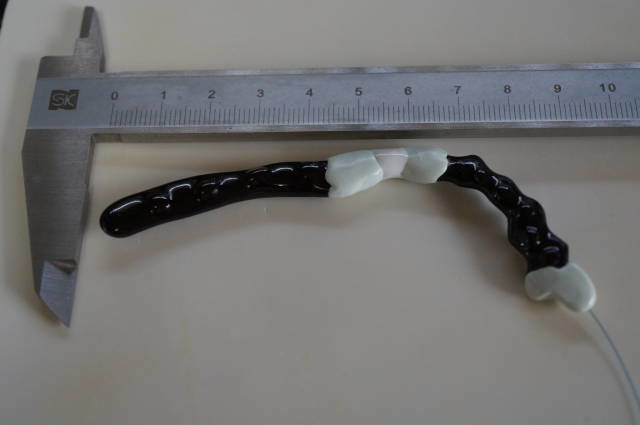
A bladder placement report described cord failure after three months
In an entry published in April 2023, a customer reported a broken jointed cord after 3 months of daily wear. The break was about 5 cm from its rear end, at a 90-degree bend. Mr. Okada inferred that substantial device length had remained inside the bladder.
He considered the unusually thick construction and additional strain relevant to the failure. The customer requested another identical device; the diary does not record whether that replacement was completed.
(Source: ok-lab's diary, published April 2023)
https://ok-lab.hatenablog.com/entry/2023/04/29/123107
Bladder loops failed to provide steady anchoring during Mr. Okada's test
In an entry published in November 2024, Mr. Okada described a silicone-covered wire loop with a prostate chip behind it. He found that movement and changes in penis length disrupted its position. He reported little of the expected balloon-like holding effect.
Mr. Okada still expressed interest in the sensations from the flexible loop. However, he cautioned that the arrangement could not be relied upon for stable positioning of the prostate chip.
(Source: ok-lab's diary, published November 2024)
https://ok-lab.hatenablog.com/entry/2024/11/02/122858
Deeper bladder placement held steadily but caused urgency and lingering pain
In an entry published in December 2024, Mr. Okada tested his own sample of a requested ceramic chip-and-loop design. In his test, a position 20 mm deeper left about 8 cm inside the bladder and held steadily. However, he reported urgent needs to urinate and ended the trial after about 5 hours.
Mild pain continued for about 1 hour afterward. He subsequently changed the bladder-loop connection to a single flexible wire, aiming to reduce unwanted pressure. He cautioned that the customer's proposed larger design would be difficult to tolerate for days.
(Source: ok-lab's diary, published December 2024)
https://ok-lab.hatenablog.com/entry/2024/12/21/122903
A flexible bladder vibration prototype still raised concerns about prolonged use
In an entry published in February 2026, Mr. Okada described a vibrating prototype with a flexible connection between its ceramic chip and motor. He reported that the connection could straighten temporarily and recover its curved shape inside the bladder. Mr. Okada nevertheless warned that prolonged bladder vibration might be harmful.
(Source: ok-lab's diary, published February 2026)
https://ok-lab.hatenablog.com/entry/2026/02/14/121602
One bladder placement trial ended with symptoms Mr. Okada compared to heart failure
In an entry published in June 2026, Mr. Okada tested his own miniature flexible assembly with an older screw-shaped resin tip. He believed the tip had reached the bladder.
After 5–10 minutes, he felt seriously unwell and described the episode as resembling heart failure. He reported recovery 1–2 hours after the device was removed. Mr. Okada said he could not recommend the design broadly and had not tested prolonged wear.
(Source: ok-lab's diary, published June 2026)
https://ok-lab.hatenablog.com/entry/2026/06/06/122905
The maker's answer to leaving a prostate chip in the bladder
Mr. Okada explored stronger supports and flexible connections, while reporting limits to comfort and prolonged use.
Five screw supports improved bladder anchoring but proved unsuitable for sleep
In an entry published in December 2023, Mr. Okada described 5 screw-shaped supports behind the main chip. He reported his firmest hold so far with the front chip extending into the bladder.
The stimulation still kept him from settling down to sleep, so he ended that test before sleeping. He cautioned that this difficult design was not something he could recommend to everyone.
(Source: ok-lab's diary, published December 2023)
https://ok-lab.hatenablog.com/entry/2023/12/09/123055

An S-shaped bladder anchor introduced flexible joints and a covered wire
In an entry published in May 2024, Mr. Okada described an S-shaped assembly using shape-memory wire (wire that returns toward its set curve). Its joints could straighten temporarily and recover their curve inside the bladder. He believed this shape resisted movement in either direction.
The published prices for its bladder, prostate, and lower sections were ¥3,000, (about $19 at ¥156 = $1, rate as of 2026-09-04) ¥3,000, (about $19 at ¥156 = $1, rate as of 2026-09-04) and ¥2,000, (about $13 at ¥156 = $1, rate as of 2026-09-04) respectively, excluding tax. The stated ¥13,000 (about $83 at ¥156 = $1, rate as of 2026-09-04) total included ¥4,000 (about $26 at ¥156 = $1, rate as of 2026-09-04) for wire connections and ¥1,000 (about $6 at ¥156 = $1, rate as of 2026-09-04) for a tube cover, also excluding tax. Mr. Okada recommended that cover because he found exposed wire harsh at the internal urethral sphincter (the muscle at the bladder boundary).
(Source: ok-lab's diary, published May 2024)
https://ok-lab.hatenablog.com/entry/2024/05/18/122913
Large bladder loops prompted advice against prolonged wear after pain appeared
In an entry published in June 2025, Mr. Okada reported pain after urination during a large-loop test. He also described the loop being pushed outward, including during changes in posture.
He worried that urine remaining in the bladder could increase the chance of bladder inflammation. He advised against prolonged continuous use of large bladder loops and did not recommend sizes 50 mm or larger for stable retention.
(Source: ok-lab's diary, published June 2025)
https://ok-lab.hatenablog.com/entry/2025/06/14/122936
If you see blood in your urine, even a small amount or for the first time, do not wait and see. See a urologist right away.
If you suddenly cannot urinate, or the device cannot be removed, do not try to fix it yourself. Go to a medical facility, including emergency care, immediately.
How leaving a prostate chip in the bladder changed over time

| Published | What the diary said then |
|---|---|
| Nov 2020 | Bent connectors were offered only at 3–5 mm spacing, for ¥1,000 (about $6 at ¥156 = $1, rate as of 2026-09-04) excluding tax. |
| Jan 2021 | Mr. Okada favored 0.5 mm connecting wire; durability remained unconfirmed. |
| Oct 2021 | A screw-shaped chip left the bladder during ordinary urination in Mr. Okada's test. |
| Dec 2024 | Mr. Okada reported less awareness of a 50 mm loop as urine accumulated. |
| Aug 2025 | Thin-wire loop pricing remained unannounced while Mr. Okada considered an intellectual-property consultation. |
| Sep 2025 | Mr. Okada reported about 20 hours of retention with a winged stainless-steel chip. |
OK Prostate Chip products related to leaving a prostate chip in the bladder

The current list includes the short ceramic twist chip discussed as a component in a bladder-anchor request.
Products that appear in these entries
| Product (official name) | Price incl. tax | Relation to this topic |
|---|---|---|
| Short ceramic twist chip (OKプロステートチップ 陶器素材ショートタイプ ツイスト) | ¥4,400 (about $28 at ¥156 = $1, rate as of 2026-09-04) | In July 2022, a customer proposed two of these chips for a bladder-anchor assembly; staff warned about inward migration. |
(Source: ok-lab's diary, published July 2022)
https://ok-lab.hatenablog.com/entry/2022/07/30/122933
Products the diary mentioned as alternatives
The diary names no alternative.
The custom assemblies and prototypes discussed above are separate from this listed component. No matching product can be confirmed on the current list.
Common worries about leaving a prostate chip in the bladder

Customers asked whether bladder anchoring could prevent expulsion, whether bleeding would resolve, and whether external safeguards were necessary.
"Can bladder anchoring keep another chip from coming out?"
In an entry published in November 2021, a customer wanted a bladder chip to anchor a second chip against expulsion. Mr. Okada recalled 2 earlier bladder-retention builds that had been easily expelled. He said retention varied between individuals and could not judge whether this use would harm the bladder.
The diary does not record whether the requested assembly was completed. Mr. Okada's reply offered no assurance that bladder anchoring was safe.
(Source: ok-lab's diary, published November 2021)
https://ok-lab.hatenablog.com/entry/2021/11/06/125812
"Does bleeding after bladder placement go away with practice?"
In an entry published in May 2022, a customer asked whether repeated bleeding meant their long chip was unsuitable or required adaptation. They reported bleeding on 3 consecutive occasions, with 5–10 drops after removal and urination. They reported no bleeding after switching to a shorter model.
Mr. Okada considered bladder friction possible but could not confirm where the blood came from. The diary does not record a medical diagnosis or a later assessment. He doubted that bladder bleeding would resolve through adaptation and advised medical assessment if it continued.
(Source: ok-lab's diary, published May 2022)
https://ok-lab.hatenablog.com/entry/2022/05/14/123043
"Does a bladder anchor need an external tube holder?"
In an entry published in July 2022, a customer asked whether an external tube holder was essential for their proposed two-chip arrangement. The planned front chip would sit inside the bladder, with the rear chip at the prostate. Staff said the holder was optional and might be convenient during longer use.
They warned that bladder placement greatly increased the risk of the entire assembly slipping inward. The diary does not record how the proposed arrangement performed. Staff considered a safeguard outside the head of the penis necessary to prevent inward migration.
(Source: ok-lab's diary, published July 2022)
https://ok-lab.hatenablog.com/entry/2022/07/30/122933
Buying from outside Japan

OK Lab ships internationally to countries covered by Japan Post's EMS courier service. Overseas orders are paid in advance by PayPal. Each order carries a ¥400 (about $3 at ¥156 = $1, rate as of 2026-09-04) handling fee, and EMS shipping is charged on top. These terms come from OK Lab's official sales-terms page (written here as plain text, not a link: ok-lab.net/docs/law), checked on September 7, 2026; confirm them on the official store before you order, because they can change.
Summary of this article
| What you wanted to know | The answer |
|---|---|
| In short | Bladder anchoring remained uncertain. |
| About this product | A Japanese urethral device; prices use JPY. |
| Key terms | Anchors and loops are intended to help hold position. |
| What happens | Reports include movement, bleeding, breakage, and illness. |
| The maker's answer | Design changes came with cautions about prolonged wear. |
| Changes over time | Construction and reported test results continued changing. |
| Related products | The short ceramic twist component remains listed. |
| Common worries | Safety, bleeding, and inward migration prompted questions. |
| Buying internationally | Advance PayPal payment, EMS postage, and a ¥400 (about $3 at ¥156 = $1, rate as of 2026-09-04) fee. |
Source: ok-lab's diary (Okada Comfortable Life Laboratory). The original entries are in Japanese; quotations on this page are translated. Photos and videos are on the original entries.
This article is a summary of the maker's development diary. The product is not a medical device and no result is guaranteed. If anything feels wrong or worries you, see a doctor. Prices, specifications and cautions change, so confirm the latest information on the official blog and the official site. Questions about ordering and shipping go to the seller.