![How many retrieval threads does the chip need? | Connection design matters [OK Prostate Chip]](/img/a/T0120/eyecatch.svg)
This page is based on entries from "ok-lab's diary" (https://ok-lab.hatenablog.com/), the Japanese development diary written by Mr. Okada, founder of OK Lab, a small company in Japan (Okada Comfortable Life Laboratory). Only the entries about "retrieval thread arrangements and counts" are summarized here, in order of publication. Past prices and sizes are as written at the time. Current prices come from the official product list (retrieved September 4, 2026). Quotations are translated from Japanese.
Note: This page is a personal reading log by someone with no connection to the maker or the seller. It reflects the source entries as of their publication dates and makes no guarantee of accuracy or safety. The product is not a medical device; talk to a doctor about any health decision. Check the official site for current information. This page contains advertising.
In short
Separate retrieval threads can lose their intended independence when accessories bring them together.
The maker matched thread connections and stopper designs to each configuration.
The current list includes three-hole and six-hole stoppers, plus separate resin safety parts.
If you see blood in your urine, even a small amount or for the first time, do not wait and see. See a urologist right away. If you suddenly cannot urinate, or the device cannot be removed, do not try to fix it yourself. Go to a medical facility, including emergency care, immediately.
About this product

The OK Prostate Chip is a small device that is placed in the urethra (the urine passage) so that it acts on the prostate; the maker sells it in several shapes, sizes and materials. It is made and sold by OK Lab (Okada Comfortable Life Laboratory), a small company in Japan, through its own online store, and prices are in Japanese yen (JPY).
The maker's development diary, "ok-lab's diary", is written in Japanese. This page is an English summary of it, and every quotation is translated.
OK Lab ships internationally, so readers outside Japan can order (see "Buying from outside Japan" below). Product names on this page are plain-English descriptions. The official Japanese product name is shown once in the product table so you can find the same item in the store.
Before you read: key terms
| Term | Plain-English meaning |
|---|---|
| Retrieval thread | A line attached to the chip, intended for retrieval and accessory connections. |
| Urethra | The urine passage, where the diary describes the chip being placed. |
| Auxiliary part | An extra component behind the main chip, intended to help move or position it. |
| Internal stopper | A thread-mounted accessory intended to help hold the chip's position inside the urethra. |
| Safety part | A small thread-connecting component used as an end stop or to form a loop. |
| Nylon grade | A size label used here to compare thread thickness and comfort. |
| Catheter | A tube discussed here as a proposed aid to positioning the chip. |
| Nitinol | Shape-memory alloy wire, made from nickel and titanium, proposed as an alternative connection material. |
What happens: retrieval thread problems
The OK Prostate Chip is a small device placed in the urethra (the urine passage) to act on the prostate. Its retrieval thread is an attached line intended to provide a connection for taking the chip out. Some designs have several strands, which may carry auxiliary parts (extra components) or remain independent. Stopper parts can sit inside the urethra or outside the head of the penis, depending on the design.
Two retrieval threads needed coordinated lengths in the separate-chip design
In an entry published in March 2018, Mr. Okada linked 2 separate threads to a risk of chips lying side by side. He believed coordinated thread lengths and a shared external stopper reduced that risk.
He also acknowledged previously underestimating reports of inward movement. Mr. Okada favored a combined thread holder and stopper.
(Source: ok-lab's diary, published March 2018)
https://ok-lab.hatenablog.com/entry/20180324/1521875816
A retrieval thread could not initially free folded chips
In an entry published in July 2018, a customer wanted to combine a semi-long chip with a separate chip. Mr. Okada had expressed reservations but accepted cautious testing.
The customer reported folding that left the separate chip's retrieval thread ineffective, followed by difficult removal. The customer eventually got the chips out; Mr. Okada warned that the separate component could rotate.
(Source: ok-lab's diary, published July 2018)
https://ok-lab.hatenablog.com/entry/20180707/1530947332
Thicker retrieval thread felt irritating in the maker's comparison
In an entry published in April 2019, Mr. Okada recalled comparing nylon grades (thread-size labels) 2-0, 3-0, 4-0 and 5-0. He chose 3-0 after finding 2-0 irritating to the tissue lining.
He favored 2 strands over thicker thread and reported similar thread sensation during roughly a week of personal testing. Mr. Okada cautioned that sharp edges could damage nylon despite its resistance to a strong hand pull.
(Source: ok-lab's diary, published April 2019)
https://ok-lab.hatenablog.com/entry/2019/04/27/153239
The maker designed retrieval thread holes to retain a backup
In an entry published in June 2021, Mr. Okada revealed a titanium prototype with a resin-free thread connection. Its internal hole structure held 2 strands; he said 1 remaining strand could stay fixed if the other broke.
The design also removed the resin-curing delay before dispatch. Mr. Okada cautioned that the curved channels made thread replacement delicate work.
(Source: ok-lab's diary, published June 2021)
https://ok-lab.hatenablog.com/entry/2021/06/12/125849
A retrieval thread loop could shrink without easily reopening
In an entry published in March 2023, Mr. Okada described a loop that could shrink under tension from the lower threads. Once smaller, it could not simply expand again; restoring its size required rethreading.
He treated that property as useful for a silicone-covered support connection. Mr. Okada favored the resin safety part (a small thread-connecting component) for this connection because the loop resisted reopening.
(Source: ok-lab's diary, published March 2023)
https://ok-lab.hatenablog.com/entry/2023/03/04/123042
Four retrieval threads initially came with strict accessory limits
In an entry published in May 2023, Mr. Okada began offering 4-thread configurations for increasingly heavy chips. His design grouped the strands immediately behind the chip with a resin safety part. At that point, he identified only that part as compatible with all 4 strands.
He limited 4-thread replacement service to original 4-thread purchases, excluding conversions of 1-thread or 2-thread chips. Mr. Okada proposed the additional strands specifically as retrieval backups.
(Source: ok-lab's diary, published May 2023)
https://ok-lab.hatenablog.com/entry/2023/05/13/123004
Three retrieval threads kept the extra connection separate from accessories
In an entry published in March 2025, a customer wanted separate thread attachments together with several accessories. OK Lab's staff warned that those accessories would immediately reunite the strands, weakening the intended benefit.
The customer proposed 3 strands instead: 2 carrying the accessories and 1 independent retrieval strand on the opposite side. The diary shows the finished custom build; the staff's caution concerned keeping that retrieval connection independent.
(Source: ok-lab's diary, published March 2025)
https://ok-lab.hatenablog.com/entry/2025/03/01/122825
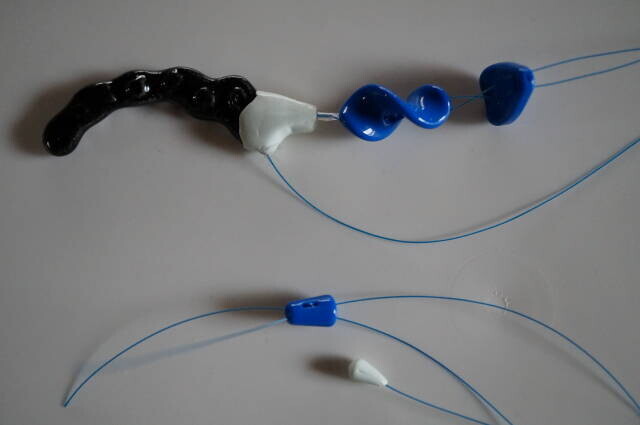
Nitinol retrieval threads arrived with a limited personal test
In an entry published in August 2025, Mr. Okada introduced nitinol (shape-memory alloy wire) thread connections. He reported secure attachment and no problems during his personal 3-day continuous-use test.
The published upgrade cost ¥2,000 (about $13 at ¥156 = $1, rate as of 2026-09-04) excluding tax, with a maximum thread length of 35cm. He excluded the resin safety part because its tight bends would overstrain the wire. Mr. Okada advised people concerned about breakage to wait before adopting nitinol.
(Source: ok-lab's diary, published August 2025)
https://ok-lab.hatenablog.com/entry/2025/08/09/122924
Coated retrieval threads replaced the proposal for bare nitinol
In an entry published in September 2025, Mr. Okada adopted a policy against products allowing bare nitinol to contact skin. Thin silicone coating became part of the specification at no extra charge. He framed this as a response to concerns about metal allergy.
Thicker coating cost ¥500 (about $3 at ¥156 = $1, rate as of 2026-09-04) excluding tax per 5cm, but those sections could not fit through auxiliary holes. Mr. Okada advised judging thicker coating by the intended accessory arrangement.
(Source: ok-lab's diary, published September 2025)
https://ok-lab.hatenablog.com/entry/2025/09/06/122911
Four retrieval threads did not remove a linked pair's folding risk
In an entry published in August 2026, a customer asked whether a safety part could connect two chips in opposite directions. Mr. Okada said its simpler hole pattern allowed thread access from either direction, unlike the main chip's connection.
He first found the arrangement less useful, then developed a rear-to-rear pair with 4 strands leaving in one direction. He cautioned that this changed the design's intended orientation. Mr. Okada warned that both chips could overlap if the whole assembly migrated into the bladder.
(Source: ok-lab's diary, published August 2026)
https://ok-lab.hatenablog.com/entry/2026/08/29/122931
The maker's answer to retrieval thread problems
The maker's responses depended on the attachment points, accessory holes, and jobs assigned to each strand.
Three-hole retrieval thread connections depended on the accessory's design
In an entry published in July 2018, Mr. Okada explained a 3-hole accessory design with distinct A and B faces. Different opening shapes supported a returning thread path, and the auxiliary component used a different entry hole.
He said damp nylon could hold its shape and become less prone to sliding. Mr. Okada cautioned that gripping tools could deform the delicate thread.
(Source: ok-lab's diary, published July 2018)
https://ok-lab.hatenablog.com/entry/20180707/1530947332
Independent retrieval threads prompted a change to the internal stopper
In an entry published in September 2020, a customer requested separately attached threads and a 6-hole internal stopper (a positioning accessory). OK Lab's staff explained that joining both strands there would largely cancel their different pulling points.
The customer accepted a change to the 3-hole model. Staff favored an internal stopper associated with only the main strand, while allowing a 6-hole safety part outside the body.
(Source: ok-lab's diary, published September 2020)
https://ok-lab.hatenablog.com/entry/2020/09/26/124400
A retrieval thread loop required understanding the dedicated safety part
In an entry published in November 2021, Mr. Okada introduced a prototype resin safety part with 4 internal channel groups. He described a friction system supporting both an end stop and a loop.
Planned prices were ¥1,500 (about $10 at ¥156 = $1, rate as of 2026-09-04) excluding tax for the part, plus ¥500 (about $3 at ¥156 = $1, rate as of 2026-09-04) for connection service. Mr. Okada cautioned that loop-length adjustment depended on understanding the thread connection.
(Source: ok-lab's diary, published November 2021)
https://ok-lab.hatenablog.com/entry/2021/11/06/125812
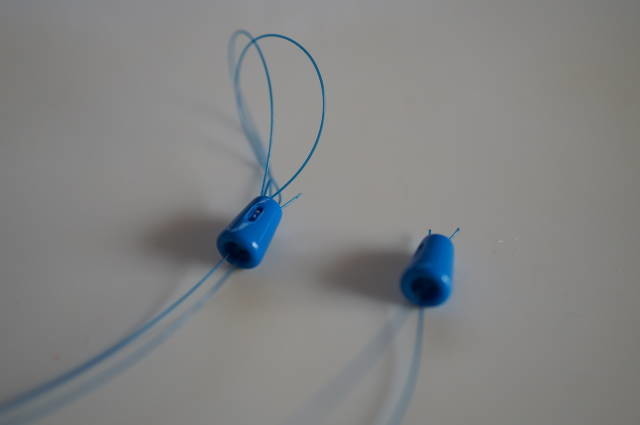
A catheter proposal gave two retrieval threads separate jobs
In an entry published in February 2022, a customer proposed a catheter (a tube) carrying a remotely operated chip clamp. Mr. Okada replied that he could not make the proposed tiny moving mechanism.
His alternative used 2 threads: 1 serving the stopper and 1 under tension for a catheter connection. The diary does not record the customer's experience with the alternative. Mr. Okada cautioned that tube friction could also drag connected thread and stopper parts.
(Source: ok-lab's diary, published February 2022)
https://ok-lab.hatenablog.com/entry/2022/02/19/123621
If you see blood in your urine, even a small amount or for the first time, do not wait and see. See a urologist right away. If you suddenly cannot urinate, or the device cannot be removed, do not try to fix it yourself. Go to a medical facility, including emergency care, immediately.
How retrieval thread problems changed over time
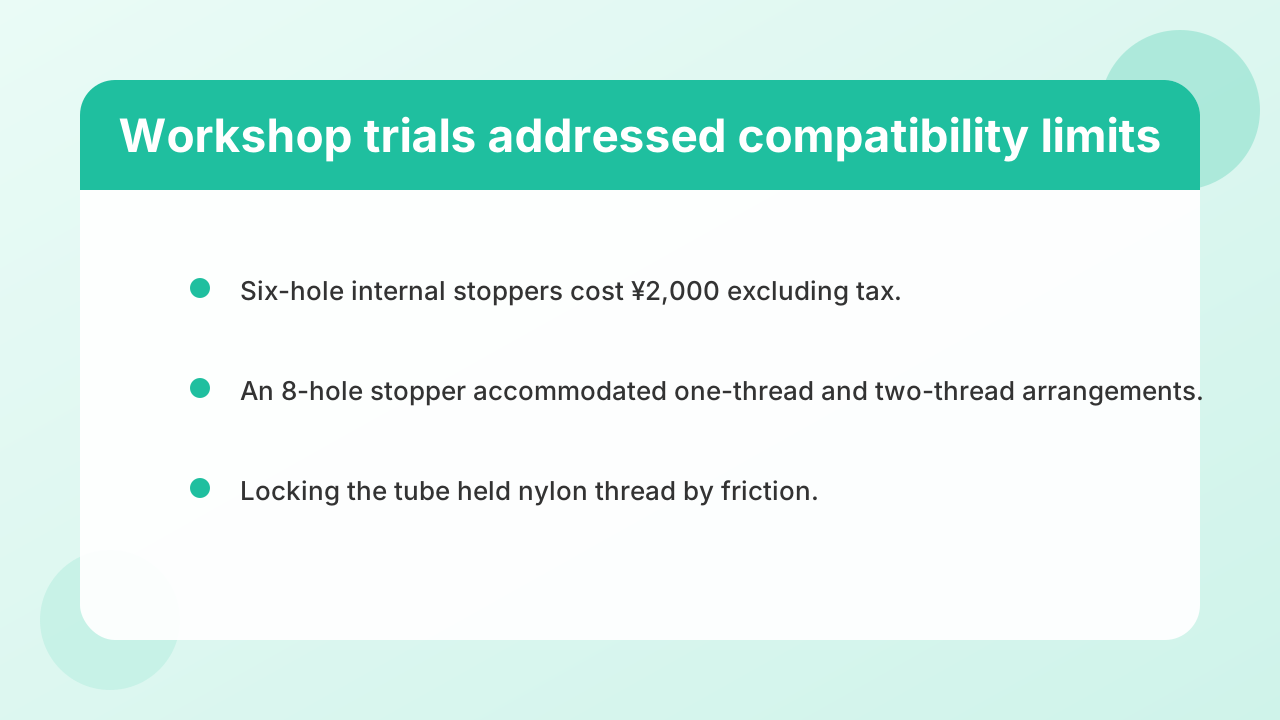
| Published | What the diary said then |
|---|---|
| Apr 2019 | Six-hole internal stoppers cost ¥2,000 (about $13 at ¥156 = $1, rate as of 2026-09-04) excluding tax. |
| May 2021 | An 8-hole resin stopper accommodated one-thread and two-thread arrangements. |
| Oct 2021 | Thread-replacement policy changed: blue resin chips would be returned without sterilization. |
| Jul 2022 | Locking the tube also held nylon thread by friction. |
| Jul 2023 | 12-hole internal and external stoppers debuted at ¥3,000 (about $19 at ¥156 = $1, rate as of 2026-09-04) and ¥2,500, (about $16 at ¥156 = $1, rate as of 2026-09-04) respectively, excluding tax. |
| Aug 2023 | A stainless-steel flat auxiliary part accommodated all 4 threads in a workshop trial. |
| Mar 2026 | Workshop finishing enabled all 4 nylon threads to fit a stainless-steel screw auxiliary part. |
OK Prostate Chip products related to retrieval thread problems
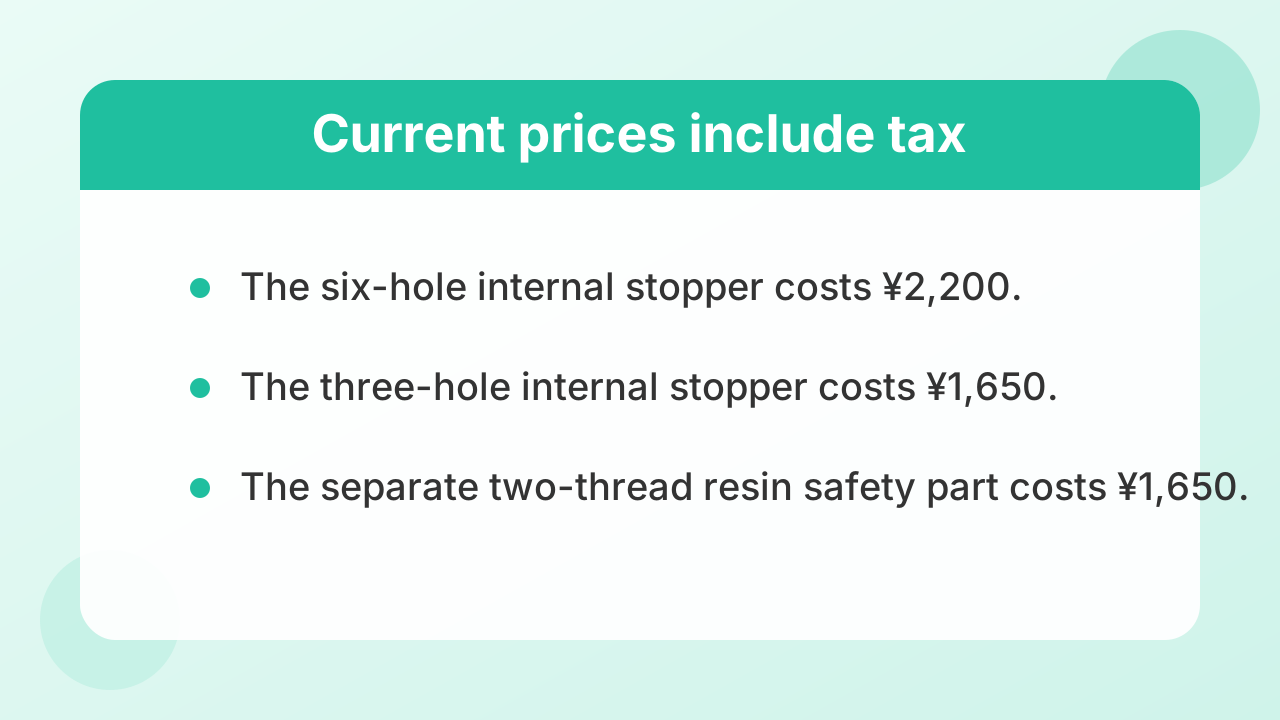
The current list confirms these individual products, with prices in Japanese yen.
Products that appear in these entries
| Product (official name) | Price incl. tax | Relation to this topic |
|---|---|---|
| Six-hole internal stopper (六穴方式オプションチップ(括約筋ストッパーチップ)) | ¥2,200 (about $14 at ¥156 = $1, rate as of 2026-09-04) | A September 2020 order included this stopper before staff advised changing it because the threads had separate attachment points. |
| Separate two-thread resin safety part (二本糸用セーフティチップ(生体適合樹脂)単体) | ¥1,650 (about $11 at ¥156 = $1, rate as of 2026-09-04) | An October 2022 customer received this part unattached after selecting the standalone listing. |
| Semi-long stainless-steel chip (OKプロステートチップ セミロングタイプ(サージカルステンレス)) | ¥9,900 (about $63 at ¥156 = $1, rate as of 2026-09-04) | An October 2022 customer ordered this chip with the separately supplied resin safety part. |
(Source: ok-lab's diary, published September 2020)
https://ok-lab.hatenablog.com/entry/2020/09/26/124400
(Source: ok-lab's diary, published October 2022)
https://ok-lab.hatenablog.com/entry/2022/10/01/122944
Products the diary mentioned as alternatives
| Product (official name) | Price incl. tax | Relation to this topic |
|---|---|---|
| Three-hole internal stopper (三穴方式オプションチップ(括約筋ストッパーチップ)) | ¥1,650 (about $11 at ¥156 = $1, rate as of 2026-09-04) | In September 2020, staff favored this over the six-hole internal stopper for separately attached threads. |
(Source: ok-lab's diary, published September 2020)
https://ok-lab.hatenablog.com/entry/2020/09/26/124400
The six-hole tube holder was discontinued in an entry published in July 2022. Its tube-locking arrangement had made separate thread holes unnecessary.
(Source: ok-lab's diary, published July 2022)
https://ok-lab.hatenablog.com/entry/2022/07/16/123031
Historical items include titanium prototypes, stainless-steel auxiliaries, 12-hole stoppers, custom thread configurations, and nitinol-thread options. No matching product can be confirmed on the current list.
Common worries about retrieval thread problems
Reader requests concerned replacement, accessory compatibility, and connections for existing chips.
"Can I replace the retrieval thread myself?"
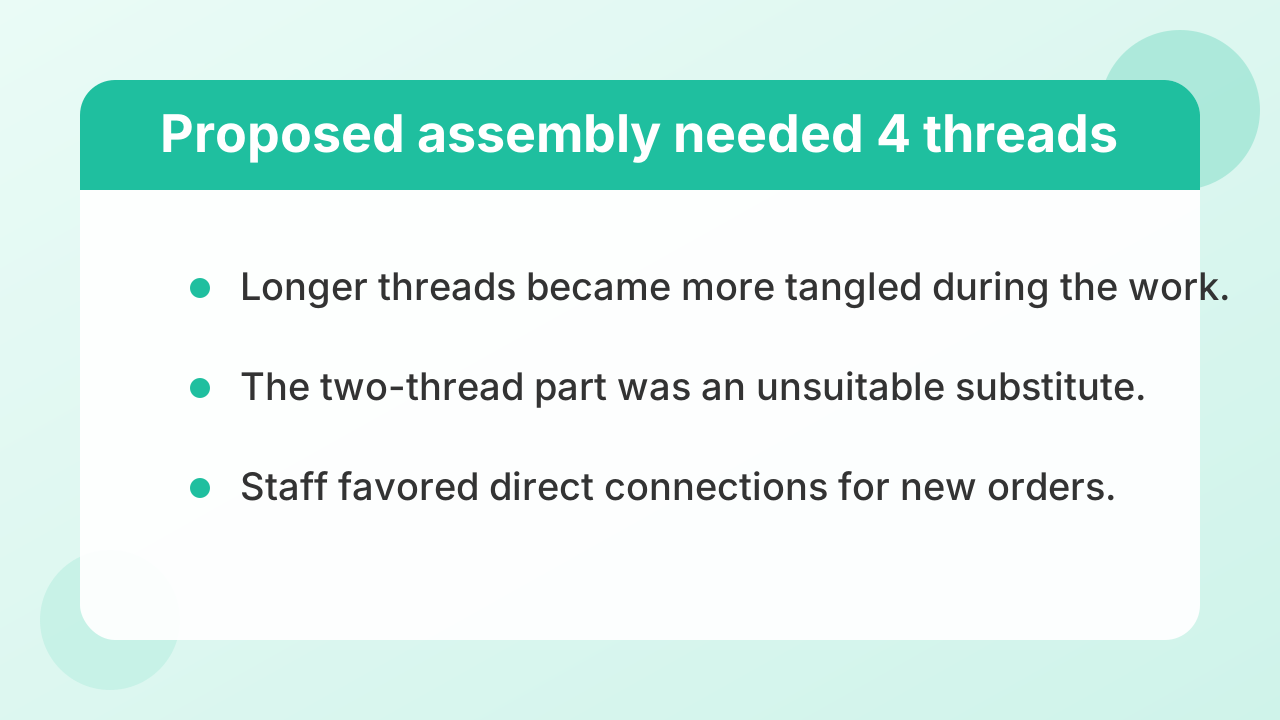
In an entry published in September 2021, a reader requested an explanation because the stainless-steel chip's thread connection was unclear. Mr. Okada provided a demonstration and noted that longer threads became more tangled during the work.
The diary does not record whether that reader completed a replacement. Mr. Okada invited follow-up questions about anything unclear.
(Source: ok-lab's diary, published September 2021)
https://ok-lab.hatenablog.com/entry/2021/09/25/125720
"Can two-thread safety parts support a four-thread assembly?"
In an entry published in December 2021, a customer wanted two-thread safety parts around a screw-shaped auxiliary chip. The proposed loop assembly needed 4 threads, so OK Lab said the two-thread part was an unsuitable substitute.
The customer accepted the established custom assembly, with a ¥1,100 (about $7 at ¥156 = $1, rate as of 2026-09-04) reduction in the order amount. The diary records no experience using the revised assembly. OK Lab favored that established configuration for this request.
(Source: ok-lab's diary, published December 2021)
https://ok-lab.hatenablog.com/entry/2021/12/04/124140
"Can existing retrieval threads support a silicone-tube connection?"
In an entry published in August 2022, a customer proposed connecting an existing chip to silicone tubing through a resin safety part. Staff first explained that their earlier attempt had failed. They later considered a version using adhesive possible, while declining a conversion service for customers' existing chips.
The diary does not record whether the proposed conversion was completed. For new orders, staff favored a purpose-made direct connection because they expected lower production costs.
(Source: ok-lab's diary, published August 2022)
https://ok-lab.hatenablog.com/entry/2022/08/20/122920
Buying from outside Japan

OK Lab ships internationally to countries covered by Japan Post's EMS courier service. Overseas orders are paid in advance by PayPal. Each order carries a ¥400 (about $3 at ¥156 = $1, rate as of 2026-09-04) handling fee, and EMS shipping is charged on top. These terms come from OK Lab's official sales-terms page (written here as plain text, not a link: ok-lab.net/docs/law), checked on September 7, 2026; confirm them on the official store before you order, because they can change.
Summary of this article
| What you wanted to know | The answer |
|---|---|
| What is the main thread worry? | Accessories can reunite strands intended to remain independent. |
| What is the product? | A urethral device made by OK Lab in Japan. |
| What do the terms mean? | Threads connect parts; accessories have distinct positioning or connection roles. |
| What problems were reported? | Folding, irritating thicker thread, shrinking loops, and incompatible accessories. |
| How did the maker respond? | With different attachment points, hole designs, strand counts, and connection materials. |
| What changed over time? | New accessories and workshop trials addressed compatibility limits. |
| Which prices are current? | The product table uses the supplied list's tax-inclusive prices. |
| What did readers ask? | About replacement, accessory compatibility, and older chips. |
| How do overseas orders work? | Advance PayPal payment, a ¥400 (about $3 at ¥156 = $1, rate as of 2026-09-04) handling fee, and additional EMS shipping. |
| What is the overall answer? | Thread count and connection design matter together. |
Source: ok-lab's diary (Okada Comfortable Life Laboratory). The original entries are in Japanese; quotations on this page are translated. Photos and videos are on the original entries.
This article is a summary of the maker's development diary. The product is not a medical device and no result is guaranteed. If anything feels wrong or worries you, see a doctor. Prices, specifications and cautions change, so confirm the latest information on the official blog and the official site. Questions about ordering and shipping go to the seller.