![Can prostate chip tubes and loops be adjusted? | Some designs allow changes, but pain may persist [OK Prostate Chip]](/img/a/T0115/eyecatch.svg)
This page is based on entries from "ok-lab's diary" (https://ok-lab.hatenablog.com/), the Japanese development diary written by Mr. Okada, founder of OK Lab, a small company in Japan (Okada Comfortable Life Laboratory). Only the entries about "adjusting tubes and loops yourself" are summarized here, in order of publication. Past prices and sizes are as written at the time. Current prices come from the official product list (retrieved September 4, 2026). Quotations are translated from Japanese.
Note: This page is a personal reading log by someone with no connection to the maker or the seller. It reflects the source entries as of their publication dates and makes no guarantee of accuracy or safety. The product is not a medical device; talk to a doctor about any health decision. Check the official site for current information. This page contains advertising.
In short
- Adjustable tubes and loops appeared in several designs, but customers also reported pain with thin silicone tubing.
- Mr. Okada proposed adjustable fittings while acknowledging problems with silicone contact and wire breakage.
- The current list includes a sliding external holder; several earlier wire designs were discontinued.
If you see blood in your urine, even a small amount or for the first time, do not wait and see. See a urologist right away. If you suddenly cannot urinate, or the device cannot be removed, do not try to fix it yourself. Go to a medical facility, including emergency care, immediately.
About this product

The OK Prostate Chip is a small device that is placed in the urethra (the urine passage) so that it acts on the prostate; the maker sells it in several shapes, sizes and materials. It is made and sold by OK Lab (Okada Comfortable Life Laboratory), a small company in Japan, through its own online store, and prices are in Japanese yen (JPY). The maker's development diary, "ok-lab's diary", is written in Japanese. This page is an English summary of it, and every quotation is translated. OK Lab ships internationally, so readers outside Japan can order (see "Buying from outside Japan" below). Product names on this page are plain-English descriptions. The official Japanese product name is shown once in the product table so you can find the same item in the store.
Before you read: key terms
| Term | Plain-English meaning |
|---|---|
| Urethra | The urine passage; it carries urine outside the body and is where the chip is placed. |
| Silicone tube | Flexible hollow tubing used to surround thread or wire, or connect parts. |
| Loop | A curved section used for support or attachment; some designs allow its size or position to change. |
| External holder | A fitting at the penis head intended to secure a tube or connection outside the body. |
| Lock key | A small external fastening part intended to hold tubing in the holder. |
| Retrieval thread | Thread connecting the chip to the outside, intended to provide a means of retrieval. |
| Sphincter | A muscle controlling urine flow; the diary discusses contact between this muscle and device parts. |
| Screw support | A twisted auxiliary part intended to help stabilize the main chip. |
| Shape-memory wire | Wire that returns toward its original shape, used for flexible connections and loops. |
What happens: adjusting prostate chip tubes and loops
The OK Prostate Chip is a small device placed in the urethra (the urine passage) to act on the prostate. Silicone tubes can surround thread or wire and connect a chip to an external holder (a fitting at the penis head). Loops are curved sections used for support or external attachment, with adjustable size or position in some designs. Depending on the design, these parts sit inside the urethra, near the penis head, or outside the body.
Long-tube adjustment did not prevent pain in the maker's tests
In an entry published in April 2022, Mr. Okada described repeated pain during tests of longer tubing. He reported the same delayed problem with a tube about 7cm long, despite changes to its position and end shape. His explanation involving silicone contact and dryness was his own theory.
He decided against selling the long-tube design because he considered it unsuitable for prolonged use. Mr. Okada advised anyone considering independent tests to obtain tubing themselves.
(Source: ok-lab's diary, published April 2022)
https://ok-lab.hatenablog.com/entry/2022/04/23/123121
External tube adjustment became possible with the projecting holder design
In an entry published in July 2022, Mr. Okada introduced a holder whose rigid projecting section faced outside the body. Its external tube and lock key (a small fastening part) allowed the internal tube length and chip position to change from outside. The diary also stated that the earlier six-hole holder had been discontinued because its separate thread attachment arrangement was no longer needed. Mr. Okada specified that the new projecting design required a lock key.
(Source: ok-lab's diary, published July 2022)
https://ok-lab.hatenablog.com/entry/2022/07/16/123031
A shorter tube relieved one customer's reported silicone tube pain
In an entry published in July 2022, a customer wanted to resolve pain from an older holder's 4mm tube end. The customer reported a suspected injury; Mr. Okada replied that he had not identified the cause in that older design. A follow-up published later in July 2022 explicitly reported comfortable use with a shortened tube. Mr. Okada cautioned that even the newer design might still cause friction-related problems.
(Source: ok-lab's diary, published July 2022)
https://ok-lab.hatenablog.com/entry/2022/07/23/123014
(Source: ok-lab's diary, published July 2022)
https://ok-lab.hatenablog.com/entry/2022/07/30/122933
Adjustable loops accompanied thinner tubing in the early flexible design
In an entry published in August 2022, Mr. Okada changed his flexible silicone support from 3mm to 2mm outside diameter. Its inside diameter became 1mm, and a prototype sliding holder allowed user-selected loop positions and sizes. This changed a support arrangement previously made to measurements supplied with an order.
The loop part cost ¥1,000 (about $6 at ¥156 = $1, rate as of 2026-09-04) excluding tax, as published in August 2022. Mr. Okada specified fitting before shipment; separate loop parts were unavailable for later attachment.
(Source: ok-lab's diary, published August 2022)
https://ok-lab.hatenablog.com/entry/2022/08/13/122909
Strong resistance prevented comfortable use despite planned silicone tube adjustment
In an entry published in August 2022, a customer wanted to use linked ceramic chips with 4mm tubing. They reported strong resistance, severe pain, and burning during urination, then asked about returning to a thread-connected configuration. Staff confirmed a normal threaded-chip configuration was possible, but could not identify the friction's cause.
Staff considered boiling essential because thread-filled tubing was difficult to clean internally. The customer's follow-up reported no meaningful improvement in surface friction after boiling. Staff also cautioned that tools could damage the retrieval thread (the chip's connection intended for retrieval).
(Source: ok-lab's diary, published August 2022)
https://ok-lab.hatenablog.com/entry/2022/08/20/122920
External adjustable loops offered different fits when body position changed
In an entry published in January 2024, Mr. Okada described external silicone rings with sliding tube stops. The larger accessory addressed changing tightness around the testicles; the smaller accessory was intended mainly for the penis head. Each was priced at ¥500 (about $3 at ¥156 = $1, rate as of 2026-09-04) excluding tax, as published in January 2024. Mr. Okada proposed adjustable sizing because a fit that initially suited one position could become uncomfortable after repositioning.
(Source: ok-lab's diary, published January 2024)
https://ok-lab.hatenablog.com/entry/2024/01/27/123012
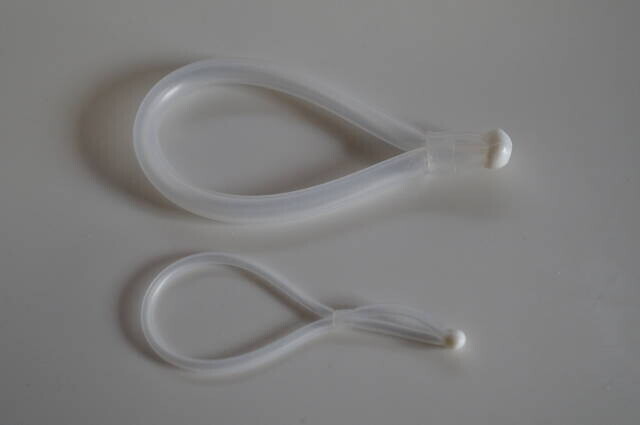
The maker's answer to adjusting prostate chip tubes and loops
The diary treats adjustment, secure attachment, and tolerance of silicone as separate concerns.
Unlocked tube adjustment also allowed unwanted movement during the maker's trial
In an entry published in July 2022, Mr. Okada described a lock key attached to the holder's external fastening. He found unlocked positioning convenient, including movement accompanying changes in penis size. However, he also reported that the tubing could project unexpectedly far outside. Mr. Okada therefore favored a locked fitting for ordinary use.
(Source: ok-lab's diary, published July 2022)
https://ok-lab.hatenablog.com/entry/2022/07/23/123014
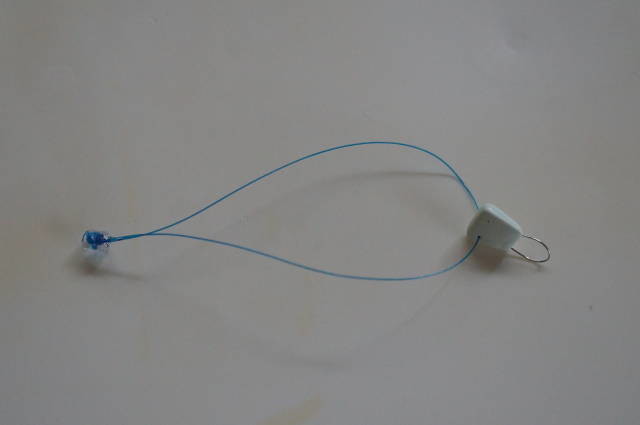
Tube adjustment did not remove the maker's concern about prolonged contact
In an entry published in August 2022, a customer asked which flexible support might suit prolonged use. Mr. Okada considered the silicone design easier to bend, but acknowledged possible harm from persistent contact with the same tissue. The diary does not record which configuration the customer chose. Mr. Okada advised against prolonged silicone contact beyond, or continuously against, the sphincter (the muscle controlling urine flow).
(Source: ok-lab's diary, published August 2022)
https://ok-lab.hatenablog.com/entry/2022/08/20/122920
Tighter screw support dimensions reduced slipping while preserving tube adjustment
In an entry published in December 2023, Mr. Okada developed a screw support (a twisted part intended to stabilize the chip). His revised prototype paired a 2mm central opening with 2.5mm tubing. The revised fit allowed deliberate position changes while resisting unwanted movement, according to Mr. Okada.
The proposed support cost ¥3,000 (about $19 at ¥156 = $1, rate as of 2026-09-04) excluding tax; its covered-thread connection cost ¥2,000 (about $13 at ¥156 = $1, rate as of 2026-09-04) excluding tax for up to 10cm, as published in December 2023. Mr. Okada proposed the sliding design for customers seeking changes to the gap between chip and support.
(Source: ok-lab's diary, published December 2023)
https://ok-lab.hatenablog.com/entry/2023/12/02/122648
Later adjustable loops gained a cover that limited their minimum size
In an entry published in August 2025, Mr. Okada revised loops made with shape-memory wire (wire that returns toward its original shape). A cover about 40mm long limited how small the loop could become, because extreme bending could prevent the wire from recovering. A dedicated adjustment part cost ¥1,000 (about $6 at ¥156 = $1, rate as of 2026-09-04) excluding tax, and this arrangement no longer accepted a stopper or safety part on the loop.
Other short covers were movable, but could not be added afterward. Mr. Okada specified that the loop's protective cover was essential.
(Source: ok-lab's diary, published August 2025)
https://ok-lab.hatenablog.com/entry/2025/08/16/122934
If you see blood in your urine, even a small amount or for the first time, do not wait and see. See a urologist right away. If you suddenly cannot urinate, or the device cannot be removed, do not try to fix it yourself. Go to a medical facility, including emergency care, immediately.
How adjusting prostate chip tubes and loops changed over time

| Published | What the diary said then |
|---|---|
| Jul 2022 | A 4mm tube option emerged, but could not accommodate products carrying two cable systems. |
| Aug 2022 | Single-tube and twin-tube holders: ¥5,500 (about $35 at ¥156 = $1, rate as of 2026-09-04) and ¥7,000 (about $45 at ¥156 = $1, rate as of 2026-09-04) excluding tax, respectively; tubing extra. |
| Nov 2022 | The maker dropped plans to sell the silicone tube garment. |
| Oct 2023 | A redesigned holder cost ¥4,000 (about $26 at ¥156 = $1, rate as of 2026-09-04) excluding tax after a ¥1,000 (about $6 at ¥156 = $1, rate as of 2026-09-04) reduction. |
| Oct 2023 | A 2mm groove increased friction holding 4mm tubing. |
| Apr 2024 | Without a tube cover, the shape-memory design allowed fixed screw placement only. |
| Oct 2024 | A loop-ended design offered 2mm tubing for easier movement, 2.5mm for firmer positioning. |
| Apr 2025 | A 0.2mm wire and enclosed nylon thread made the extension more flexible, Mr. Okada reported. |
| Dec 2025 | A cover-free custom chip had a 3.5mm minimum shaft and lacked free bending. |
| Mar 2026 | A bead-covered prototype produced more friction than expected; supply awaited improvements. |
The diary does not say what the current state is.
OK Prostate Chip products related to adjusting prostate chip tubes and loops

The current list identifies the ceramic chip and sliding holder below; historical assemblies had separate specifications.
Products that appear in these entries
| Product (official name) | Price incl. tax | Relation to this topic |
|---|---|---|
| Short twisted ceramic chip (OKプロステートチップ 陶器素材ショートタイプ ツイスト) | ¥4,400 (about $28 at ¥156 = $1, rate as of 2026-09-04) | In July 2022, this chip appeared in the customer's setup with the older holder whose tube end caused pain. |
(Source: ok-lab's diary, published July 2022)
https://ok-lab.hatenablog.com/entry/2022/07/23/123014
(Source: ok-lab's diary, published July 2022)
https://ok-lab.hatenablog.com/entry/2022/07/30/122933
Products the diary mentioned as alternatives
| Product (official name) | Price incl. tax | Relation to this topic |
|---|---|---|
| Sliding-lock external holder (スライドロック式尿道ゲートキーパー) | ¥6,600 (about $42 at ¥156 = $1, rate as of 2026-09-04) | In October 2023, Mr. Okada proposed this holder with less silicone contact than full tubing, while acknowledging possible chip movement. |
(Source: ok-lab's diary, published October 2023)
https://ok-lab.hatenablog.com/entry/2023/10/28/122832
No longer sold: the older 4-wire support, silicone support design, and 6-wire support were discontinued, according to the January 2023 entry. Mr. Okada attributed those withdrawals to reports of breakage or feared breakage. His revised policy separated the supplied tubing from user-selected wire.
(Source: ok-lab's diary, published January 2023)
https://ok-lab.hatenablog.com/entry/2023/01/07/123115
An entry published in January 2026 also described an older angled nylon joint as effectively discontinued. Staff cited unstable positioning, peeling rubber, and difficulty setting its angle.
(Source: ok-lab's diary, published January 2026)
https://ok-lab.hatenablog.com/entry/2026/01/24/122909
Other historical custom assemblies, prototypes, external rings, and separately described adjustment parts: No matching product can be confirmed on the current list.
Common worries about adjusting prostate chip tubes and loops

The replies address particular configurations; they do not establish a comfortable tube size for everyone.
"Does tube adjustment always require an external holder?"
In an entry published in July 2022, a customer asked whether a planned linked-chip tube assembly required an external holder. Staff said the holder was optional and might be convenient for prolonged use. The diary does not record whether that proposed order was completed. Staff nevertheless considered an external safeguard necessary where a device entered the bladder, because of the increased risk of inward migration.
(Source: ok-lab's diary, published July 2022)
https://ok-lab.hatenablog.com/entry/2022/07/30/122933
"Will thinner tubing always solve silicone tube pain?"
In an entry published in October 2022, a customer reported testing 2mm and 3mm tube samples. Even the 2mm sample progressed only about 3cm before pain led them to abandon the attempt. Mr. Okada acknowledged that silicone might suit some users poorly. The diary does not record a comfortable tube configuration for this customer.
(Source: ok-lab's diary, published October 2022)
https://ok-lab.hatenablog.com/entry/2022/10/08/122859
"Can adjustable loops keep a chip from shifting?"
In an entry published in July 2025, a customer asked about a configuration that could resist shifting and inward migration. Mr. Okada described a flexible extension with an adjustable end loop, connecting the chip to a shape-memory external holder. He gave 20cm as the manufacturing limit for one extension, with longer requests requiring an additional section. The diary does not record the customer's result with this proposal.
Mr. Okada recommended that holder-and-extension combination for the positioning concern.
(Source: ok-lab's diary, published July 2025)
https://ok-lab.hatenablog.com/entry/2025/07/26/122909
Buying from outside Japan

OK Lab ships internationally to countries covered by Japan Post's EMS courier service. Overseas orders are paid in advance by PayPal. Each order carries a ¥400 (about $3 at ¥156 = $1, rate as of 2026-09-04) handling fee, and EMS shipping is charged on top. These terms come from OK Lab's official sales-terms page (written here as plain text, not a link: ok-lab.net/docs/law), checked on September 7, 2026; confirm them on the official store before you order, because they can change.
Summary of this article
| What you wanted to know | The answer |
|---|---|
| What is the short answer? | Some designs adjust, but silicone-related discomfort remained in customer reports. |
| What is the product? | A urethral device made and sold by a small company in Japan. |
| What do the terms mean? | Tubes connect or cover parts; loops and holders provide support or attachment. |
| What happened in the cases? | External adjustment and sliding loops emerged alongside reports of pain. |
| What did the maker suggest? | Secure fittings and limits on prolonged silicone contact, depending on the design. |
| What changed over time? | Tube sizes, holder construction, sliding parts, and protective covers changed. |
| What products are listed today? | The related ceramic chip costs ¥4,400 (about $28 at ¥156 = $1, rate as of 2026-09-04); the sliding holder costs ¥6,600, (about $42 at ¥156 = $1, rate as of 2026-09-04) both including tax. |
| What remains uncertain? | Individual comfort and the outcomes of several proposed configurations. |
| How do overseas orders work? | Advance PayPal payment, a ¥400 (about $3 at ¥156 = $1, rate as of 2026-09-04) handling fee, and additional EMS shipping. |
Source: ok-lab's diary (Okada Comfortable Life Laboratory). The original entries are in Japanese; quotations on this page are translated. Photos and videos are on the original entries.
This article is a summary of the maker's development diary. The product is not a medical device and no result is guaranteed. If anything feels wrong or worries you, see a doctor. Prices, specifications and cautions change, so confirm the latest information on the official blog and the official site. Questions about ordering and shipping go to the seller.