![Do prostate chip stoppers prevent slipping? | Protection depends on the design [OK Prostate Chip]](/img/a/T0105/eyecatch.svg)
This page is based on entries from "ok-lab's diary" (https://ok-lab.hatenablog.com/), the Japanese development diary written by Mr. Okada, founder of OK Lab, a small company in Japan (Okada Comfortable Life Laboratory). Only the entries about "how stoppers work, their number, and their holes" are summarized here, in order of publication. Past prices and sizes are as written at the time. Current prices come from the official product list (retrieved September 4, 2026). Quotations are translated from Japanese.
Note: This page is a personal reading log by someone with no connection to the maker or the seller. It reflects the source entries as of their publication dates and makes no guarantee of accuracy or safety. The product is not a medical device; talk to a doctor about any health decision. Check the official site for current information. This page contains advertising.
In short
Stoppers can limit movement, but the diary records failures and different functions for different designs.
Mr. Okada's answers depend on stopper shape, freedom of movement, thread arrangement, and urine flow.
The current list includes 3-hole and 8-hole parts; several later custom designs have no confirmed matching listing.
If you see blood in your urine, even a small amount or for the first time, do not wait and see. See a urologist right away. If you suddenly cannot urinate, or the device cannot be removed, do not try to fix it yourself. Go to a medical facility, including emergency care, immediately.
About this product

The OK Prostate Chip is a small device that is placed in the urethra (the urine passage) so that it acts on the prostate; the maker sells it in several shapes, sizes and materials. It is made and sold by OK Lab (Okada Comfortable Life Laboratory), a small company in Japan, through its own online store, and prices are in Japanese yen (JPY).
The maker's development diary, "ok-lab's diary", is written in Japanese. This page is an English summary of it, and every quotation is translated. OK Lab ships internationally, so readers outside Japan can order (see "Buying from outside Japan" below).
Product names on this page are plain-English descriptions. The official Japanese product name is shown once in the product table so you can find the same item in the store.
Before you read: key terms
| Term | Plain-English meaning |
|---|---|
| Urethra | The urine passage; it carries urine and is where these devices are placed. |
| Sphincter stopper | An internal accessory intended to resist the chip moving toward the bladder. |
| External stopper | A part outside the penis opening, intended to stop the thread disappearing inward. |
| Safety chip | An end piece; the two-thread version discussed here brings thread lengths together. |
| Tube tail | A tube-covered extension from the chip that can carry additional parts. |
| Mesh stopper | A plate with openings intended to let urine pass while resisting movement. |
| Locking notch | A cutout in the early sliding stopper, intended to prevent further sliding. |
| Auxiliary chip | A second chip attached behind the main chip, intended to assist placement or retention. |
What happens: prostate chip stoppers
The OK Prostate Chip is a small device placed in the urethra to act on the prostate. A sphincter stopper (an internal accessory near the prostate) is intended to resist travel toward the bladder, according to the diary. Other stoppers sit outside the penis opening or hold extra parts on a thread or tube. These entries describe different designs for different jobs, including preventing inward travel, resisting outward movement, and keeping connected parts apart.
One sliding stopper replaced separate parts for erect and relaxed states
In an entry published in March 2018, revised guidance specified 1 sliding stopper, replacing an earlier suggestion of 2. Mr. Okada said it could slide naturally during erections and had a locking notch (a cutout intended to stop further sliding). He described the locked setting as a complete stop.
He reported that the silicone version came off because it was too soft. His revised recommendation was the single sliding design.
(Source: ok-lab's diary, published March 2018)
https://ok-lab.hatenablog.com/entry/20180324/1521875816
(Source: ok-lab's diary, published March 2018)
https://ok-lab.hatenablog.com/entry/20180331/1522485734
Six-hole stoppers added a separate cost to the two-thread system
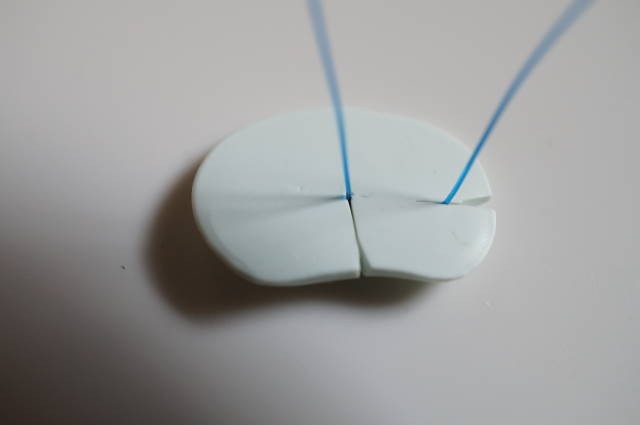
In an entry published in April 2019, 6-hole parts accommodated the maker's two-thread system. Each cost ¥500 (about $3 at ¥156 = $1, rate as of 2026-09-04) more, excluding tax, than its 3-hole equivalent. An external stopper (a part outside the penis opening) was intended to limit inward movement.
A safety chip (an end piece matching thread lengths) had a different purpose. Prices excluding tax were ¥2,000 (about $13 at ¥156 = $1, rate as of 2026-09-04) for the sphincter stopper, ¥1,500 (about $10 at ¥156 = $1, rate as of 2026-09-04) for the external stopper, and ¥1,000 (about $6 at ¥156 = $1, rate as of 2026-09-04) for the safety chip. Mr. Okada also allowed a 3-hole sphincter stopper connected to just one thread of a two-thread device.
(Source: ok-lab's diary, published April 2019)
https://ok-lab.hatenablog.com/entry/2019/04/27/153239
Mesh stopper holes addressed urine flow around the tube tail
In an entry published in November 2023, Mr. Okada described mesh stoppers (plates with urine-flow openings) for a 2.5mm tube. He said the openings addressed urine pressure against plates that remained crosswise. Widths were 8-9mm; fitted and detachable versions cost ¥2,000 (about $13 at ¥156 = $1, rate as of 2026-09-04) and ¥2,500 (about $16 at ¥156 = $1, rate as of 2026-09-04) respectively, excluding tax.
The printed size line has unclear S and M units: S=12m, M=15m, and L=18mm. His tests suggested 3 or 4 stoppers, with discomfort when too many extended beyond the wider urethral section. Mr. Okada favored the permanently fitted version nearest the chip because he wanted that part unable to detach.
(Source: ok-lab's diary, published November 2023)
https://ok-lab.hatenablog.com/entry/2023/11/25/122934
The tube tail had a separate price from its mesh stoppers
In an entry published in November 2023, the tube tail (a tube-covered extension carrying parts) cost ¥2,000 (about $13 at ¥156 = $1, rate as of 2026-09-04) excluding tax. Its diameter was 2.5mm, with lengths up to 10cm. Mr. Okada said the shortest length he could manufacture was about 3cm. His preferred length was 10cm, because he saw no particular benefit in making it shorter.
(Source: ok-lab's diary, published November 2023)
https://ok-lab.hatenablog.com/entry/2023/11/25/122934
Elastic-wire tests prompted another mesh stopper after inward movement
In an entry published in March 2024, Mr. Okada reported unexpected movement during his elastic-wire chip tests. After several hours, the chip had advanced toward the bladder; after about 5 hours, the entire chip was inside it.
A mesh stopper adapted for the wire then resisted passage in his own tests. His preference was a stopper arrangement that left space between the accessory and main chip.
(Source: ok-lab's diary, published March 2024)
https://ok-lab.hatenablog.com/entry/2024/03/30/122958
Petal stoppers used softer wire despite the risk of folding
In an entry published in April 2025, the petal stopper had 3 petals made with 0.2mm wire. Its published price was ¥3,000 (about $19 at ¥156 = $1, rate as of 2026-09-04) excluding tax. Mr. Okada reported satisfactory stopping during his own ordinary retention tests.
He also acknowledged that force could turn the petals inside out and allow passage. Mr. Okada rejected 0.3mm wire for prolonged retention because he judged its pressure too strong.
(Source: ok-lab's diary, published April 2025)
https://ok-lab.hatenablog.com/entry/2025/04/26/122909
Four-layer heart stoppers were preferred after two-layer versions slipped more easily
In an entry published in December 2025, the heart stopper targeted outward movement near the penis opening. The four-layer version cost ¥3,000 (about $19 at ¥156 = $1, rate as of 2026-09-04), and the two-layer version cost ¥2,500 (about $16 at ¥156 = $1, rate as of 2026-09-04), both excluding tax. Mr. Okada considered the two-layer design too soft and easier to dislodge.
He specified separate threads for the heart stopper because it strongly resisted outward movement. He offered two layers for people unable to accommodate four. His preference was the four-layer design, with a suggested width around 20mm.
(Source: ok-lab's diary, published December 2025)
https://ok-lab.hatenablog.com/entry/2025/12/13/122917
The maker's answer to prostate chip stoppers
Mr. Okada's proposed solutions address specific mechanical problems; his diary also records failures.
A sphincter stopper can fail when its plate cannot turn freely
In an entry published in June 2018, Mr. Okada distinguished favorable personal tests from customer reports of problems. He explicitly said the sphincter stopper could not reliably prevent a chip entering the bladder. An entry published in July 2018 explained why freedom of movement mattered to its proposed shield action.
A stopper partly caught in the muscle could remain lengthwise and be drawn inward with the chip. Mr. Okada advised against arrangements that left the stopper trapped in the muscle.
(Source: ok-lab's diary, published June 2018)
https://ok-lab.hatenablog.com/entry/20180616/1529136608
(Source: ok-lab's diary, published July 2018)
https://ok-lab.hatenablog.com/entry/20180707/1530947332
Stopper spacing alone could not ensure the maker's intended shield action
In an entry published in December 2020, a customer questioned stopper spacing after painful inward movement and outward slipping. Mr. Okada described about 8mm or more as the gap in his proposed protective arrangement. He distinguished a freely moving stopper outside the muscle from tight clamping.
The diary does not record whether this customer's later experience improved. Mr. Okada cautioned that close clamping was an advanced arrangement he did not recommend as normal stopper use.
(Source: ok-lab's diary, published December 2020)
https://ok-lab.hatenablog.com/entry/2020/12/12/124126
The 8-hole stopper combined both thread formats in one resin part
In an entry published in August 2021, Mr. Okada announced the 8-hole resin stopper for release the following week. It combined the functions of 3-hole and 6-hole parts, at ¥2,000 (about $13 at ¥156 = $1, rate as of 2026-09-04) excluding tax. A dedicated 3-hole version in that resin was not planned because reducing the hole count would not reduce its price. Mr. Okada directed buyers needing a dedicated 3-hole part to the existing resin design.
(Source: ok-lab's diary, published August 2021)
https://ok-lab.hatenablog.com/entry/2021/08/28/125823
Small tail-stopper holes addressed slipping between curved chip sections
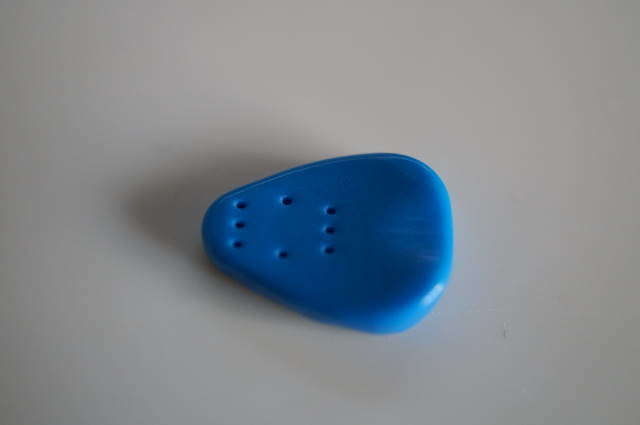
In an entry published in January 2024, Mr. Okada described curved chip sections that became slippery on their tube when wet. Dedicated tail stoppers had holes about 1.5mm across and cost ¥500 (about $3 at ¥156 = $1, rate as of 2026-09-04) excluding tax per piece. He reported that these smaller holes resisted sliding in both wet and dry conditions.
His example with gaps between the leading chip and two curved sections required 5 stoppers. The diary's proposed answer to unwanted contact between sections was the dedicated tail stopper.
(Source: ok-lab's diary, published January 2024)
https://ok-lab.hatenablog.com/entry/2024/01/06/123004
If you see blood in your urine, even a small amount or for the first time, do not wait and see. See a urologist right away. If you suddenly cannot urinate, or the device cannot be removed, do not try to fix it yourself. Go to a medical facility, including emergency care, immediately.
How prostate chip stoppers changed over time
| Published | What the diary said then |
|---|---|
| Jun 2018 | Chip size and spacing became adjustable. |
| Jul 2018 | Stopper overlap with a second chip could make thread tangles easier to recognize. |
| Sep 2019 | Approximately 0.3mm holes accommodated 0.29mm stainless thread; stopper movement differed from nylon. |
| Jul 2020 | A roughly 0.4mm or 0.5mm cable appeared flexible enough for stopper movement. |
| May 2021 | Side-hole geometry could tilt the stopper; face-hole geometry was considered more effective. |
| Sep 2021 | Smaller stoppers reduced urine pressure but might also weaken protection against inward movement. |
| Dec 2025 | Added connections kept separated shaft and stopper components attached to the main thread. |
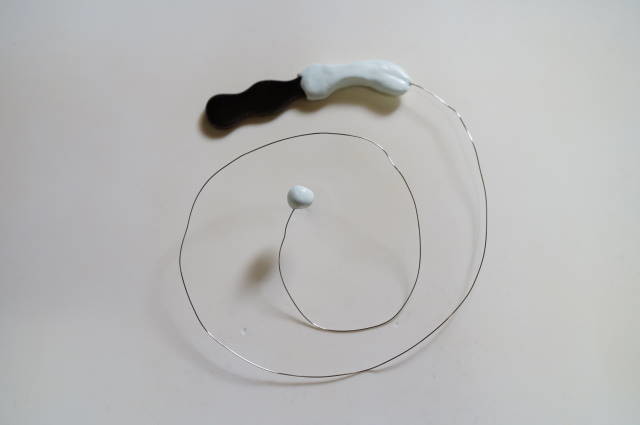
OK Prostate Chip products related to prostate chip stoppers
Current prices are confirmed for the listed parts.
Products that appear in these entries
| Product (official name) | Price incl. tax | Relation to this topic |
|---|---|---|
| Eight-hole resin sphincter stopper (八穴方式括約筋ストッパーチップ(生体適合樹脂)) | ¥2,200 (about $14 at ¥156 = $1, rate as of 2026-09-04) | In August 2021, its release combined the functions previously provided by 3-hole and 6-hole parts. |
| Six-hole safety end piece (六穴方式オプションチップ(セーフティチップ)) | ¥1,100 (about $7 at ¥156 = $1, rate as of 2026-09-04) | In September 2020, the reply accepted this external end piece while recommending a different internal stopper. |
The 8-hole resin sphincter stopper is listed in the company's own online store.

(Source: ok-lab's diary, published August 2021)
https://ok-lab.hatenablog.com/entry/2021/08/28/125823
(Source: ok-lab's diary, published September 2020)
https://ok-lab.hatenablog.com/entry/2020/09/26/124400
Products the diary mentioned as alternatives
| Product (official name) | Price incl. tax | Relation to this topic |
|---|---|---|
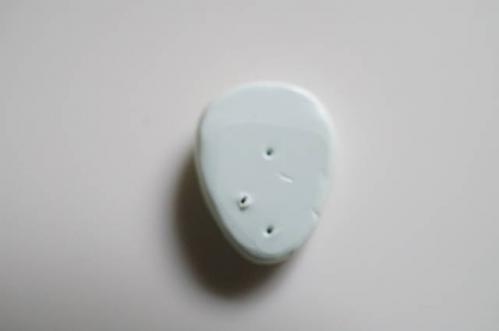
| Three-hole sphincter stopper (三穴方式オプションチップ(括約筋ストッパーチップ)) | ¥1,650 (about $11 at ¥156 = $1, rate as of 2026-09-04) | In September 2020, it replaced a shared 6-hole stopper for a customer whose threads emerged from separate locations. |
The 3-hole sphincter stopper is listed in the company's own online store.
(Source: ok-lab's diary, published September 2020)
https://ok-lab.hatenablog.com/entry/2020/09/26/124400
The August 2021 entry announced discontinuation of the older 6-hole sphincter stopper.
(Source: ok-lab's diary, published August 2021)
https://ok-lab.hatenablog.com/entry/2021/08/28/125823
Historical designs discussed here include the early sliding stopper, mesh assemblies, tube tails, dedicated tail stoppers, petal stoppers, and heart stoppers. No matching product can be confirmed on the current list.
Common worries about prostate chip stoppers
More stoppers or holes did not automatically solve customers' problems.
"Do two stoppers work better than one?"
In an entry published in May 2019, a customer reported less outward movement during urination with two stoppers. They asked whether others used multiple stoppers. Their first stopper had passed beyond the muscle, which Mr. Okada said was outside his intended design.
He acknowledged possible effectiveness. Mr. Okada did not actively recommend that arrangement because the stopper had crossed the boundary it was intended to guard.
(Source: ok-lab's diary, published May 2019)
https://ok-lab.hatenablog.com/entry/2019/05/18/150144
"Do two threads always need a 6-hole stopper?"
In an entry published in September 2020, a customer requested two threads emerging from separate locations and a shared 6-hole stopper. Mr. Okada explained that a shared stopper would largely defeat the purpose of pulling from different points. The customer accepted a change to the 3-hole version. His recommendation for that particular arrangement was a stopper associated with the main thread alone.
(Source: ok-lab's diary, published September 2020)
https://ok-lab.hatenablog.com/entry/2020/09/26/124400
"Can a stopper make placement harder for beginners?"
In an entry published in December 2020, a beginner reported four failed attempts and severe pain. They asked whether a stopper or auxiliary chip (a second chip intended to assist placement or retention) contributed to the difficulty. Mr. Okada could not explain the reported pain, and considered the larger twisted main chip harder to place than a simpler shape.
The diary does not record whether this customer later managed placement. Mr. Okada's preference in that comparison was a simpler, untwisted main chip.
(Source: ok-lab's diary, published December 2020)
https://ok-lab.hatenablog.com/entry/2020/12/12/124126
"Will more stoppers prevent a chip washing out during urination?"
In an entry published in May 2026, a customer asked whether two or three auxiliary parts could resist outward movement during urination. Mr. Okada thought extra contact with the lining could increase friction and make outward movement less likely. He expected screw-shaped auxiliary chips to affect urine flow less than sphincter stoppers.
The diary does not record how the proposed combination performed for this customer. Mr. Okada cautioned that adding sphincter stoppers could also obstruct urine flow.
(Source: ok-lab's diary, published May 2026)
https://ok-lab.hatenablog.com/entry/2026/05/23/122904
Buying from outside Japan

OK Lab ships internationally to countries covered by Japan Post's EMS courier service. Overseas orders are paid in advance by PayPal. Each order carries a ¥400 (about $3 at ¥156 = $1, rate as of 2026-09-04) handling fee, and EMS shipping is charged on top. These terms come from OK Lab's official sales-terms page (written here as plain text, not a link: ok-lab.net/docs/law), checked on September 7, 2026; confirm them on the official store before you order, because they can change.
Summary of this article
| What you wanted to know | The answer |
|---|---|
| What is the short answer? | Stoppers have different jobs, and protection can fail. |
| What is this product? | A urethral device made by OK Lab in Japan, with prices in JPY. |
| What do the terms mean? | Internal stoppers, external stoppers, and thread-end pieces serve different purposes. |
| What happened in development? | Different designs addressed different directions and types of movement. |
| What did the maker propose? | Changes to spacing, movement, holes, and connections. |
| What changed over time? | Adjustable parts, new thread formats, and revised geometry. |
| Which products are listed now? | Two internal stoppers and a safety end piece are listed. |
| Do extra stoppers always help? | Additional parts can affect retention and urine flow. |
| How do overseas orders work? | Advance PayPal payment, a ¥400 (about $3 at ¥156 = $1, rate as of 2026-09-04) handling fee, and additional Japan Post EMS shipping. |
Source: ok-lab's diary (Okada Comfortable Life Laboratory). The original entries are in Japanese; quotations on this page are translated. Photos and videos are on the original entries.
This article is a summary of the maker's development diary. The product is not a medical device and no result is guaranteed. If anything feels wrong or worries you, see a doctor. Prices, specifications and cautions change, so confirm the latest information on the official blog and the official site. Questions about ordering and shipping go to the seller.