![Where is my prostate chip? | Touch and thread provide limited clues [OK Prostate Chip]](/img/a/T0100/eyecatch.svg)
This page is based on entries from "ok-lab's diary" (https://ok-lab.hatenablog.com/), the Japanese development diary written by Mr. Okada, founder of OK Lab, a small company in Japan (Okada Comfortable Life Laboratory). Only the entries about "checking chip position by touch or thread" are summarized here, in order of publication. Past prices and sizes are as written at the time. Current prices come from the official product list (retrieved September 4, 2026). Quotations are translated from Japanese.
This article is about checking chip position by touch or thread, and summarizes customer reports, the maker's advice, and design changes. It discusses limited clues, hospital removal, related products, and buying from outside Japan.
Note: This page is a personal reading log by someone with no connection to the maker or the seller. It reflects the source entries as of their publication dates and makes no guarantee of accuracy or safety. The product is not a medical device; talk to a doctor about any health decision. Check the official site for current information. This page contains advertising.
In short
- A chip can become difficult to feel, and remaining thread length alone cannot establish its position.
- Mr. Okada describes physical reference points, while acknowledging differences between bodies and chip designs.
- An August 2026 change extended thread beyond its marker, with an exception at maximum length.
If you see blood in your urine, even a small amount or for the first time, do not wait and see. See a urologist right away. If you suddenly cannot urinate, or the device cannot be removed, do not try to fix it yourself. Go to a medical facility, including emergency care, immediately.
About this product
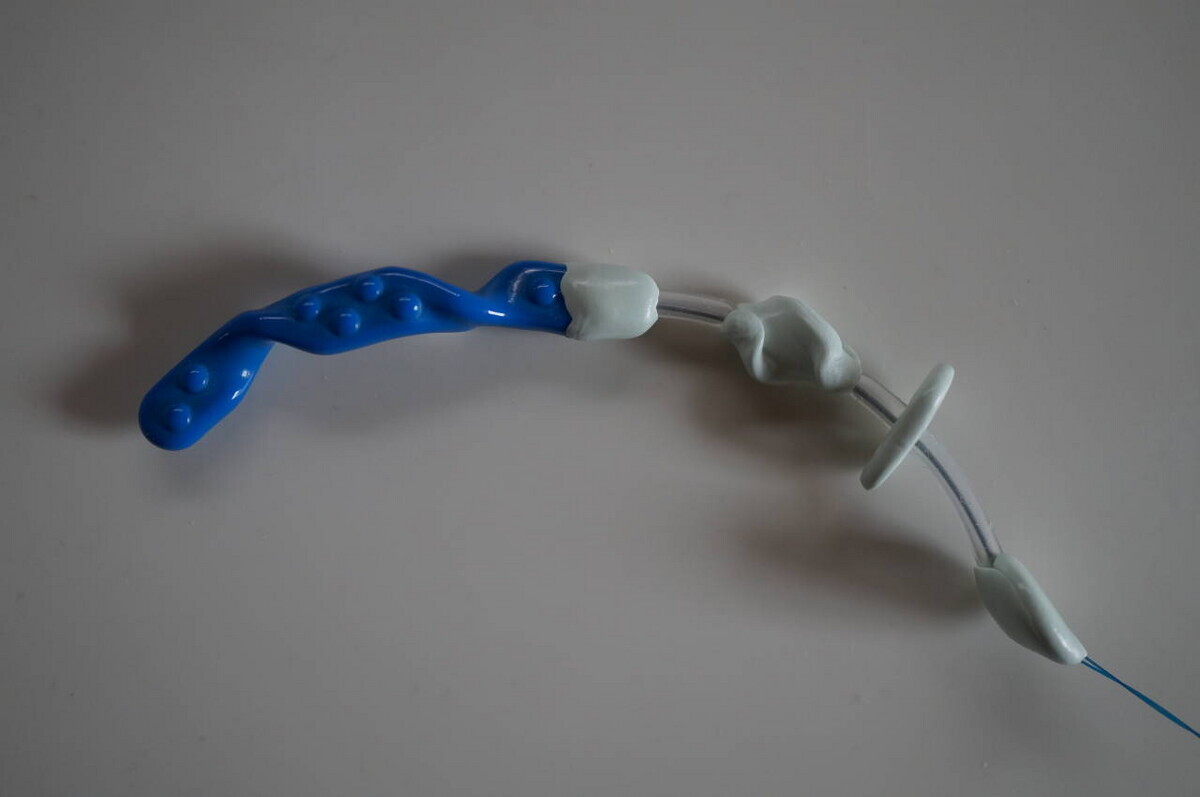
The OK Prostate Chip is a small device that is placed in the urethra (the urine passage) so that it acts on the prostate; the maker sells it in several shapes, sizes and materials. It is made and sold by OK Lab (Okada Comfortable Life Laboratory), a small company in Japan, through its own online store, and prices are in Japanese yen (JPY). The maker's development diary, "ok-lab's diary", is written in Japanese. This page is an English summary of it, and every quotation is translated. OK Lab ships internationally, so readers outside Japan can order (see "Buying from outside Japan" below). Product names on this page are plain-English descriptions. The official Japanese product name is shown once in the product table so you can find the same item in the store.
Before you read: key terms
| Term | Plain-English meaning |
|---|---|
| Prostate | The organ between the external sphincter and bladder, targeted by the chip for internal stimulation. |
| Urethra | The urine passage, where the chip sits to act on the prostate. |
| Bulbar urethra | The wider urine-passage section near the prostate; a touch-reference area in the diary. |
| External urethral sphincter | The controllable muscle before the prostate, described as gripping the chip to support its position. |
| Retrieval thread | Thread attached for retrieval, also used in the maker's position estimates. |
| Auxiliary screw | A twisted accessory behind the main chip, discussed as a support and a separate touch reference. |
| Safety chip | A thread component intended to prevent inward loss and serve as a position marker. |
| Shape-memory wire | Wire that recovers a preset shape after bending; it connects and supports separated chip components. |
| Cystoscope and forceps | Hospital instruments for viewing and gripping an object inside the body. |
What happens: checking prostate chip position
The OK Prostate Chip is a small device placed in the urethra so that it acts on the prostate. The diary discusses recognizing its position through the skin, through attached parts that remain detectable, and through changes in exposed thread. These references concern a device hidden inside the urine passage, including the bend near the prostate. The accounts below describe both useful clues and situations where customers remained uncertain or needed hospital treatment.
Longer chip retrieval threads became an option after the previous maximum proved too short
In an entry published in January 2018, a customer reported that a custom chip's 25cm thread was too short for their circumstances. They wanted a longer option, and an annotation says lengths beyond 25cm could then be requested.
The diary does not record whether that customer received a longer thread. No matching product can be confirmed on the current list. The entry directs longer-thread requests to the order notes.
(Source: ok-lab's diary, published January 2018)
https://ok-lab.hatenablog.com/entry/20180118/1516263011
Linked chip position became a safety concern after hospital removal
In an entry published in March 2018, a customer reported hospital removal after linked chips tangled in what they described as the prostate. Mr. Okada called this his first report of hospital removal; the anonymous message left other circumstances unknown. He suspected that a chip had reversed direction, allowing the pair to overlap.
The planned leading-chip length changed from 25–28mm to 30mm or more. He acknowledged that even the longer design might turn around in some bodies. His advice emphasized confirming by touch that the chips formed a lengthwise chain.
(Source: ok-lab's diary, published March 2018)
https://ok-lab.hatenablog.com/entry/20180310/1520672565
Curved tails made chip position easier to feel in early vibrating models
In an entry published in March 2019, Mr. Okada introduced a curved cable-connection tail on vibrating Version 2. He described the tail as touchable even when the short chip's body lay entirely within the prostate.
The design included 8–10mm of resin beyond the chip's rear to support the cable connection. No matching product can be confirmed on the current list. Mr. Okada cautioned that one illustrated deeper placement was excessive.
(Source: ok-lab's diary, published March 2019)
https://ok-lab.hatenablog.com/entry/2019/03/23/173222
Cable stoppers added another reference for checking chip position by touch
An entry published in July 2019 described a cable stopper with a proposed price of ¥1,500 (about $10 at ¥156 = $1, rate as of 2026-09-04) excluding tax. Planned sizes were M at 9mm and L at approximately 11mm. The design specified a gap of approximately 15mm or more between the main chip and stopper.
Mr. Okada cautioned that a stopper caught in the muscle could also be drawn farther inward. No matching product can be confirmed on the current list. His advice centered on a touch reference in the bulbar urethra (the wider section near the bend).
(Source: ok-lab's diary, published July 2019)
https://ok-lab.hatenablog.com/entry/2019/07/06/152113
Uncertain chip position accompanied a version-four removal problem in September 2020
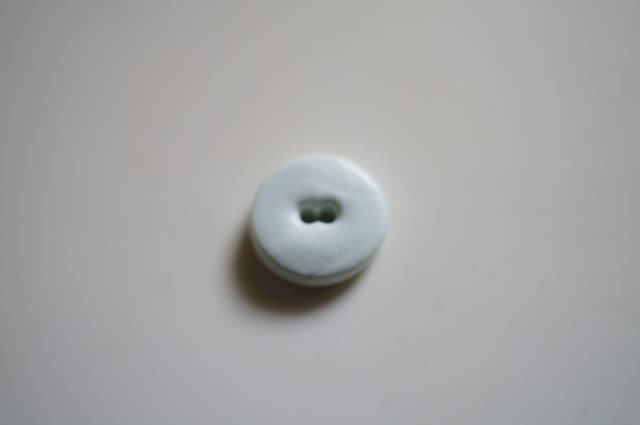
In an entry published in September 2020, a customer could neither remove nor externally locate a curved chip (Umiushi Ver.4). Mr. Okada suggested its off-center thread attachment might explain the difficulty. A follow-up received the next day reported successful removal.
Mr. Okada acknowledged that he had not personally tested this version before receiving the report. No matching product can be confirmed on the current list. He advised consulting a urologist if the chip could not be removed.
(Source: ok-lab's diary, published September 2020)
https://ok-lab.hatenablog.com/entry/2020/09/05/095734
A folded pair complicated chip position after previously uneventful use
In an entry published in August 2022, a customer reported trouble with a short resin chip supplied with an auxiliary chip. Earlier use had involved no strong pain, but the linked pieces became folded together and stuck for 5 days. A hospital removed them using a cystoscope (a viewing instrument) and forceps (gripping tools).
The customer reported some bleeding and pain afterward, without disruption to everyday life. No matching product can be confirmed on the current list. Mr. Okada's advice stressed reassessing the pair's shape through touch when more thread disappeared than usual.
(Source: ok-lab's diary, published August 2022)
https://ok-lab.hatenablog.com/entry/2022/08/20/122920
In August 2026, extra thread behind the safety chip became standard
In an entry published in August 2026, Mr. Okada changed the standard safety chip (a marker intended to prevent thread disappearing). Approximately 5–10cm of nylon thread would extend behind the specified marker position. Mr. Okada's example retained the marker at 20cm, with the extension beyond it.
The standard safety chip remained free; additional ones cost ¥500 (about $3 at ¥156 = $1, rate as of 2026-09-04) excluding tax each, as published in August 2026. He suggested that marker positions could help distinguish deeper movement from movement away from the prostate.
(Source: ok-lab's diary, published August 2026)
https://ok-lab.hatenablog.com/entry/2026/08/15/122912
The maker's answer to checking prostate chip position
Mr. Okada's answers use physical reference points, while later entries emphasize differences in anatomy and design.
An early reply used a touch reference to interpret thread length as a clue to position
In an entry published in January 2018, a beginner asked about losing track of the chip beyond the base of the penis. Mr. Okada suggested that uncertainty could arise in the wider section near the bend.
The diary does not record whether that customer's uncertainty was resolved. His proposed estimate combined thread travel with the point where the chip became detectable to a finger at the bulbar urethra.
(Source: ok-lab's diary, published January 2018)
https://ok-lab.hatenablog.com/entry/20180127/1517054930
Reduced exposed chip retrieval thread length was considered a possible sign of tangling
In an entry published in March 2018, Mr. Okada considered how a retrieval thread (the thread attached for removal) could catch around linked chips. He estimated that such a tangle would shorten the exposed thread by at least 6cm.
He acknowledged that the change might go unnoticed because the tangle was hidden inside the body. His advice treated unexpected shortening as a possible tangle requiring reassessment, without force.
(Source: ok-lab's diary, published March 2018)
https://ok-lab.hatenablog.com/entry/20180312/1520844839
An auxiliary screw provided a separate clue to chip position
In an entry published in May 2020, a first-time buyer of a short twisted ceramic chip requested additional stoppers over concerns about inward movement. OK Lab accepted the additions; the diary does not record how this customer's completed setup felt in use.
Mr. Okada's intended arrangement placed only the main chip beyond the external urethral sphincter (the controllable muscle before the prostate). He advised awareness of the auxiliary screw (a twisted support accessory), whose rear was intended to remain perceptible through the skin.
(Source: ok-lab's diary, published May 2020)
https://ok-lab.hatenablog.com/entry/2020/05/09/143600
Shape-memory wire extended the accessible reference for checking chip position
An entry published in April 2024 described linked chips supported by shape-memory wire (wire that recovers a preset shape). Mr. Okada said the rear chip remained detectable in the bulbar urethra while the front chip occupied the prostate.
He also attributed support against movement in either direction to the wire connection. No matching product can be confirmed on the current list. His proposed approach used the accessible rear chip as a reference for the whole assembly's position.
(Source: ok-lab's diary, published April 2024)
https://ok-lab.hatenablog.com/entry/2024/04/06/122941
If you see blood in your urine, even a small amount or for the first time, do not wait and see. See a urologist right away. If you suddenly cannot urinate, or the device cannot be removed, do not try to fix it yourself. Go to a medical facility, including emergency care, immediately.
How checking prostate chip position changed over time
| Published | What the diary said then |
|---|---|
| Oct 2017 | A beginner reported detecting the chip through the skin. |
| Jan 2018 | Mr. Okada described reassurance from a detectable second glass chip. |
| Dec 2018 | A miniature vibrating chip was under development to make its location perceptible. |
| Sep 2019 | Mr. Okada described longer chips as easier to locate than short ones. |
| Dec 2020 | Clothing snagged exposed thread, prompting development of a fully internal arrangement. |
| Nov 2023 | A prototype combined a 2.5mm tube tail with a stopper having an approximately 1.6mm hole. |
| Mar 2024 | A flexible prototype's roughly 4cm rear extension provided a detectable end bump. |
| Mar 2025 | Mr. Okada reported a touchable wire-end loop on a threadless prototype. |
| Nov 2025 | Resin fixing points provided location clues on a continuous-wire prototype. |
| Aug 2026 | The maximum 35cm thread specification retained its end-fixed safety chip without extra thread. |
OK Prostate Chip products related to checking prostate chip position
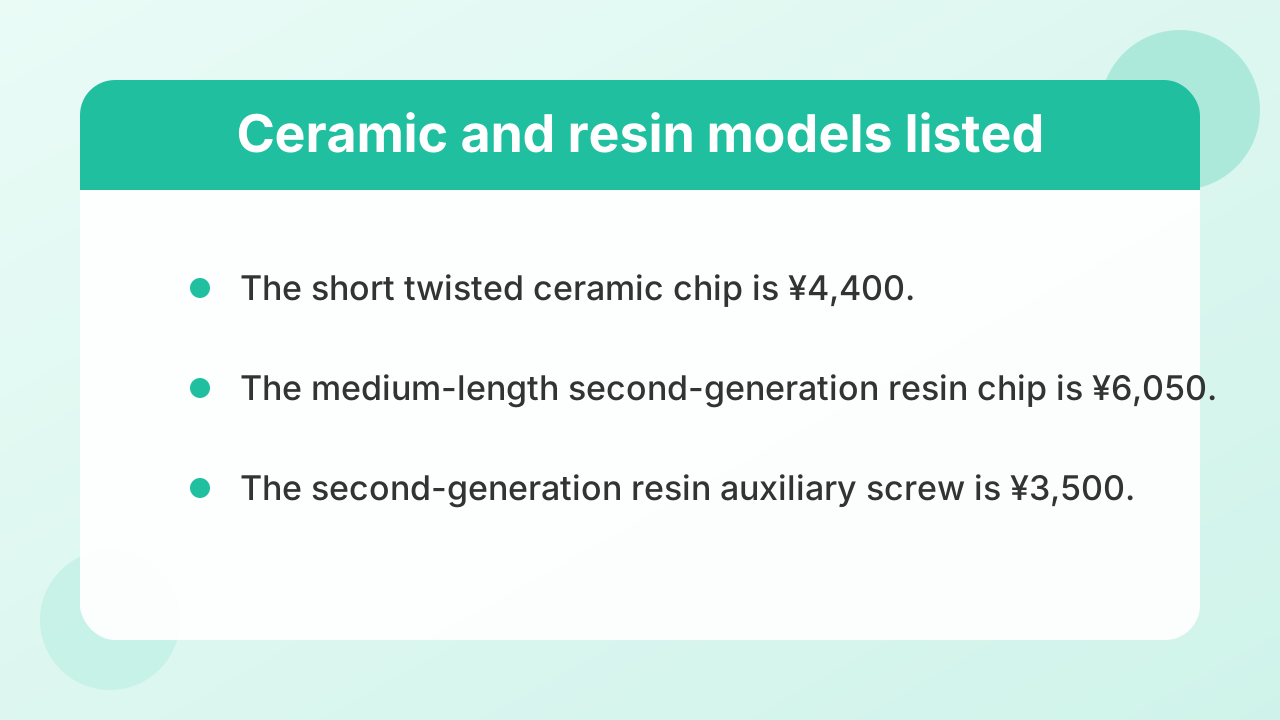
The current list includes the ceramic and resin models named in these placement questions.
Products featured in these entries about the chip
| Product (official name) | Price incl. tax | Relation to this topic |
|---|---|---|
| Short twisted ceramic chip (OKプロステートチップ 陶器素材ショートタイプ ツイスト) | ¥4,400 (about $28 at ¥156 = $1, rate as of 2026-09-04) | In May 2020, its buyer asked about position awareness and preventing inward movement. |
| Auxiliary screw option (スクリュー型補助チップ追加オプション) | ¥3,300 (about $21 at ¥156 = $1, rate as of 2026-09-04) | In May 2020, this accessory was the touch reference in the maker's reply. |
| Three-hole internal stopper (三穴方式オプションチップ(括約筋ストッパーチップ)) | ¥1,650 (about $11 at ¥156 = $1, rate as of 2026-09-04) | In May 2020, OK Lab accepted its addition to the worried beginner's order. |
| Three-hole safety chip (三穴方式オプションチップ(セーフティチップ)) | ¥550 (about $4 at ¥156 = $1, rate as of 2026-09-04) | In May 2020, the same buyer requested this additional thread safeguard. |
| Medium-length second-generation resin chip (OKプロステートチップ セミロングタイプ(第二世代生体適合樹脂)) | ¥6,050 (about $39 at ¥156 = $1, rate as of 2026-09-04) | In April 2026, its user asked how chip and accessory positions should be interpreted. |
| Second-generation resin auxiliary screw (スクリュー型補助チップ追加オプション(第二世代生体適合樹脂)) | ¥3,500 (about $22 at ¥156 = $1, rate as of 2026-09-04) | In April 2026, the buyer asked whether this accessory should remain detectable by touch. |
(Source: ok-lab's diary, published May 2020)
https://ok-lab.hatenablog.com/entry/2020/05/09/143600
(Source: ok-lab's diary, published April 2026)
https://ok-lab.hatenablog.com/entry/2026/04/18/122906
Alternative chip products mentioned in the diary
The diary names no alternative.
Common worries about checking prostate chip position
Later replies qualify the idea that touch or exposed thread can establish exactly where a chip sits.
"Can thread length prove the chip reached my prostate?"
In an entry published in December 2020, a beginner asked whether 15cm of visible thread meant their chip had not reached the prostate. They had reported repeated difficulty with a short twisted ceramic chip.
Mr. Okada said no fixed remaining length could settle that question because urethral length varies between individuals. The diary does not record whether this customer subsequently achieved the intended position. His proposed assessment depended on knowing the customer's own urethral length.
(Source: ok-lab's diary, published December 2020)
https://ok-lab.hatenablog.com/entry/2020/12/12/124126
"Does an unfelt auxiliary screw mean incorrect chip position?"
In an entry published in April 2026, a customer asked about the intended position of their medium-length second-generation resin chip and auxiliary screw. Mr. Okada described the muscle gripping either the main chip's final hollow or the gap behind its entire body.
He said body differences could make the screw difficult to feel even while it remained on the nearer side of the muscle. His reply did not establish which arrangement this customer had. He advised interpreting position with individual anatomy and thread information in mind.
(Source: ok-lab's diary, published April 2026)
https://ok-lab.hatenablog.com/entry/2026/04/18/122906
"Does weak sensation tell me my chip position?"
In an entry published in August 2026, a customer asked whether weak sensation and resistance to removal meant the chip was correctly positioned. Mr. Okada considered several possible positions; the reply did not establish the customer's actual location.
His proposed estimates compared thread positions against initial sphincter contact: roughly 50mm farther for the prostate area. He described 100mm farther as more suggestive of the bladder. His advice relied on an individual reference point, and he presented these distances as estimates.
(Source: ok-lab's diary, published August 2026)
https://ok-lab.hatenablog.com/entry/2026/08/08/122906
Buying from outside Japan
OK Lab ships internationally to countries covered by Japan Post's EMS courier service. Overseas orders are paid in advance by PayPal. Each order carries a ¥400 (about $3 at ¥156 = $1, rate as of 2026-09-04) handling fee, and EMS shipping is charged on top. These terms come from OK Lab's official sales-terms page (written here as plain text, not a link: ok-lab.net/docs/law), checked on September 7, 2026; confirm them on the official store before you order, because they can change.
Summary of this article
| What you wanted to know | The answer |
|---|---|
| What is the short answer? | Touch and thread provide clues that vary with anatomy and design. |
| What is the product? | A urethral device made and sold by OK Lab in Japan. |
| What do the terms mean? | They distinguish chip components and anatomical reference points. |
| What happened to customers? | Reports include uncertainty and hospital removal of trapped linked chips. |
| What did the maker suggest? | Physical reference points and attention to unexpected changes in exposed thread. |
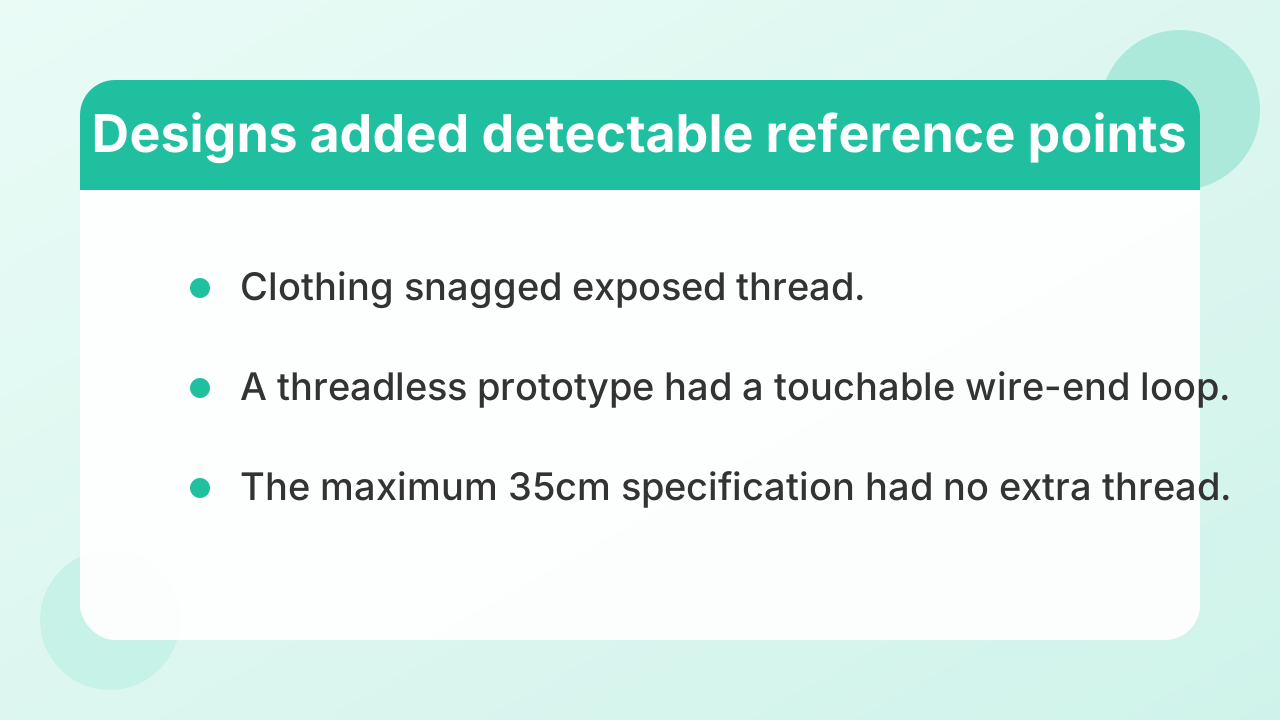
| What changed over time? | Designs added detectable tails, wire connections, and extra thread behind a marker. |
| What is listed today? | Current yen prices appear in the product table. |
| Can sensation confirm position? | The replies allow several explanations and individual differences. |
| How do overseas purchases work? | Advance PayPal payment, EMS shipping, and a ¥400 (about $3 at ¥156 = $1, rate as of 2026-09-04) handling fee apply. |
Source: ok-lab's diary (Okada Comfortable Life Laboratory). The original entries are in Japanese; quotations on this page are translated. Photos and videos are on the original entries.
This article is a summary of the maker's development diary. The product is not a medical device and no result is guaranteed. If anything feels wrong or worries you, see a doctor. Prices, specifications and cautions change, so confirm the latest information on the official blog and the official site. Questions about ordering and shipping go to the seller.