![Is My Prostate Chip in the Right Place? | Sensation Alone Cannot Confirm It [OK Prostate Chip]](/img/a/T0099/eyecatch.svg)
This page is based on entries from "ok-lab's diary" (https://ok-lab.hatenablog.com/), the Japanese development diary written by Mr. Okada, founder of OK Lab, a small company in Japan (Okada Comfortable Life Laboratory). Only the entries about "how to tell whether the chip is in the right place" are summarized here, in order of publication. Past prices and sizes are as written at the time. Current prices come from the official product list (retrieved September 4, 2026). Quotations are translated from Japanese.
Note: This page is a personal reading log by someone with no connection to the maker or the seller. It reflects the source entries as of their publication dates and makes no guarantee of accuracy or safety. The product is not a medical device; talk to a doctor about any health decision. Check the official site for current information. This page contains advertising.
In short
The maker’s replies do not establish sensation or resistance as proof of correct chip position.
Mr. Okada describes positions by device shape and warns that stoppers can fail.
The current list includes the ceramic twist and second-generation resin models discussed in these entries.
If you see blood in your urine, even a small amount or for the first time, do not wait and see. See a urologist right away. If you suddenly cannot urinate, or the device cannot be removed, do not try to fix it yourself. Go to a medical facility, including emergency care, immediately.
About this product

The OK Prostate Chip is a small device that is placed in the urethra (the urine passage) so that it acts on the prostate; the maker sells it in several shapes, sizes and materials. It is made and sold by OK Lab (Okada Comfortable Life Laboratory), a small company in Japan, through its own online store, and prices are in Japanese yen (JPY).
The maker's development diary, "ok-lab's diary", is written in Japanese. This page is an English summary of it, and every quotation is translated. OK Lab ships internationally, so readers outside Japan can order (see "Buying from outside Japan" below).
Product names on this page are plain-English descriptions. The official Japanese product name is shown once in the product table so you can find the same item in the store.
Before you read: key terms
| Term | Plain-English meaning |
|---|---|
| Urethra | The urine passage; it is also the route occupied by the chip. |
| Prostatic urethra | The passage within the prostate; the diary describes it as a location for the main chip. |
| Outer urinary sphincter | A muscle before the prostate; the maker describes it gripping a chip’s narrowing. |
| Inner urinary sphincter | The muscle on the bladder side; the maker discusses sensations there when considering inward movement. |
| Bulbar urethra | The wider passage before the outer sphincter; the intended region for the second chip in linked designs. |
| Retrieval thread | Thread attached to the device for removal. |
| Screw-shaped auxiliary chip | An extra component behind the main chip, discussed as a positioning aid. |
| Sphincter stopper | An accessory intended to limit inward movement; the diary records failures. |
| Hooked guide wire | A wire discussed as a placement aid for the introductory blue chip. |
| Endoscopic removal | The hospital procedure used to retrieve a chip in these entries. The diary does not explain this. |
What happens: prostate chip position
The OK Prostate Chip is a small device placed in the urethra to act on the prostate. The position question concerns where its body and attached parts sit relative to the prostate and nearby muscles. Those parts may remain before the prostate, sit within it, or travel toward the bladder, according to the diary. Mr. Okada’s replies discuss shape, movement, and sensation as clues to what might have happened.
Muscle movement left prostate chip position uncertain in April 2018
In an entry published in April 2018, a customer asked whether inward movement meant a linked chip had settled correctly. Mr. Okada thought muscle movement meant half or all of the first chip had reached the prostatic urethra (the passage within the prostate). When asked again, he said there was no single correct retained position.
He associated a stretching sensation at the inner urinary sphincter (the muscle beside the bladder) with having passed the prostate. The diary does not confirm this customer’s actual chip location. Mr. Okada explicitly discouraged the risky sensation-based test he had described.
(Source: ok-lab's diary, published April 2018)
https://ok-lab.hatenablog.com/entry/20180414/1523697398
An extra 5cm raised concern about prostate chip position in January 2019
In an entry published in January 2019, a customer reported that standing caused about 5cm of remaining thread to disappear inward. The customer wanted to understand both the disappearing thread and the loss of a preferred position. Mr. Okada suspected movement into the bladder.
The diary does not record whether the problem was resolved. Mr. Okada proposed a longer retrieval thread (the attached thread for removal) or a stopper as possible responses.
(Source: ok-lab's diary, published January 2019)
https://ok-lab.hatenablog.com/entry/20190112/1547275441
A curved tail offered one prostate chip position cue in March 2019
In an entry published in March 2019, Mr. Okada described a curved tail on the second-version vibrating chip. He thought its curve helped the device remain in place.
For the short version, he said the tail remained slightly detectable when the whole chip lay within the prostate. He interpreted complete loss of that tail’s feel as movement into the bladder. He highlighted the curved tail as that version’s position cue.
(Source: ok-lab's diary, published March 2019)
https://ok-lab.hatenablog.com/entry/2019/03/23/173222
An accessory crossing prompted a prostate chip position warning in April 2020
In an entry published in April 2020, a customer asked why prickling stopped with a short ceramic twist chip and screw-shaped auxiliary chip. That accessory was an extra component behind the main chip. Mr. Okada said he had not experienced the feeling himself, so his explanation was a guess.
He thought the main chip would already be in the bladder if the accessory had also crossed the sphincter. The diary does not record a confirmed location. He cautioned about the accessory itself migrating into the bladder.
(Source: ok-lab's diary, published April 2020)
https://ok-lab.hatenablog.com/entry/2020/04/25/133218
Stopper failure made prostate chip position a hospital issue in February 2025
In an entry published in February 2025, a customer reported that a sea-slug-shaped version 5 chip had migrated into the bladder. The large mesh stopper, size L, also passed inward, the external stopper detached, and the entire 35cm thread disappeared. The customer asked for a way to avoid surgery, but staff could offer no self-retrieval method.
The customer reported endoscopic removal (the hospital retrieval procedure), costing ¥25,000 (about $160 at ¥156 = $1, rate as of 2026-09-04), or about ¥35,000 (about $224 at ¥156 = $1, rate as of 2026-09-04) including examinations and medicines. The follow-up also reported bleeding, infection, mild fever, and fatigue. Staff advised following the treating doctor’s decision.
(Source: ok-lab's diary, published February 2025)
https://ok-lab.hatenablog.com/entry/2025/02/22/122939
The maker's answer to prostate chip position
The maker describes positions for particular designs and warns that retention accessories cannot guarantee protection against bladder migration.
Intended prostate chip position left its auxiliary screw before the sphincter
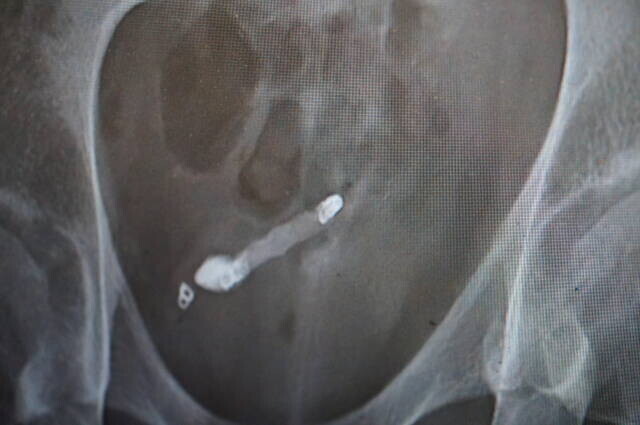
In an entry published in May 2020, a beginner asked about bladder migration after ordering the ceramic twist chip and auxiliary screw. Mr. Okada described only the main chip as lying beyond the outer urinary sphincter (the muscle before the prostate). The accessory’s intended location was before that muscle.
He accepted the customer’s request for extra safety accessories, but the diary does not record their performance in use. Mr. Okada cautioned that a stopper too close to the accessory might fail to function.
(Source: ok-lab's diary, published May 2020)
https://ok-lab.hatenablog.com/entry/2020/05/09/143600
Stopper spacing alone did not settle prostate chip position concerns
In an entry published in December 2020, a customer asked about a sea-slug-shaped version 4 chip and a stopper that moved inward. Mr. Okada’s reply discussed about 8mm or more of separation as part of a proposed arrangement. His description also depended on the stopper remaining outside the muscle, with room to move.
He did not describe spacing alone as sufficient protection. He warned that a stopper caught in the muscle could travel inward with the main chip.
(Source: ok-lab's diary, published December 2020)
https://ok-lab.hatenablog.com/entry/2020/12/12/124126
Guide-wire estimates described prostate chip position for a specific blue model
In an entry published in September 2021, Mr. Okada described a 15mm introductory blue-resin chip and a hooked guide wire (a placement aid). He associated the wire’s first stimulus point with the outer sphincter. His account put the inner sphincter about 30mm farther on, with the chip’s resulting position 5-10mm before the bladder.
Testing also showed that the wire could catch the chip. Mr. Okada therefore withdrew the original easy-placement claim and presented it as an introductory model.
(Source: ok-lab's diary, published September 2021)
https://ok-lab.hatenablog.com/entry/2021/09/04/125843
Rear narrowing defined the basic prostate chip position in October 2021
In an entry published in October 2021, a customer asked whether a rear groove or a stopper supplied the intended hold. Mr. Okada said the basic design extended beyond the blue-resin model being discussed. He also described arrangements involving separate stoppers or screw-shaped accessories. His basic design called for the outer sphincter to grip the narrowing immediately before the rear bulge.
(Source: ok-lab's diary, published October 2021)
https://ok-lab.hatenablog.com/entry/2021/10/23/125707
Linked prostate chip position assigned its rear component to the bulbar urethra
In his February 2025 commentary, Mr. Okada described the first linked chip as lying in the prostate. The second belonged in the bulbar urethra (the wider passage before the outer sphincter).
He warned that keeping the second chip in the prostate could encourage movement toward the bladder. He emphasized that a sphincter stopper (an accessory intended to limit inward movement) could not reliably prevent that outcome.
(Source: ok-lab's diary, published February 2025)
https://ok-lab.hatenablog.com/entry/2025/02/22/122939
If you see blood in your urine, even a small amount or for the first time, do not wait and see. See a urologist right away. If you suddenly cannot urinate, or the device cannot be removed, do not try to fix it yourself. Go to a medical facility, including emergency care, immediately.
How prostate chip position changed over time

| Published | What the diary said then |
|---|---|
| Apr 2018 | Two reports described sensation disappearing after sphincter passage. |
| May 2018 | Mr. Okada described glass as much more slippery than resin. |
| Jun 2019 | Mr. Okada linked leakage to a bulky chip section preventing full muscle closure. |
| Jun 2022 | Staff warned that some blog photos showed approximate, incorrect positions. |
| Feb 2024 | Mr. Okada allowed some movement while part of the chip remained in the prostate. |
| Dec 2024 | Mr. Okada distinguished a position that lasts from one that produces sensation. |
| Mar 2025 | Mr. Okada used white-resin discoloration as a clue to bladder exposure. |
| Sep 2025 | Prototype discoloration led Mr. Okada to revise his initial location estimate. |
| Aug 2026 | Mr. Okada listed several possible locations for a chip that felt barely noticeable. |
OK Prostate Chip products related to prostate chip position

The current list contains products from these discussions, including combinations that prompted concerns about position.
Products that appear in these entries
| Product (official name) | Price incl. tax | Relation to this topic |
|---|---|---|
| Short ceramic twist chip (OKプロステートチップ 陶器素材ショートタイプ ツイスト) | ¥4,400 (about $28 at ¥156 = $1, rate as of 2026-09-04) | In April 2020, a customer questioned its position after a prickling sensation stopped. |
| Screw-shaped auxiliary chip option (スクリュー型補助チップ追加オプション) | ¥3,300 (about $21 at ¥156 = $1, rate as of 2026-09-04) | In April 2020, its possible passage beyond the sphincter prompted a warning about bladder migration. |
| Three-hole sphincter stopper (三穴方式オプションチップ(括約筋ストッパーチップ)) | ¥1,650 (about $11 at ¥156 = $1, rate as of 2026-09-04) | In May 2020, Mr. Okada accepted a beginner’s request to add this accessory after concerns about bladder migration. |
| Three-hole safety chip (三穴方式オプションチップ(セーフティチップ)) | ¥550 (about $4 at ¥156 = $1, rate as of 2026-09-04) | In May 2020, the same beginner requested this additional accessory, and Mr. Okada accepted. |
| Second-generation resin semi-long chip (OKプロステートチップ セミロングタイプ(第二世代生体適合樹脂)) | ¥6,050 (about $39 at ¥156 = $1, rate as of 2026-09-04) | In April 2026, a customer using this chip reported poor urine flow and uncertainty about its location. |
| Second-generation resin auxiliary screw option (スクリュー型補助チップ追加オプション(第二世代生体適合樹脂)) | ¥3,500 (about $22 at ¥156 = $1, rate as of 2026-09-04) | In April 2026, the customer questioned whether this accessory had also passed the outer sphincter. |
The short ceramic twist chip is listed in OK Lab’s own online store.
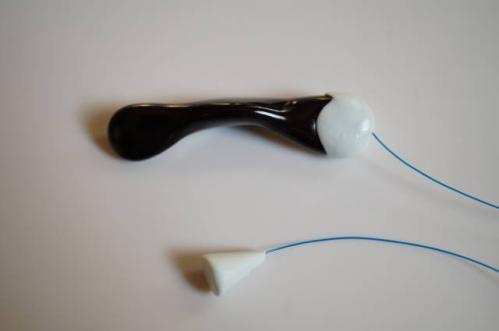
The second-generation resin semi-long chip is listed in the same store.

(Source: ok-lab's diary, published April 2020)
https://ok-lab.hatenablog.com/entry/2020/04/25/133218
(Source: ok-lab's diary, published May 2020)
https://ok-lab.hatenablog.com/entry/2020/05/09/143600
(Source: ok-lab's diary, published April 2026)
https://ok-lab.hatenablog.com/entry/2026/04/18/122906
Products the diary mentioned as alternatives
The diary names no alternative.
The second-version vibrating chip, introductory blue chip with hooked wire, and sea-slug-shaped versions 4 and 5 are historical designs discussed above. No matching product can be confirmed on the current list.
Common worries about prostate chip position

The replies describe several possible explanations for similar sensations, without confirming each customer’s location.
"Does a sharp sensation confirm prostate chip position?"
In an entry published in January 2019, a different customer asked whether a brief, distinctive feeling meant prostate contact or bladder entry. Mr. Okada thought it represented passage through the inner urinary sphincter. He considered further inward travel to be possible bladder migration.
The diary does not record confirmation of that interpretation. Mr. Okada suggested a sphincter stopper for this customer.
(Source: ok-lab's diary, published January 2019)
https://ok-lab.hatenablog.com/entry/20190112/1547275441
"Can an unseen auxiliary screw still mean correct prostate chip position?"
In an entry published in April 2026, a customer using the second-generation resin semi-long chip and matching auxiliary screw questioned their location. The customer reported poor urine flow and wondered whether the main chip had reached the bladder.
Mr. Okada said the accessory could remain before the outer sphincter yet be difficult to feel from outside. He also considered the possibility that the muscle was gripping the accessory, but did not confirm the cause of reduced flow. His reply stressed that individual differences prevented a general definition of the correct position.
(Source: ok-lab's diary, published April 2026)
https://ok-lab.hatenablog.com/entry/2026/04/18/122906
"Does resistance confirm prostate chip position?"
In an entry published in August 2026, a customer asked whether resistance on the thread meant the chip had settled correctly. Mr. Okada said resistance could occur near the prostate or with the chip entirely inside the bladder. His estimate for the prostate region was about 50mm beyond initial sphincter contact.
He associated about 100mm beyond that point with a greater likelihood of bladder migration. The diary does not record a confirmed location for this customer. Mr. Okada emphasized that resistance alone could not establish the chip’s position.
(Source: ok-lab's diary, published August 2026)
https://ok-lab.hatenablog.com/entry/2026/08/08/122906
Buying from outside Japan

OK Lab ships internationally to countries covered by Japan Post's EMS courier service. Overseas orders are paid in advance by PayPal. Each order carries a ¥400 (about $3 at ¥156 = $1, rate as of 2026-09-04) handling fee, and EMS shipping is charged on top. These terms come from OK Lab's official sales-terms page (written here as plain text, not a link: ok-lab.net/docs/law), checked on September 7, 2026; confirm them on the official store before you order, because they can change.
Summary of this article
| What you wanted to know | The answer |
|---|---|
| Can sensation confirm position? | The maker’s replies leave uncertainty. |
| What is the product? | A urethral device from Japan’s OK Lab. |
| Why distinguish the parts? | Main chips and accessories have different intended locations. |
| What happened? | Some position concerns involved bladder migration and hospital removal. |
| What did the maker propose? | Positions based on design, with limits to stopper protection. |
| What changed? | Later replies added warnings about photos and uncertain sensations. |
| What do products cost? | The table gives September 2026 list prices in yen. |
| What about common worries? | Neither sensation nor resistance confirmed each customer’s location. |
| How do overseas orders work? | Advance PayPal payment, ¥400 (about $3 at ¥156 = $1, rate as of 2026-09-04) handling, and additional EMS shipping. |
| What is the overall answer? | The diary does not confirm an individual reader’s chip position. |
Source: ok-lab's diary (Okada Comfortable Life Laboratory). The original entries are in Japanese; quotations on this page are translated. Photos and videos are on the original entries.
This article is a summary of the maker's development diary. The product is not a medical device and no result is guaranteed. If anything feels wrong or worries you, see a doctor. Prices, specifications and cautions change, so confirm the latest information on the official blog and the official site. Questions about ordering and shipping go to the seller.