![How Far Should a Prostate Chip Go? | Shallow Placement Still Carries Risks [OK Prostate Chip]](/img/a/T0095/eyecatch.svg)
This page is based on entries from "ok-lab's diary" (https://ok-lab.hatenablog.com/), the Japanese development diary written by Mr. Okada, founder of OK Lab, a small company in Japan (Okada Comfortable Life Laboratory). Only the entries about "how far to insert the chip" are summarized here, in order of publication. Past prices and sizes are as written at the time. Current prices come from the official product list (retrieved September 4, 2026). Quotations are translated from Japanese.
Note: This page is a personal reading log by someone with no connection to the maker or the seller. It reflects the source entries as of their publication dates and makes no guarantee of accuracy or safety. The product is not a medical device; talk to a doctor about any health decision. Check the official site for current information. This page contains advertising.
In short
- Shallow placement did not prevent every reported injury, and feeling comfortable did not establish the chip's location.
- Mr. Okada repeatedly favored shallower placement, while acknowledging problems with depth, shape, and movement.
- A slide-lock holder remains listed, but the latest diary replies still describe uncertainty about a chip's position.
If you see blood in your urine, even a small amount or for the first time, do not wait and see. See a urologist right away. If you suddenly cannot urinate, or the device cannot be removed, do not try to fix it yourself. Go to a medical facility, including emergency care, immediately.
About this product
The OK Prostate Chip is a small device that is placed in the urethra (the urine passage) so that it acts on the prostate; the maker sells it in several shapes, sizes and materials. It is made and sold by OK Lab (Okada Comfortable Life Laboratory), a small company in Japan, through its own online store, and prices are in Japanese yen (JPY). The maker's development diary, "ok-lab's diary", is written in Japanese. This page is an English summary of it, and every quotation is translated. OK Lab ships internationally, so readers outside Japan can order (see "Buying from outside Japan" below). Product names on this page are plain-English descriptions. The official Japanese product name is shown once in the product table so you can find the same item in the store.
Before you read: key terms
| Term | Plain-English meaning |
|---|---|
| Urethra | The passage carrying urine out of the body; the chip occupies part of this passage. |
| Sphincter | A muscle that closes a passage; the diary discusses urinary sphincters as boundaries affecting chip position and urine flow. |
| Bulbar urethra | The wider section before the sphincter in the diary's diagrams; it carries urine and features in the maker's shallow-placement proposals. |
| Retrieval thread | A thread attached to the chip for retrieval; the maker also refers to its length when discussing location. |
| External holder | A device outside the body that secures a tube or chip connection to limit movement. |
| Flexible support | A bendable urethral device discussed as a support for chip placement; its shape affected stability and urine control. |
What happens: prostate chip insertion depth
The OK Prostate Chip is a small device placed in the urethra to stimulate the prostate through the urine passage. In these entries, shallow placement means limiting how much of the device extends toward the prostate or bladder. Mr. Okada often discusses the bulbar urethra (the wider section before the sphincter, a muscle controlling urine flow) as an alternative location. His proposals aim to limit deeper contact, but the diary also records bleeding during shallow use and uncertainty about where a chip actually rests.
Linked chips made insertion depth harder to limit in January 2018
In an entry published in January 2018, Mr. Okada announced linked and long chips. The linked design measured 5cm or more, which he considered easier to advance.
He also warned that its length allowed it to reach the bladder easily. Mr. Okada did not recommend the linked design to beginners with little knowledge of the urethra.
(Source: ok-lab's diary, published January 2018)
https://ok-lab.hatenablog.com/entry/20180114/1515943724
A sharply curved chip went too deep before bleeding began
In an entry published in November 2019, Mr. Okada described testing a sharply curved combination after receiving a urologist's warning about pronounced curves. He reported bleeding from the urine opening after the entire leading chip reached the prostate and bladder region.
He suspected pressure injury, but the entry does not report a medical diagnosis. Mr. Okada later wrote that prolonged use of this combination appeared to impose a strain. His stated precaution afterward was avoiding larger chips for a while.
(Source: ok-lab's diary, published November 2019)
https://ok-lab.hatenablog.com/entry/2019/11/16/154802
Shallow placement still preceded bleeding with a long chip
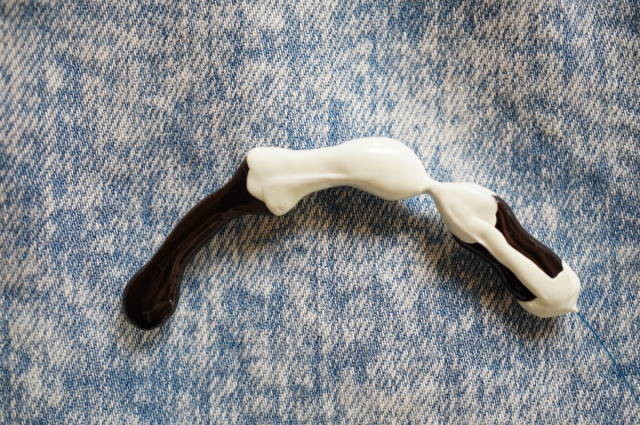
In an entry published in July 2020, a customer described 1 week of initially comfortable shallow placement with a 70mm chip. The customer attributed later bleeding during morning erections to pressure against its enlarged rear section.
As bleeding worsened, the customer stopped using it and requested shorter designs, believing roughly 20mm at the rear was excessive. The requested overall length was about 50mm. Mr. Okada began work on a custom model and considered a separate redesign with fewer bulges. The diary does not record how the requested replacements felt in use.
(Source: ok-lab's diary, published July 2020)
https://ok-lab.hatenablog.com/entry/2020/07/11/123235
A flexible support created urine leakage at its insertion depth
In an entry published in December 2022, Mr. Okada reported a problem with an accordion-shaped flexible support (a bendable urethral device). He wrote that his sphincter could not close fully around it, allowing urine to leak.
He therefore rejected that arrangement for his own continuous wear, despite finding other aspects useful. A revised arrangement separated the chip's role from the support's role around the sphincter. Mr. Okada's conclusion was that the tested flexible support was unsuitable for his intended continuous use.
(Source: ok-lab's diary, published December 2022)
https://ok-lab.hatenablog.com/entry/2022/12/24/122944
A chip stuck report prompted staff to favor shallow placement
In an entry published in May 2023, a customer reported being unable to retrieve a long curved-tail chip after half a day. The customer eventually retrieved it the following morning, after considering a visit to a urologist.
Staff explained that the combined design resisted movement and lacked the flexibility of linked chips. Mr. Okada added that its curved rear section had originally been intended as an aid outside the deeper prostate region. Staff favored a shallower position with that rear section in the bulbar urethra, describing this as comparatively safer.
(Source: ok-lab's diary, published May 2023)
https://ok-lab.hatenablog.com/entry/2023/05/06/123024
The maker's answer to prostate chip insertion depth
The maker's recurring answer combines limited depth with attention to shape, stability, and reported symptoms.
Early beginner advice treated shallow placement as a separate goal
An entry published in October 2017 placed the beginner endpoint before the urinary sphincter. Mr. Okada described the wider bulbar section as a place where the chip could remain without reaching the prostate.
Another entry published later in October 2017 returned to the same boundary. This time, he explicitly linked deeper use to confidence in safety and hygiene management. His advice for beginners favored the bulbar region until they had that knowledge.
(Source: ok-lab's diary, published October 2017)
https://ok-lab.hatenablog.com/entry/20171008/1507448709
(Source: ok-lab's diary, published October 2017)
https://ok-lab.hatenablog.com/entry/20171022/1508644866
Bleeding prompted questions about insertion depth, size, and medical assessment
In an entry published in May 2022, a customer reported bleeding after three consecutive uses of longer chips, with almost no pain. The customer said bleeding had stopped after changing to a semi-long model.
Mr. Okada considered bladder contact a possibility, while acknowledging that he lacked personal experience of the suspected problem. His proposed explanation considered depth first and size second; the entry does not establish either as the cause. The diary does not record a later medical assessment or further results from this customer. Mr. Okada advised seeking a doctor's judgment if bleeding was continuing.
(Source: ok-lab's diary, published May 2022)
https://ok-lab.hatenablog.com/entry/2022/05/14/123043
Shallow placement separated the fixed support's role from its connected chip
In an entry published in April 2023, Mr. Okada discussed a fixed support paired with a flexible chip connection. His preferred arrangement kept the rigid support in the bulbar region, while the connected chip served a different position.
He cautioned that testing had been brief and that short attached chips might not reach the prostate. Among the possibilities, he mentioned a long ceramic four-point twist chip as a simpler single-piece option. For readers considering the equipment, he favored the ordinary support over his complicated urine-collection version.
(Source: ok-lab's diary, published April 2023)
https://ok-lab.hatenablog.com/entry/2023/04/15/123038
An external holder was intended to keep shallow placement stable
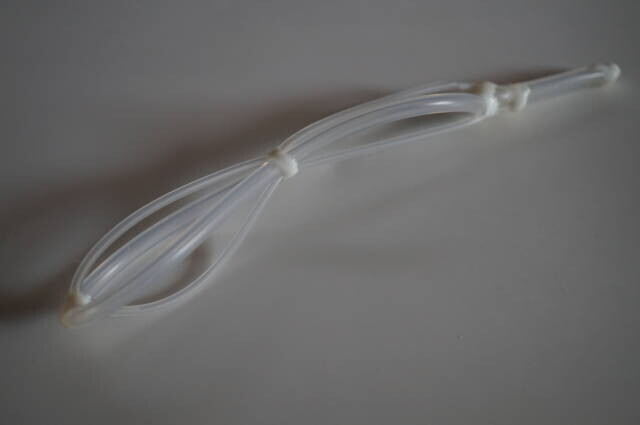
In an entry published in October 2023, Mr. Okada tested a 4mm silicone tube with a brushlike tip divided into 16 sections. He described an external holder (a device securing the connection outside the body) as preventing inward movement in the shallow configuration.
He also warned that reaching the bladder could cause urine to escape. Mr. Okada's preferred beginner arrangement kept the tube short of the sphincter.
(Source: ok-lab's diary, published October 2023)
https://ok-lab.hatenablog.com/entry/2023/10/28/122832

If you see blood in your urine, even a small amount or for the first time, do not wait and see. See a urologist right away. If you suddenly cannot urinate, or the device cannot be removed, do not try to fix it yourself. Go to a medical facility, including emergency care, immediately.
How prostate chip insertion depth changed over time
| Published | What the diary said then |
|---|---|
| Oct 2017 | Mr. Okada proposed bulbar placement for dribbling after urination, without reaching the prostate. |
| Jan 2019 | Mr. Okada suspected bladder-side sphincter irritation in his discomfort during prolonged long-chip use. |
| Jun 2021 | A titanium design offered several recesses for different positions around the sphincter. |
| Aug 2022 | Mr. Okada cautioned against prolonged silicone-tube contact with the sphincter. |
| Dec 2022 | A planned tube version replaced the ceramic tip with perforated resin and adjustable length. |
| Nov 2023 | Mr. Okada expected the gourd-shaped support's expanding end to limit deeper movement. |
| Jul 2025 | Mr. Okada recommended an adjustable connection and shape-memory holder for a customer's preferred position. |
| Nov 2025 | A more comfortable shallow loop prototype was still abandoned because insertion remained too difficult. |
OK Prostate Chip products related to prostate chip insertion depth
The current list includes a holder from the shallow-placement discussion and a ceramic chip mentioned as an alternative.
Products that appear in these entries
| Product (official name) | Price incl. tax | Relation to this topic |
|---|---|---|
| Slide-lock external holder (スライドロック式尿道ゲートキーパー) | ¥6,600 (about $42 at ¥156 = $1, rate as of 2026-09-04) | In October 2023, Mr. Okada tested this holder with a shallow tube and credited it with preventing inward movement. |
(Source: ok-lab's diary, published October 2023)
https://ok-lab.hatenablog.com/entry/2023/10/28/122832

Products the diary mentioned as alternatives
| Product (official name) | Price incl. tax | Relation to this topic |
|---|---|---|
| Long ceramic four-point twist chip (OKプロステートチップ 陶器素材ロングタイプ 4点ツイスト) | ¥7,700 (about $49 at ¥156 = $1, rate as of 2026-09-04) | In April 2023, Mr. Okada suggested this longer chip when shorter attachments might not reach the prostate; testing was still brief. |
(Source: ok-lab's diary, published April 2023)
https://ok-lab.hatenablog.com/entry/2023/04/15/123038
The diary also discusses curved combinations, shortened chips, flexible supports, gourd-shaped supports, and curved-tail chips.
Common worries about prostate chip insertion depth
The later questions show that sensation and resistance did not give the maker a definite location for each customer's chip.
"Could weak sensation mean my chip is too deep?"
In an entry published in May 2025, a customer asked whether weak sensation meant the chip was too shallow or too deep. The customer had been using a separate urethral support to advance it.
Mr. Okada acknowledged that this made depth difficult to judge and that a chip could accidentally enter the bladder. He also thought the customer's level of arousal could affect sensation. The diary does not record the customer's eventual chip position or outcome. His caution concerned the uncertainty of judging depth with that separate support.
(Source: ok-lab's diary, published May 2025)
https://ok-lab.hatenablog.com/entry/2025/05/31/122940
"Could my semi-long chip go too deep during use?"
In an entry published in July 2026, a customer in Austria asked about a large semi-long chip and feared reaching the bladder. Mr. Okada thought finger pressure could allow slight entry, but would not send the whole semi-long chip into the bladder.
The same reply acknowledged that erections could move a chip toward the bladder during prolonged wear. He also described an initial sensation of bladder entry that could fade with time. The diary does not confirm where this customer's chip actually rested. Mr. Okada advised understanding the anatomy when considering position.
(Source: ok-lab's diary, published July 2026)
https://ok-lab.hatenablog.com/entry/2026/07/18/122919
"Does no sensation mean the chip is too deep?"
In an entry published in August 2026, a customer asked whether little sensation and resistance to retrieval meant successful placement. Mr. Okada offered several possibilities: a recess fitting around the sphincter, passage beyond it, or complete entry into the bladder.
He said resistance to retrieval could also occur with a chip entirely inside the bladder. He therefore did not identify the customer's location from sensation alone. His reply discussed the retrieval thread (the thread attached for taking the chip out) as another clue. Mr. Okada's suggested assessment considered thread length as well as sensation, but the entry contains no confirmed location.
(Source: ok-lab's diary, published August 2026)
https://ok-lab.hatenablog.com/entry/2026/08/08/122906
Buying from outside Japan
OK Lab ships internationally to countries covered by Japan Post's EMS courier service. Overseas orders are paid in advance by PayPal. Each order carries a ¥400 (about $3 at ¥156 = $1, rate as of 2026-09-04) handling fee, and EMS shipping is charged on top. These terms come from OK Lab's official sales-terms page (written here as plain text, not a link: ok-lab.net/docs/law), checked on September 7, 2026; confirm them on the official store before you order, because they can change.
Summary of this article
| What you wanted to know | The answer |
|---|---|
| What is the short answer? | Shallower placement appears throughout the diary, alongside injuries and uncertainty about position. |
| What is this product? | A urethral device made by OK Lab in Japan, with prices in JPY. |
| Which terms matter? | The urethra, sphincter, bulbar region, retrieval thread, and supports describe different parts of the discussion. |
| What happened in practice? | Reports included bleeding, leakage, and a chip that became difficult to retrieve. |
| What did the maker propose? | Limited depth, different support arrangements, and medical assessment for continuing bleeding. |
| What changed over time? | The diary moved from shallow-placement proposals to adjustable connections and revised support designs. |
| Which listed products relate? | The slide-lock holder and long ceramic four-point twist chip appear in the relevant discussions. |
| Can sensation establish depth? | The maker's later replies described several possible locations without confirming the customers' actual positions. |
| How do overseas orders work? | Advance PayPal payment, a ¥400 (about $3 at ¥156 = $1, rate as of 2026-09-04) handling fee, and additional EMS shipping. |
Source: ok-lab's diary (Okada Comfortable Life Laboratory). The original entries are in Japanese; quotations on this page are translated. Photos and videos are on the original entries.
This article is a summary of the maker's development diary. The product is not a medical device and no result is guaranteed. If anything feels wrong or worries you, see a doctor. Prices, specifications and cautions change, so confirm the latest information on the official blog and the official site. Questions about ordering and shipping go to the seller.