![How long does insertion take? | Personal reports vary widely [OK Prostate Chip]](/img/a/T0083/eyecatch.svg)
This page is based on entries from "ok-lab's diary" (https://ok-lab.hatenablog.com/), the Japanese development diary written by Mr. Okada, founder of OK Lab, a small company in Japan (Okada Comfortable Life Laboratory). Only the entries about "insertion time" are summarized here, in order of publication. Past prices and sizes are as written at the time. Current prices come from the official product list (retrieved September 4, 2026). Quotations are translated from Japanese.
Note: This page is a personal reading log by someone with no connection to the maker or the seller. It reflects the source entries as of their publication dates and makes no guarantee of accuracy or safety. The product is not a medical device; talk to a doctor about any health decision. Check the official site for current information. This page contains advertising.
In short
Reported insertion times range from seconds to over an hour, and some attempts ended unsuccessfully.
Mr. Okada discusses lubrication, fit, and design changes, but his replies establish no universal insertion time.
The current list includes the single-chip glass model and short ceramic vibrating chip discussed below.
If you see blood in your urine, even a small amount or for the first time, do not wait and see. See a urologist right away.
If you suddenly cannot urinate, or the device cannot be removed, do not try to fix it yourself. Go to a medical facility, including emergency care, immediately.
About this product
The OK Prostate Chip is a small device that is placed in the urethra (the urine passage) so that it acts on the prostate; the maker sells it in several shapes, sizes and materials. It is made and sold by OK Lab (Okada Comfortable Life Laboratory), a small company in Japan, through its own online store, and prices are in Japanese yen (JPY). The maker's development diary, "ok-lab's diary", is written in Japanese. This page is an English summary of it, and every quotation is translated. OK Lab ships internationally, so readers outside Japan can order (see "Buying from outside Japan" below). Product names on this page are plain-English descriptions. The official Japanese product name is shown once in the product table so you can find the same item in the store.
Before you read: key terms
| Term | Plain-English meaning |
|---|---|
| Urethra | The urine passage; the chip travels through it toward the prostate. |
| Retrieval thread | A line attached to a chip, intended for removal. |
| Resin | Material used to form chips and coat components; the entries discuss its resistance against tissue. |
| Cable stopper | An attachment on a device's cable, intended to help keep the device positioned. |
| Shape-memory wire | Wire intended to hold a preset shape, used in supports and loops. |
| Jointed shaft | Connected, resin-covered segments containing wire and nylon, developed to help advance a device. |
What happens: prostate chip insertion time
The OK Prostate Chip is a small device placed in the urethra (the urine passage) to act on the prostate. Insertion time describes how long placement takes, from the opening at the penis toward the intended position near the prostate. The entries describe delays along this route, including difficulty at a curve and resistance from different device shapes. Their timings come from individual customer reports and Mr. Okada's own tests.
One glass-chip user reported shorter insertion time after earlier difficulty
In an entry published in March 2018, a single-chip glass model user reported spending 30-40 minutes struggling at a curve. Later attempts brought the overall insertion time to around 10 minutes, with less discomfort afterward.
These were the customer's observations following changes in approach. The diary does not record a direct reply to this customer's timing report.
(Source: ok-lab's diary, published March 2018)
https://ok-lab.hatenablog.com/entry/20180310/1520672565
A cable stopper increased insertion time in Mr. Okada's July tests
In an entry published in July 2019, Mr. Okada compared a cable stopper with an ordinary chip. He reported about 5 minutes for the stopper, versus about 1 minute for the chip.
The planned price was ¥1,500 (about $10 at ¥156 = $1, rate as of 2026-09-04) excluding tax, with M at 9 mm and L around 11 mm. Mr. Okada cautioned that the cable stopper could slow urination compared with the version for nylon thread.
(Source: ok-lab's diary, published July 2019)
https://ok-lab.hatenablog.com/entry/2019/07/06/152113
Prolonged insertion time preceded suspected bleeding reported by a resin-chip customer
In an entry published in May 2020, a resin two-chip user asked about stalled progress and another attempt after injury. After about 1 hour, the removed device had material on it that looked like blood. Staff could not establish the first chip's position from the information supplied and gave no definite recovery interval.
Staff emphasized lubrication and described ceramic and glass as smoother against tissue than resin. A follow-up reported successful placement despite continuing pain. When asked about another product, staff declined to recommend one particular choice because customers' preferences differed.
(Source: ok-lab's diary, published May 2020)
https://ok-lab.hatenablog.com/entry/2020/05/23/132040
Slow insertion persisted with a custom design Mr. Okada would not recommend
In an entry published in August 2022, a customer reported roughly 30 minutes for a combined sea-slug-shaped custom chip, Ver.4+5. A trial involving a catheter, discussed as a tubular insertion aid, had also failed.
The customer nevertheless described stable placement once the chip was in position. Mr. Okada said the shape and size were beyond what he would attempt. He did not recommend it, expressing concern about pressure inside the bladder.
(Source: ok-lab's diary, published August 2022)
https://ok-lab.hatenablog.com/entry/2022/08/13/122909
An adjustable loop increased insertion time despite making removal easier
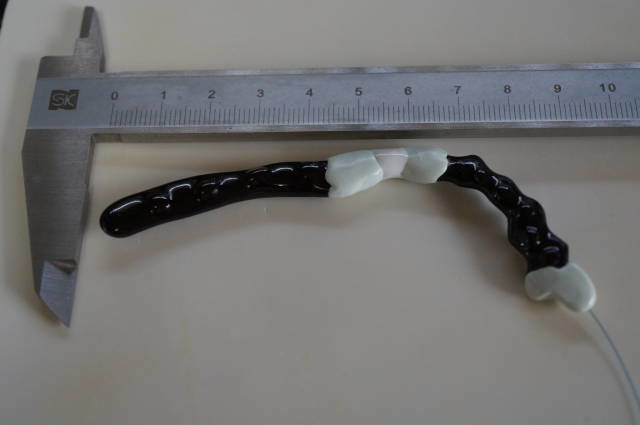
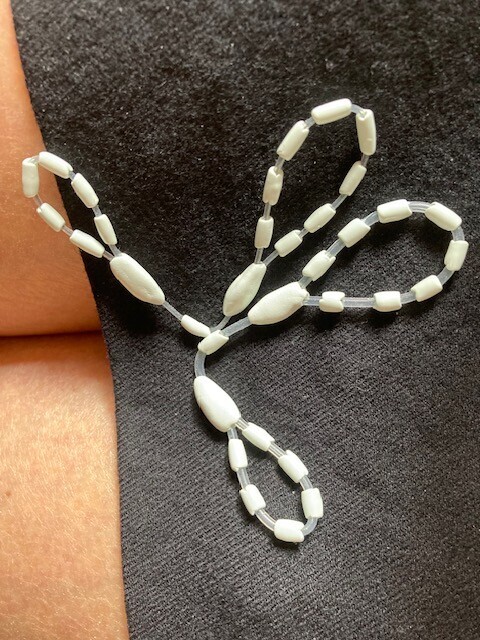
In an entry published in November 2025, Mr. Okada tested an adjustable loop that remained open during insertion. He reported more than 5 minutes, compared with 1-2 minutes without that loop arrangement. He attributed the delay to the open loop's resistance, although he found removal easier.
The sliding resin attachment held the loop across the main shaft and cost an additional ¥1,000 (about $6 at ¥156 = $1, rate as of 2026-09-04) excluding tax. Mr. Okada suggested lubrication might help, without reporting a timed comparison.
(Source: ok-lab's diary, published November 2025)
https://ok-lab.hatenablog.com/entry/2025/11/08/122932
The maker's answer to prostate chip insertion time
Mr. Okada's responses address material, construction, and individual fit; they do not establish a time everyone should expect.
Mr. Okada's slow insertion advice differed between resin and glass
In an entry published in October 2017, Mr. Okada said dryness varied with a person's condition. His lubrication advice associated lotion with resin chips. For glass, he regarded water as a possible lubricant, based on his own experience.
(Source: ok-lab's diary, published October 2017)
https://ok-lab.hatenablog.com/entry/20171019/1508375473
Slow insertion prompted a custom vibration design after an initial refusal
In an entry published in April 2025, a customer wanted quicker placement and proposed adapting the short ceramic vibrating chip. Staff initially said the proposed combination of cable and shape-memory wire was difficult to make. Mr. Okada then developed a prototype joined at only two points, allowing separate cable and wire movement elsewhere.
Published prices were ¥11,000 (about $70 at ¥156 = $1, rate as of 2026-09-04) excluding tax for the minimum example and ¥16,500 (about $106 at ¥156 = $1, rate as of 2026-09-04) excluding tax for the fully equipped prototype. The diary does not record the customer's results with that prototype. Mr. Okada cautioned that closely combining the materials as originally requested was beyond his workshop's methods.
(Source: ok-lab's diary, published April 2025)
https://ok-lab.hatenablog.com/entry/2025/04/26/122909
A jointed shaft reduced insertion time in the maker's prototype tests
In an entry published in November 2025, Mr. Okada reported about 1 minute for each of three jointed-shaft prototypes. The shaft's resin-covered wire-and-nylon segments measured 20 mm long and about 4 mm wide, with a maximum of 12 units.
Published shaft prices excluding tax were ¥1,000 (about $6 at ¥156 = $1, rate as of 2026-09-04) through 6 units, or ¥1,500 (about $10 at ¥156 = $1, rate as of 2026-09-04) through 12 units. Resin coating added ¥500 (about $3 at ¥156 = $1, rate as of 2026-09-04) for 1 unit, also excluding tax. Mr. Okada cautioned that easier insertion also came with weaker retention.
(Source: ok-lab's diary, published November 2025)
https://ok-lab.hatenablog.com/entry/2025/11/29/122908
Slow insertion postponed the beaded prototype's planned release in March
In an entry published in March 2026, Mr. Okada described unexpected difficulty with a beaded wire prototype. Even the 1 mm tube version took more than 10 minutes to reach the prostate. He postponed the planned launch to continue development.
A further entry published in March 2026 reported only a small time reduction with a revised insertion aid. Mr. Okada still described substantial resistance from the beads. The diary does not say what the current state is.
(Source: ok-lab's diary, published March 2026)
https://ok-lab.hatenablog.com/entry/2026/03/07/122907
(Source: ok-lab's diary, published March 2026)
https://ok-lab.hatenablog.com/entry/2026/03/14/122910
If you see blood in your urine, even a small amount or for the first time, do not wait and see. See a urologist right away.
If you suddenly cannot urinate, or the device cannot be removed, do not try to fix it yourself. Go to a medical facility, including emergency care, immediately.
How prostate chip insertion time changed over time
| Published | What the diary said then |
|---|---|
| Oct 2017 | A beginner reported 30-second passage along the urethra, but had not completed placement. |
| May 2018 | A long-chip user estimated 90 minutes initially, then 30 minutes on the third day. |
| Oct 2020 | An unglazed prototype initially resisted movement, then became slippery as moisture accumulated. |
| Apr 2021 | Mr. Okada reported 5-second placement with a smoothly finished silver prototype. |
| Jun 2024 | A thinner custom motor design measured 11 mm wide and 6.5 mm thick. |
| Apr 2026 | A long-chip user reported 30-second placement and an inward-moving stopper that was recovered. |
OK Prostate Chip products related to prostate chip insertion time
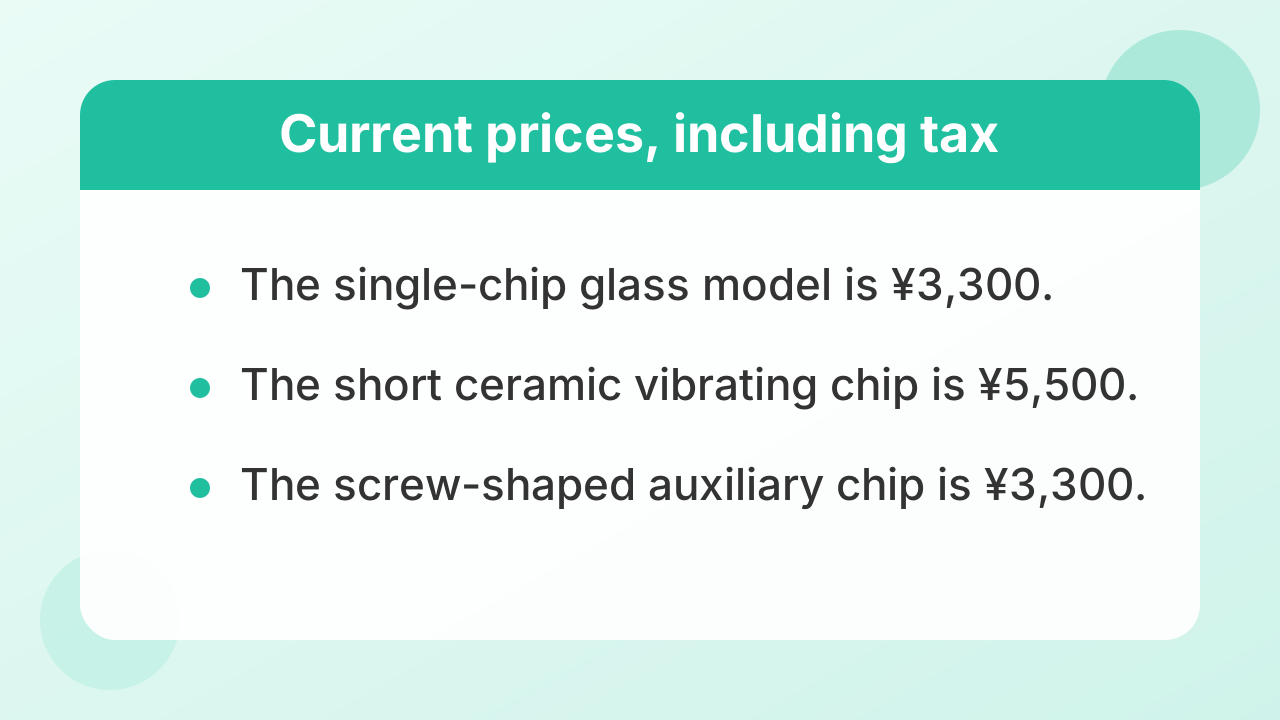
The current list includes products discussed in these exchanges; the custom prototypes carry separate historical prices.
Products that appear in these entries
| Product (official name) | Price incl. tax | Relation to this topic |
|---|---|---|
| Single-chip glass model (OKプロステートチップ ガラス素材1チップタイプ) | ¥3,300 (about $21 at ¥156 = $1, rate as of 2026-09-04) | In March 2018, its user reported shorter insertion time after earlier difficulty at a curve. |
| Short ceramic vibrating chip (OKプロステート核振チップ 陶器素材ショートタイプ) | ¥5,500 (about $35 at ¥156 = $1, rate as of 2026-09-04) | In April 2025, a customer selected this base product when requesting a custom design for quicker placement. |
(Source: ok-lab's diary, published March 2018)
https://ok-lab.hatenablog.com/entry/20180310/1520672565
(Source: ok-lab's diary, published April 2025)
https://ok-lab.hatenablog.com/entry/2025/04/26/122909
Products the diary mentioned as alternatives
| Product (official name) | Price incl. tax | Relation to this topic |
|---|---|---|
| Screw-shaped auxiliary chip (スクリュー型補助チップ追加オプション) | ¥3,300 (about $21 at ¥156 = $1, rate as of 2026-09-04) | In December 2019, staff suggested this add-on instead of a semi-long chip alone, citing easier insertion and less slipping. |
(Source: ok-lab's diary, published December 2019)
https://ok-lab.hatenablog.com/entry/2019/12/28/131319
Historical cable stopper, modified motor chip, and combined sea-slug-shaped custom chip: No matching product can be confirmed on the current list.
Adjustable loop, jointed shaft, and custom vibration prototype: No matching product can be confirmed on the current list.
Unglazed, silver, beaded-wire, and thinner custom motor prototypes: No matching product can be confirmed on the current list.
Common worries about prostate chip insertion time
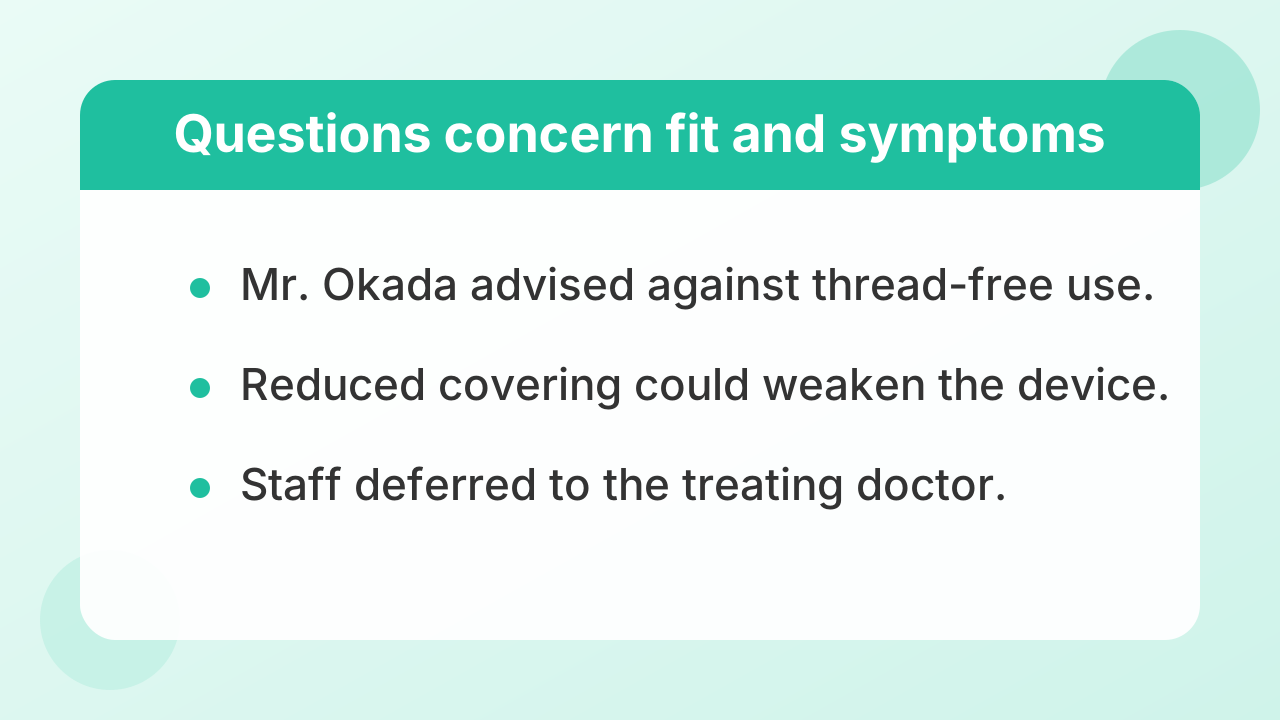
The customer questions concern the retrieval thread, physical fit, and symptoms following an unsuccessful attempt.
"Does the retrieval thread make insertion take longer?"
In an entry published in February 2018, a customer said a thread-free short chip reached the prostate within minutes. They asked whether a long chip could also be used without its retrieval thread. Mr. Okada replied that he could place any chip with its thread in about 1 minute.
The same customer later reported being unable to remove the short chip; it came out the next morning. Mr. Okada advised against thread-free use, particularly with the long design.
(Source: ok-lab's diary, published February 2018)
https://ok-lab.hatenablog.com/entry/20180214/1518601774
"Can a thinner chip fix slow insertion?"
In an entry published in August 2019, a customer requested a thinner motor chip after an unsuccessful attempt lasting nearly 1 hour, despite ample lubricant. The chip contained an 8 mm motor, and the customer identified thickness as the difficulty.
Mr. Okada explained that the motor was about 4 mm thick, increasing to around 6 mm with its resin covering. He offered workshop reworking and later reported a finished thickness of 5 mm. The diary does not record whether the modified chip subsequently fitted. Mr. Okada warned that reduced covering could weaken the device and that long-term durability was not guaranteed.
(Source: ok-lab's diary, published August 2019)
https://ok-lab.hatenablog.com/entry/2019/08/10/125102
"What if slow insertion ends with painful urination?"
In an entry published in July 2023, a customer outside Japan reported abandoning an attempt after 40 minutes. They described painful urination afterward and a hospital diagnosis of inflammation in the urine passage.
Staff suspected unsuitable sizing and opposed reuse of the item purchased through Amazon, an online marketplace. They also suggested cancelling a separate vibrating-product order; the diary does not record whether it was cancelled.
The customer clarified that they had chosen the smallest listed size and asked what had caused the symptoms. Staff acknowledged limited medical knowledge and deferred to the treating doctor, while mentioning smaller sizes only as a conditional alternative.
(Source: ok-lab's diary, published July 2023)
https://ok-lab.hatenablog.com/entry/2023/07/08/122632
Buying from outside Japan
OK Lab ships internationally to countries covered by Japan Post's EMS courier service. Overseas orders are paid in advance by PayPal. Each order carries a ¥400 (about $3 at ¥156 = $1, rate as of 2026-09-04) handling fee, and EMS shipping is charged on top. These terms come from OK Lab's official sales-terms page (written here as plain text, not a link: ok-lab.net/docs/law), checked on September 7, 2026; confirm them on the official store before you order, because they can change.
Summary of this article
| What you wanted to know | The answer |
|---|---|
| What is the short answer? | Reported times vary widely, including unsuccessful attempts. |
| What is the product? | A urethral device made by OK Lab in Japan. |
| What do the terms mean? | Threads support retrieval; stoppers and shafts serve different positioning roles. |
| What caused reported delays? | Customers and Mr. Okada described curves, thickness, and resistance from particular shapes. |
| What did the maker propose? | Material-specific lubrication advice, workshop changes, and redesigned prototypes. |
| Did insertion become consistently faster? | Later entries still recorded difficult placement and a postponed prototype launch. |
| What do listed products cost? | The glass model is ¥3,300 (about $21 at ¥156 = $1, rate as of 2026-09-04); the short ceramic vibrating chip is ¥5,500, (about $35 at ¥156 = $1, rate as of 2026-09-04) including tax. |
| What concerns accompanied slow insertion? | Reports included suspected bleeding, painful urination, and difficulty removing a thread-free chip. |
| How do overseas orders work? | Advance PayPal payment, a ¥400 (about $3 at ¥156 = $1, rate as of 2026-09-04) handling fee, and additional EMS shipping charges. |
Source: ok-lab's diary (Okada Comfortable Life Laboratory). The original entries are in Japanese; quotations on this page are translated. Photos and videos are on the original entries.
This article is a summary of the maker's development diary. The product is not a medical device and no result is guaranteed. If anything feels wrong or worries you, see a doctor. Prices, specifications and cautions change, so confirm the latest information on the official blog and the official site. Questions about ordering and shipping go to the seller.