![Does lubricant make my chip slip out? | The maker reports a trade-off [OK Prostate Chip]](/img/a/T0072/eyecatch.svg)
This page is based on entries from "ok-lab's diary" (https://ok-lab.hatenablog.com/), the Japanese development diary written by Mr. Okada, founder of OK Lab, a small company in Japan (Okada Comfortable Life Laboratory). Only the entries about lubricant and chips that slip out are summarized here, in order of publication. Past prices and sizes are as written at the time. Current prices come from the official product list (retrieved September 4, 2026). Quotations are translated from Japanese.
Note: This page is a personal reading log by someone with no connection to the maker or the seller. It reflects the source entries as of their publication dates and makes no guarantee of accuracy or safety. The product is not a medical device; talk to a doctor about any health decision. Check the official site for current information. This page contains advertising.
In short
- The diary describes easier movement and unwanted slipping as two sides of the same problem.
- Mr. Okada's answers depended on material, moisture, shape and support.
- Current products include models discussed here, but the diary also records failed and unfinished designs.
If you see blood in your urine, even a small amount or for the first time, do not wait and see. See a urologist right away. If you suddenly cannot urinate, or the device cannot be removed, do not try to fix it yourself. Go to a medical facility, including emergency care, immediately.
About this product
The OK Prostate Chip is a small device that is placed in the urethra (the urine passage) so that it acts on the prostate; the maker sells it in several shapes, sizes and materials. It is made and sold by OK Lab (Okada Comfortable Life Laboratory), a small company in Japan, through its own online store, and prices are in Japanese yen (JPY).
The maker's development diary, "ok-lab's diary", is written in Japanese. This page is an English summary of it, and every quotation is translated.
OK Lab ships internationally, so readers outside Japan can order (see "Buying from outside Japan" below). Product names on this page are plain-English descriptions. The official Japanese product name is shown once in the product table so you can find the same item in the store.
Before you read: key terms
| Term | Plain-English meaning |
|---|---|
| Urethra | The urine passage; it carries urine and is where these devices are placed. |
| Lubricant | Lotion or other moisture used to reduce friction around the device. |
| Sphincter | A muscle ring around the urine passage; the diary discusses it as a possible holding point. |
| Stopper | An additional device part intended to limit unwanted movement; the entries describe different designs. |
| Epoxy | A resin used to cover surfaces or join parts; the beaded prototype used it around tubing. |
| 4-line support cable | Paired cables reinforced with supporting wires, developed to help hold a chip in position. |
| Micro prostate bougie | A thin instrument intended to stimulate the area around the prostate. |
What happens: chip slipping out
The OK Prostate Chip is a small device placed in the urethra (the urine passage) to act on the prostate. Lubricant is the lotion or moisture around the chip that reduces friction as it moves through that passage. The diary describes a recurring trade-off: easier movement can come with difficulty keeping a chip in position. Mr. Okada links slipping to moisture, material and the device's shape or support.
Without lubricant, a beginner reported resistance before meaningful progress
In an entry published in October 2017, a beginner on the staff described difficulty getting started. The staff member reported less than 5 mm of progress without lotion because of discomfort. Lotion helped with initial progress, but the wider account still described difficulty and eventual expulsion during urination.
Mr. Okada wrote that slippery body fluids could make a chip move inward easily and also come out easily. He considered lubricant safer for dry resin, while treating water as sufficient for glass in his own experience.
(Source: ok-lab's diary, published October 2017)
https://ok-lab.hatenablog.com/entry/20171019/1508375473
Chip slipping defeated an early stopper and challenged its name
In an entry published in June 2018, a customer testing a stopper reported that it followed the main chip inward. With zero spacing, the stopper remained lengthwise instead of stopping the movement. The customer concluded that a gap of at least 1–2 mm was necessary in that test.
Mr. Okada said this failure required a fundamental rethink of the planned patent application. He also cautioned that the failed design might no longer deserve its name as a sphincter stopper.
(Source: ok-lab's diary, published June 2018)
https://ok-lab.hatenablog.com/entry/20180616/1529136608
Lubricant eased placement, but the larger linked chip kept slipping
In an entry published in April 2019, a customer described difficult placement with a larger custom linked pair. Mr. Okada suggested that lubricant might address the resistance. The customer's follow-up said lubricant made placement possible, but the chip then slipped back through the sphincter more readily.
The account also included pain and bleeding, alongside a request for a custom screw-shaped chip. For that proposed shape, Mr. Okada cautioned that removing its narrow middle might increase contact with the passage lining and therefore friction.
(Source: ok-lab's diary, published April 2019)
https://ok-lab.hatenablog.com/entry/2019/04/13/150233
A chip slipping out struck the toilet and broke
In an entry published in October 2019, a customer compared a short ceramic chip with a single resin screw chip. The customer found the ceramic surface smoother and reported having stopped using added lubricant. During urination, the short ceramic chip flew out, hit the toilet and broke in half.
Mr. Okada replied that a ceramic improvement introduced that week had increased strength, although comparative impact testing remained limited. He cautioned that resistance to impact depended on where the ceramic was struck.
(Source: ok-lab's diary, published October 2019)
https://ok-lab.hatenablog.com/entry/2019/10/05/141806
A ceramic pair proved too slippery for stable positioning during testing
In an entry published in March 2024, Mr. Okada tested ceramic chips connected by an elastic wire. He reported that very little force moved the assembly more than 3 cm toward the bladder. He attributed the unexpected movement to smooth ceramic and the absence of rubber around the connection.
His account described an external stopper as the support then limiting inward movement. He questioned the design's suitability for staying in a fixed position and said further wire and connection tests were needed before sales began.
(Source: ok-lab's diary, published March 2024)
https://ok-lab.hatenablog.com/entry/2024/03/16/123023
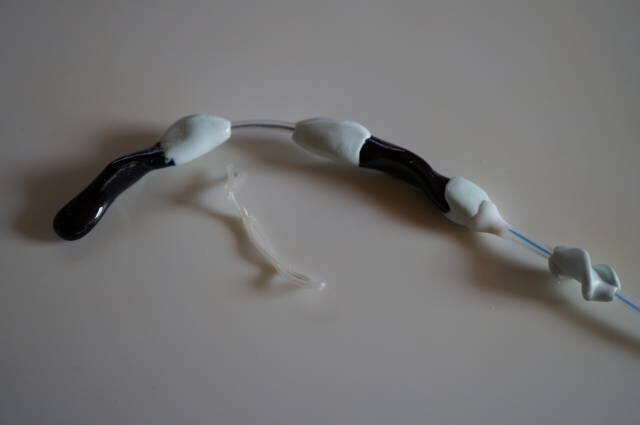
An epoxy prototype stayed put but remained difficult without lubricant
In entries published in March 2026, Mr. Okada described a loop prototype covered with epoxy beads (small sections of resin around tubing). Without lubricant, he found more resistance from the beads than from the tubing he had expected them to improve upon. His later explanation focused on the expanding wire pressing the beads into the passage lining.
He nevertheless reported excellent stability once the prototype was in position. He postponed offering it to customers until he could improve the difficult placement.
(Source: ok-lab's diary, published March 2026)
https://ok-lab.hatenablog.com/entry/2026/03/07/122907
(Source: ok-lab's diary, published March 2026)
https://ok-lab.hatenablog.com/entry/2026/03/14/122910
The maker's answer to chip slipping out
Mr. Okada explored material choices, supporting cables and adjustable loops, with different limitations appearing in each design.
A linked resin design offered an alternative without lubricant
In an entry published in January 2018, Mr. Okada announced a linked resin pair after a customer raised concerns about glass breaking. He could not guarantee that glass would never break, and his resin-pair tests had succeeded without lotion.
The planned price comprised resin chips at ¥1,000 (about $6 at ¥156 = $1, rate as of 2026-09-04) × 2 and thread connections at ¥1,000 (about $6 at ¥156 = $1, rate as of 2026-09-04) × 2. The entry stated a total of ¥4,000 (about $26 at ¥156 = $1, rate as of 2026-09-04) excluding tax. Mr. Okada recommended the resin option for short-duration use.
(Source: ok-lab's diary, published January 2018)
https://ok-lab.hatenablog.com/entry/20180121/1516504265
Cable support helped hold chips previously considered too slippery
In an entry published in March 2022, Mr. Okada described chips whose ends lacked a resin coating. He considered their smoothness a drawback because they were difficult to hold near the prostate. He then reported stable positioning with a 4-line support cable (paired cables reinforced by supporting wires).
According to his account, the added support changed what this slippery design could do. He proposed cable support as a way to hold the chip while allowing limited movement around the chosen position.
(Source: ok-lab's diary, published March 2022)
https://ok-lab.hatenablog.com/entry/2022/03/26/123336
An adjustable loop reduced chip slipping but increased resistance
In an entry published in November 2025, Mr. Okada reported revising an adjustable loop after an earlier arrangement slipped out during urination. The revised design used a loop crossing the main shaft, held by a sliding resin connection. He reported no movement during urination, but placement took about 5 times as long.
The additional charge for that crossed, sliding connection was ¥1,000 (about $6 at ¥156 = $1, rate as of 2026-09-04) excluding tax, as published in November 2025. Mr. Okada thought lubricant might make placement easier, while making clear that his own test had been without it.
(Source: ok-lab's diary, published November 2025)
https://ok-lab.hatenablog.com/entry/2025/11/08/122932
The micro bougie claim about going without lubricant was design-specific
In an entry published in May 2026, Mr. Okada described a micro prostate bougie (a thin instrument intended for stimulation near the prostate). It combined a 1 mm tube shaft with 30-micron wires. He reported little resistance and attributed easier movement to water remaining on the device.
The 25 cm shaft was ¥3,000 (about $19 at ¥156 = $1, rate as of 2026-09-04), and the 8 cm fine-wire section was ¥8,000 (about $51 at ¥156 = $1, rate as of 2026-09-04), excluding tax. The diary's stated total was ¥11,000 (about $70 at ¥156 = $1, rate as of 2026-09-04) excluding tax, as published in May 2026. Mr. Okada's conclusion that lubricant was unnecessary concerned the 1 mm tube with a wire core.
(Source: ok-lab's diary, published May 2026)
https://ok-lab.hatenablog.com/entry/2026/05/23/122904
If you see blood in your urine, even a small amount or for the first time, do not wait and see. See a urologist right away. If you suddenly cannot urinate, or the device cannot be removed, do not try to fix it yourself. Go to a medical facility, including emergency care, immediately.
How chip slipping out changed over time
| Published | What the diary said then |
|---|---|
| Oct 2017 | Mr. Okada distinguished dry resin from wet glass when discussing lubrication. |
| Jan 2018 | Linked resin chips received a 2 mm gap because of concerns about exposed-thread irritation. |
| Jun 2018 | A failed stopper test prompted reconsideration of its name and planned patent. |
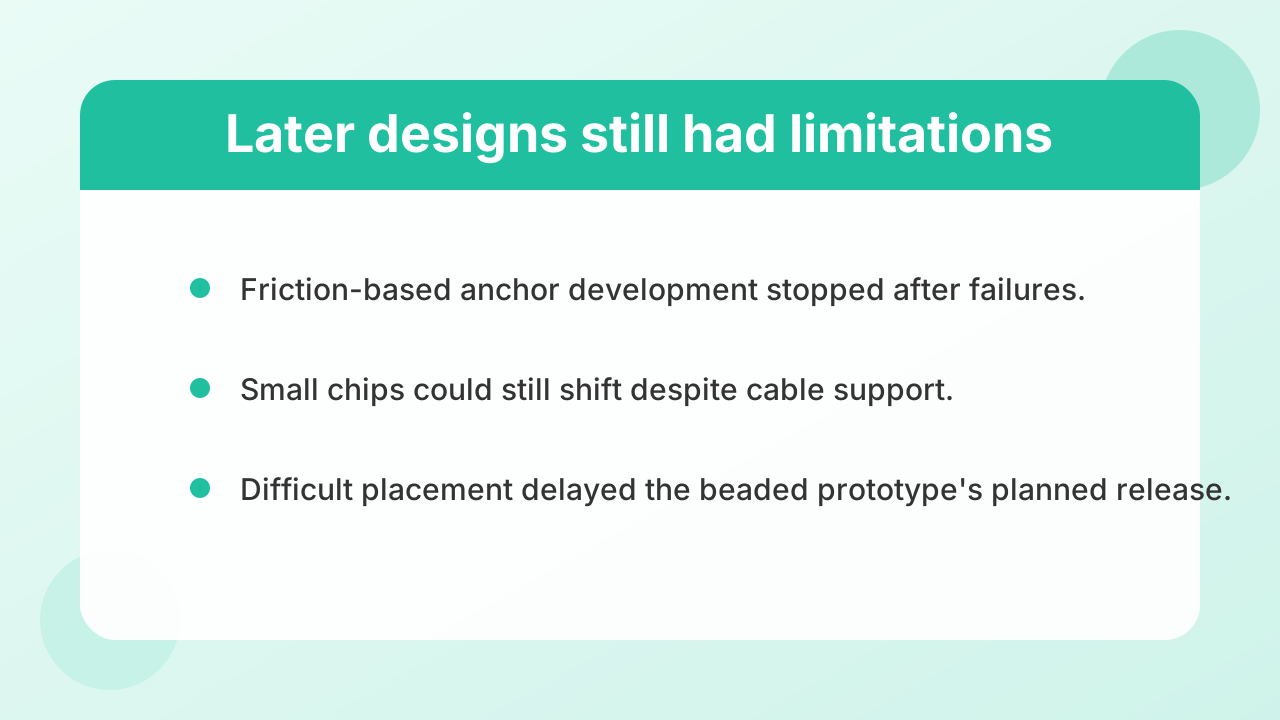
| May 2019 | Friction-based anchor development stopped after failures with heavy secretions. |
| Oct 2019 | Mr. Okada reported stronger ceramic production, while acknowledging limited impact testing. |
| Mar 2022 | Supporting wires provided another way to stabilize slippery chips. |
| May 2022 | Mr. Okada acknowledged that small chips could still shift despite cable support. |
| Nov 2025 | A revised loop held during urination but increased placement time. |
| Mar 2026 | Difficult placement delayed the beaded prototype's planned release. |
| May 2026 | A thin wire-and-tube design brought a new, design-specific claim about unnecessary lubricant. |
OK Prostate Chip products related to chip slipping out
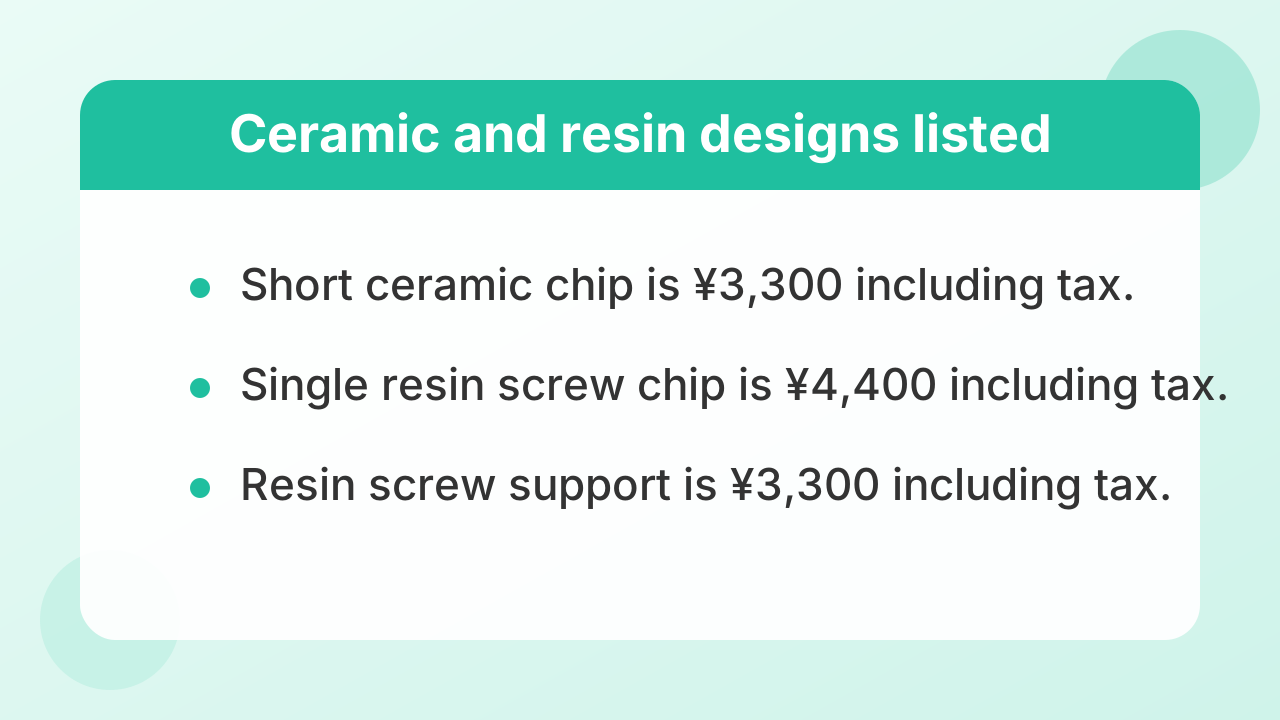
The current list includes the short ceramic chip and resin screw designs discussed in customer reports.
Products that appear in these entries
| Product (official name) | Price incl. tax | Relation to this topic |
|---|---|---|
| Short ceramic chip (OKプロステートチップ 陶器素材ショートタイプ) | ¥3,300 (about $21 at ¥156 = $1, rate as of 2026-09-04) | In October 2019, a customer reported that this chip flew out during urination and broke against the toilet. |
| Single resin screw chip (OKプロステートチップ 樹脂素材1チップタイプ スクリュー) | ¥4,400 (about $28 at ¥156 = $1, rate as of 2026-09-04) | In October 2019, the same customer compared this screw chip with the short ceramic model and reported easier urination. |
| Resin screw support (スクリュー型補助チップ追加オプション(生体適合樹脂)) | ¥3,300 (about $21 at ¥156 = $1, rate as of 2026-09-04) | In January 2022, a customer questioned why this support moved inward more easily than an older screw support. |
(Source: ok-lab's diary, published October 2019)
https://ok-lab.hatenablog.com/entry/2019/10/05/141806
(Source: ok-lab's diary, published January 2022)
https://ok-lab.hatenablog.com/entry/2022/01/15/124252
Products the diary mentioned as alternatives
The diary names no alternative.
Historical configurations here include the linked resin pair, stopper and anchor prototypes, custom linked pair, and supported bare-ended chip. They also include the wire-linked ceramic pair, adjustable loop, beaded prototype and micro bougie. No matching product can be confirmed on the current list.
Common worries about chip slipping out
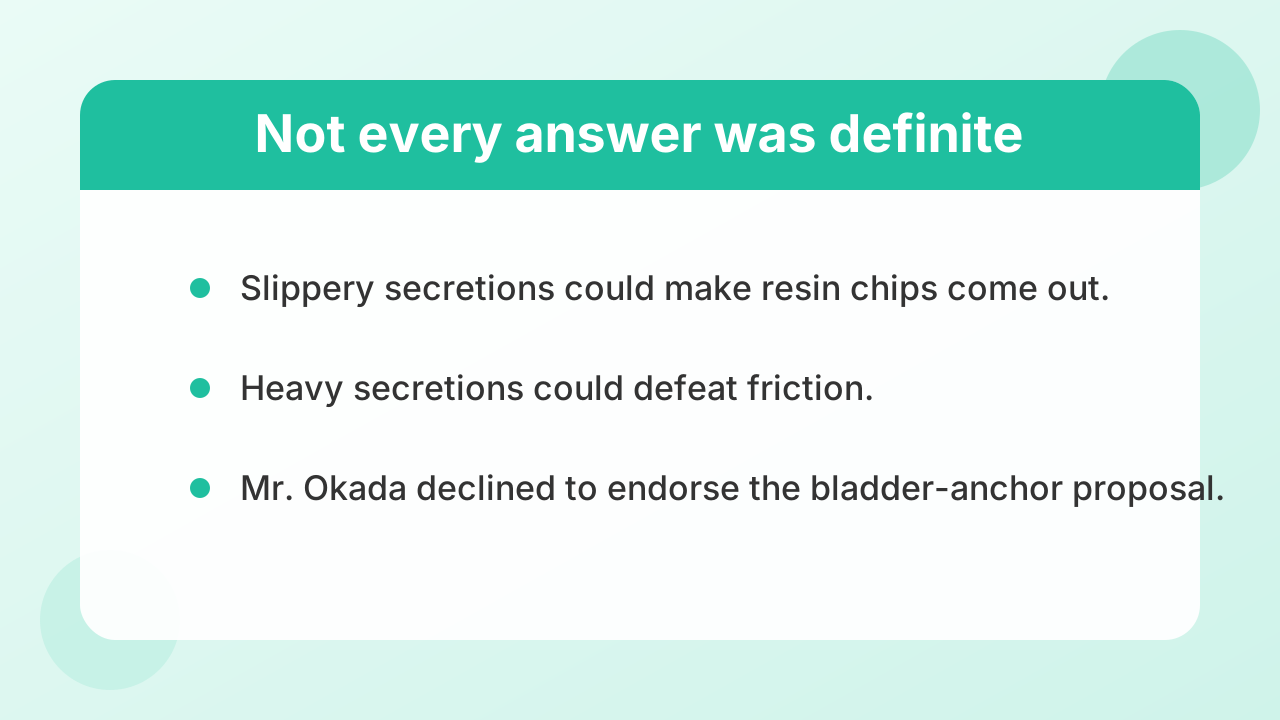
Customers asked about slippery materials and extra anchors; Mr. Okada did not offer a reliable solution for every case.
"Can body fluids explain my chip slipping out?"
In an entry published in May 2018, a glass-chip customer asked whether material or body fluids explained repeated slipping. Mr. Okada replied that, in his experience, slippery secretions could make even resin chips come out readily. He did not think a fixed position was achievable under those conditions.
The diary does not record whether this customer later found a stable arrangement. Mr. Okada suggested that a shape held by the sphincter might stay in place more readily.
(Source: ok-lab's diary, published May 2018)
https://ok-lab.hatenablog.com/entry/20180524/1527153380
"Could an anchor stop my chip slipping out?"
In an entry published in May 2019, a customer asked to test an anchor prototype shown in the diary. Mr. Okada said it still failed under some conditions and that he was not satisfied with it.
He explained that heavy secretions could defeat the friction on which the anchor depended, so development had been suspended. He declined to recommend the prototype for customer testing.
(Source: ok-lab's diary, published May 2019)
https://ok-lab.hatenablog.com/entry/2019/05/25/144939
"Why is my screw support too slippery to stay put?"
In an entry published in January 2022, a customer reported unexpected inward movement with a resin screw support. The customer said its nominal size matched an older support and wondered whether the material explained the difference. Mr. Okada considered the newer resin more slippery and thought this might be gentler on the passage lining.
The diary does not record whether the customer later resolved the movement. Mr. Okada cautioned that a less slippery material could be more useful when the purpose was preventing inward movement or expulsion.
(Source: ok-lab's diary, published January 2022)
https://ok-lab.hatenablog.com/entry/2022/01/15/124252
"Would a bladder anchor stop my chip slipping out?"
In an entry published in November 2021, a customer wanted a linked design with a chip in the bladder acting as an anchor. The request followed repeated expulsion during urination. Mr. Okada said he could not confirm that the proposed arrangement was safe or judge its burden on the bladder.
The diary does not record whether the requested assembly was supplied. Mr. Okada declined to endorse the bladder-anchor proposal.
(Source: ok-lab's diary, published November 2021)
https://ok-lab.hatenablog.com/entry/2021/11/06/125812
Buying from outside Japan
OK Lab ships internationally to countries covered by Japan Post's EMS courier service. Overseas orders are paid in advance by PayPal.
Each order carries a ¥400 (about $3 at ¥156 = $1, rate as of 2026-09-04) handling fee, and EMS shipping is charged on top. These terms come from OK Lab's official sales-terms page (written here as plain text, not a link: ok-lab.net/docs/law), checked on September 7, 2026; confirm them on the official store before you order, because they can change.
Summary of this article
| What you wanted to know | The answer |
|---|---|
| What is the short answer? | The diary links easier movement with the possibility of unwanted slipping. |
| What is this product? | A small urethral device made and sold by OK Lab in Japan. |
| Which terms matter? | Lubrication concerns friction; stoppers and supporting cables concern unwanted movement. |
| What happened in the reports? | Accounts included expulsion, inward movement, a failed stopper and a broken ceramic chip. |
| What did the maker propose? | Material changes, linked designs, supporting cables and adjustable loops, each with limitations. |
| What changed over time? | Failed anchors led to further support designs; later prototypes still presented difficulties. |
| Which related products are listed today? | The short ceramic chip, single resin screw chip and resin screw support appear on the supplied list. |
| Did customer questions receive definite answers? | Some received tentative explanations; Mr. Okada declined to endorse the bladder-anchor proposal. |
| How do overseas orders work? | The supplied terms specify advance PayPal payment, a handling fee and additional EMS shipping. |
Source: ok-lab's diary (Okada Comfortable Life Laboratory). The original entries are in Japanese; quotations on this page are translated. Photos and videos are on the original entries.
This article is a summary of the maker's development diary. The product is not a medical device and no result is guaranteed. If anything feels wrong or worries you, see a doctor. Prices, specifications and cautions change, so confirm the latest information on the official blog and the official site. Questions about ordering and shipping go to the seller.