![My prostate chip turns sideways—why won't it fit? | The maker's answer depends on its shape [OK Prostate Chip]](/img/a/T0079/eyecatch.svg)
This page is based on entries from "ok-lab's diary" (https://ok-lab.hatenablog.com/), the Japanese development diary written by Mr. Okada, founder of OK Lab, a small company in Japan (Okada Comfortable Life Laboratory). Only the entries about changing a chip's orientation are summarized here, in order of publication. Past prices and sizes are as written at the time. Current prices come from the official product list (retrieved September 4, 2026). Quotations are translated from Japanese.
Note: This page is a personal reading log by someone with no connection to the maker or the seller. It reflects the source entries as of their publication dates and makes no guarantee of accuracy or safety. The product is not a medical device; talk to a doctor about any health decision. Check the official site for current information. This page contains advertising.
In short
- Customers reported sideways rotation, difficulty passing particular shapes, and different results after orientation changes.
- Mr. Okada's explanations depended on shape, moisture, attachments, and where the chip stopped.
- Some named ceramic models remain on the current list; historical custom builds cannot all be matched.
If you see blood in your urine, even a small amount or for the first time, do not wait and see. See a urologist right away. If you suddenly cannot urinate, or the device cannot be removed, do not try to fix it yourself. Go to a medical facility, including emergency care, immediately.
About this product
The OK Prostate Chip is a small device that is placed in the urethra (the urine passage) so that it acts on the prostate; the maker sells it in several shapes, sizes and materials.
It is made and sold by OK Lab (Okada Comfortable Life Laboratory), a small company in Japan, through its own online store, and prices are in Japanese yen (JPY).
The maker's development diary, "ok-lab's diary", is written in Japanese. This page is an English summary of it, and every quotation is translated.
OK Lab ships internationally, so readers outside Japan can order (see "Buying from outside Japan" below).
Product names on this page are plain-English descriptions. The official Japanese product name is shown once in the product table so you can find the same item in the store.
Before you read: key terms
| Term | Plain-English meaning |
|---|---|
| Insertion angle | The direction a chip faces; the diary discusses it as one factor affecting passage. |
| Retrieval thread | Thread attached to the device for drawing it out; its attachment features in a damage report. |
| Sphincter | A muscle described as gripping the chip and affecting its position; its normal bodily purpose is not explained here. |
| Sphincter stopper | An additional part intended to limit inward movement; a customer asked whether it also made entry harder. |
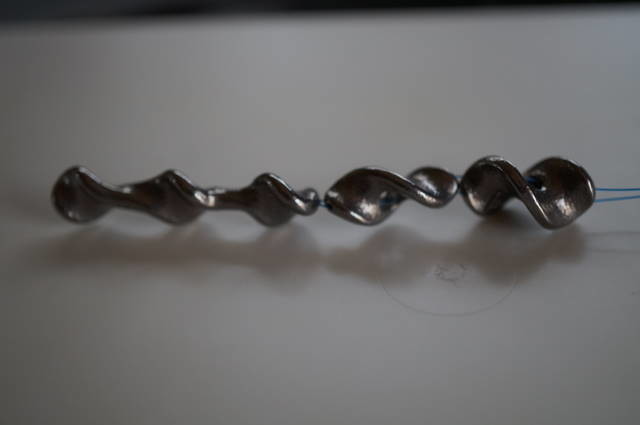
| Screw auxiliary section | A twisted part behind the leading chip; the titanium prototype used these sections for flexibility. |
| Wire-knit prototype | Connected wire loops forming a flexible device without a solid leading chip. |
What happens: prostate chip insertion problems
The OK Prostate Chip is a small device placed in the urethra (urine passage) to act on the prostate. Insertion angle means which direction the chip faces inside that passage, including how its curve aligns with the passage. The entries discuss unexpected rotation and orientation differences reported when a chip would not fit. Mr. Okada's explanations depend on the chip's shape, its attachments, and where the difficulty occurs.
Reverse chip orientation raised a resin damage concern in February 2019
In an entry published in February 2019, a customer reported satisfaction with a reinforced curved chip after earlier breakages. They preferred its curve facing the opposite way from the usual orientation, rather than exchanging its leading and trailing ends.
Mr. Okada thought that reversed position could make withdrawal harder. He also warned that force across the retrieval thread's attachment could peel away resin and possibly accelerate damage. His reply therefore raised a durability concern alongside the customer's favorable report.
(Source: ok-lab's diary, published February 2019)
https://ok-lab.hatenablog.com/entry/2019/02/16/171153
An insertion angle report followed pain from a custom vibrating chip
In an entry published in November 2019, a customer said a custom vibrating chip initially caused pain at the opening and would not fit. Their account associated successful entry with a 90-degree change in orientation.
The customer reported that entry became possible, but found the standard controller's vibration disappointing. Mr. Okada's reply addressed the motor rather than the painful entry.
(Source: ok-lab's diary, published November 2019)
https://ok-lab.hatenablog.com/entry/2019/11/02/132358
New ceramic twist shapes brought another claim about insertion angle
An entry published in December 2019 introduced short ceramic twist chips in S and M, plus a medium-length curved ceramic twist in M. Their maximum width was approximately 8 mm.
Mr. Okada also discussed a screw auxiliary section (a twisted part behind the leading chip). The short twist combination with a 0 mm gap measured approximately 45–50 mm overall. He described that combination as less dependent on orientation and recommended it for beginners at the time.
(Source: ok-lab's diary, published December 2019)
https://ok-lab.hatenablog.com/entry/2019/12/07/162608
Successful entry did not settle one customer's insertion angle concerns
In an entry published in May 2022, a customer wanted the smaller B design because their A chip would not fit. Their existing build had a 14 cm four-line support section.
Mr. Okada questioned the insertion angle, and the customer reported success 10 minutes later. His own repeat checks associated this design with an orientation opposite to that used for ordinary chips.
Despite that result, the customer chose a bumpy curved B build with a 12 cm support section. Mr. Okada considered the looser-fitting B design a possible choice with that support arrangement.
(Source: ok-lab's diary, published May 2022)
https://ok-lab.hatenablog.com/entry/2022/05/07/123013
A stainless twin's insertion angle report followed resizing and earlier discomfort
In an entry published in November 2023, a customer reported that their resized stainless twin chip now entered easily. They described an approximately 160-degree orientation change. Mr. Okada accepted that report and withdrew his earlier 90-degree estimate.
The customer said the rounded stainless tip avoided the pricking previously experienced with a resin chip. They also reported occasional bleeding with that earlier resin chip and wanted a rounder rear section on the twin. The reply did not record a medical assessment of the bleeding.
(Source: ok-lab's diary, published November 2023)
https://ok-lab.hatenablog.com/entry/2023/11/04/122744
A flexible wire prototype brought another insertion angle claim and historical prices
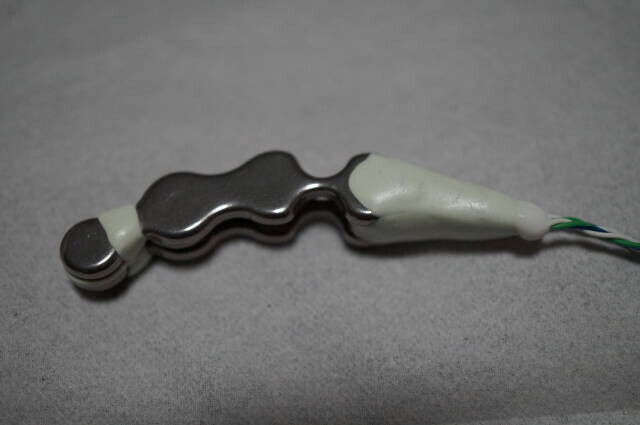
In an entry published in June 2025, Mr. Okada described a 48 cm wire-knit prototype made with 0.2 mm wire. He reported passage through the urine passage and beyond the prostate, with different entry behavior depending on which end led.
The published price was ¥4,000 (about $26 at ¥156 = $1, rate as of 2026-09-04) tax excluded per 12 cm loop. A 12x3 configuration was listed at ¥12,000 (about $77 at ¥156 = $1, rate as of 2026-09-04) tax excluded. Mr. Okada suggested 12x2 or 12x3 as usual configurations, depending on the intended use.
(Source: ok-lab's diary, published June 2025)
https://ok-lab.hatenablog.com/entry/2025/06/28/122915
The maker's answer to prostate chip insertion problems
Mr. Okada treated orientation as one part of a problem that could also involve shape, moisture, or attachments.
Early chip rotation advice also depended on moisture, according to Mr. Okada
In an entry published in January 2018, Mr. Okada discussed a chip that had become horizontal. His advice distinguished horizontal and vertical orientation.
In the same passage, he claimed that ample moisture could make orientation less important for reaching the prostate. He based part of that explanation on his own experience with natural moisture. His answer addressed both orientation changes and how readily the chip could slide.
(Source: ok-lab's diary, published January 2018)
https://ok-lab.hatenablog.com/entry/20180127/1517054930
Long curved chips made insertion angle important in an October reply
In an entry published in October 2019, a customer with a medium-length ceramic teardrop chip asked which way curved models faced. Mr. Okada explained their curve as a response to the bend beneath the pubic bone. He stated that a sufficiently long curved chip facing the opposite way could not pass that bend.
The customer also asked whether losing track of its position meant it had reached the bladder. Mr. Okada could not confirm that from touch alone. His orientation advice depended on the curved model being discussed.
(Source: ok-lab's diary, published October 2019)
https://ok-lab.hatenablog.com/entry/2019/10/26/145539
A titanium prototype was intended to make insertion angle less important
In an entry published in June 2021, Mr. Okada described a titanium prototype with two added screw auxiliary sections. Its leading section, approximately 30 mm, did not bend, while the sections behind it could change direction freely.
He said its different indentations could serve as holding points for the sphincter (the muscle described as gripping the chip). He presented this flexibility as allowing different positions despite the device's length. Mr. Okada favored the firm leading section over an arrangement made entirely from flexible auxiliary sections.
(Source: ok-lab's diary, published June 2021)
https://ok-lab.hatenablog.com/entry/2021/06/19/125845
Short curved chip rotation concerned a customer after initial success
In an entry published in October 2021, a customer described initial success with a short curved chip (Sea Slug 4), followed by difficulty. They suspected unexpected rotation and asked whether its direction could remain fixed.
Mr. Okada considered rotation unsurprising for that short, strongly curved shape. He thought earlier movement could occur in different orientations, while alignment near the sphincter mattered more. His advice focused on that later location rather than preventing every earlier change in angle.
(Source: ok-lab's diary, published October 2021)
https://ok-lab.hatenablog.com/entry/2021/10/02/125825
A beginner's chip rotation question also involved an added stopper
In an entry published in April 2025, a beginner reported 90-degree and 180-degree rotation of a medium-length ribbed chip (Fishbone). Mr. Okada thought its angle could settle naturally near the sphincter, while an opposing curve could prevent progress.
He also thought the sphincter stopper (an additional part intended to limit inward movement) could greatly increase difficulty for beginners. His suggestion was to consider the chip's behavior separately from that attachment.
The entry contains no later insertion result, and the customer also raised concerns about possible prostate inflammation. Mr. Okada advised consulting a urologist about that health concern.
(Source: ok-lab's diary, published April 2025)
https://ok-lab.hatenablog.com/entry/2025/04/26/122909
If you see blood in your urine, even a small amount or for the first time, do not wait and see. See a urologist right away. If you suddenly cannot urinate, or the device cannot be removed, do not try to fix it yourself. Go to a medical facility, including emergency care, immediately.
How prostate chip insertion problems changed over time
| Published | What the diary said then |
|---|---|
| Dec 2019 | New ceramic twist versions were priced the same as their glass counterparts. |
| Feb 2021 | Mr. Okada contrasted easily twisting nylon thread with bent stainless wire that resisted rotation. |
| Dec 2021 | A flat-curved L chip's 11 mm bulge proved difficult for Mr. Okada. |
| Oct 2023 | A returned stainless twin measured 9.6 mm thick, with some widths exceeding 10 mm. |
| Apr 2024 | Mr. Okada described long, wire-linked double chips as resistant to rotation. |
| Apr 2025 | Mr. Okada attributed increasing difficulty during repeated attempts partly to drying inside the passage. |
| Jun 2025 | The wire-knit design had a manufacturing limit of 12 cm per loop. |
The diary does not say what the current state is.
OK Prostate Chip products related to prostate chip insertion problems
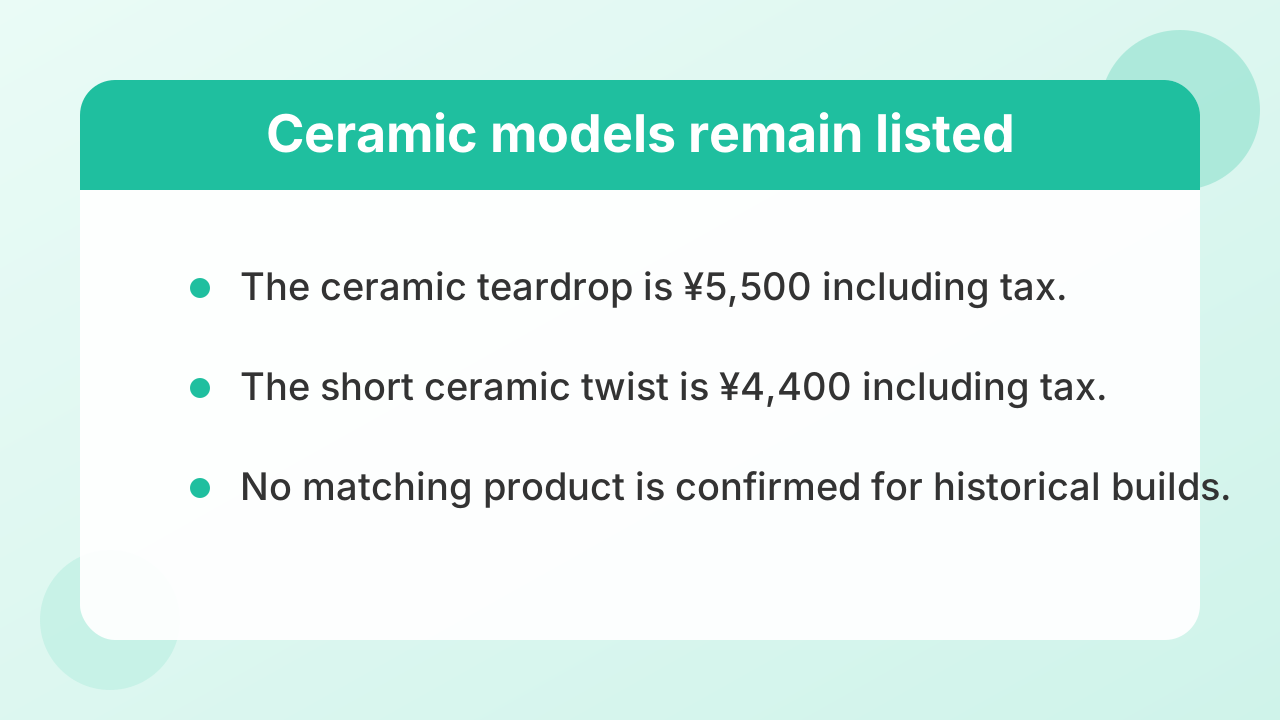
The current list includes ceramic models discussed in questions about orientation and unsuccessful entry.
Products that appear in these entries
| Product (official name) | Price incl. tax | Relation to this topic |
|---|---|---|
| Medium-length ceramic teardrop chip (OKプロステートチップ 陶器素材セミロング勾玉タイプ) | ¥5,500 (about $35 at ¥156 = $1, rate as of 2026-09-04) | In October 2019, its purchaser asked about curved-chip orientation and how to interpret the device's position. |
| Short ceramic twist chip (OKプロステートチップ 陶器素材ショートタイプ ツイスト) | ¥4,400 (about $28 at ¥156 = $1, rate as of 2026-09-04) | In December 2020, a customer reported unsuccessful attempts with this model and additional parts. |
The medium-length ceramic teardrop chip is listed in OK Lab's own online store.
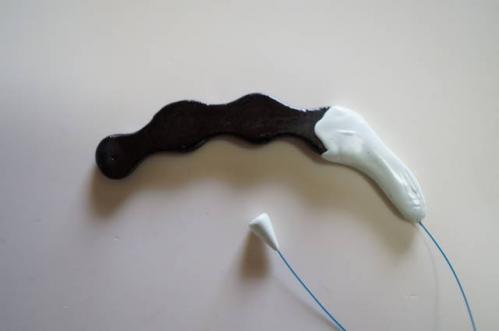
The short ceramic twist chip is listed in OK Lab's own online store.
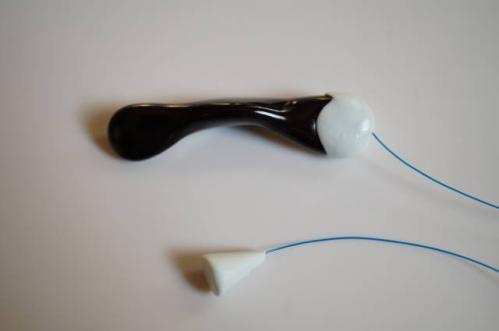
(Source: ok-lab's diary, published October 2019)
https://ok-lab.hatenablog.com/entry/2019/10/26/145539
(Source: ok-lab's diary, published December 2020)
https://ok-lab.hatenablog.com/entry/2020/12/12/124126
Products the diary mentioned as alternatives
The diary names no alternative.
For the historical custom builds, named variants, and prototypes discussed here: No matching product can be confirmed on the current list.
Common worries about prostate chip insertion problems
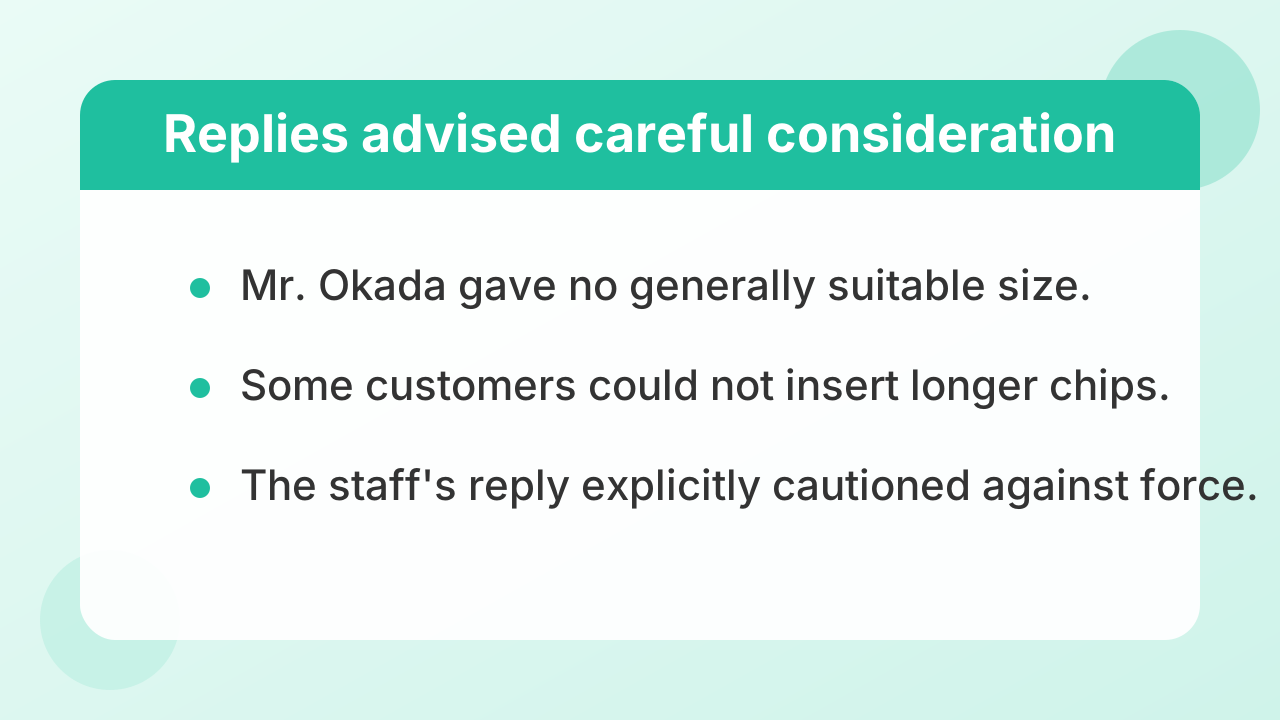
The questions concern fit, rotation, attachments, and what Mr. Okada could infer from a customer's description.
"Does chip rotation mean a single chip is misplaced?"
In an entry published in May 2018, a customer with a small glass chip asked whether vertical and sideways positions were equivalent. They also described a brief sensation and difficulty keeping the chip in place.
Mr. Okada thought the chip had passed the sphincter, while allowing that orientation might change the sensation. The diary does not record whether the customer's positioning problem was resolved. For a single-chip design, he advised against placing much importance on vertical versus sideways orientation.
(Source: ok-lab's diary, published May 2018)
https://ok-lab.hatenablog.com/entry/20180524/1527153380
"Does chip rotation mean a larger model would fit better?"
In an entry published in November 2019, a customer with an SS medium-length chip asked about a larger model. Their reasons included rotation and a sensation that did not last.
Mr. Okada linked easy rotation to the chip's short length and slight curve. He expected longer, more curved designs to rotate less easily, but gave no generally suitable size. His reply advised careful consideration because some customers had been unable to insert longer chips.
(Source: ok-lab's diary, published November 2019)
https://ok-lab.hatenablog.com/entry/2019/11/30/164020
"Could chip rotation explain why a twist model won't fit?"
In an entry published in December 2020, a beginner reported four unsuccessful attempts with a short ceramic twist chip and accessories. They asked whether rotation or the added parts explained the difficulty.
Mr. Okada thought reversed orientation of the short twist and screw auxiliary section was unlikely to be the main problem. He said the twist tip was larger than a simple tip and could meet more resistance at the sphincter. He favored a simpler shape for easier passage, but the entry records no subsequent result.
(Source: ok-lab's diary, published December 2020)
https://ok-lab.hatenablog.com/entry/2020/12/12/124126
"Why won't the large curved chip go in straight?"
In an entry published in January 2022, a customer requested the smaller curved B design after difficulty with a threadless curved A chip. They suspected the bulky thread-attachment area prevented passage.
The reply relayed Mr. Okada's own experience: straightforward vertical or sideways alignment had failed, while another angle had allowed entry. That was his experience, and the diary does not record whether the customer's original chip later fitted. The staff's reply explicitly cautioned against force and limited its suggestion to a personal account.
(Source: ok-lab's diary, published January 2022)
https://ok-lab.hatenablog.com/entry/2022/01/01/124134
Buying from outside Japan
OK Lab ships internationally to countries covered by Japan Post's EMS courier service. Overseas orders are paid in advance by PayPal. Each order carries a ¥400 (about $3 at ¥156 = $1, rate as of 2026-09-04) handling fee, and EMS shipping is charged on top. These terms come from OK Lab's official sales-terms page (written here as plain text, not a link: ok-lab.net/docs/law), checked on September 7, 2026; confirm them on the official store before you order, because they can change.
Summary of this article
| What you wanted to know | The answer |
|---|---|
| In short: does sideways rotation explain everything? | Mr. Okada's replies also considered shape, moisture, attachments, and the location of difficulty. |
| About this product: who makes it? | OK Lab in Japan makes the urethral device and sells it through its own online store. |
| Key terms: what else affects orientation? | The entries discuss curved bodies, retrieval threads, flexible auxiliary sections, and stoppers. |
| What happens: did changing orientation always resolve the concern? | Some reports recorded successful entry, but others raised damage, discomfort, or unresolved fit questions. |
| The maker's answer: what did he emphasize? | His explanations varied with the particular model and the customer's description. |
| Changes over time: what developed? | Ceramic twists, flexible connections, resized twins, and wire-knit prototypes brought different claims and problems. |
| Related products: what is currently listed? | The ceramic teardrop and short ceramic twist models are listed at ¥5,500 (about $35 at ¥156 = $1, rate as of 2026-09-04) and ¥4,400, (about $28 at ¥156 = $1, rate as of 2026-09-04) including tax. |
| Common worries: does rotation prove a larger chip is needed? | Mr. Okada offered no generally suitable larger size in the relevant reply. |
| Buying abroad: what are the stated terms? | Advance PayPal payment, EMS shipping, and a ¥400 (about $3 at ¥156 = $1, rate as of 2026-09-04) handling fee, with shipping charged separately. |
Source: ok-lab's diary (Okada Comfortable Life Laboratory). The original entries are in Japanese; quotations on this page are translated. Photos and videos are on the original entries.
This article is a summary of the maker's development diary. The product is not a medical device and no result is guaranteed. If anything feels wrong or worries you, see a doctor. Prices, specifications and cautions change, so confirm the latest information on the official blog and the official site. Questions about ordering and shipping go to the seller.