![My prostate chip won't go in | The maker points to size and shape [OK Prostate Chip]](/img/a/T0086/eyecatch.svg)
This page is based on entries from "ok-lab's diary" (https://ok-lab.hatenablog.com/), the Japanese development diary written by Mr. Okada, founder of OK Lab, a small company in Japan (Okada Comfortable Life Laboratory). Only the entries about "a prostate chip that is too big to fit" are summarized here, in order of publication. Past prices and sizes are as written at the time. Current prices come from the official product list (retrieved September 4, 2026). Quotations are translated from Japanese.
Note: This page is a personal reading log by someone with no connection to the maker or the seller. It reflects the source entries as of their publication dates and makes no guarantee of accuracy or safety. The product is not a medical device; talk to a doctor about any health decision. Check the official site for current information. This page contains advertising.
In short
Customers reported chips stopping at the rear bulge or another wide section.
Mr. Okada's replies include downsizing, finished-width warnings, and limits on reworking used chips.
Related models remain on the supplied current list, which does not specify size options.
If you see blood in your urine, even a small amount or for the first time, do not wait and see. See a urologist right away.
If you suddenly cannot urinate, or the device cannot be removed, do not try to fix it yourself. Go to a medical facility, including emergency care, immediately.
About this product
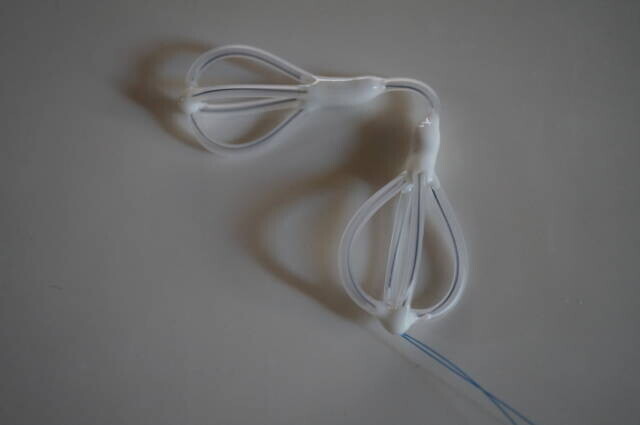
The OK Prostate Chip is a small device that is placed in the urethra (the urine passage) so that it acts on the prostate; the maker sells it in several shapes, sizes and materials. It is made and sold by OK Lab (Okada Comfortable Life Laboratory), a small company in Japan, through its own online store, and prices are in Japanese yen (JPY). The maker's development diary, "ok-lab's diary", is written in Japanese. This page is an English summary of it, and every quotation is translated. OK Lab ships internationally, so readers outside Japan can order (see "Buying from outside Japan" below). Product names on this page are plain-English descriptions. The official Japanese product name is shown once in the product table so you can find the same item in the store.
Before you read: key terms
| Term | Plain-English meaning |
|---|---|
| Urethra | The urine passage, where the chip is placed to act on the prostate. |
| Twin chip | Two ceramic chips joined together to create a thicker assembly. |
| Resin coating | Material covering a motor or reinforcing a ring; it increases the finished dimensions. |
| Crown loop | A reshaped flexible loop for urethral use; the maker describes greater resistance to compression. |
| Clamping tool | An instrument designed to grip and move a chip; its gripping section adds thickness. |
What happens: prostate chip fitting problems
The OK Prostate Chip is a small device placed in the urethra, intended to act on the prostate from inside. The fitting problems discussed here concern solid bulges, enlarged ends, and added parts that must fit within that passage. Customers sought larger designs for stronger sensations or a fit that better suited them. The diary describes obstacles near the penis head and farther along the passage.
A custom glass chip could be too big at its rear
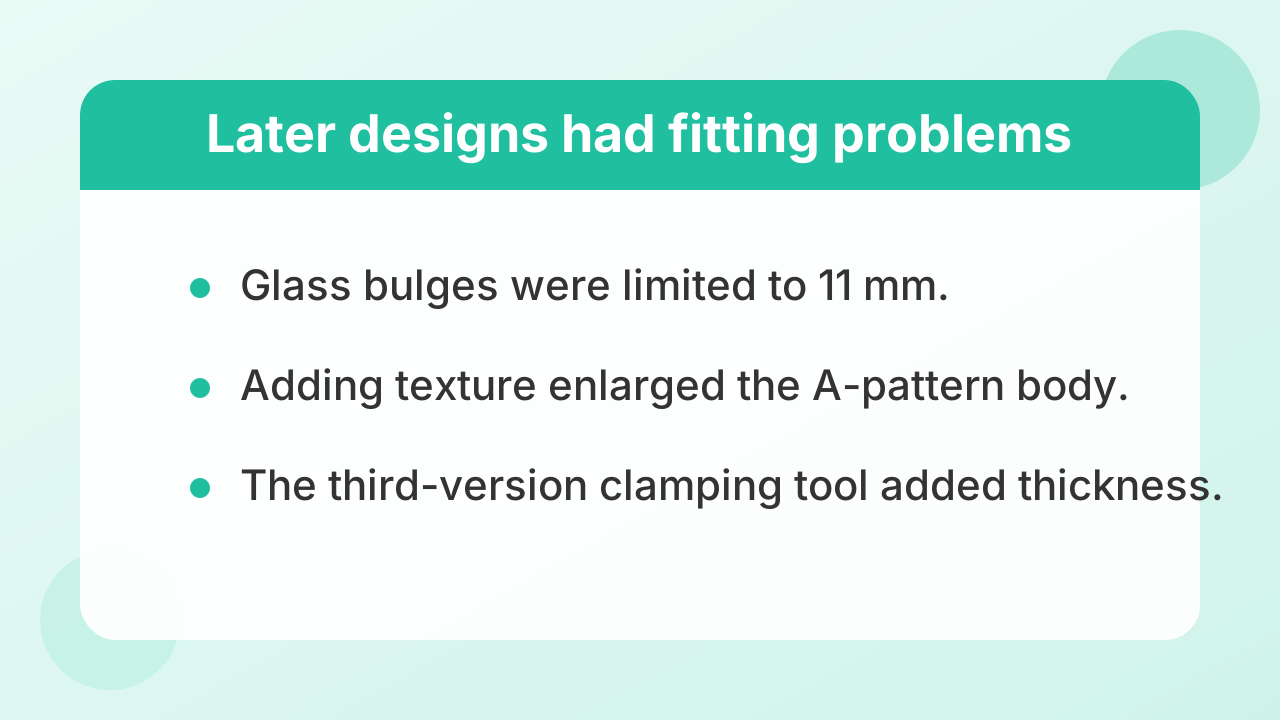
In an entry published in September 2018, a customer requested a 60 mm glass chip with three 12 mm prostate bulges. Mr. Okada put the manufacturing limit at 11 mm, citing the glass stock and technical constraints. A 12 mm rear bulge was possible, but he reported insertion difficulties with rear bulges measuring 10-11 mm or more.
Three 11 mm bulges would leave insufficient spacing within 60 mm, so he proposed smaller bulges when spacing mattered. The customer revised the order, and the finished dimensions were recorded as 59,9,10.5,11; no account of its fit followed. Mr. Okada cautioned that individual differences prevented a definite answer about suitability.
(Source: ok-lab's diary, published September 2018)
https://ok-lab.hatenablog.com/entry/20180908/1536384939
A curved ceramic chip would not go beyond the penis head
In an entry published in September 2020, a customer reported that a double-twist ceramic chip's rear would not pass beyond the penis head. The same customer also reported using a sea-slug version 4 chip twice, followed by prostate inflammation and a 39°C fever. They were receiving treatment and wanted to return their purchases.
Mr. Okada declined returns of used products for individual circumstances, and the diary records no later recovery update. His reply advised consulting a urinary specialist when fever occurred.
(Source: ok-lab's diary, published September 2020)
https://ok-lab.hatenablog.com/entry/2020/09/12/093836
An extra-large semi-long chip would not fit despite lubricant
In an entry published in February 2021, an experienced customer sought help with a textured semi-long L chip. Bulge 3, its widest section, stopped at a narrow point near the penis head despite lubricant, and the customer reported increasing pain.
Mr. Okada explained that this model was deliberately oversized; the entry does not record a later successful fit. His sizing caution was that both the short L and semi-long L were extra-large designs for customers seeking bigger, lower-priced chips.
(Source: ok-lab's diary, published February 2021)
https://ok-lab.hatenablog.com/entry/2021/02/13/121440
A doubled ceramic prototype was too big for Mr. Okada
Entries published in February 2021 describe a customer seeking substantially thicker ceramic chips. Mr. Okada initially explained that fixed molds prevented larger custom ceramic pieces. After the customer's follow-up, he made a twin chip (two ceramic pieces joined together) using the thick curved model.
The prototype was approximately 13 mm thick, and Mr. Okada reported that it would not enter his urethra. He reported continuous wear of a smaller short-SS twin prototype about 7 mm thick. His subsequent reply cautioned that widening the gap between ceramic pieces raised design and strength concerns.
(Source: ok-lab's diary, published February 2021)
https://ok-lab.hatenablog.com/entry/2021/02/13/121440
(Source: ok-lab's diary, published February 2021)
https://ok-lab.hatenablog.com/entry/2021/02/20/130830
An A-pattern chip was too big at its rear for several buyers
In an entry published in April 2022, Mr. Okada described the large A-pattern chip as the biggest chip in his range. He reported several complaints that it would not fit, usually because of its rear section. He also reported difficulty fitting it himself.
A newly added textured version increased the body size but left the rear section unchanged. Its standard nylon-thread version cost the underlying chip's price plus ¥1,000 (about $6 at ¥156 = $1, rate as of 2026-09-04) tax excluded, as published in April 2022. Mr. Okada described the model as intended for people already comfortable with the large four-point-twist ceramic chip.
(Source: ok-lab's diary, published April 2022)
https://ok-lab.hatenablog.com/entry/2022/04/23/123121

A connected chip developed cracks after attempts to overcome fitting problems
In an entry published in October 2022, a customer reported difficulty fitting a connected sea-slug 5+4 chip. After several attempts, they noticed a crack in its rubber connection and asked whether continued use was appropriate.
Staff replied that the crack undermined the connection and increased the risk of eventual breakage. They attributed greater strain to narrower passages tending to straighten the connected pieces. The diary does not record this customer's result after repair. Staff offered to repair the assembly with a shallower connection angle.
(Source: ok-lab's diary, published October 2022)
https://ok-lab.hatenablog.com/entry/2022/10/29/122854
An oversized chip preceded heart failure in Mr. Okada's personal account
In an entry published in January 2024, Mr. Okada described testing an enlarged ceramic prototype approximately 13.3 mm wide. He reported that it passed into position and kept his prostate expanded to 13 mm. He then reported heart failure shortly after going to bed.
Mr. Okada attributed the episode to the oversized chip and reported recovery within several hours after its removal. The diary does not record a medical assessment establishing that cause. Elsewhere in the same discussion, Mr. Okada identified a smaller central bulge as a design alternative.
(Source: ok-lab's diary, published January 2024)
https://ok-lab.hatenablog.com/entry/2024/01/20/122910
An added clamping tool could make a chip too big to fit
An entry published in March 2026 introduces a third-version clamping tool, an instrument designed to grip and move a chip. Mr. Okada explained that its gripping section added thickness, potentially making an otherwise suitable chip too large. He also reported unintended chip movement and threads becoming entangled with the tool.
Published prices were ¥7,000 (about $45 at ¥156 = $1, rate as of 2026-09-04) tax excluded for lengths up to 20 cm, and ¥9,000 (about $58 at ¥156 = $1, rate as of 2026-09-04) tax excluded for lengths up to 30 cm. Mr. Okada cautioned that the combined thickness required room beyond the chip's own dimensions.
(Source: ok-lab's diary, published March 2026)
https://ok-lab.hatenablog.com/entry/2026/03/21/122906
The maker's answer to prostate chip fitting problems
Mr. Okada offered smaller dimensions and case-specific alternatives while acknowledging that he could not predict an individual's fit.
A motor's stated diameter understated why the finished chip would not fit
An entry published in March 2019 concerns a customer asking whether an oversized vibrating chip could be reworked. Mr. Okada refused reworking or correction after a customer had placed a chip in the urethra. He instead offered replacement with an 8 mm motor unit for ¥3,000 (about $19 at ¥156 = $1, rate as of 2026-09-04) tax excluded.
The diary does not record whether that replacement went ahead. He explained that a resin coating, the material surrounding the motor, made a 10 mm motor measure 11 mm-12 mm. Mr. Okada advised considering that finished width when ordering.
(Source: ok-lab's diary, published March 2019)
https://ok-lab.hatenablog.com/entry/2019/03/09/150813
The maker's draft manual proposed smaller chips for fitting problems
An entry published in July 2021 presents a draft instruction manual addressing failure to pass the penis head. It attributes this problem to an oversized chip or a narrow urethra and names downsizing as a response.
The draft also discusses bleeding, alongside other problems associated with the device. It advises against customers repairing or altering the device themselves.
(Source: ok-lab's diary, published July 2021)
https://ok-lab.hatenablog.com/entry/2021/07/24/125923
Mr. Okada could not choose a reliable size for chip fitting problems
In an entry published in April 2025, a newcomer asked which chip size would suit their previous experience with other instruments. Mr. Okada said he could not identify the best size for that person. He described passage through the penis-head region as the deciding initial obstacle for solid chips.
He contrasted solid chips with flexible designs that, in his account, could change shape through narrow areas. No subsequent purchase or fitting result is recorded. Mr. Okada directed the customer to the stated product dimensions and their own previous experience when judging size.
(Source: ok-lab's diary, published April 2025)
https://ok-lab.hatenablog.com/entry/2025/04/12/122910
A flexible crown loop could still be too big to fit
An entry published in July 2025 describes a crown loop, a reshaped flexible loop for urethral use. Mr. Okada explained that reshaping a 40 mm loop produced a length around 30 mm, while further shortening increased width. His prototype passed the penis head but did not pass completely farther along the passage.
He warned that a crown loop 30 mm wide could resist compression more strongly than an ordinary loop of that width. The crown shape carried no price change at the time. Mr. Okada requested a maximum acceptable dimension for custom orders because exact finished sizes were difficult to achieve.
(Source: ok-lab's diary, published July 2025)
https://ok-lab.hatenablog.com/entry/2025/07/26/122909
If you see blood in your urine, even a small amount or for the first time, do not wait and see. See a urologist right away.
If you suddenly cannot urinate, or the device cannot be removed, do not try to fix it yourself. Go to a medical facility, including emergency care, immediately.
How prostate chip fitting problems changed over time
| Published | What the diary said then |
|---|---|
| Sep 2018 | Glass production constraints limited prostate bulges to 11 mm. |
| Mar 2019 | A 10 mm motor reached 11 mm-12 mm after coating. |
| Feb 2021 | A doubled ceramic prototype approximately 13 mm thick did not fit Mr. Okada. |
| Jul 2021 | The draft manual named downsizing for failure to pass the penis head. |
| Apr 2022 | Adding texture enlarged the A-pattern body without changing its troublesome rear section. |
| Oct 2022 | One customer reported 10.5 mm failed, 8.5 mm barely fitted, and 9 mm fitted. |
| Oct 2022 | Cracked connections prompted an offer of repair with a shallower angle. |
| Jan 2024 | Mr. Okada reported heart failure following his oversized-prototype test. |
| Jul 2025 | Crown loops introduced stronger resistance to compression despite matching ordinary-loop widths. |
| Mar 2026 | The third-version clamping tool added thickness and could complicate fit. |
The diary does not say what the current state is.
OK Prostate Chip products related to prostate chip fitting problems
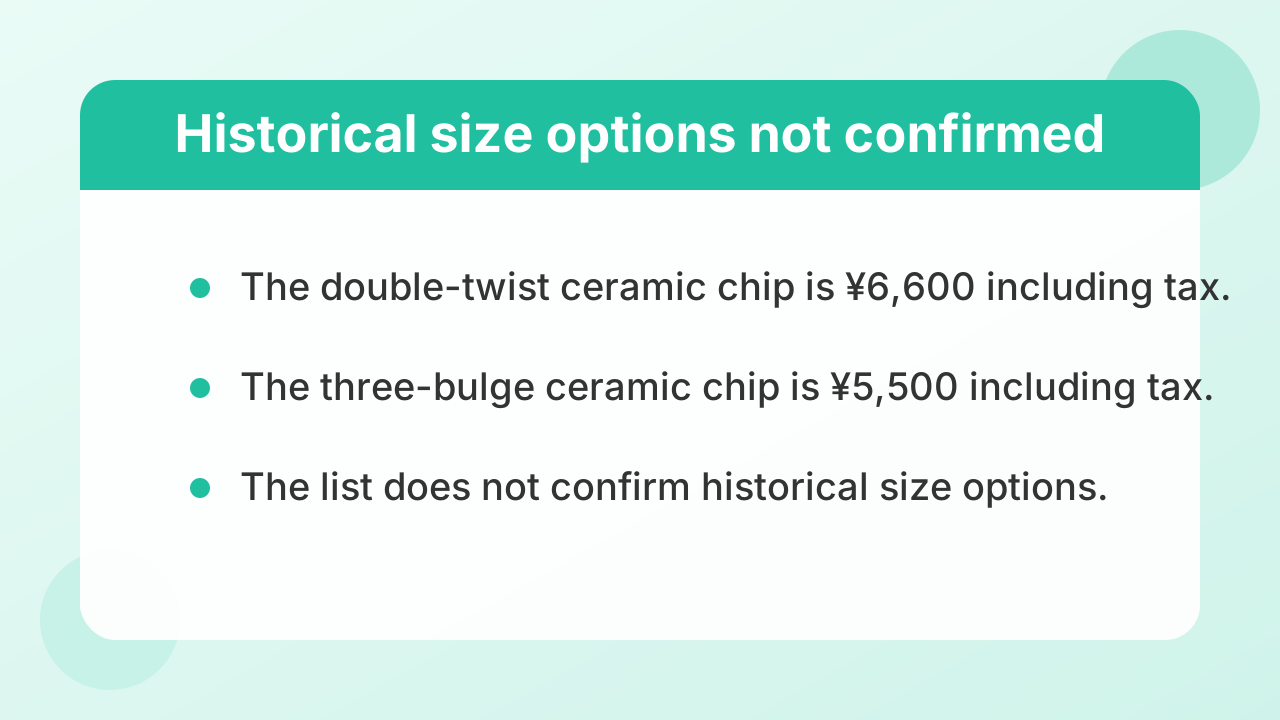
These current listings identify models discussed in the cases; the supplied list does not confirm their historical size options.
Products that appear in these entries
| Product (official name) | Price incl. tax | Relation to this topic |
|---|---|---|
| Double-twist ceramic chip (OKプロステートチップ 陶器素材覚醒タイプ ダブルツイスト(ラブカチップ)) | ¥6,600 (about $42 at ¥156 = $1, rate as of 2026-09-04) | A September 2020 customer reported that its rear would not pass beyond the penis head. |
| Three-bulge ceramic chip (OKプロステートチップ 陶器素材覚醒タイプ) | ¥5,500 (about $35 at ¥156 = $1, rate as of 2026-09-04) | An October 2022 customer reported a difficult fit with the S size. |
(Source: ok-lab's diary, published September 2020)
https://ok-lab.hatenablog.com/entry/2020/09/12/093836
(Source: ok-lab's diary, published October 2022)
https://ok-lab.hatenablog.com/entry/2022/10/08/122859
Products the diary mentioned as alternatives
Mr. Okada proposed a stainless-steel ring chip as an alternative when larger custom ceramic chips could not be made. In the follow-up, he proposed a plain stainless-steel ring as a preliminary alternative to the reinforced assembly.
The entries also describe custom glass builds, doubled ceramics, sea-slug models, an A-pattern chip, enlarged prototypes, crown loops, and clamping tools. No matching product can be confirmed on the current list.
Common worries about prostate chip fitting problems
Customers asked about lubricant, ring dimensions, and whether changing an accessory could resolve the problem.
"Why won't my thick curved chip fit despite lubricant?"
In an entry published in February 2021, a customer asked for help with the thick curved ceramic model. They reported that lubricant allowed the first two bulges to pass, but the third white section would not fit.
Mr. Okada sought permission to publish the question and invite reader responses; the customer agreed. The diary does not record whether this customer later achieved a fit. Mr. Okada's own advice focused on accommodating the model's pronounced curve.
(Source: ok-lab's diary, published February 2021)
https://ok-lab.hatenablog.com/entry/2021/02/13/121440
"Could ring measurements explain why a chip won't fit?"
In an entry published in February 2021, the customer discussing thicker ceramic assemblies also requested an 11 mm auxiliary ring. Mr. Okada replied that the resin reinforcement would make its thickest section 13 mm or more. He expressed concern that the completed assembly might not fit.
The diary does not record a fitting result for that customer's proposed ring assembly. Before committing to the reinforced build, Mr. Okada proposed a plain stainless-steel ring as the preliminary alternative.
(Source: ok-lab's diary, published February 2021)
https://ok-lab.hatenablog.com/entry/2021/02/20/130830
"Could changing tools solve an integrated stopper's fitting problems?"
In an entry published in March 2026, a customer asked whether the second-version clamping tool suited an integrated apple-shaped stopper. Staff said its all-resin surface was incompatible, offering an added rubber section for ¥550 (about $4 at ¥156 = $1, rate as of 2026-09-04) or the third-version tool. The customer requested a revised quotation for the latter.
Mr. Okada then warned that combining the cable, stopper, and clamp could create excessive thickness. The requested assembly had not yet been made, and no completed purchase is recorded. He suggested reconsidering the second-version arrangement with rubber, while admitting he could not identify a reliably better option.
(Source: ok-lab's diary, published March 2026)
https://ok-lab.hatenablog.com/entry/2026/03/21/122906
Buying from outside Japan
OK Lab ships internationally to countries covered by Japan Post's EMS courier service. Overseas orders are paid in advance by PayPal. Each order carries a ¥400 (about $3 at ¥156 = $1, rate as of 2026-09-04) handling fee, and EMS shipping is charged on top. These terms come from OK Lab's official sales-terms page (written here as plain text, not a link: ok-lab.net/docs/law), checked on September 7, 2026; confirm them on the official store before you order, because they can change.
Summary of this article
| What you wanted to know | The answer |
|---|---|
| What is the short answer? | Customers reported that wide sections prevented a chip from fitting. |
| What is this product? | A urethral device made and sold by OK Lab in Japan. |
| Which terms matter? | Coatings, joined pieces, and accessory thickness all feature in the diary's size discussions. |
| What happened in the cases? | Reports included failed fits, cracked connections, and Mr. Okada's personal health episode. |
| What did the maker suggest? | Smaller dimensions, attention to finished width, and case-specific review. |
| What changed over time? | Later entries added doubled ceramics, flexible loops, and accessories with their own fitting problems. |
| Which current products appear? | The double-twist ceramic chip and three-bulge ceramic chip appear on the supplied list. |
| What did customers ask? | Whether lubricant, ring dimensions, or a different accessory could help. |
| How do overseas purchases work? | Advance PayPal payment, a ¥400 (about $3 at ¥156 = $1, rate as of 2026-09-04) handling fee, and additional EMS shipping charges. |
Source: ok-lab's diary (Okada Comfortable Life Laboratory). The original entries are in Japanese; quotations on this page are translated. Photos and videos are on the original entries.
This article is a summary of the maker's development diary. The product is not a medical device and no result is guaranteed. If anything feels wrong or worries you, see a doctor. Prices, specifications and cautions change, so confirm the latest information on the official blog and the official site. Questions about ordering and shipping go to the seller.