![Why is my prostate chip hard to insert? | Shape and support both matter [OK Prostate Chip]](/img/a/T0084/eyecatch.svg)
This page is based on entries from "ok-lab's diary" (https://ok-lab.hatenablog.com/), the Japanese development diary written by Mr. Okada, founder of OK Lab, a small company in Japan (Okada Comfortable Life Laboratory). Only the entries about "shapes that are easier or harder to advance" are summarized here, in order of publication. Past prices and sizes are as written at the time. Current prices come from the official product list (retrieved September 4, 2026). Quotations are translated from Japanese.
Note: This page is a personal reading log by someone with no connection to the maker or the seller. It reflects the source entries as of their publication dates and makes no guarantee of accuracy or safety. The product is not a medical device; talk to a doctor about any health decision. Check the official site for current information. This page contains advertising.
In short
- Small chips can be difficult to locate, while flexible connections can fold instead of transmitting pressure.
- Mr. Okada explored supported joints, cables, and flatter shapes, with different drawbacks for each.
- The current list includes solid chips and auxiliaries, but does not confirm every later custom design.
About this product

The OK Prostate Chip is a small device that is placed in the urethra (the urine passage) so that it acts on the prostate; the maker sells it in several shapes, sizes and materials. It is made and sold by OK Lab (Okada Comfortable Life Laboratory), a small company in Japan, through its own online store, and prices are in Japanese yen (JPY). The maker's development diary, "ok-lab's diary", is written in Japanese. This page is an English summary of it, and every quotation is translated. OK Lab ships internationally, so readers outside Japan can order (see "Buying from outside Japan" below). Product names on this page are plain-English descriptions. The official Japanese product name is shown once in the product table so you can find the same item in the store.
Before you read: key terms
| Term | Plain-English meaning |
|---|---|
| Urethra | The urine passage, where the diary describes the device resting and moving. |
| Screw auxiliary | A spiral-shaped second chip, intended to help movement and positioning behind the main chip. |
| Flat-face curve | A curve across a chip's thinner dimension, intended to provide a broader rear contact surface. |
| Twin cables | Two cables attached to one vibrating chip, proposed as support against folding. |
| Jointed connector | A bendable support joining parts while transmitting pressure. |
| Spring chip | A metal-coil prototype intended for placement near the prostate. |
| Six-wire support | An older cable-support assembly intended to assist movement and positioning. |
| Chipless device | A wire-and-tube loop structure without a solid main chip, intended to provide pressure inside the urethra. |
| Retrieval extension | A soft trailing part intended to help retrieval; the diary also calls it an antenna. |
| Silicone | Material used for tubing and rubber coverings around wires or connections. |
| Epoxy resin | A hard-setting material used to secure connections or form supporting sections. |
What happens: prostate chip insertion difficulty
The OK Prostate Chip is a small device placed in the urethra to act on the prostate. This topic concerns the shape of its body and the support connecting it to trailing parts. The diary describes difficulty both near the opening and at the curve before the prostate. Rear surfaces, connecting gaps, and flexible supports are intended to influence how pressure reaches the leading chip.
If you see blood in your urine, even a small amount or for the first time, do not wait and see. See a urologist right away. NHS: blood in urine If you suddenly cannot urinate, or the device cannot be removed, do not try to fix it yourself. Go to a medical facility, including emergency care, immediately. NIDDK: inability to urinate
A short ceramic chip was hard to insert despite success with resin
In an entry published in May 2020, a customer wanted a short ceramic chip with a more pronounced narrow waist. Their single-chip resin model had been manageable, but the ceramic chip would not enter despite lubrication. Mr. Okada said ceramic needed enough thickness for strength, so he could not reproduce the glass model's deeper waist.
He offered connection reworking for ¥1,100 (about $7 at ¥156 = $1, rate as of 2026-09-04), as published in May 2020. The diary does not record the outcome. His warning was that a slimmer connection could be weaker.
(Source: ok-lab's diary, published May 2020)
https://ok-lab.hatenablog.com/entry/2020/05/02/131505
Easier insertion was not painless for one ceramic chip customer
In an entry published in September 2020, a customer could no longer locate their smallest short ceramic chip near the curve. A short ceramic twist chip with a screw auxiliary (a spiral-shaped supporting second chip) was easier for them to advance. However, they reported severe pain during urination and signs of bleeding, without the sensation they had expected.
They said the urination pain disappeared after two days. Mr. Okada attributed pain generally to damage involving excessive friction. He emphasized that individual sensations differed.
(Source: ok-lab's diary, published September 2020)
https://ok-lab.hatenablog.com/entry/2020/09/19/123115
Flat-face curves offered easier insertion through a broader rear surface
In an entry published in November 2021, Mr. Okada discussed a submitted flat-face curve design (curving across the chip's thinner dimension). He considered its broad rear surface easier to handle than the narrower contact surface of earlier shapes. An entry published in December 2021 announced the design's release at ¥5,500 (about $35 at ¥156 = $1, rate as of 2026-09-04) excluding tax.
The launch listed lengths of 38mm, 42mm, and 47mm. Mr. Okada favored this direction of rear curvature for easier handling.
(Source: ok-lab's diary, published November 2021)
https://ok-lab.hatenablog.com/entry/2021/11/20/125643
(Source: ok-lab's diary, published December 2021)
https://ok-lab.hatenablog.com/entry/2021/12/04/124140
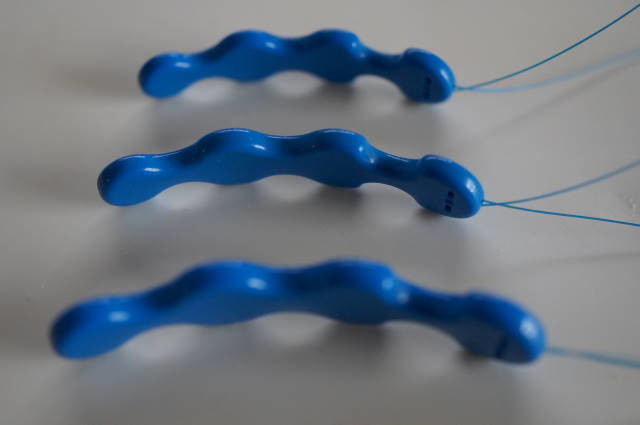
Easier insertion was never the soft retrieval extension's intended job
In an entry published in September 2025, a customer reported a broken connection and bleeding after using a custom bumpy chip. They suspected pressure during insertion had contributed. Staff distinguished its retrieval extension (a soft trailing part) from the firmer support designed to withstand pushing.
Staff offered to reattach the extension because the failure occurred shortly after delivery. The diary does not record the outcome. Mr. Okada cautioned that added force would not resolve a lack of progress.
(Source: ok-lab's diary, published September 2025)
https://ok-lab.hatenablog.com/entry/2025/09/27/123018
Flexible ceramic joints still caused insertion difficulty for one customer
In an entry published in February 2026, a customer praised a chip with a jointed connector (a bendable support) but described difficult entry and removal. Mr. Okada focused on those difficulties and developed a more flexible revision. His comparison suggested easier movement with the revised joint, alongside milder pressure.
The new version retained approximately 15mm between ceramic sections, with about 5mm forming the bending portion. Mr. Okada presented the more flexible option for people struggling with the original joint.
(Source: ok-lab's diary, published February 2026)
https://ok-lab.hatenablog.com/entry/2026/02/07/122919
The maker expected easier insertion from a firmer spiral prototype
In an entry published in July 2026, Mr. Okada described a spiral prototype whose original support was too soft. A firmer central support held the spiral's shape, leading him to expect easier insertion. However, he reported an episode he described as heart failure during his own brief trial.
He had made only one prototype and had not settled its specifications. Mr. Okada said further successful prototypes were needed before specifications and sales could be finalized.
(Source: ok-lab's diary, published July 2026)
https://ok-lab.hatenablog.com/entry/2026/07/04/122918
The maker's answer to prostate chip insertion difficulty
Mr. Okada's proposals balance support against flexibility, friction, and the difficulty of keeping the device in place.
Mr. Okada linked easier insertion to supported joints between chips
In an entry published in October 2020, Mr. Okada rejected a spring-chip prototype (made from a metal coil) because it did not bend enough internally. Shorter linked sections revived a different problem: overlapping parts. He recalled stopping sales of an earlier linked-glass design after similar trouble.
Rubber coating around the linking thread reduced folding in his tests. He attributed easier movement to better alignment between the leading part and its auxiliary. His proposed answer was a supported connection that could still bend.
(Source: ok-lab's diary, published October 2020)
https://ok-lab.hatenablog.com/entry/2020/10/24/115457
Thicker tubing offered easier insertion support for linked chip designs
In an entry published in July 2022, Mr. Okada added tubing with 5mm outside diameter and 3mm inside diameter. He found the earlier 4mm outside, 3mm inside tube insufficiently supportive for a linked-chip assembly. The thicker wall was intended to resist folding.
He distinguished this from a single-chip assembly, where the tube needed greater flexibility near the curve. For that arrangement, Mr. Okada favored the more flexible 4mm tube.
(Source: ok-lab's diary, published July 2022)
https://ok-lab.hatenablog.com/entry/2022/07/23/123014
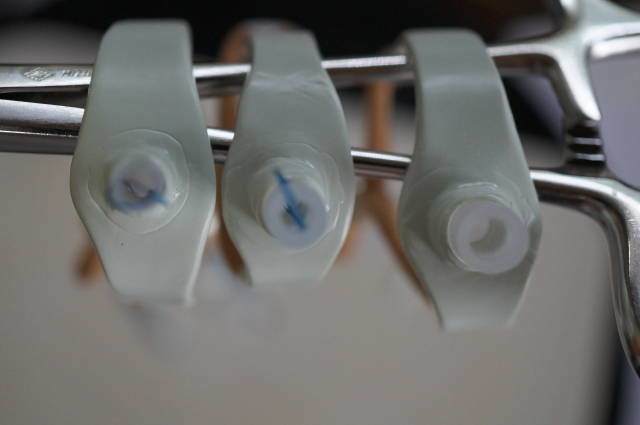
Twin cables became an easier insertion alternative after six-wire support stopped
In an entry published in November 2022, a customer sought help with a medium-length ceramic vibrating chip. Mr. Okada said six-wire support (an older cable-support assembly) was no longer offered then. The order recorded the extra-cable option.
The diary does not record the outcome. His alternative for this customer's difficulty was twin cables (two cables supporting the same vibrating chip).
(Source: ok-lab's diary, published November 2022)
https://ok-lab.hatenablog.com/entry/2022/11/19/122516
Beaded loops remained hard to insert after the maker revised them
In entries published in March 2026, Mr. Okada tested a beaded chipless device (covered wire loops without a solid main chip). Epoxy resin (a hard-setting material) covered silicone (the tubing material), aiming to reduce tissue contact with the latter. His tests instead found strong friction along the passage, followed by only partial improvement after revisions.
He also described difficult removal, although the device stayed firmly positioned during his tests. Mr. Okada limited the proposed audience to people accepting difficult placement in exchange for stability.
(Source: ok-lab's diary, published March 2026)
https://ok-lab.hatenablog.com/entry/2026/03/07/122907
(Source: ok-lab's diary, published March 2026)
https://ok-lab.hatenablog.com/entry/2026/03/14/122910
If you see blood in your urine, even a small amount or for the first time, do not wait and see. See a urologist right away. If you suddenly cannot urinate, or the device cannot be removed, do not try to fix it yourself. Go to a medical facility, including emergency care, immediately.
How prostate chip insertion difficulty changed over time
| Published | What the diary said then |
|---|---|
| Mar 2018 | Separate chips could move alongside each other instead of transmitting pressure forward. |
| Jul 2019 | Cable-stopper tests revealed folding that interfered with forward movement. |
| Oct 2020 | Rubber-supported connections improved alignment in the maker's spring-chip tests. |
| Dec 2021 | The flat-face curve design reached its announced release. |
| Jul 2022 | A thicker-walled tube joined the available prototype configurations. |
| Nov 2022 | Twin cables were proposed after six-wire support stopped. |
| Aug 2024 | Cable reinforcement spacing changed from 5cm to 2.5cm; the price stayed unchanged. |
| Jan 2026 | A linked ceramic design gained a thinner connection and a different flexible core. |
| Feb 2026 | Customer feedback prompted a more flexible ceramic joint option. |
| Jun 2026 | Mr. Okada clarified that nominal zero-spacing orders still included cushioning tubing. |
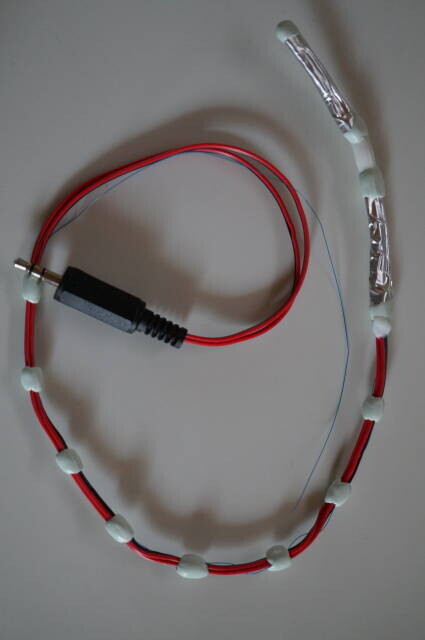
OK Prostate Chip products related to prostate chip insertion difficulty

Current listings include solid chips and auxiliaries from these cases, without confirming every historical custom configuration.
Products that appear in these entries
| Product (official name) | Price incl. tax | Relation to this topic |
|---|---|---|
| Single-chip resin model (OKプロステートチップ 樹脂素材1チップタイプ) | ¥2,200 (about $14 at ¥156 = $1, rate as of 2026-09-04) | In May 2020, the customer could manage this model but not their short ceramic chip. |
| Short ceramic chip (OKプロステートチップ 陶器素材ショートタイプ) | ¥3,300 (about $21 at ¥156 = $1, rate as of 2026-09-04) | In May 2020, its smaller waist and rear connection featured in an insertion complaint. |
| Short ceramic twist chip (OKプロステートチップ 陶器素材ショートタイプ ツイスト) | ¥4,400 (about $28 at ¥156 = $1, rate as of 2026-09-04) | In September 2020, a customer advanced it with an auxiliary but reported pain and bleeding. |
| Screw auxiliary option (スクリュー型補助チップ追加オプション) | ¥3,300 (about $21 at ¥156 = $1, rate as of 2026-09-04) | In September 2020, it helped the customer advance the twist chip. |
| Second-generation resin screw auxiliary (スクリュー型補助チップ追加オプション(第二世代生体適合樹脂)) | ¥3,500 (about $22 at ¥156 = $1, rate as of 2026-09-04) | In June 2026, a customer questioned spacing and possible difficulty with several linked auxiliaries. |
(Source: ok-lab's diary, published May 2020)
https://ok-lab.hatenablog.com/entry/2020/05/02/131505
(Source: ok-lab's diary, published September 2020)
https://ok-lab.hatenablog.com/entry/2020/09/19/123115
(Source: ok-lab's diary, published June 2026)
https://ok-lab.hatenablog.com/entry/2026/06/06/122905
Products the diary mentioned as alternatives
| Product (official name) | Price incl. tax | Relation to this topic |
|---|---|---|
| Extra cable for a vibrating chip (ケーブル追加(核振チップオプション)) | ¥1,100 (about $7 at ¥156 = $1, rate as of 2026-09-04) | In November 2022, Mr. Okada proposed twin cables instead of discontinued six-wire support for insertion difficulty. |
The extra-cable option is listed in OK Lab's own online store.

(Source: ok-lab's diary, published November 2022)
https://ok-lab.hatenablog.com/entry/2022/11/19/122516
Earlier linked-glass design: sales had stopped, according to the October 2020 entry. Six-wire support: unavailable at the time of the November 2022 reply.
For the custom assemblies and prototypes discussed above, the current-list status is:
No matching product can be confirmed on the current list.
Common worries about prostate chip insertion difficulty

The diary's replies distinguish shape problems from connection problems, while leaving individual fit uncertain.
"Would a plain chip be easier to insert?"
In an entry published in December 2020, a beginner asked about a plain chip after four unsuccessful attempts with a ceramic twist model. Mr. Okada could not explain the reported prickling sensation or offer a complete answer from the description. He thought the twist's greater bulk could increase resistance near the prostate.
The diary does not record the outcome. His shape comparison favored a plain chip over a twist for this particular difficulty.
(Source: ok-lab's diary, published December 2020)
https://ok-lab.hatenablog.com/entry/2020/12/12/124126
"Can screw connections make a chip hard to insert?"
In an entry published in November 2022, a reader asked about difficulty with an auxiliary spaced 4mm from the main chip. Mr. Okada said he could not answer the stopper question from personal experience because he rarely used one. For the screw auxiliary, he distinguished thread-linked designs from connections supported by cord.
The diary does not record the outcome. Mr. Okada suggested a cord-linked screw auxiliary as a possible alternative for the reported difficulty.
(Source: ok-lab's diary, published November 2022)
https://ok-lab.hatenablog.com/entry/2022/11/05/122757
"Does zero spacing guarantee easier insertion between screw auxiliaries?"
In an entry published in June 2026, a customer asked whether several auxiliaries would remain flexible and manageable. Mr. Okada declined to judge suitable personal spacing, correcting staff's earlier specific recommendation. He explained that orders specifying 0mm still contained cushioning tubing, so the actual gap was not literally zero.
He said tubing was routinely included for gaps of approximately 10mm or less. The diary does not record the outcome. Mr. Okada asked customers to settle design questions before paying.
(Source: ok-lab's diary, published June 2026)
https://ok-lab.hatenablog.com/entry/2026/06/06/122905
Buying from outside Japan

OK Lab ships internationally to countries covered by Japan Post's EMS courier service. Overseas orders are paid in advance by PayPal. Each order carries a ¥400 (about $3 at ¥156 = $1, rate as of 2026-09-04) handling fee, and EMS shipping is charged on top. These terms come from OK Lab's official sales-terms page (ok-lab.net/docs/law), checked on September 7, 2026; confirm them on the official store before you order, because they can change.
Summary of this article
| What you wanted to know | The answer |
|---|---|
| In short: why the difficulty? | Shape and support both affect movement. |
| About the product: who makes it? | OK Lab in Japan; prices are in JPY. |
| Key terms: what supports movement? | Cables, tubes, auxiliaries, and joints have different roles. |
| What happens: is easier movement trouble-free? | Reports include pain, bleeding, breakage, and difficult removal. |
| The maker's answer: what helps? | Supported connections can reduce folding, with tradeoffs. |
| Changes over time: is development finished? | Later entries still report revisions and unresolved problems. |
| Products: what is currently listed? | The tables show qualifying products and current prices. |
| Common worries: can personal fit be guaranteed? | Mr. Okada declined individual spacing recommendations. |
| Overseas buying: what are the terms? | Advance PayPal payment, ¥400 (about $3 at ¥156 = $1, rate as of 2026-09-04) handling, and additional EMS shipping. |
| Overall: which shape works best? | The diary establishes no universal answer. |
Source: ok-lab's diary (Okada Comfortable Life Laboratory). The original entries are in Japanese; quotations on this page are translated. Photos and videos are on the original entries.
This article is a summary of the maker's development diary. The product is not a medical device and no result is guaranteed. If anything feels wrong or worries you, see a doctor. Prices, specifications and cautions change, so confirm the latest information on the official blog and the official site. Questions about ordering and shipping go to the seller.