![My prostate chip won't go in | Repeated attempts can lead to injury [OK Prostate Chip]](/img/a/T0082/eyecatch.svg)
This page is based on entries from "ok-lab's diary" (https://ok-lab.hatenablog.com/), the Japanese development diary written by Mr. Okada, founder of OK Lab, a small company in Japan (Okada Comfortable Life Laboratory). Only the entries about "repeated insertion failure" are summarized here, in order of publication. Past prices and sizes are as written at the time. Current prices come from the official product list (retrieved September 4, 2026). Quotations are translated from Japanese.
Note: This page is a personal reading log by someone with no connection to the maker or the seller. It reflects the source entries as of their publication dates and makes no guarantee of accuracy or safety. The product is not a medical device; talk to a doctor about any health decision. Check the official site for current information. This page contains advertising.
In short
- Repeated insertion failure appears alongside pain, bleeding, damaged parts, and hospital treatment in the diary.
- Staff at OK Lab, a small company in Japan, advised against reusing an ill-fitting product after recovery.
- Related products remain listed, but the beaded prototype's release was delayed and the retrieval tool abandoned.
If you see blood in your urine, even a small amount or for the first time, do not wait and see. See a urologist right away.
If you suddenly cannot urinate, or the device cannot be removed, do not try to fix it yourself. Go to a medical facility, including emergency care, immediately.
About this product

The OK Prostate Chip is a small device that is placed in the urethra (the urine passage) so that it acts on the prostate; the maker sells it in several shapes, sizes and materials. It is made and sold by OK Lab (Okada Comfortable Life Laboratory), a small company in Japan, through its own online store, and prices are in Japanese yen (JPY).
The maker's development diary, "ok-lab's diary", is written in Japanese. This page is an English summary of it, and every quotation is translated.
OK Lab ships internationally, so readers outside Japan can order (see "Buying from outside Japan" below). Product names on this page are plain-English descriptions. The official Japanese product name is shown once in the product table so you can find the same item in the store.
Before you read: key terms
| Term | Plain-English meaning |
|---|---|
| Urethra | The urine passage, which is also where these devices are placed. |
| Sphincter | A muscle described as gripping the chip and helping hold it near the prostate. |
| Stopper | An added part intended to limit inward movement; the maker says its position matters. |
| Screw attachment | A twisted accessory intended to add stimulation or support a chip's position. |
| Chipless loop | A wire-and-tube device intended to stimulate the prostate without a solid chip. |
| Urethritis | A diagnosis reported after painful urination. The diary does not explain this. |
| Acute pyelitis; acute prostatitis | Diagnoses given as reasons for hospital treatment. The diary does not explain this. |
What happens: prostate chip insertion problems
The OK Prostate Chip is a small device placed inside the urethra to stimulate the prostate. The insertion problems here concern reaching the prostate area after the device enters the penis. Customers describe difficulty at the opening, around the bend deeper inside, and near the sphincter (the muscle described as gripping the chip). Their questions cover solid chips, attached parts, and flexible loop devices intended for the same area.
Repeated insertion failure began before 5 mm in a beginner's report
In an entry published in October 2017, a beginner on OK Lab's staff reported stopping before 5 mm because of discomfort. After baby lotion was introduced, the report described progress into the head of the penis. Progress later stalled near the sphincter.
During urination, every chip suddenly came out; catching the thread's end piece prevented the assembly from falling into the toilet. Mr. Okada's response emphasized lubrication for resin chips in dry conditions.
(Source: ok-lab's diary, published October 2017)
https://ok-lab.hatenablog.com/entry/20171019/1508375473
A stopper explanation did not resolve repeated insertion failure with vibration
In an entry published in January 2020, a compact vibrating chip with a 10 mm motor would not pass the sphincter. Mr. Okada first blamed an extra stopper; the customer said it was already outside. He then suggested dryness and difficulty relaxing, alongside size.
Vibration also failed. A later size alteration allowed insertion but exposed some motor metal. His final reply treated an exposed seam as a concern, after acknowledging modification risks.
(Source: ok-lab's diary, published January 2020)
https://ok-lab.hatenablog.com/entry/2020/01/25/150127
A cracked connector complicated repeated insertion failure with linked curved chips
In an entry published in October 2022, a customer reported repeated difficulty with linked curved chips (Sea Slug 5 + 4). A crack appeared in their rubber connector. OK Lab's staff said this weakened the connection and increased the risk of eventual breakage.
They thought a narrower urethra forced the curved assembly straighter, increasing stress on the rubber. Staff offered a repair with a gentler connection angle.
(Source: ok-lab's diary, published October 2022)
https://ok-lab.hatenablog.com/entry/2022/10/29/122854

Repeated insertion failure preceded a urethritis diagnosis outside Japan
In an entry published in July 2023, a customer outside Japan reported abandoning an attempt after 40 minutes without progress. Severe pain during urination followed, and a doctor diagnosed urethritis. Staff initially judged the size unsuitable and advised against reusing that product, even after recovery.
The customer replied that it was the smallest size and asked whether injury or germs explained the symptoms. Staff acknowledged limited medical knowledge and could not establish the cause from the messages. They advised following the treating doctor's guidance and canceling the customer's pending vibrating-product order.
(Source: ok-lab's diary, published July 2023)
https://ok-lab.hatenablog.com/entry/2023/07/08/122632
Repeated insertion failure also affected the maker's small screw attachment
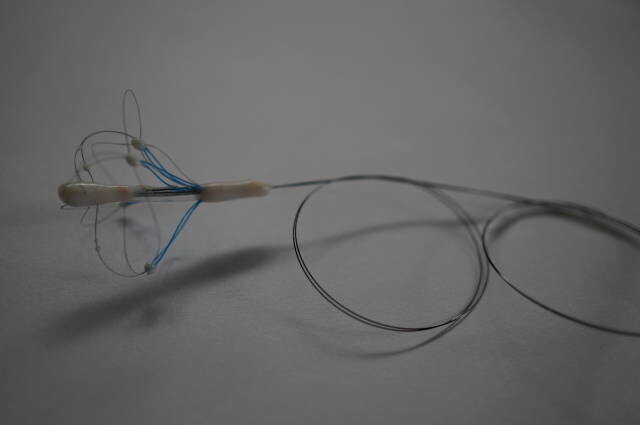
In an entry published in January 2025, Mr. Okada tested a chipless loop (a flexible wire-and-tube device). Its SS screw attachment (a twisted accessory for added stimulation) passed the penile opening but resisted passage across the sphincter. He reported intense pain during rapid removal, without lingering pain afterward. Mr. Okada advised caution and subsequently ruled out further personal tests of screws on that prostate loop.
(Source: ok-lab's diary, published January 2025)
https://ok-lab.hatenablog.com/entry/2025/01/04/122911
Repeated insertion failure postponed the launch of a beaded loop prototype
In an entry published in March 2026, Mr. Okada described a beaded chipless prototype intended to reduce contact with its tubing. Resin beads covered sections of the loops. He reported more friction than expected and difficulty throughout the passage, not just near the sphincter.
His 1 mm tube version took over 10 minutes to reach the intended area. Mr. Okada withheld the planned release pending improvements because positioning the device remained too difficult.
(Source: ok-lab's diary, published March 2026)
https://ok-lab.hatenablog.com/entry/2026/03/07/122907
Bleeding after repeated insertion failure preceded a customer's hospital admission
In an entry published in May 2026, a customer described repeated failed attempts followed by bleeding. Chills began 2 days later. The reported diagnoses were acute pyelitis and acute prostatitis, conditions the diary does not explain.
Hospital treatment lasted 3 days, after which the customer asked about alternatives requiring less hand-guided placement. Mr. Okada mentioned other instruments, a wire aid, and a cable option; the diary does not record a subsequent trial. His reply acknowledged that he could not judge which product would suit this customer.
(Source: ok-lab's diary, published May 2026)
https://ok-lab.hatenablog.com/entry/2026/05/16/122906
The maker's answer to prostate chip insertion problems
The maker's replies addressed individual designs and their limits, while some proposed solutions were delayed or abandoned.
Repeated insertion failure prompted warnings about temporary insertion aids
In an entry published in February 2018, a customer reported success with an improvised insertion aid after repeated difficulty. Mr. Okada had not tested the customer's medical instrument; his demonstration used a different tube. He described instrument-assisted placement as a temporary measure and warned that it could push the chip into the bladder. Mr. Okada specifically cautioned against excessive depth.
(Source: ok-lab's diary, published February 2018)
https://ok-lab.hatenablog.com/entry/20180224/1519457027
Repeated insertion failure led to resizing offers with durability limits
In an entry published in May 2020, a customer could not accommodate a ceramic vibrating chip's 10 mm motor section. Forceful attempts were followed by 3 days of inflammation near the base of the penile head. Mr. Okada offered maker-performed resizing to approximately 10.4 mm wide and 4.6 mm thick for ¥1,100 (about $7 at ¥156 = $1, rate as of 2026-09-04).
He also offered an 8 mm motor replacement for ¥3,300 (about $21 at ¥156 = $1, rate as of 2026-09-04); these were prices published in May 2020. The diary does not record which option the customer chose. Mr. Okada warned that durability could not be guaranteed after the proposed resizing.
(Source: ok-lab's diary, published May 2020)
https://ok-lab.hatenablog.com/entry/2020/05/02/131505
Repeated insertion failure made stopper position a separate concern
In an entry published in December 2020, a customer described a stopper (an added part intended to limit inward movement) being drawn inward. Mr. Okada distinguished a stopper acting as a barrier from one trapped beside the main chip. His reply included an 8 mm spacing figure, but also described the risk of the stopper following the chip inward. Mr. Okada cautioned that merely having a stopper did not establish its protective position.
(Source: ok-lab's diary, published December 2020)
https://ok-lab.hatenablog.com/entry/2020/12/12/124126
Repeated insertion failure ended development of an experimental retrieval tool
In an entry published in May 2026, Mr. Okada reported that a retrieval prototype's double 0.15 mm wire shaft could not cross the sphincter. Reinforcement addressed that difficulty but introduced another concern: the tool could push the chip farther inward. He therefore abandoned development of the retrieval tool. Mr. Okada concluded that supplying this unfinished device to someone awaiting medical removal would be wrong.
(Source: ok-lab's diary, published May 2026)
https://ok-lab.hatenablog.com/entry/2026/05/02/122917
If you see blood in your urine, even a small amount or for the first time, do not wait and see. See a urologist right away.
If you suddenly cannot urinate, or the device cannot be removed, do not try to fix it yourself. Go to a medical facility, including emergency care, immediately.
How prostate chip insertion problems changed over time

| Published | What the diary said then |
|---|---|
| Jan 2018 | Earlier lost-chip experiences informed the addition of a thread with an end safety piece. |
| Aug 2019 | A vibrating chip still would not fit after approximately 1 mm of maker resizing. |
| Sep 2019 | Mr. Okada said stainless thread could bend instead of advancing the chip across the sphincter. |
| Feb 2020 | Mr. Okada identified a bent external cable as a possible source of resistance. |
| Apr 2021 | Mr. Okada said added supports did not completely prevent outward movement. |
| Oct 2021 | Mr. Okada described rotation as unsurprising with a short, sharply curved chip. |
| Apr 2025 | Mr. Okada attributed worsening resistance during repeated attempts partly to dryness. |
| Nov 2025 | Difficult double loops prompted jointed supports; bare-wire loop versions were rejected. |
| Aug 2026 | Two-wire cable remained standard inside silicone tubing; four-wire requests were declined because thicker tubing was needed. |
OK Prostate Chip products related to prostate chip insertion problems

The current list includes products from these accounts, including products customers struggled with.
Products that appear in these entries
| Product (official name) | Price incl. tax | Relation to this topic |
|---|---|---|
| Short ceramic chip (OKプロステートチップ 陶器素材ショートタイプ) | ¥3,300 (about $21 at ¥156 = $1, rate as of 2026-09-04) | In September 2020, a customer could not locate this chip well enough to continue its progress. |
| Twisted short ceramic chip (OKプロステートチップ 陶器素材ショートタイプ ツイスト) | ¥4,400 (about $28 at ¥156 = $1, rate as of 2026-09-04) | In September 2020, this chip with an added screw featured in the account of painful urination. |
| Auxiliary screw option (スクリュー型補助チップ追加オプション) | ¥3,300 (about $21 at ¥156 = $1, rate as of 2026-09-04) | In September 2020, this accessory accompanied the twisted ceramic chip in the same customer account. |
(Source: ok-lab's diary, published September 2020)
https://ok-lab.hatenablog.com/entry/2020/09/19/123115
Products the diary mentioned as alternatives
| Product (official name) | Price incl. tax | Relation to this topic |
|---|---|---|
| Multipurpose stainless-steel wire (多目的ステンレスワイヤー) | ¥550 (about $4 at ¥156 = $1, rate as of 2026-09-04) | In May 2026, Mr. Okada mentioned a wire aid after repeated failure, while acknowledging he could not determine suitability. |
(Source: ok-lab's diary, published May 2026)
https://ok-lab.hatenablog.com/entry/2026/05/16/122906
The compact vibrating assembly, linked curved chips, screw-bearing loop, beaded prototype, and retrieval prototype are historical configurations discussed above. No matching product can be confirmed on the current list.
Common worries about prostate chip insertion problems

The diary gives qualified answers about materials, accessories, and whether exposed thread can establish the chip's position.
"Can repeated insertion failure leave blood after a long attempt?"
In an entry published in May 2020, a customer described difficulty with a set containing 2 chips after about 1 hour. They noticed a substance resembling blood and asked when another attempt would be possible. Mr. Okada gave no definite waiting period and described the change of direction as the main obstacle.
A follow-up reported successful placement despite continuing pain. Asked about materials, Mr. Okada described glass and ceramic as smoother than resin, without choosing a specific replacement product. His reply emphasized lubrication.
(Source: ok-lab's diary, published May 2020)
https://ok-lab.hatenablog.com/entry/2020/05/23/132040
"Can an added screw still cause prostate chip insertion problems?"
In an entry published in September 2020, a customer switched from a short ceramic chip to a twisted version with an auxiliary screw. They reported severe pain during urination and pink-tinged genital fluid after substantial pressure. The customer said the pain resolved after 2 days, but reported no pleasurable sensation. Mr. Okada cautioned that urinary pain could reflect damage to the urethral lining from excessive friction; he did not establish this customer's diagnosis.
(Source: ok-lab's diary, published September 2020)
https://ok-lab.hatenablog.com/entry/2020/09/19/123115
"Can exposed thread explain why my chip won't go in?"
In an entry published in December 2020, a beginner reported 4 unsuccessful attempts with a twisted ceramic chip. The customer asked whether 15 cm of exposed thread proved that placement had failed. Mr. Okada said differences in urethral length prevented that conclusion from thread length alone. He also acknowledged that he could not explain the customer's particular sensations. His product advice favored a simple, untwisted chip because he expected less resistance at the sphincter.
(Source: ok-lab's diary, published December 2020)
https://ok-lab.hatenablog.com/entry/2020/12/12/124126
Buying from outside Japan

OK Lab ships internationally to countries covered by Japan Post's EMS courier service. Overseas orders are paid in advance by PayPal. Each order carries a ¥400 (about $3 at ¥156 = $1, rate as of 2026-09-04) handling fee, and EMS shipping is charged on top. These terms come from OK Lab's official sales-terms page (written here as plain text, not a link: ok-lab.net/docs/law), checked on September 7, 2026; confirm them on the official store before you order, because they can change.
Summary of this article
| What you wanted to know | The answer |
|---|---|
| Immediate answer | Repeated attempts have been followed by injury and hospital treatment. |
| What the product is | A device from Japan placed in the urine passage to act on the prostate. |
| What the terms mean | Chips, loops, screws, and stoppers serve different roles. |
| What customers experienced | Problems included resistance, damaged connections, pain, and bleeding. |
| What the maker proposed | Replies covered individual designs, with limits and abandoned development. |
| What changed over time | Reports expanded from solid chips to cables, loops, and prototype failures. |
| What is currently listed | Related ceramic products and a wire aid remain on the supplied list. |
| What common questions reveal | Material and accessory changes did not provide a universal answer. |
| How overseas buying works | Advance PayPal payment, a ¥400 (about $3 at ¥156 = $1, rate as of 2026-09-04) handling fee, and additional EMS shipping. |
| Overall answer | The diary records both unsuccessful attempts and limits to the maker's advice. |
Source: ok-lab's diary (Okada Comfortable Life Laboratory). The original entries are in Japanese; quotations on this page are translated. Photos and videos are on the original entries.
This article is a summary of the maker's development diary. The product is not a medical device and no result is guaranteed. If anything feels wrong or worries you, see a doctor. Prices, specifications and cautions change, so confirm the latest information on the official blog and the official site. Questions about ordering and shipping go to the seller.