![Chip won't go past the bend? | The maker points to shape, tension, and moisture [OK Prostate Chip]](/img/a/T0081/eyecatch.svg)
This page is based on entries from "ok-lab's diary" (https://ok-lab.hatenablog.com/), the Japanese development diary written by Mr. Okada, founder of OK Lab, a small company in Japan (Okada Comfortable Life Laboratory). Only the entries about "getting past the urethral sphincter" are summarized here, in order of publication. Past prices and sizes are as written at the time. Current prices come from the official product list (retrieved September 4, 2026). Quotations are translated from Japanese.
Note: This page is a personal reading log by someone with no connection to the maker or the seller. It reflects the source entries as of their publication dates and makes no guarantee of accuracy or safety. The product is not a medical device; talk to a doctor about any health decision. Check the official site for current information. This page contains advertising.
In short
- Customers describe chips stalling near the bend before the prostate, sometimes after earlier success.
- Mr. Okada's explanations focus on alignment, moisture, relaxation, and the resistance added by particular designs.
- Later prototypes changed shape and flexibility, but the current list does not confirm those builds.
If you see blood in your urine, even a small amount or for the first time, do not wait and see. See a urologist right away. If you suddenly cannot urinate, or the device cannot be removed, do not try to fix it yourself. Go to a medical facility, including emergency care, immediately.
About this product
The OK Prostate Chip is a small device that is placed in the urethra (the urine passage) so that it acts on the prostate; the maker sells it in several shapes, sizes and materials. It is made and sold by OK Lab (Okada Comfortable Life Laboratory), a small company in Japan, through its own online store, and prices are in Japanese yen (JPY). The maker's development diary, "ok-lab's diary", is written in Japanese. This page is an English summary of it, and every quotation is translated. OK Lab ships internationally, so readers outside Japan can order (see "Buying from outside Japan" below). Product names on this page are plain-English descriptions. The official Japanese product name is shown once in the product table so you can find the same item in the store.
Before you read: key terms
| Term | Plain-English meaning |
|---|---|
| Urethra | The urine passage; the chip occupies part of this passage. |
| Prostate | The gland targeted by the chip. Its usual function: The diary does not explain this. |
| External urethral sphincter | A muscle around the urine passage, described in the diary as opening for urination. |
| Bulbar urethra | The wider passage before the sphincter, along the chip's route. |
| Lubrication | Slipperiness from moisture or lotion; Mr. Okada associates it with reduced resistance. |
| Chipless device | Loops replacing the solid chip, intended to act on the prostate. |
| Guide loop | A leading loop intended to ease sphincter passage. |
| Guide wire | A wire aid for guiding loop-based devices toward the sphincter. |
| Sphincter stopper | An additional part intended to limit inward movement. |
What happens: getting past the urethral sphincter
The OK Prostate Chip is a small device placed in the urethra to act on the prostate. These entries concern the external urethral sphincter (the urine-control muscle), which the diary locates before the prostate along the chip's route. Mr. Okada describes a nearby bend where customers report losing track of the chip or encountering resistance. His explanations concern direction, shape, and moisture; the accounts include failures and reported success.
Gradual sphincter passage followed posture changes in a beginner's report
In an entry published in October 2017, a staff member described a chip stopping near the sphincter and slipping back during a rest. The report linked gradual progress to posture changes and pelvic movement.
The attempts also involved discomfort. Mr. Okada advises allowing progress to happen at each person's pace.
(Source: ok-lab's diary, published October 2017)
https://ok-lab.hatenablog.com/entry/20171019/1508375473
Losing track of the chip left sphincter passage unconfirmed
In an entry published in January 2018, a beginner reported severe pain and losing track of the chip near the scrotum. Mr. Okada suspected misdirection within the bulbar urethra (the wider section before the sphincter). His reply described external manual guidance as a way of changing the tip's direction toward the sphincter.
He linked easier passage to tip lubrication (slipperiness from natural secretions or lotion). The diary does not record whether placement subsequently succeeded. Mr. Okada cautions against expecting success after only two or three attempts.
(Source: ok-lab's diary, published January 2018)
https://ok-lab.hatenablog.com/entry/20180127/1517054930
Hospital removal of a stuck chip prompted longer two-chip designs
In an entry published in March 2018, a customer reported that a two-chip device became tangled and required hospital removal. Mr. Okada said this was the first hospital-removal report he had received. He suspected a reversal near the bend, but could not establish the mechanism.
The leading chip had measured approximately 25-28mm; he announced a minimum of 30mm for future two-chip builds. He acknowledged that a 30mm chip might still reverse. Mr. Okada emphasizes the risk from folded or overlapping chips.
(Source: ok-lab's diary, published March 2018)
https://ok-lab.hatenablog.com/entry/20180310/1520672565
A beginner reported sphincter passage after repeated ceramic twist difficulties
In an entry published in December 2020, a beginner reported four failed attempts with a 32mm ceramic short twist chip. They asked whether a simpler chip would be more suitable. Mr. Okada thought the twist's larger shape added resistance, and associated easier sphincter passage with relaxation and alignment.
In a follow-up published in January 2021, the same customer reported success on the sixth attempt. They credited a more relaxing setting. His purchasing advice favored a simpler shape when the twist created too much resistance.
(Source: ok-lab's diary, published December 2020)
https://ok-lab.hatenablog.com/entry/2020/12/12/124126
(Source: ok-lab's diary, published January 2021)
https://ok-lab.hatenablog.com/entry/2021/01/02/123619
Wire-assisted sphincter passage did not ensure the chip stayed put
In an entry published in September 2021, Mr. Okada revised claims about a blue-resin chip designed for wire assistance. The wire sometimes caught on the chip afterward, bringing both out together.
The aid could help with passage without reliably leaving the chip in place. Mr. Okada cautions that describing this as easy placement would overstate his results.
(Source: ok-lab's diary, published September 2021)
https://ok-lab.hatenablog.com/entry/2021/09/04/125843
A flatter curved prototype eased sphincter passage in one test
In an entry published in November 2021, Mr. Okada tested a design curved along its thin dimension. He contrasted its broad, flat contact surface with the narrow surface presented by earlier designs.
He reported markedly easier passage around the bend during his own test. Mr. Okada favors a flatter rear curve in future designs.
(Source: ok-lab's diary, published November 2021)
https://ok-lab.hatenablog.com/entry/2021/11/20/125643
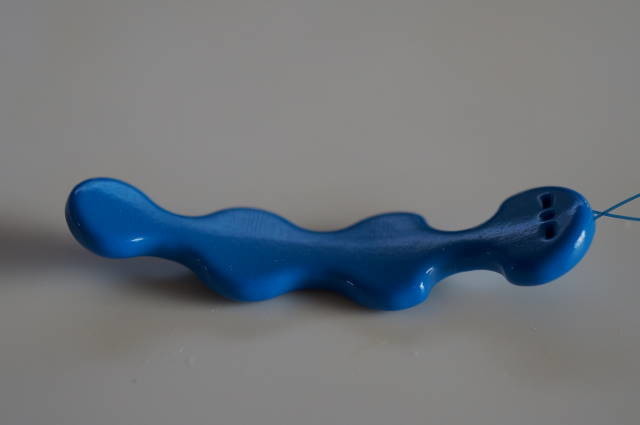
A reverse-curved chip's sphincter passage varied between the maker's tests
In an entry published in June 2024, Mr. Okada described inconsistent passage with a reverse-curved, wire-linked chip. His SS and S versions had worked, but an M version would not pass on one occasion.
He said ordinary chips up to L had been easier, attributing added resistance to the reverse bend. He suspected changing moisture levels explained the inconsistent results. Mr. Okada's advice focused on lubrication; the failure's cause remained unconfirmed.
(Source: ok-lab's diary, published June 2024)
https://ok-lab.hatenablog.com/entry/2024/06/29/123044
A small guide loop eased sphincter passage in the maker's test
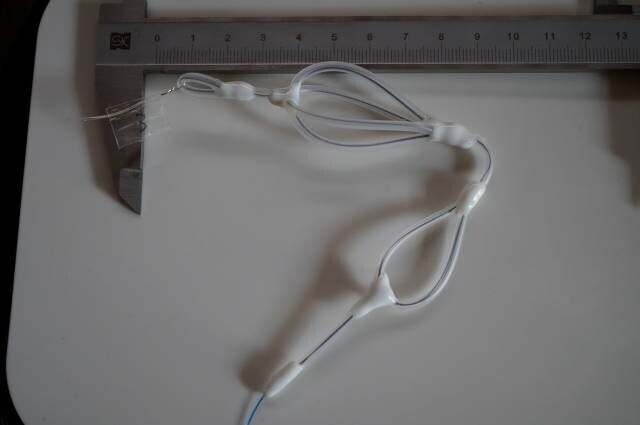
In an entry published in February 2025, Mr. Okada reported difficulty with a 0.4mm wire chipless device (loops replacing a solid chip). He tested a 0.3mm wire guide loop (a leading loop intended to ease passage). He reported that the sphincter difficulty disappeared in testing.
He offered both a direct guide-loop design and a version based on a shortened bladder loop. Mr. Okada favors the addition for his own 0.4mm device while acknowledging that requirements differ between users.
(Source: ok-lab's diary, published February 2025)
https://ok-lab.hatenablog.com/entry/2025/02/22/122939
The maker's answer to getting past the urethral sphincter
Mr. Okada treats the difficulty as a question of design and conditions, with limits on what each aid can accomplish.
Steel-wire assistance could buckle before successful urethral sphincter passage
In an entry published in September 2019, a beginner asked whether magnetic assistance could make placement easier. Mr. Okada doubted that a magnet would provide enough force at the sphincter, although he considered possible supporting uses.
He described steel-thread assistance as useful before that point, but said the thread could simply buckle at the sphincter. He distinguished direct control of the chip from force transmitted through its thread. Mr. Okada advises against relying on the wire alone at the sphincter.
(Source: ok-lab's diary, published September 2019)
https://ok-lab.hatenablog.com/entry/2019/09/14/143710
Extra chip length was not the maker's answer to sphincter resistance
In an entry published in November 2022, a correspondent proposed a longer, thinner chip for beginners struggling to reach the prostate. Mr. Okada was reluctant, describing long, thin, minimally curved designs as especially dangerous in his experience.
He explained his design rule: chips measuring 40mm or more required curvature. He mentioned curved or flexible possibilities, but did not endorse the proposed long, nearly straight shape. Mr. Okada advises against greater length as a beginner's solution to difficult passage.
(Source: ok-lab's diary, published November 2022)
https://ok-lab.hatenablog.com/entry/2022/11/12/122932
A guide wire's limited role ended before urethral sphincter passage
In an entry published in December 2024, Mr. Okada tested a guide wire (a temporary aid for guiding a loop-based device). He reported a sharp sensation when its tip reached the sphincter, and inconsistent results farther along.
His cautious proposal limited wire guidance to the approach and emphasized awareness of the device's position by touch. The 0.4mm wire cost ¥3,000 (about $19 at ¥156 = $1, rate as of 2026-09-04) excluding tax at either 30cm or 40cm, as published that month. Mr. Okada recommends limiting the wire's role to guidance toward the sphincter.
(Source: ok-lab's diary, published December 2024)
https://ok-lab.hatenablog.com/entry/2024/12/07/122832
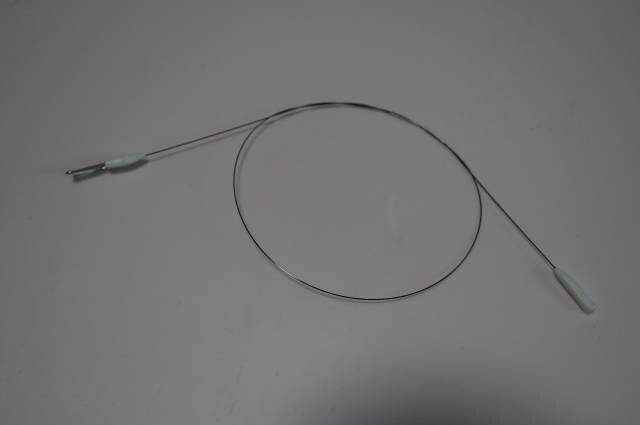
Sphincter stoppers could complicate chip placement for a first-time buyer
In an entry published in April 2025, a first-time buyer said repeated attempts had made progress harder. They also questioned their sphincter stopper (an additional part intended to limit inward movement).
Mr. Okada associated repeated attempts with drying, and linked sphincter resistance to tension and insufficient moisture. He thought the stopper could add substantial difficulty and proposed assessing the main chip separately from that added complication. The diary does not record whether the revised arrangement worked. Mr. Okada also advises medical consultation for the customer's concern about possible prostate inflammation.
(Source: ok-lab's diary, published April 2025)
https://ok-lab.hatenablog.com/entry/2025/04/26/122909
If you see blood in your urine, even a small amount or for the first time, do not wait and see. See a urologist right away. If you suddenly cannot urinate, or the device cannot be removed, do not try to fix it yourself. Go to a medical facility, including emergency care, immediately.
How getting past the urethral sphincter changed over time
| Published | What the diary said then |
|---|---|
| Mar 2018 | Mr. Okada considered stopping sales after hospital removal, but did not immediately do so. |
| Sep 2019 | Mr. Okada described semi-long chips as easier to locate by touch than short chips. |
| Sep 2021 | The 15mm blue-resin traction chip was offered in SS, S, M, and L. |
| Nov 2022 | A curved-tail extension made a short ceramic chip approximately 45mm long. |
| Mar 2024 | Mr. Okada reported easier passage with a flexible prototype curved approximately 90 degrees. |
| Jan 2025 | A staggered design shortened the secondary loop by about 2mm to change passage. |
| Feb 2025 | Guide-loop additions cost ¥2,000 (about $13 at ¥156 = $1, rate as of 2026-09-04) for direct and ¥3,000 (about $19 at ¥156 = $1, rate as of 2026-09-04) for bladder-loop versions, excluding tax. |
| Jan 2026 | Mr. Okada reported that jointed prototypes followed the urethral curve more easily. |
| Apr 2026 | A sliding-tip prototype's 0.4mm or 0.5mm core wire lacked sufficient stiffness for sphincter passage. |
| Jun 2026 | Mr. Okada reported difficult passage and severe illness during a screw-tipped prototype test. |

OK Prostate Chip products related to getting past the urethral sphincter
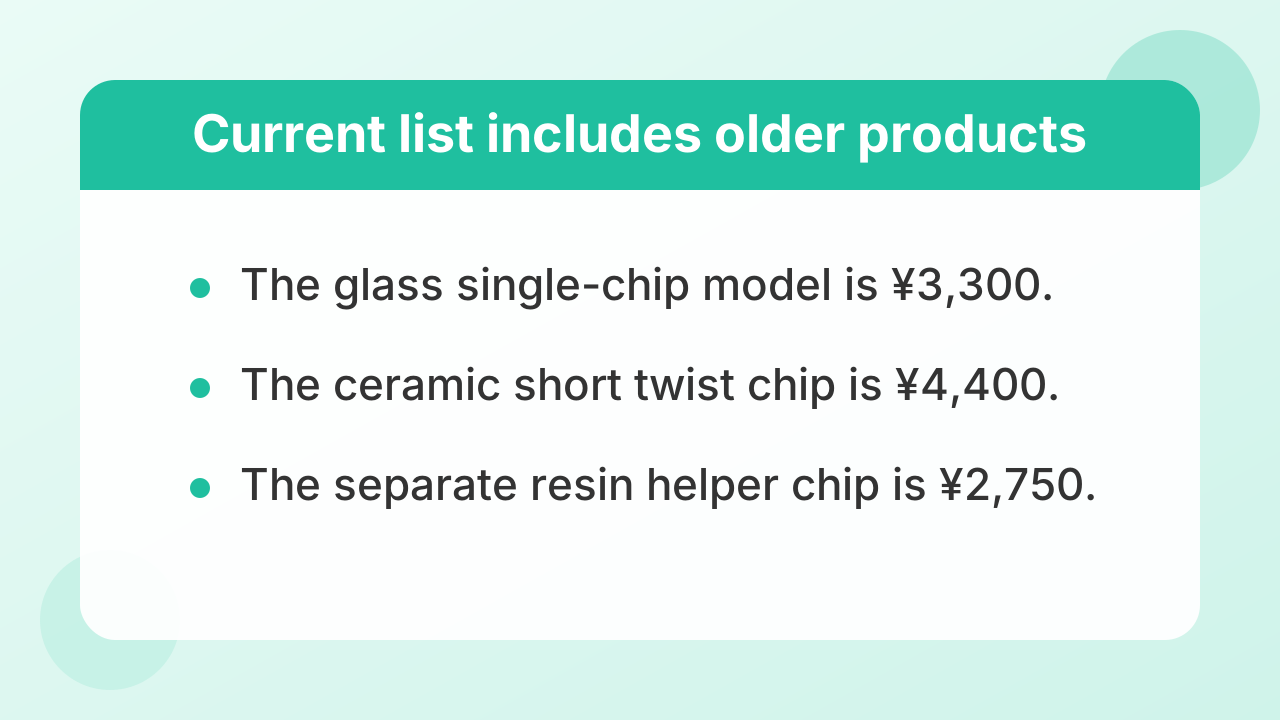
The current list includes some older products discussed in these accounts.
Products that appear in these entries
| Product (official name) | Price incl. tax | Relation to this topic |
|---|---|---|
| Glass single-chip model (OKプロステートチップ ガラス素材1チップタイプ) | ¥3,300 (about $21 at ¥156 = $1, rate as of 2026-09-04) | A November 2019 customer described difficult placement followed by the chip coming out during urination. |
| Ceramic short twist chip (OKプロステートチップ 陶器素材ショートタイプ ツイスト) | ¥4,400 (about $28 at ¥156 = $1, rate as of 2026-09-04) | A December 2020 beginner questioned this model's suitability after repeated unsuccessful attempts. |
(Source: ok-lab's diary, published November 2019)
https://ok-lab.hatenablog.com/entry/2019/11/09/132111
(Source: ok-lab's diary, published December 2020)
https://ok-lab.hatenablog.com/entry/2020/12/12/124126
Products the diary mentioned as alternatives
| Product (official name) | Price incl. tax | Relation to this topic |
|---|---|---|
| Separate resin helper chip (OKプロステートチップ 樹脂素材セパレートタイプ♀チップ) | ¥2,750 (about $18 at ¥156 = $1, rate as of 2026-09-04) | In March 2018, Mr. Okada proposed this helper when a leading chip alone could not cross the sphincter. |
(Source: ok-lab's diary, published March 2018)
https://ok-lab.hatenablog.com/entry/20180317/1521275320
For the historical named designs, prototypes, and custom configurations: No matching product can be confirmed on the current list.
Common worries about getting past the urethral sphincter
The questions concern placement, rotation, and added strength; the recorded outcomes differ.
"Does a chip slipping back mean sphincter passage failed?"
In an entry published in November 2019, a glass single-chip customer reported sensations they associated with reaching the prostate. The chip later came out during urination, and they wanted a model that stayed in place longer.
Mr. Okada mentioned longer and curved-tail shapes, but said no chip guaranteed unchanged positioning during urination. The diary does not record which replacement, if any, this customer bought. Mr. Okada advises against forcing a return to the earlier position when it becomes difficult.
(Source: ok-lab's diary, published November 2019)
https://ok-lab.hatenablog.com/entry/2019/11/09/132111
"Does chip rotation explain trouble getting past the urethral sphincter?"
In an entry published in October 2021, a customer reported initial success followed by failures with a sharply curved version 4 chip. They wondered whether turns of 90 or 180 degrees explained the change. Their standard semi-long SS chip had worked.
Mr. Okada associated sharper curvature with greater pressure and rotation within the passage. No subsequent success with that model is recorded. His advice emphasized alignment near the sphincter without requiring one orientation throughout the route.
(Source: ok-lab's diary, published October 2021)
https://ok-lab.hatenablog.com/entry/2021/10/02/125825
"Can stronger wire solve trouble getting past the urethral sphincter?"
In an entry published in April 2025, a customer reported failed placement with a custom 0.4mm double-wire, double-loop build. OK Lab suggested assistance, and the customer's follow-up confirmed eventual placement. The customer reported chills, limiting use to under 30 minutes.
Mr. Okada suspected an imbalance between front-loop stiffness and rear-section flexibility. He recommends modest configurations over the strongest construction.
(Source: ok-lab's diary, published April 2025)
https://ok-lab.hatenablog.com/entry/2025/04/12/122910
Buying from outside Japan
OK Lab ships internationally to countries covered by Japan Post's EMS courier service. Overseas orders are paid in advance by PayPal. Each order carries a ¥400 (about $3 at ¥156 = $1, rate as of 2026-09-04) handling fee, and EMS shipping is charged on top. These terms come from OK Lab's official sales-terms page (written here as plain text, not a link: ok-lab.net/docs/law), checked on September 7, 2026; confirm them on the official store before you order, because they can change.
Summary of this article
| What you wanted to know | The answer |
|---|---|
| Why might the chip stop? | Mr. Okada discusses shape, alignment, tension, and moisture. |
| What is the product? | A urethral device made by OK Lab in Japan. |
| What is the sphincter? | The urine-control muscle near the bend before the prostate. |
| What happened in the cases? | Accounts include progress, inconsistent passage, and hospital removal. |
| What does the maker suggest? | His proposals address specific obstacles; added components can complicate placement. |
| What changed over time? | Designs progressed through altered curves, wire aids, loops, and flexible joints. |
| Which prices are current? | Glass single-chip ¥3,300 (about $21 at ¥156 = $1, rate as of 2026-09-04); ceramic short twist ¥4,400 (about $28 at ¥156 = $1, rate as of 2026-09-04); resin helper ¥2,750, (about $18 at ¥156 = $1, rate as of 2026-09-04) including tax. |
| Do reader reports promise success? | The correspondence records differing results and unresolved cases. |
| How do overseas orders work? | Advance PayPal payment, a ¥400 (about $3 at ¥156 = $1, rate as of 2026-09-04) handling fee, and additional EMS shipping. |
| What remains uncertain? | Not every failure's cause or customer's outcome is established. |
Source: ok-lab's diary (Okada Comfortable Life Laboratory). The original entries are in Japanese; quotations on this page are translated. Photos and videos are on the original entries.
This article is a summary of the maker's development diary. The product is not a medical device and no result is guaranteed. If anything feels wrong or worries you, see a doctor. Prices, specifications and cautions change, so confirm the latest information on the official blog and the official site. Questions about ordering and shipping go to the seller.