![Can a wire or tube help when the chip won't go in? | Sometimes, with serious limits [OK Prostate Chip]](/img/a/T0075/eyecatch.svg)
This page is based on entries from "ok-lab's diary" (https://ok-lab.hatenablog.com/), the Japanese development diary written by Mr. Okada, founder of OK Lab, a small company in Japan (Okada Comfortable Life Laboratory). Only the entries about "pushing the chip in with wires, catheters, or straws" are summarized here, in order of publication. Past prices and sizes are as written at the time. Current prices come from the official product list (retrieved September 4, 2026). Quotations are translated from Japanese.
This article is about pushing the chip in with a wire, tube, or straw, and summarizes customer reports, the maker's proposals, and limits. It includes changes over time, serious problems, current products, common worries, and buying from outside Japan.
Note: This page is a personal reading log by someone with no connection to the maker or the seller. It reflects the source entries as of their publication dates and makes no guarantee of accuracy or safety. The product is not a medical device; talk to a doctor about any health decision. Check the official site for current information. This page contains advertising.
In short
Wire, catheter, and straw reports include successful placement, failed attempts, bleeding, and difficulty removing devices.
Mr. Okada developed insertion aids, but also rejected excessive stiffness and warned about damage to delicate devices.
The multipurpose stainless-steel wire remains on the current product list at ¥550 (about $4 at ¥156 = $1, rate as of 2026-09-04) including tax.
If you see blood in your urine, even a small amount or for the first time, do not wait and see. See a urologist right away. If you suddenly cannot urinate, or the device cannot be removed, do not try to fix it yourself. Go to a medical facility, including emergency care, immediately.
About this product
The OK Prostate Chip is a small device that is placed in the urethra (the urine passage) so that it acts on the prostate; the maker sells it in several shapes, sizes and materials. It is made and sold by OK Lab (Okada Comfortable Life Laboratory), a small company in Japan, through its own online store, and prices are in Japanese yen (JPY). The maker's development diary, "ok-lab's diary", is written in Japanese. This page is an English summary of it, and every quotation is translated. OK Lab ships internationally, so readers outside Japan can order (see "Buying from outside Japan" below). Product names on this page are plain-English descriptions. The official Japanese product name is shown once in the product table so you can find the same item in the store.
Before you read: key terms
| Term | Plain-English meaning |
|---|---|
| Urethra | The urine passage, where the chip and insertion aids are placed. |
| Milking | Manual positioning intended to advance a chip. |
| Catheter | A urine-drainage tube discussed here as an insertion aid. |
| Pushing wire | A wire tool intended to advance a chip. |
| Retrieval thread | Thread attached to a chip for removal. |
| Sheath | A sleeve supporting a device extension during placement. |
| Chipless device | A flexible wire-loop design for placement around the prostate. |
| Nitinol | Shape-memory wire material used for flexible tools and loop devices. |
| Sphincter | A muscular closure; its resistance matters in the diary's placement reports. |
| Urethral sound | An insertion instrument discussed as an alternative for reaching the prostate area. |
What happens: pushing a prostate chip in
The OK Prostate Chip is a small device placed in the urethra (the urine passage) to act on the prostate. These entries discuss tools intended to advance it when manual placement proves difficult. A catheter (a urine-drainage tube) or pushing wire may contact the chip inside that passage. Later straw designs serve as a sheath (supporting sleeve) around a short extension on a flexible loop device.
Catheter-assisted chip insertion succeeded in one report but raised a warning about excessive depth
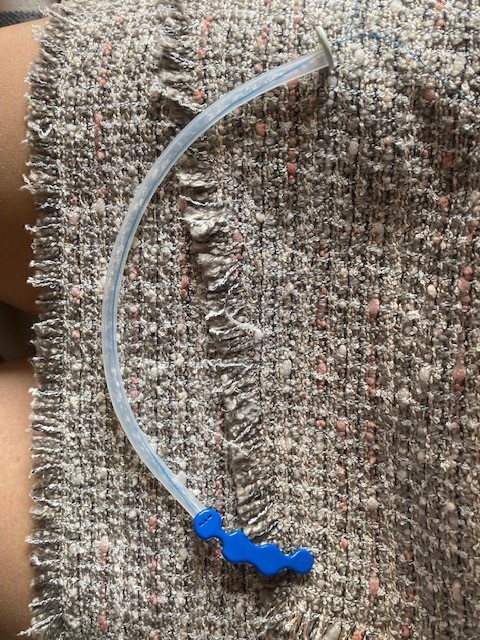
In an entry published in February 2018, a customer reported successful catheter-assisted placement after struggling with milking (manual chip positioning). Mr. Okada reproduced the idea with silicone tubing, but said he had not tested a medical catheter. He also discussed the possibility of an entire chip entering the bladder. Mr. Okada cautioned against excessive depth and described tools as a temporary aid.
(Source: ok-lab's diary, published February 2018)
https://ok-lab.hatenablog.com/entry/20180224/1519457027
A stiffer cable was built for chip insertion, but comfort remained unreported
In an entry published in October 2019, a customer requested a stiffer cable for a vibrating chip. Mr. Okada built a 20 cm section from paired 1.6 mm wires, initially without an extra charge. Future processing fees became ¥1,000 (about $6 at ¥156 = $1, rate as of 2026-09-04) excluding tax; the diary does not record the customer's experience. Mr. Okada suggested limiting the stiff section because rigid cable could be awkward outside the body.
(Source: ok-lab's diary, published October 2019)
https://ok-lab.hatenablog.com/entry/2019/10/12/125944
Wire-assisted chip insertion was followed by difficult removal and bleeding in a prototype test
In an entry published in February 2021, Mr. Okada described testing a flexible stainless-steel ring prototype with a wire aid. The prototype measured 12 cm long and 5.6 mm across. He reported difficulty removing it after four hours, followed by blood on the device and discomfort during urination. Mr. Okada wrote that he planned to suspend chip testing temporarily.
(Source: ok-lab's diary, published February 2021)
https://ok-lab.hatenablog.com/entry/2021/02/27/130152
A recessed pushing wire improved contact but still sometimes slipped
In an entry published in February 2022, a customer described results with a custom wire designed to make pushing easier. The customer reported occasional overlap between tool and chip, but said the recessed end improved contact. Mr. Okada welcomed the report and suggested that the useful recess shape depended on the chip's size and shape.
(Source: ok-lab's diary, published February 2022)
https://ok-lab.hatenablog.com/entry/2022/02/19/123621
A flexible wire for pushing introduced a different material and price
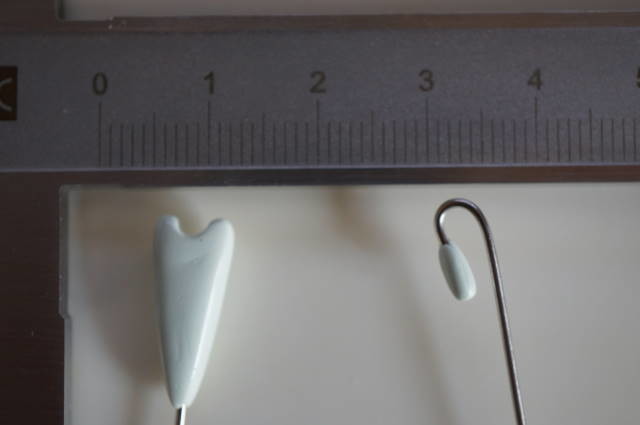
In an entry published in October 2024, Mr. Okada presented a wire made from nitinol (a shape-memory wire material). It used 0.4 mm wire, with 20 cm, 25 cm, and 30 cm lengths priced at ¥3,000 (about $19 at ¥156 = $1, rate as of 2026-09-04) excluding tax. The design could lie alongside the retrieval thread (thread attached for removal). Mr. Okada proposed both a thread-following role and ordinary pushing as possible uses.
(Source: ok-lab's diary, published October 2024)
https://ok-lab.hatenablog.com/entry/2024/10/19/122847
Straw-assisted pushing followed a move away from an exposed wire extension
In an entry published in March 2025, Mr. Okada abandoned an exposed extension for continuous wear because he feared contamination. He then reported a heart-failure episode while testing a shorter 9 cm design, which he attributed to excessive stimulation. He developed a shorter extension for the chipless device (a flexible wire-loop design), describing a straw as its supporting sleeve.
The extension cost ¥3,000 (about $19 at ¥156 = $1, rate as of 2026-09-04) excluding tax in that entry. Mr. Okada favored a short extension and restricted the earlier exposed version to short-term use.
(Source: ok-lab's diary, published March 2025)
https://ok-lab.hatenablog.com/entry/2025/03/15/122925
Rubber-coated clamps improved grip for chip insertion but introduced removal problems
In entries published in March 2026, Mr. Okada described successive versions of a spring-wire gripping aid. The second version gripped silicone parts but slipped on bare ceramic or resin. Its prices were ¥3,000 (about $19 at ¥156 = $1, rate as of 2026-09-04) excluding tax up to 20 cm, and ¥4,000 (about $26 at ¥156 = $1, rate as of 2026-09-04) excluding tax up to 30 cm.
The third version added rubber gripping surfaces, priced at ¥7,000 (about $45 at ¥156 = $1, rate as of 2026-09-04) and ¥9,000 (about $58 at ¥156 = $1, rate as of 2026-09-04) excluding tax for those respective lengths. Mr. Okada reported added bulk, thread tangling, and chips moving with the tool during withdrawal. He favored the second version for easier tool withdrawal, while describing the third as easier for initial placement.
(Source: ok-lab's diary, published March 2026)
https://ok-lab.hatenablog.com/entry/2026/03/14/122910
(Source: ok-lab's diary, published March 2026)
https://ok-lab.hatenablog.com/entry/2026/03/21/122906
Persistent chip insertion attempts ended in bleeding and hospital treatment
In an entry published in May 2026, a customer sought alternatives after repeated failed placement attempts led to bleeding. The customer reported a fever of 39.4 degrees, acute kidney and prostate infections, and three days in hospital.
Mr. Okada discussed flexible urethral sounds (insertion instruments), a multipurpose wire, and a silicone-covered cable. The diary does not record whether the customer tried another device afterward. Mr. Okada said further product advice depended on understanding the customer's difficulties.
(Source: ok-lab's diary, published May 2026)
https://ok-lab.hatenablog.com/entry/2026/05/16/122906
The maker's answer to pushing a prostate chip in
Mr. Okada's proposals address stiffness, contact, and device shape, with limits that differ by design.
A thicker pushing wire was refused because Mr. Okada considered it dangerous
An entry published in January 2022 records a request for a stiffer custom wire after difficulty positioning the chip. Mr. Okada declined the requested 2–3 mm diameter, calling it too rigid and dangerous; the existing wire was 0.7 mm.
Custom pricing became ¥2,000 (about $13 at ¥156 = $1, rate as of 2026-09-04) excluding tax, compared with ¥500 (about $3 at ¥156 = $1, rate as of 2026-09-04) excluding tax for the ordinary wire. Mr. Okada limited the custom diameter to 1 mm, rejecting greater stiffness as unsuitable for this request.
(Source: ok-lab's diary, published January 2022)
https://ok-lab.hatenablog.com/entry/2022/01/29/123455
Silicone tubing for chip insertion reflected a shift in the maker's assumptions
In an entry published in February 2022, Mr. Okada reconsidered his belief that difficulty with milking mainly reflected inexperience. He acknowledged that individual differences might matter, and developed a silicone-tube aid.
The kit contained a 25 cm tube with 5 mm outer diameter, plus a 30 cm, 0.5 mm wire. Its price was ¥1,000 (about $6 at ¥156 = $1, rate as of 2026-09-04) excluding tax. Mr. Okada cautioned that silicone had substantial friction and that the thread could move with the tube during withdrawal.
(Source: ok-lab's diary, published February 2022)
https://ok-lab.hatenablog.com/entry/2022/02/19/123621
Guide wire testing for prostate devices led to a narrower role after uncomfortable results
In an entry published in December 2024, Mr. Okada tested a guide wire intended for chipless devices. He reported stinging near the sphincter (a muscular closure), and said deeper placement did not always work. The design used 0.4 mm shape-memory wire, with 30 cm or 40 cm lengths at ¥3,000 (about $19 at ¥156 = $1, rate as of 2026-09-04) excluding tax. His final recommendation limited the guide's role to the approach to the sphincter.
(Source: ok-lab's diary, published December 2024)
https://ok-lab.hatenablog.com/entry/2024/12/07/122832
Pushing wires were specifically discouraged for a delicate custom device
In an entry published in June 2026, Mr. Okada tested a delicate wire device with a front-mounted screw chip. He reported difficult placement and an episode he described as heart failure after 5–10 minutes. He completed the customer's separate build after testing his own version; prolonged use had not been tested. Mr. Okada warned that ordinary pushing wires and his gripping aids could easily break the delicate structure.
(Source: ok-lab's diary, published June 2026)
https://ok-lab.hatenablog.com/entry/2026/06/06/122905
Repositioning screw parts changed the proposed role of pushing wires
In an entry published in June 2026, Mr. Okada described a revised layout with screw parts behind the delicate wire structure. He suggested that this layout might allow a pushing-wire aid, unlike the front-mounted version discussed earlier that month. Mr. Okada specified that the screw parts were not intended to cross the sphincter.
(Source: ok-lab's diary, published June 2026)
https://ok-lab.hatenablog.com/entry/2026/06/13/122909
If you see blood in your urine, even a small amount or for the first time, do not wait and see. See a urologist right away. If you suddenly cannot urinate, or the device cannot be removed, do not try to fix it yourself. Go to a medical facility, including emergency care, immediately.
How pushing a prostate chip in changed over time
| Published | What the diary said then |
|---|---|
| Sep 2019 | Mr. Okada reported that stainless-steel thread bent at the sphincter. |
| Jan 2021 | A multipurpose 0.7 mm wire appeared at ¥500 (about $3 at ¥156 = $1, rate as of 2026-09-04) excluding tax. |
| Sep 2021 | Wire snagging led Mr. Okada to withdraw the easy-placement claim. |
| Feb 2022 | A dedicated wire gained separate ends for nylon-thread and cable-equipped chips. |
| Aug 2023 | Staff warned that jointed connections added bulk; Mr. Okada proposed thinner cable. |
| Mar 2025 | A loop-ended extension added a proposed retrieval role for a straw sleeve. |
| Apr 2025 | A split-straw prototype addressed buckling in a 0.2 mm extension. |
| Nov 2025 | An articulated nitinol-and-nylon design measured about 4 mm, versus earlier 6 mm joints. |
| Jul 2026 | Separate stopper plates replaced a proposed one-piece cylinder for a custom cable assembly. |
| Aug 2026 | The customer selected two stopper plates, and the custom electrode assembly was completed. |
OK Prostate Chip products related to pushing a prostate chip in
The current list includes the long ceramic vibrating chip and the multipurpose stainless-steel wire.
Products featured in these entries about chip insertion
| Product (official name) | Price incl. tax | Relation to this topic |
|---|---|---|
| Long ceramic vibrating chip (OKプロステート核振チップ 陶器素材ロングタイプ) | ¥8,800 (about $56 at ¥156 = $1, rate as of 2026-09-04) | A February 2022 customer asked about a stiffer cable for this model; Mr. Okada discouraged that cable because handling was awkward. |
(Source: ok-lab's diary, published February 2022)
https://ok-lab.hatenablog.com/entry/2022/02/26/123231
Products the diary discussed as alternatives for chip insertion
| Product (official name) | Price incl. tax | Relation to this topic |
|---|---|---|
| Multipurpose stainless-steel wire (多目的ステンレスワイヤー) | ¥550 (about $4 at ¥156 = $1, rate as of 2026-09-04) | In May 2026, Mr. Okada mentioned this wire as an alternative to difficult manual placement, without determining its suitability for that customer. |
(Source: ok-lab's diary, published May 2026)
https://ok-lab.hatenablog.com/entry/2026/05/16/122906
Other custom builds, old versions, and prototypes described here:
No matching product can be confirmed on the current list.
Common worries about pushing a prostate chip in
The replies discuss possible aids, but also describe failed approaches and uncertain individual results.
"Will an insertion cable make a vibrating chip easier to place?"
In an entry published in February 2022, a customer asked about a stiff cable for the long ceramic vibrating chip. Mr. Okada quoted ¥500 (about $3 at ¥156 = $1, rate as of 2026-09-04) excluding tax per 10 cm, with ¥1,000 (about $6 at ¥156 = $1, rate as of 2026-09-04) for 20 cm. The diary does not record whether this proposed cable order was completed. Because he found rigid cables awkward, Mr. Okada favored his newly proposed dedicated pushing wire instead.
(Source: ok-lab's diary, published February 2022)
https://ok-lab.hatenablog.com/entry/2022/02/26/123231
"Could a catheter insertion aid hold the chip securely?"
In an entry published in February 2022, a customer proposed a remotely opening grip on a catheter. Mr. Okada said he lacked the technology for a soft mechanism only 6–7 mm wide when open. He proposed a simpler tube-and-thread concept instead; the diary does not record a working remote-control grip. His alternative came with a warning that withdrawing the tube could also move attached parts.
(Source: ok-lab's diary, published February 2022)
https://ok-lab.hatenablog.com/entry/2022/02/19/123621
"Can a shaped wire for pushing stop slipping past tubing?"
In an entry published in April 2024, a customer reported that a U-shaped tool sometimes slipped beside a tube-connected chip. The customer requested two C-shaped ends, with inner diameters of 6–8 mm and 5–7 mm. OK Lab made the tool, but the diary does not record the customer's experience with it. The staff cautioned that a close fit could drag the cable during tool withdrawal.
(Source: ok-lab's diary, published April 2024)
https://ok-lab.hatenablog.com/entry/2024/04/20/122856
"Does pushing with a straw guarantee that a flexible device will fit?"
In an entry published in April 2025, a customer struggled with a 0.4 mm double-wire, double-loop chipless build. Staff suggested a straw aid but warned it might not solve the problem. The customer later reported successful placement after further attempts, followed by chills from what they described as excessive stimulation. Use lasted less than 30 minutes; Mr. Okada advised a less powerful initial specification.
(Source: ok-lab's diary, published April 2025)
https://ok-lab.hatenablog.com/entry/2025/04/12/122910
Buying from outside Japan
OK Lab ships internationally to countries covered by Japan Post's EMS courier service. Overseas orders are paid in advance by PayPal. Each order carries a ¥400 (about $3 at ¥156 = $1, rate as of 2026-09-04) handling fee, and EMS shipping is charged on top. These terms come from OK Lab's official sales-terms page (written here as plain text, not a link: ok-lab.net/docs/law), checked on September 7, 2026; confirm them on the official store before you order, because they can change.
Summary of this article
| What you wanted to know | The answer |
|---|---|
| Short answer? | Tools sometimes helped; failed placement and injury also occurred. |
| What is the product? | A urethral device made by OK Lab in Japan. |
| Key terms? | Wires, catheters, and sheaths have different supporting roles. |
| Reported outcomes? | Success, slipping, difficult removal, bleeding, and hospital treatment. |
| Maker's proposals? | Different tools and limits for different designs. |
| Changes over time? | Wires, sleeves, gripping aids, and custom supports. |
| Current products? | Ceramic vibrating chip: ¥8,800 (about $56 at ¥156 = $1, rate as of 2026-09-04); multipurpose wire: ¥550, (about $4 at ¥156 = $1, rate as of 2026-09-04) including tax. |
| Common uncertainties? | Fit, slipping, and missing follow-up reports. |
| Overseas buying? | Advance PayPal payment, ¥400 (about $3 at ¥156 = $1, rate as of 2026-09-04) handling, plus EMS shipping. |
| Overall finding? | Changing proposals and individual experiences, including serious problems. |
Source: ok-lab's diary (Okada Comfortable Life Laboratory). The original entries are in Japanese; quotations on this page are translated. Photos and videos are on the original entries.
This article is a summary of the maker's development diary. The product is not a medical device and no result is guaranteed. If anything feels wrong or worries you, see a doctor. Prices, specifications and cautions change, so confirm the latest information on the official blog and the official site. Questions about ordering and shipping go to the seller.