![What are the electrodes made of, and can wires fail? | Materials and connections both changed [OK Prostate Chip]](/img/a/T0067/eyecatch.svg)
This page is based on entries from "ok-lab's diary" (https://ok-lab.hatenablog.com/), the Japanese development diary written by Mr. Okada, founder of OK Lab, a small company in Japan (Okada Comfortable Life Laboratory). Only the entries about "electrode materials and wiring" are summarized here, in order of publication. Past prices and sizes are as written at the time. Current prices come from the official product list (retrieved September 4, 2026). Quotations are translated from Japanese.
Note: This page is a personal reading log by someone with no connection to the maker or the seller. It reflects the source entries as of their publication dates and makes no guarantee of accuracy or safety. The product is not a medical device; talk to a doctor about any health decision. Check the official site for current information. This page contains advertising.
In short
- The diary records aluminum and stainless-steel electrodes, difficult electrical joints, and cables that failed.
- Mr. Okada developed reinforced connections and warned about electrical risks in circuits without standard pads.
- Current listings include named components, but the historical custom electrode assemblies have no confirmed matching listing.
If you see blood in your urine, even a small amount or for the first time, do not wait and see. See a urologist right away. If you suddenly cannot urinate, or the device cannot be removed, do not try to fix it yourself. Go to a medical facility, including emergency care, immediately.
About this product

The OK Prostate Chip is a small device that is placed in the urethra (the urine passage) so that it acts on the prostate; the maker sells it in several shapes, sizes and materials. It is made and sold by OK Lab (Okada Comfortable Life Laboratory), a small company in Japan, through its own online store, and prices are in Japanese yen (JPY). The maker's development diary, "ok-lab's diary", is written in Japanese. This page is an English summary of it, and every quotation is translated.
OK Lab ships internationally, so readers outside Japan can order (see "Buying from outside Japan" below). Product names on this page are plain-English descriptions. The official Japanese product name is shown once in the product table so you can find the same item in the store.
Before you read: key terms
| Term | Plain-English meaning |
|---|---|
| Electrode | An electrical contact used to deliver current; these entries describe aluminum surfaces and stainless-steel chips. |
| Resin | Material used for chip bodies and for securing or covering electrical connections. |
| Crimping | A pressure-held joint used to connect conductive materials without solder. |
| Soldering | A joint made with solder, used to connect wiring to metal components. |
| Male plug / female socket | Projecting and receiving connectors used to join separate cable sections. |
| Parallel cable | Paired wires joined side by side, providing electrical connections and mechanical support. |
| Nylon-thread cable | Fine wiring twisted with nylon thread, combining electrical connection with thread reinforcement. |
| Snap-button connector | A press-together electrical contact used between chip wiring and the stimulation unit's cable. |
| Capacitor | A component Mr. Okada describes as blocking direct current; he attributes a protective function to pads acting this way. |
| Silicone tubing | A flexible sleeve used to protect fine electrode wiring. |
| USB | A connector format considered for cable connections. The diary does not explain this. |
What happens: electrode materials and wiring
The OK Prostate Chip is a small device placed in the urethra to act on the prostate. These entries describe electrodes (electrical contacts) made from aluminum on resin (a hard-setting material), or from stainless-steel chips themselves. Cables carry current from an external stimulation unit to the chip, with connectors outside the body. The diary covers urethral and rectal designs, including failed connections, changed materials, and custom connector requests.
Early aluminum electrode proposals raised concerns about pads, corrosion, and pain
In an entry published in December 2018, a customer requesting a rectal electrode chip reported repeated pad failures: poor durability and unreliable current delivery. They reported green deposits, reduced conduction, and surrounding staining with copper-containing metal, and favored crimping (pressure-held joints) over soldering (joints bonded with solder). They considered lead-free solder essential; their preferred exposed width was 1cm–1.5cm, reporting severe pain below 1cm and weaker stimulation when wider.
They preferred a male plug (projecting connector) on the chip and an intermediate female socket (receiving connector), citing easier washing and sudden-pull protection. Mr. Okada initially considered small pads, then produced a metal-electrode prototype; electrical testing awaited delivery of his stimulation unit. His initial reply made acceptance conditional on checking whether the resin and wiring would bond.
(Source: ok-lab's diary, published December 2018)
https://ok-lab.hatenablog.com/entry/20181208/1544250742
Internal stainless-steel electrode connections required larger rings and extra work
In an entry published in March 2021, a customer wanted stainless-steel ring electrodes with more exposed metal and less digging into tissue. Mr. Okada rejected thin internal supports as too weak and produced a design with thicker resin inside the ring. It required an outside diameter of at least 5.6mm and added ¥500 (about $3 at ¥156 = $1, rate as of 2026-09-04) excluding tax per chip. Mr. Okada restricted internal connections to that size range because the resin needed room.
(Source: ok-lab's diary, published March 2021)
https://ok-lab.hatenablog.com/entry/2021/03/13/130202
ShapeMate electrode cables needed crimping, and only current flow was tested
In an entry published in May 2021, a customer wanted an electrode chip connected to ShapeMate, an electrical stimulation device. OK Lab initially offered to examine the supplied cable, while warning that modification might prove impossible and operation could not be guaranteed. Inside, Mr. Okada found fibrous bundles without a remaining metal core; he suspected conductive nonmetal fibers and found soldering unsuitable.
A crimped connection was completed, but a meter confirmed only that current could pass. Mr. Okada urged caution about urethral use.
(Source: ok-lab's diary, published May 2021)
https://ok-lab.hatenablog.com/entry/2021/05/01/130245
Intermittent electrode current left a cable fault suspected but unexplained
In an entry published in May 2022, a customer reported intermittent current from a resin chip containing 3 motors and 2 electrodes. Current cut in and out when the wire near its base bent, prompting a replacement request. Mr. Okada suspected cable breakage because the electrodes simply held copper wire against aluminum tape, but he could not explain the failure.
The diary does not record whether the replacement was completed. Mr. Okada left a stronger cable proposal under study because a suitable material had not been found.
(Source: ok-lab's diary, published May 2022)
https://ok-lab.hatenablog.com/entry/2022/05/28/123218
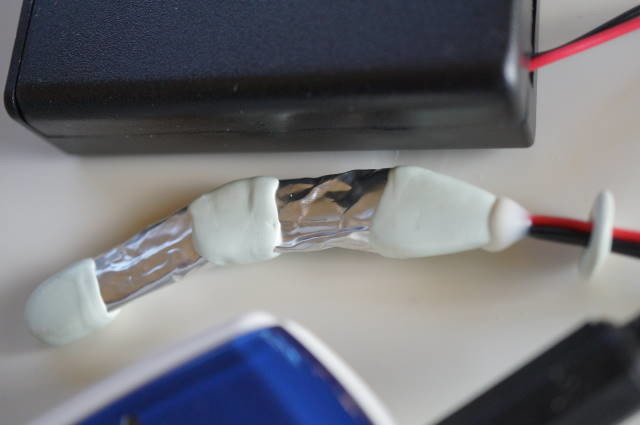
Stainless-steel electrode soldering became possible after repeated failures and cable changes
In an entry published in August 2023, Mr. Okada revisited a request that OK Lab had initially declined over soldering difficulties. After repeated failures, he reported stable soldered joints using nylon-thread cable (fine wiring twisted with nylon for support). The trial specification included a 25cm cable, a snap-button connector (press-together electrical contact), and 10cm of double thread afterward.
The published surcharge was ¥4,000 (about $26 at ¥156 = $1, rate as of 2026-09-04) excluding tax, added to the ordinary stainless-steel chip price. The diary does not record the original customer's experience with the finished electrode. Mr. Okada also offered unfinished cable ends, but required accompanying nylon thread for his strength guarantee.
(Source: ok-lab's diary, published August 2023)
https://ok-lab.hatenablog.com/entry/2023/08/26/122534
An aluminum electrode redesign followed early failure of a single-wire link
In an entry published in August 2024, Mr. Okada recalled an early two-chip prototype whose single connecting wire had failed quickly. He had judged that arrangement impractical. His new design retained parallel cable (paired wires joined side by side) between the chips, alongside nylon reinforcement.
The minimum published price was ¥10,000 (about $64 at ¥156 = $1, rate as of 2026-09-04) excluding tax, covering 2 short chips, electrode work, cable connections, connecting thread, and the plug connection. Mr. Okada suggested shorter chip lengths for beginners when discussing that custom design.
(Source: ok-lab's diary, published August 2024)
https://ok-lab.hatenablog.com/entry/2024/08/10/122913
Mr. Okada reported firm stainless-steel electrode connections with parallel cable
In an entry published in December 2024, a customer selected a ridged stainless-steel chip for a custom electrode assembly. Mr. Okada reported a firm electrical connection between stainless steel and parallel cable, with an intermediate wire joining them. He then began accepting requests for this connection, extending the earlier approach based on nylon-thread cable.
Electrical connection work carried an additional charge beyond ordinary cable attachment. OK Lab required an individual quotation based on the requested configuration.
(Source: ok-lab's diary, published December 2024)
https://ok-lab.hatenablog.com/entry/2024/12/07/122832
The maker's answer to electrode materials and wiring
Mr. Okada's responses focused on reinforcement, protected cable connections, and limits on electrical configurations.
Experimental electrode connections included nylon reinforcement because rubber strength was unproven
In an entry published in January 2021, Mr. Okada presented linked stainless-steel rings with a screw-shaped auxiliary chip. Rubber-covered wiring supported flexible joints, with nylon thread through the full assembly because the rubber connection's strength was unproven.
One wire connected the rings, while two connected the second ring and auxiliary chip. Mr. Okada limited both cable and nylon thread to 30cm, and directed longer-cable requests toward commercially sold extensions.
(Source: ok-lab's diary, published January 2021)
https://ok-lab.hatenablog.com/entry/2021/01/02/123619
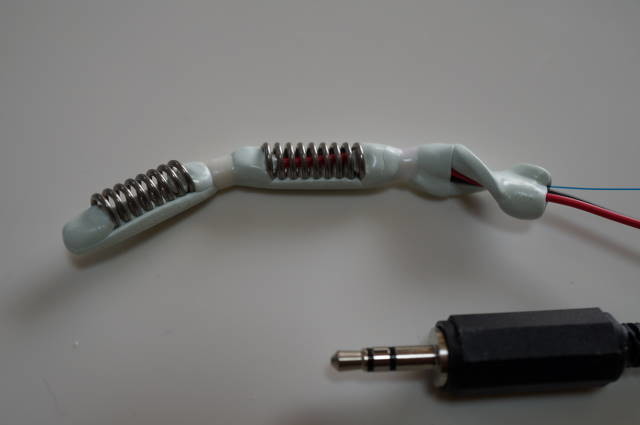
Mr. Okada warned that pad-free electrode circuits could deliver strong shocks
In an entry published in August 2023, Mr. Okada raised a warning about 2-electrode arrangements without a standard pad. He described a pad as functioning like a capacitor (a component he said blocked direct current), providing protection if the stimulation unit failed.
On that basis, he believed retaining a pad preserved a protective barrier. Mr. Okada warned that pad-free circuits lacked that barrier and could deliver a strong shock if the controller failed.
(Source: ok-lab's diary, published August 2023)
https://ok-lab.hatenablog.com/entry/2023/08/26/122534
Tube-covered electrode cables followed an initial refusal and a thicker prototype
In an entry published in October 2023, a customer asked for the fine electrode cable inside protective tubing. OK Lab initially declined: its existing tubing was too narrow, and securing a larger sleeve seemed difficult. Mr. Okada then completed a prototype using silicone tubing (a flexible protective sleeve), approximately 2mm inside and 4mm outside.
Production took about 5 days, with a ¥2,000 (about $13 at ¥156 = $1, rate as of 2026-09-04) surcharge excluding tax over the earlier stainless-steel electrode price. Mr. Okada reported greater stability and offered the thicker covering as protection for vulnerable cable connections.
(Source: ok-lab's diary, published October 2023)
https://ok-lab.hatenablog.com/entry/2023/10/07/123003
If you see blood in your urine, even a small amount or for the first time, do not wait and see. See a urologist right away. If you suddenly cannot urinate, or the device cannot be removed, do not try to fix it yourself. Go to a medical facility, including emergency care, immediately.
How electrode materials and wiring changed over time

| Published | What the diary said then |
|---|---|
| Apr 2019 | Two aluminum pieces formed one continuous electrode on a single-lobed chip. |
| Jan 2021 | Cable connections, flexible joints, and the stimulation-unit plug each cost ¥1,000 (about $6 at ¥156 = $1, rate as of 2026-09-04) excluding tax. |
| Mar 2021 | Flexible assemblies used linked short chips; the spring itself still could not bend. |
| Aug 2023 | Sales of the proposed USB connector version remained undecided. |
| Oct 2023 | A twin-electrode version inside 4mm tubing still awaited testing. |
| Jul 2024 | Expected delivery of the long ridged stainless-steel chip was cancelled pending remaking. |
| Aug 2024 | Optional covering between chips cost ¥1,000 (about $6 at ¥156 = $1, rate as of 2026-09-04) excluding tax, for lengths up to 10mm. |
| Aug 2024 | Elastic wire remained a future test candidate because solder would not bond to it. |
| Dec 2024 | Direct snap-button connections became possible without an intermediate USB connector. |
| Mar 2025 | The maker proposed linked electrodes; the connecting sections would not conduct current. |
OK Prostate Chip products related to electrode materials and wiring
The current list prices these named components; the diary's custom electrode assemblies had separate specifications and charges.
Products that appear in these entries
| Product (official name) | Price incl. tax | Relation to this topic |
|---|---|---|
| Short stainless-steel ring chip (OKプロステートチップ ステンレスリング ショートタイプ) | ¥3,300 (about $21 at ¥156 = $1, rate as of 2026-09-04) | January 2021: a customer's suggestion about this ring helped prompt the experimental electrode assembly. |
| Screw-shaped auxiliary chip (スクリュー型補助チップ追加オプション) | ¥3,300 (about $21 at ¥156 = $1, rate as of 2026-09-04) | January 2021: this auxiliary part formed the final section of the experimental assembly. |
| Ridged stainless-steel chip (OKプロステートチップ 凶悪ゾロ(サージカルステンレス)) | ¥9,900 (about $63 at ¥156 = $1, rate as of 2026-09-04) | December 2024: the customer selected this shape for the custom electrode with a new parallel-cable connection. |
(Source: ok-lab's diary, published January 2021)
https://ok-lab.hatenablog.com/entry/2021/01/02/123619
(Source: ok-lab's diary, published December 2024)
https://ok-lab.hatenablog.com/entry/2024/12/07/122832
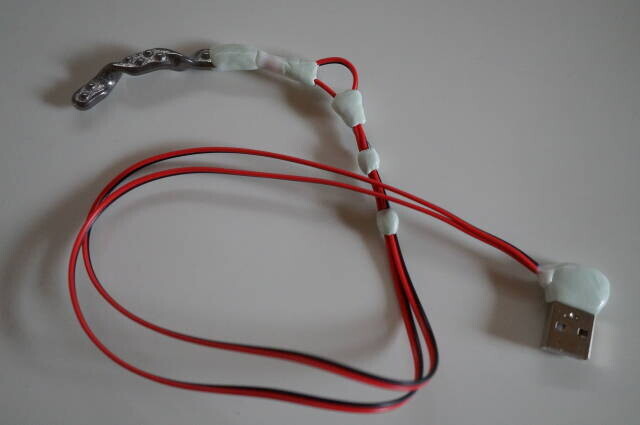
Products the diary mentioned as alternatives
The diary names no alternative.
Custom electrode assemblies and the long ridged stainless-steel version: No matching product can be confirmed on the current list.
Common worries about electrode materials and wiring
OK Lab's replies set limits on connector availability, exposed metal area, and cable strength.
"Can resin electrode cables use thin wiring and snap buttons?"
In an entry published in July 2024, a customer requested fine wiring and snap-button connectors on a resin electrode chip. OK Lab agreed to try, while warning that the thin cable could break more easily. Mr. Okada completed a prototype and reported that its electrical connections passed a meter test.
The diary does not record how the finished cable held up in use. OK Lab's reply favored tube reinforcement and warned that separate snap-button ends raised strength concerns.
(Source: ok-lab's diary, published July 2024)
https://ok-lab.hatenablog.com/entry/2024/07/20/123059
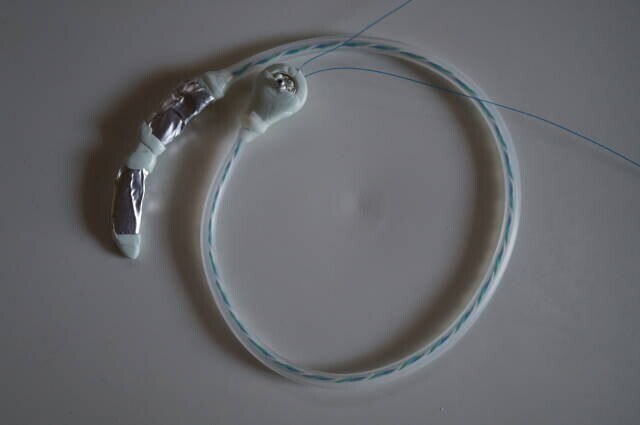
"Can small flat chips work as stainless-steel electrodes?"
In an entry published in July 2024, a customer proposed a narrow assembly using flat stainless-steel auxiliary chips as electrodes. Mr. Okada said a roughly 15mm part would need about 5mm at each end covered by resin. Its central opening would leave little metal touching tissue, so he rejected that part for this design.
He thought a different two-electrode assembly could be made, but did not accept the customer's full proposal. The diary does not record whether an order followed. Mr. Okada specified at least a short-chip-sized second section as the alternative.
(Source: ok-lab's diary, published July 2024)
https://ok-lab.hatenablog.com/entry/2024/07/27/122927
"Can an electrode cable have a 2.5mm plug?"
In an entry published in August 2024, a reader asked about a 2.5mm connector for a particular stimulation unit. Mr. Okada said suitable standalone parts were unavailable to him, so this was outside the normal service. The diary does not record a completed connector order. He offered paid work on a commercially supplied connector sent to OK Lab.
(Source: ok-lab's diary, published August 2024)
https://ok-lab.hatenablog.com/entry/2024/08/17/122842
Buying from outside Japan

OK Lab ships internationally to countries covered by Japan Post's EMS courier service. Overseas orders are paid in advance by PayPal. Each order carries a ¥400 (about $3 at ¥156 = $1, rate as of 2026-09-04) handling fee, and EMS shipping is charged on top. These terms come from OK Lab's official sales-terms page (written here as plain text, not a link: ok-lab.net/docs/law), checked on September 7, 2026; confirm them on the official store before you order, because they can change.
Summary of this article
| What you wanted to know | The answer |
|---|---|
| What is the main concern? | Both electrical contact and cable strength caused development problems. |
| What is the base product? | A small urethral device made and sold by OK Lab in Japan. |
| What do the technical terms describe? | Metal contacts, connecting joints, cable reinforcement, and external connectors. |
| What happened in the reported cases? | Some prototypes worked electrically; other cables failed or remained untested in use. |
| What did the maker propose? | Reinforcement, protective tubing, and caution about pad-free electrical circuits. |
| How did the designs change? | Later entries introduced new cable joints, coverings, and connector options. |
| What is listed today? | Named components appear in the current list; historical custom assemblies have no confirmed matching listing. |
| Can every requested connection be made? | Replies identify limits involving small contacts, thin cables, and connector parts. |
| How do overseas purchases work? | Advance PayPal payment, a handling fee, and additional EMS shipping charges. |
Source: ok-lab's diary (Okada Comfortable Life Laboratory). The original entries are in Japanese; quotations on this page are translated. Photos and videos are on the original entries.
This article is a summary of the maker's development diary. The product is not a medical device and no result is guaranteed. If anything feels wrong or worries you, see a doctor. Prices, specifications and cautions change, so confirm the latest information on the official blog and the official site. Questions about ordering and shipping go to the seller.