![Can I connect an OK Prostate Chip to an Omron unit? | The model and connector matter [OK Prostate Chip]](/img/a/T0066/eyecatch.svg)
This page is based on entries from "ok-lab's diary" (https://ok-lab.hatenablog.com/), the Japanese development diary written by Mr. Okada, founder of OK Lab, a small company in Japan (Okada Comfortable Life Laboratory). Only the entries about "connecting an OK Prostate Chip to an Omron unit" are summarized here, in order of publication. Past prices and sizes are as written at the time. Current prices come from the official product list (retrieved September 4, 2026). Quotations are translated from Japanese.
Note: This page is a personal reading log by someone with no connection to the maker or the seller. It reflects the source entries as of their publication dates and makes no guarantee of accuracy or safety. The product is not a medical device; talk to a doctor about any health decision. Check the official site for current information. This page contains advertising.
In short
- The diary reports Omron compatibility for electrode chips (chips with electrical contacts) and names its test model.
- Mr. Okada set design conditions and limited what testing he could offer for custom connectors.
- The current list prices base products, but does not confirm the historical custom electrode assemblies.
If you see blood in your urine, even a small amount or for the first time, do not wait and see. See a urologist right away.
If you suddenly cannot urinate, or the device cannot be removed, do not try to fix it yourself. Go to a medical facility, including emergency care, immediately.
About this product
The OK Prostate Chip is a small device that is placed in the urethra (the urine passage) so that it acts on the prostate; the maker sells it in several shapes, sizes and materials. It is made and sold by OK Lab (Okada Comfortable Life Laboratory), a small company in Japan, through its own online store, and prices are in Japanese yen (JPY).
The maker's development diary, "ok-lab's diary", is written in Japanese. This page is an English summary of it, and every quotation is translated. OK Lab ships internationally, so readers outside Japan can order (see "Buying from outside Japan" below).
Product names on this page are plain-English descriptions. The official Japanese product name is shown once in the product table so you can find the same item in the store.
Before you read: key terms
| Term | Plain-English meaning |
|---|---|
| Electrode; pole | An electrical contact on a chip, used to pass current; the diary counts separate contacts as poles. |
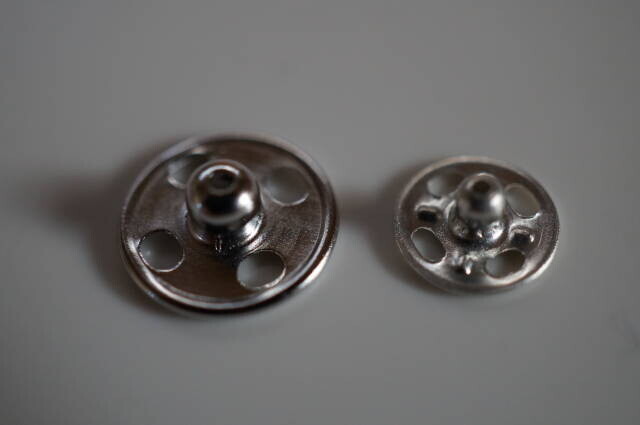
| Snap button connector | A button-shaped electrical connector used to join electrode cabling to a compatible cable. |
| Stereo mini plug | A cable plug proposed by the customer for the Omron connection. |
| Elepuls HV-F127 | The Omron electrical stimulation unit the maker named as its electrode-chip test model. |
| Electrical resistance | Opposition to electrical current; Mr. Okada used it as a reason for restricting electrode designs. |
| Continuity test | A check that a connection conducts electricity, used when the maker lacked the customer's machine. |
| Parallel cable | Paired wires running side by side, used for connections between the chip and other components. |
| USB connector | A detachable cable junction used in the December 2024 custom assembly. |
| Triphase connection | A connection the customer proposed for combining electrical outputs from multiple machines. |
What happens: Omron compatibility
The OK Prostate Chip is a small device placed in the urethra, the urine passage, to act on the prostate. These entries discuss electrode versions, meaning chips with electrical contacts, intended to receive stimulation from an Omron low-frequency unit. The diary includes both urethral chips and rectal chips, with contacts on or within the chip body. Cables and connectors provide the connection to the external unit, while the entries track changing designs and questions about whether particular parts fit.
An early Omron connection request exposed problems with pads and metal
In an entry published in December 2018, a customer requested a rectal chip with electrodes. The customer said Omron's plug matched a standard stereo mini plug (a cable connector). They reported that treatment pads lacked durability and transferred stimulation poorly to internal tissue.
They described a proposed exposed metal width of 1cm–1.5cm. Mr. Okada made a prototype, but his newly ordered Omron unit had not arrived, so he could not test it. His initial reply made testing a condition of accepting the custom work.
(Source: ok-lab's diary, published December 2018)
https://ok-lab.hatenablog.com/entry/20181208/1544250742
Snap button connections carried separate component charges in April 2019
An entry published in April 2019 priced snap button connections (button-style electrical links) at ¥4,000, (about $26 at ¥156 = $1, rate as of 2026-09-04) excluding tax, beyond the chip price. Its components were an aluminum electrode at ¥1,000 (about $6 at ¥156 = $1, rate as of 2026-09-04), a chip-shaped button terminal at ¥2,000 (about $13 at ¥156 = $1, rate as of 2026-09-04), and a cable connection at ¥1,000 (about $6 at ¥156 = $1, rate as of 2026-09-04). These component prices also excluded tax.
The same entry gave complete electrode-equipped examples: a single-bump rectal chip at ¥9,000 (about $58 at ¥156 = $1, rate as of 2026-09-04) and a semi-long glass chip at ¥7,000 (about $45 at ¥156 = $1, rate as of 2026-09-04), excluding tax. A short resin example was ¥5,000, (about $32 at ¥156 = $1, rate as of 2026-09-04) excluding tax, as published in April 2019. Mr. Okada directed custom requests to email.
(Source: ok-lab's diary, published April 2019)
https://ok-lab.hatenablog.com/entry/2019/04/13/150233
An Omron connection could not use a snap on only one side
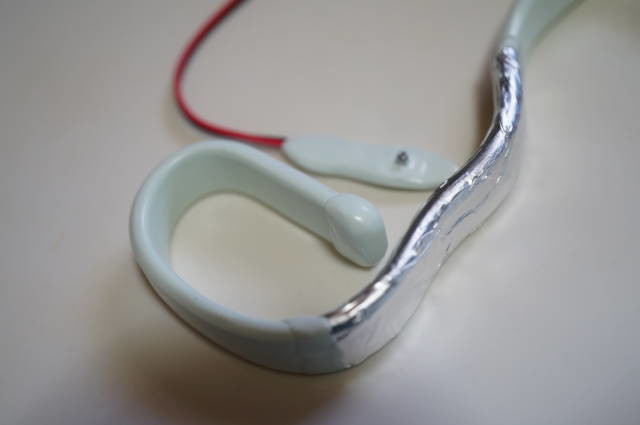
In an entry published in August 2019, a customer requested a semi-long resin urethral electrode and a single-bump U-shaped rectal electrode. The request specified nylon reinforcement on the urethral version and 70cm cables. The maker quoted ¥7,560 (about $48 at ¥156 = $1, rate as of 2026-09-04) for the urethral electrode and ¥9,720 (about $62 at ¥156 = $1, rate as of 2026-09-04) for the rectal electrode.
The diary does not record how this pair worked in use. The maker said Omron's specifications required matching snap connectors on both of the 2 poles (electrical contacts).
(Source: ok-lab's diary, published August 2019)
https://ok-lab.hatenablog.com/entry/2019/08/31/131337
The maker's Omron compatibility answer named a specific test model
In an entry published in December 2022, a customer asked whether the plug on a modified resin chip would work with an Omron unit. The quotation included ¥4,400 (about $28 at ¥156 = $1, rate as of 2026-09-04) for electrode processing on two contacts. A 70cm cable and the connection plug were priced at ¥1,100 (about $7 at ¥156 = $1, rate as of 2026-09-04) each.
The entry records a quotation, without an account of the customer's later use. The maker answered that all its electrode chips had been tested with the Omron Elepuls HV-F127 (the named electrical stimulation unit).
(Source: ok-lab's diary, published December 2022)
https://ok-lab.hatenablog.com/entry/2022/12/03/122846
Nylon reinforcement changed the maker's answer about stainless steel Omron connections
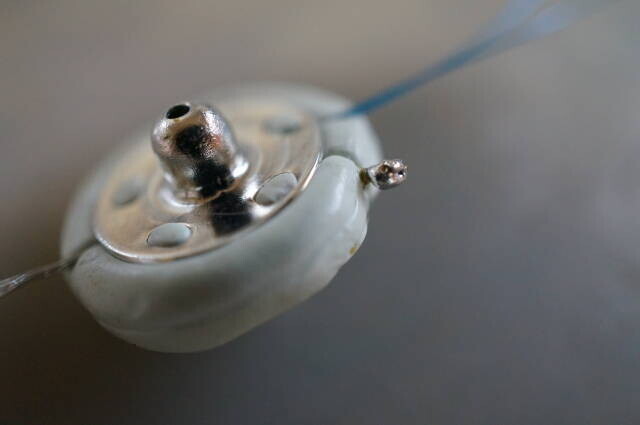
An entry published in August 2023 revisited a customer's request for a stainless steel electrode chip. Staff initially declined, citing difficulty attaching the electrical connection and delayed stainless steel stock. The customer clarified that the whole steel chip could form a single pole, with a cable attached.
Mr. Okada later reported that a very fine cable reinforced with nylon made the connection feasible, and he considered offering it. He described a snap connector intended for Omron equipment, while also allowing an unfinished cable end for the custom request. Mr. Okada made the cable's strength guarantee conditional on retaining its nylon reinforcement.
(Source: ok-lab's diary, published August 2023)
https://ok-lab.hatenablog.com/entry/2023/08/26/122534
The maker's answer to Omron compatibility
Mr. Okada answered through design restrictions, connector checks, and quotations for the requested electrical work.
Mr. Okada restricted Omron connections because of his concerns about electrical faults
In an entry published in April 2019, Mr. Okada addressed faults involving electrode chips and the external unit. He wanted at least 500Ω of electrical resistance (opposition to current) between poles, even if the unit malfunctioned. The diary does not record measured resistance for each customer's arrangement.
He said urine could bridge the poles of a two-pole urethral chip, creating an unwanted electrical connection. He also said using other terminals left responsibility with the user if the unit failed. Mr. Okada restricted electrode orders to a single pole per body cavity.
(Source: ok-lab's diary, published April 2019)
https://ok-lab.hatenablog.com/entry/2019/04/13/150233
Larger snap button connections required supplied parts and had limited testing
In an entry published in September 2024, Mr. Okada said he had supplied electrodes only with Omron-compatible plugs or snap connectors. He completed a larger-connector version after a customer supplied the actual button. He had no suitable unit for testing that alternative connection.
He offered only a continuity test (a check that the connection conducts electricity), not an operating test with that machine. Mr. Okada said customers requesting large connectors needed to obtain the buttons and send them to OK Lab.
(Source: ok-lab's diary, published September 2024)
https://ok-lab.hatenablog.com/entry/2024/09/28/122919
Stainless steel Omron connections gained cable options with individually quoted surcharges
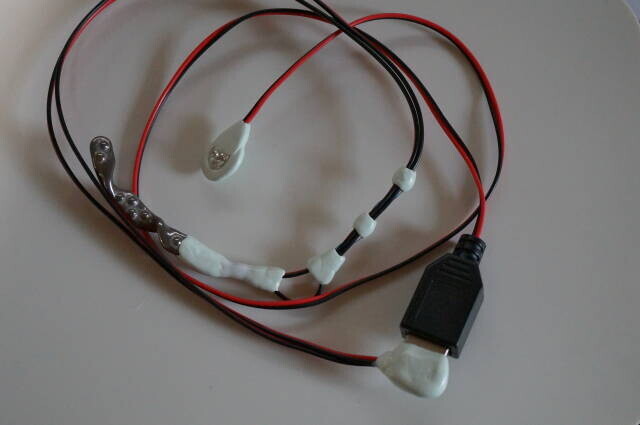
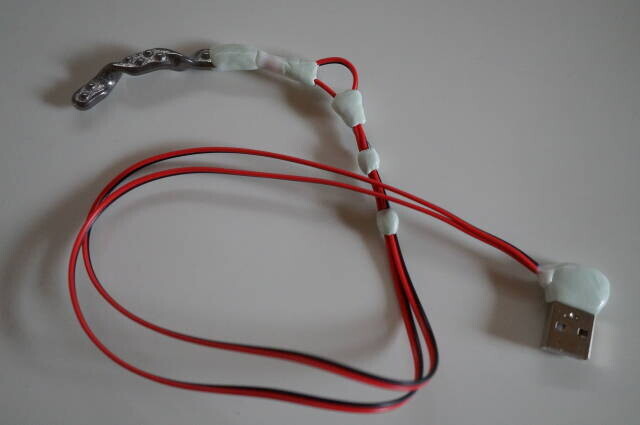
In an entry published in December 2024, a customer requested a custom electrode based on the sculpted surgical stainless steel chip. Staff accepted the unfamiliar work, and Mr. Okada reported a strong connection through an intermediate wire. He began offering stainless steel connections to parallel cable (paired wires running side by side).
The options included direct snap connections and connections through a USB connector (a detachable cable junction) described as suitable for boiling. Electrical work added a surcharge to standard cable-connection prices and custom loop assembly prices. Mr. Okada said staff would quote each configuration individually.
(Source: ok-lab's diary, published December 2024)
https://ok-lab.hatenablog.com/entry/2024/12/07/122832
If you see blood in your urine, even a small amount or for the first time, do not wait and see. See a urologist right away.
If you suddenly cannot urinate, or the device cannot be removed, do not try to fix it yourself. Go to a medical facility, including emergency care, immediately.
How Omron compatibility changed over time
| Published | What the diary said then |
|---|---|
| Dec 2018 | Household aluminum foil had strength problems in the customer's prototype. |
| Apr 2019 | Cable lengths offered: 20cm, 25cm, or 30cm. |
| Aug 2019 | The maker said the requested electrode chips could withstand boiling. |
| Dec 2022 | The maker identified HV-F127 testing when answering an Omron compatibility question. |
| Aug 2023 | Nylon-reinforced fine cable made stainless steel electrode development feasible, according to Mr. Okada. |
| Sep 2024 | A larger connector request stalled because the specified button was unavailable. |
| Sep 2024 | Customer-supplied larger buttons became an option, with testing limited to electrical continuity. |
| Oct 2024 | Staff found a 4mm button where the request had specified 3.5mm. |
| Dec 2024 | Mr. Okada began accepting conductive stainless steel connections using parallel cable. |
The diary does not say what the current state is.
OK Prostate Chip products related to Omron compatibility
The current list prices the stainless steel base chip; the December 2024 electrical customization required a separate quote.
Products that appear in these entries
| Product (official name) | Price incl. tax | Relation to this topic |
|---|---|---|
| Sculpted surgical stainless steel chip (OKプロステートチップ 凶悪ゾロ(サージカルステンレス)) | ¥9,900 (about $63 at ¥156 = $1, rate as of 2026-09-04) | In December 2024, the customer selected this shape and material for an electrode request whose electrical connection work carried additional charges. |
(Source: ok-lab's diary, published December 2024)
https://ok-lab.hatenablog.com/entry/2024/12/07/122832
Products the diary mentioned as alternatives
The diary names no alternative.
Historical electrode assemblies and custom connector configurations:
No matching product can be confirmed on the current list.
Common worries about Omron compatibility
Customer questions concerned custom quotations, connector fit, and whether unusual electrical arrangements could be verified.
"Could I order an Omron connection with a short resin chip?"
An entry published in August 2019 records a separate request for a short resin urethral chip and a single-bump U-shaped rectal chip. Mr. Okada quoted ¥12,280 (about $79 at ¥156 = $1, rate as of 2026-09-04), including electrode work and plug processing.
The quote listed ¥1,080 (about $7 at ¥156 = $1, rate as of 2026-09-04) for the resin chip and ¥5,400 (about $35 at ¥156 = $1, rate as of 2026-09-04) for the rectal chip. Electrode processing was ¥2,160 (about $14 at ¥156 = $1, rate as of 2026-09-04) per chip, while plug processing was ¥1,080 (about $7 at ¥156 = $1, rate as of 2026-09-04). The diary does not record whether that quoted order was completed.
(Source: ok-lab's diary, published August 2019)
https://ok-lab.hatenablog.com/entry/2019/08/31/131337
"Will an existing cable fit the Omron snap button connection?"
In an entry published in September 2024, a customer asked for a larger snap connector to fit a cable they already owned. They requested 3.5mm, while accepting the earlier 2.3mm size as a fallback.
The customer reported that Omron's supplied cable used 2.3mm buttons matching OK Lab's standard connector. Mr. Okada paused work because the requested larger connector was not in stock.
(Source: ok-lab's diary, published September 2024)
https://ok-lab.hatenablog.com/entry/2024/09/21/122907
"Can an Omron connection have two buttons on one electrode?"
In an entry published in October 2024, a customer requested two buttons on a single stainless steel electrode. The customer wanted a triphase connection (a connection intended to combine outputs), describing access for multiple machines. Staff measured the supplied button at 4mm, despite the original 3.5mm request.
They raised concerns about cable strength, unfamiliar construction, and their inability to verify operation. After clarification, Mr. Okada showed a finished assembly but said he did not fully understand the overlapping-wave explanation. The diary does not record how that arrangement performed with the customer's equipment.
(Source: ok-lab's diary, published October 2024)
https://ok-lab.hatenablog.com/entry/2024/10/26/122649
Buying from outside Japan
OK Lab ships internationally to countries covered by Japan Post's EMS courier service. Overseas orders are paid in advance by PayPal. Each order carries a ¥400 (about $3 at ¥156 = $1, rate as of 2026-09-04) handling fee, and EMS shipping is charged on top. These terms come from OK Lab's official sales-terms page (written here as plain text, not a link: ok-lab.net/docs/law), checked on September 7, 2026; confirm them on the official store before you order, because they can change.
Summary of this article
| What you wanted to know | The answer |
|---|---|
| What is the main compatibility issue? | The diary distinguishes the tested Omron model from custom connector arrangements. |
| What is the product? | A small device made by OK Lab in Japan; these entries concern versions with electrical contacts. |
| What do the connection terms mean? | Electrodes carry current, connectors join cabling, and continuity checks whether an electrical path exists. |
| What happened during development? | Customer requests exposed pad, connector, and stainless steel cable problems. |
| What was the maker's answer? | Mr. Okada imposed design conditions, limited some testing, and quoted custom work individually. |
| What changed over time? | The supplied entries progress from a December 2018 prototype to additional cable options in December 2024. |
| What is currently priced? | The listed stainless steel base chip costs ¥9,900 (about $63 at ¥156 = $1, rate as of 2026-09-04) incl. tax; historical custom assemblies are not confirmed. |
| What did customers ask? | Whether particular plugs fitted, which connectors could be supplied, and how custom requests would be quoted. |
| How are overseas orders handled? | Advance PayPal payment, a ¥400 (about $3 at ¥156 = $1, rate as of 2026-09-04) handling fee, and additional Japan Post EMS shipping charges. |
Source: ok-lab's diary (Okada Comfortable Life Laboratory). The original entries are in Japanese; quotations on this page are translated. Photos and videos are on the original entries.
This article is a summary of the maker's development diary. The product is not a medical device and no result is guaranteed. If anything feels wrong or worries you, see a doctor. Prices, specifications and cautions change, so confirm the latest information on the official blog and the official site. Questions about ordering and shipping go to the seller.