![Will two cables stop my chip's wires breaking? | Backup power has limits [OK Prostate Chip]](/img/a/T0056/eyecatch.svg)
This page is based on entries from "ok-lab's diary" (https://ok-lab.hatenablog.com/), the Japanese development diary written by Mr. Okada, founder of OK Lab, a small company in Japan (Okada Comfortable Life Laboratory). Only the entries about "two cables and resistance to wire breakage" are summarized here, in order of publication. Past prices and sizes are as written at the time. Current prices come from the official product list (retrieved September 4, 2026). Quotations are translated from Japanese.
Note: This page is a personal reading log by someone with no connection to the maker or the seller. It reflects the source entries as of their publication dates and makes no guarantee of accuracy or safety. The product is not a medical device; talk to a doctor about any health decision. Check the official site for current information. This page contains advertising.
In short
Two cables may preserve power after some cable breaks, but Mr. Okada says thin motor wires can still fail.
His proposed measures included backup wiring, shared strain, and later cables joined to limit sharp bends.
Current listings include the original ceramic base model and USB fitting, without confirming the historical custom builds.
About this product

The OK Prostate Chip is a small device that is placed in the urethra (the urine passage) so that it acts on the prostate; the maker sells it in several shapes, sizes and materials. It is made and sold by OK Lab (Okada Comfortable Life Laboratory), a small company in Japan, through its own online store, and prices are in Japanese yen (JPY).
The maker's development diary, "ok-lab's diary", is written in Japanese. This page is an English summary of it, and every quotation is translated.
OK Lab ships internationally, so readers outside Japan can order (see "Buying from outside Japan" below). Product names on this page are plain-English descriptions. The official Japanese product name is shown once in the product table so you can find the same item in the store.
Before you read: key terms
| Term | Plain-English meaning |
|---|---|
| Urethra | The urine passage; the diary describes the chip and part of its cables sitting inside it. |
| Twin cables | Two electrical cable runs attached to one motor, intended to provide another power path and share strain. |
| Retrieval line | A line attached to the chip for removal; the original customer wanted cable instead of nylon thread. |
| USB connector | An end fitting used to connect the chip's wiring to its power equipment. |
| Polarity | The positive or negative electrical side; the maker uses this distinction to explain which wire breaks interrupt power. |
| Controller | A device that sets vibration patterns; the early design allowed a separate controller on each cable. |
| Resin | A protective covering around electrical connections, used to reinforce the thin motor wires. |
| Screw-shaped support | A positioning attachment discussed for the vibrating chip; the March prototype incorporated both cables. |
| Cable stopper | A piece associated with the cables, intended to help keep the chip in position. |
What happens: chip cable breakage
The OK Prostate Chip is a device placed in the urethra (the urine passage) to act on the prostate. Twin cables (two electrical cable runs attached to one motor) concern the vibrating version of this device. They carry power to the motor, with part of their length in the urethra and connectors outside the body. Mr. Okada proposed another electrical path if a cable broke, while warning that the motor's thinner wires remained vulnerable.
Repeated chip cable breakage led to a request for extra support
In an entry published in February 2020, a customer reported partial wire failure near the base of a recently repaired medium-length vibrating chip. They wanted a thicker retrieval line (a line attached for removal), without needing it to carry power. Mr. Okada rejected the requested powered-cable position, but said both cables could emerge together, which he thought would increase strength.
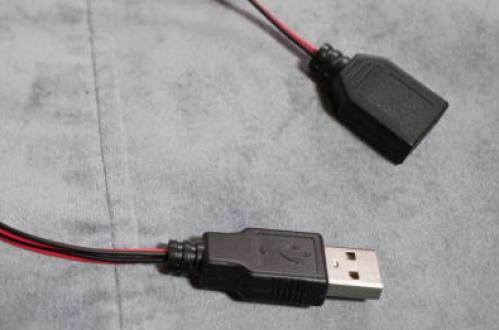
He proposed separate USB connectors (end fittings for electrical connections), allowing the other cable to supply power after a cable failure. The customer accepted, and Mr. Okada reported making the chip; the diary does not record that customer's experience using it. After testing the design himself, Mr. Okada favored two powered cables connected to the motor.
(Source: ok-lab's diary, published February 2020)
https://ok-lab.hatenablog.com/entry/2020/02/08/151653
The maker's motor barely moved during his test with twin cables
In a separate development section published in February 2020, Mr. Okada described testing a 10mm motor alone, approximately 15mm long. He reported that the two cables supported each other against bending, without an obvious change in softness. He also reported no additional discomfort or obstruction to urination in that test.
According to his account, urination displaced the single-cable motor, whereas the twin-cable motor barely moved. He suspected close contact between the cables helped explain the difference. Based on his own test, Mr. Okada recommended the arrangement with two cables emerging directly from the motor.
(Source: ok-lab's diary, published February 2020)
https://ok-lab.hatenablog.com/entry/2020/02/08/151653
Twin cables gained a cheaper version with one USB connector
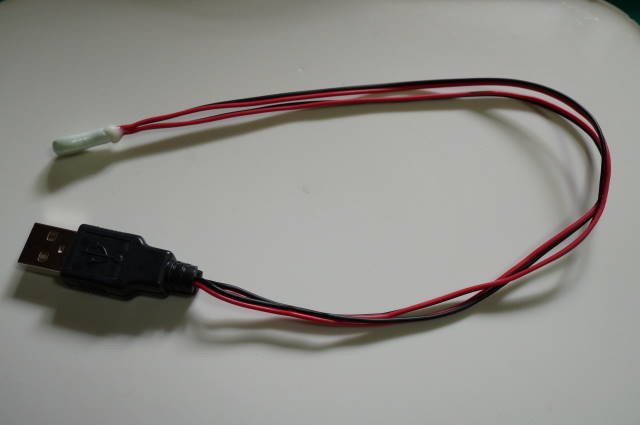
In an entry published in February 2020, Mr. Okada introduced twin cables ending in one USB connector. The example used an 8mm motor-only chip, with a cable surcharge of ¥1,000 (about $6 at ¥156 = $1, rate as of 2026-09-04) tax excluded. He wrote that 1 broken wire among the 4 would not stop the motor.
According to him, 2 broken wires would stop it if they shared the same polarity (positive or negative electrical side). He said it could continue if the two breaks affected different polarities. Mr. Okada offered this version for customers interested in twin cables without two separate vibration-control devices.
(Source: ok-lab's diary, published February 2020)
https://ok-lab.hatenablog.com/entry/2020/02/15/144151
Twin cables were proposed again after a chip connection failed
In an entry published in June 2024, a customer reported breakage where the chip and cable joined. The proposed custom build was an L-size double-headed vibrating chip with a motor measuring slightly over 8mm, quoted at ¥8,800 (about $56 at ¥156 = $1, rate as of 2026-09-04). An extra cable cost ¥1,100 (about $7 at ¥156 = $1, rate as of 2026-09-04) in that entry.
The diary does not record whether the altered chip lasted longer for this customer. Mr. Okada proposed two cables to spread the strain at the join.
(Source: ok-lab's diary, published June 2024)
https://ok-lab.hatenablog.com/entry/2024/06/08/123008
Twin cables gained a flexible loop in the later prototype
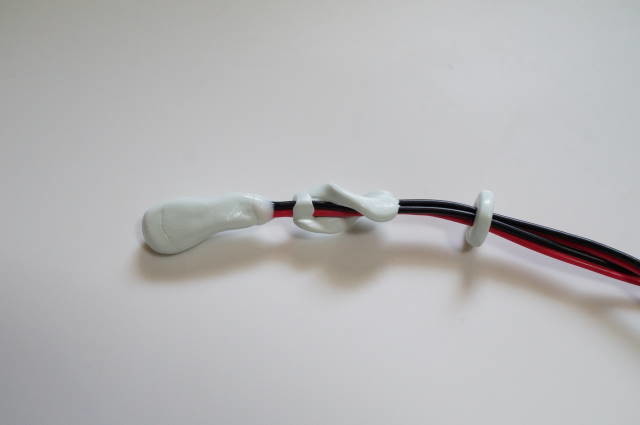
In an entry published in September 2024, Mr. Okada described joined twin cables with a flexible loop behind the vibrating chip. Unequal cable lengths formed the loop, intended to sit near the bend in the lower urethra. He expected that shape to help the chip stay in position.
The shorter side measured about 1cm, and the loop's natural bulge about 8mm. Mr. Okada described a 90-degree bend, with a loop that could change shape rather than remain rigid. He offered larger or smaller loops, while cautioning that their flexibility prevented exact millimeter specifications.
(Source: ok-lab's diary, published September 2024)
https://ok-lab.hatenablog.com/entry/2024/09/07/123204
The maker's answer to chip cable breakage
Mr. Okada proposed extra electrical paths and shared strain, while identifying thin motor wires as a remaining weakness.
Thin motor wires limited what twin cables could protect
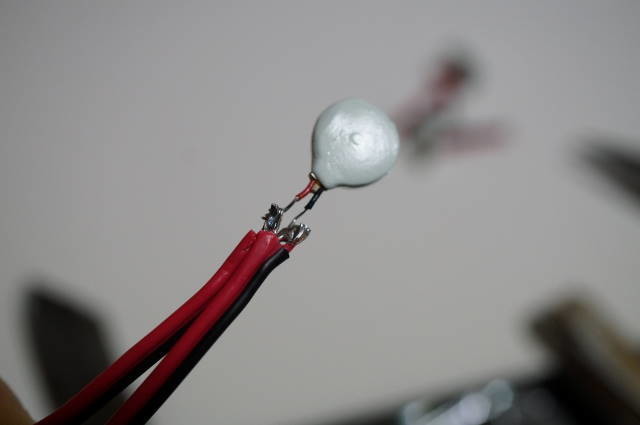
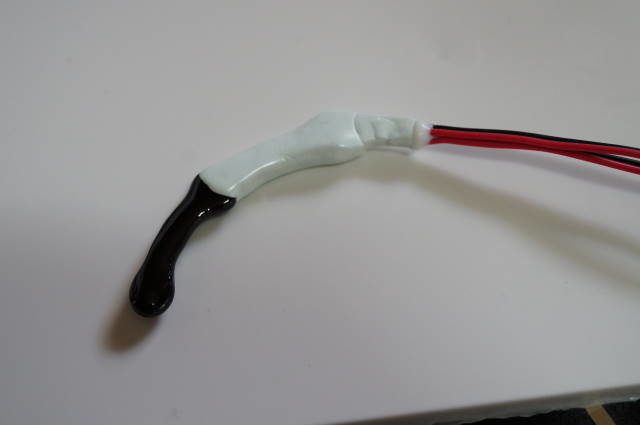
In a reply published in February 2020, Mr. Okada considered the motor's thin wires more likely to fail than the thicker cables. He considered home repair impractical because exposing the fault through resin (a protective covering) could tear those thin wires further.
He described a direct motor connection as the only possible remedy, while warning that the factory's very thick resin covering made access difficult. Mr. Okada cautioned that self-repair was beyond what he considered achievable with his own skills.
(Source: ok-lab's diary, published February 2020)
https://ok-lab.hatenablog.com/entry/2020/02/08/151653
Separate USB connectors increased the historical price of twin cables
An entry published in February 2020 priced two powered cables with separate USB connectors as an option for vibrating chips. The extra cable cost ¥1,000 (about $6 at ¥156 = $1, rate as of 2026-09-04) tax excluded, and the extra USB connector cost ¥500 (about $3 at ¥156 = $1, rate as of 2026-09-04) tax excluded. The published total surcharge was ¥1,500 (about $10 at ¥156 = $1, rate as of 2026-09-04) tax excluded.
Mr. Okada also described two controllers (devices that set vibration patterns) producing independent rhythms in his prototype. A February 2020 follow-up priced an extension with a USB plug and socket at ¥1,000 (about $6 at ¥156 = $1, rate as of 2026-09-04) tax excluded, with length available by request. For easier handling, Mr. Okada suggested approximately 30cm of twin cable plus an extension, instead of making the full 70cm twin.
(Source: ok-lab's diary, published February 2020)
https://ok-lab.hatenablog.com/entry/2020/02/08/151653
(Source: ok-lab's diary, published February 2020)
https://ok-lab.hatenablog.com/entry/2020/02/15/144151
Joined twin cables reduced sharp bending in the maker's prototype
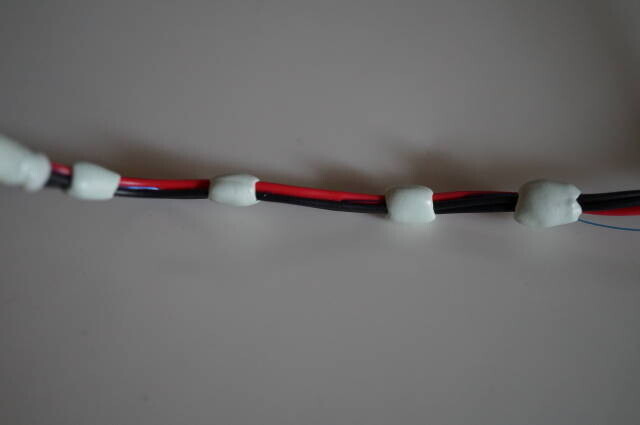
In an entry published in September 2024, Mr. Okada described thread supports at approximately 1cm intervals and covered wire supports every 2.5cm. He reported that the joined cables could bend without folding as sharply as earlier arrangements. He expected better resistance to breakage and easier positioning than with either one cable or two loose cables.
However, he cautioned that two thicker cables could place extra strain on the motor's thin wires. Mr. Okada emphasized careful connections and protective resin around that vulnerable join during manufacture.
(Source: ok-lab's diary, published September 2024)
https://ok-lab.hatenablog.com/entry/2024/09/07/123204
Longer joined twin cables carried higher historical processing charges
An entry published in September 2024 set out separate prices, all tax excluded, above the ordinary vibrating chip price. The added cable cost ¥1,000 (about $6 at ¥156 = $1, rate as of 2026-09-04), and the nylon thread cost another ¥1,000 (about $6 at ¥156 = $1, rate as of 2026-09-04). Processing a joined section up to 10cm cost ¥2,000 (about $13 at ¥156 = $1, rate as of 2026-09-04).
Beyond 10cm, each further 5cm added ¥500 (about $3 at ¥156 = $1, rate as of 2026-09-04); the published processing charge for the maximum 20cm was ¥3,000 (about $19 at ¥156 = $1, rate as of 2026-09-04). The completed cable length was 35cm from chip end to USB; the previous 70cm length could not be supplied for this design. Mr. Okada suggested an audio extension cable for extra reach.
(Source: ok-lab's diary, published September 2024)
https://ok-lab.hatenablog.com/entry/2024/09/07/123204
How chip cable breakage changed over time
| Published | What the diary said then |
|---|---|
| Feb 2020 | Two powered cables were introduced as a backup for some wire failures. |
| Feb 2020 | A single USB connector reduced the extra hardware and quoted surcharge. |
| Mar 2020 | The support-and-stopper prototype worked, although the stopper was harder to pass. |
| Jun 2024 | A second cable was proposed to share strain at the chip connection. |
| Sep 2024 | Joined cables added controlled bending and a flexible loop. |
| Sep 2024 | The design limited total cable length and introduced charges based on joined length. |
The diary does not say what the current state is.
OK Prostate Chip products related to chip cable breakage
The current list includes the ceramic vibrating base model and connector fitting specified in the original request.
Products that appear in these entries
| Product (official name) | Price incl. tax | Relation to this topic |
|---|---|---|
| Extended ceramic vibrating chip (OKプロステート核振チップ 陶器素材覚醒タイプ) | ¥7,700 (about $49 at ¥156 = $1, rate as of 2026-09-04) | A February 2020 customer ordered this base model while requesting two powered cables after a different chip failed. |
| USB-connector fitting option (USB端子付け加工(核振チップオプション)) | ¥550 (about $4 at ¥156 = $1, rate as of 2026-09-04) | The February 2020 correspondence included this fitting option in the customer's two-cable request. |
The extended ceramic vibrating chip is listed in OK Lab's own online store.
The USB-connector fitting option is listed in the company's own online store.
(Source: ok-lab's diary, published February 2020)
https://ok-lab.hatenablog.com/entry/2020/02/08/151653
Products the diary mentioned as alternatives
The diary names no alternative.
Historical repair model and custom prototypes:
No matching product can be confirmed on the current list.
Common worries about chip cable breakage
Readers asked about cable strain, stronger motors, and whether twin cables could accommodate positioning attachments.
"Would twin cables prevent failures caused by pushing?"
In an entry published in February 2020, a reader asked whether pushing put enough strain on the cables to break them. Mr. Okada thought roughly 100 uses would be unlikely to cause that degree of cable damage, but called this a guess. He said he had no method for reinforcing those fine motor wires.
His reply quoted the regular vibrating-chip price plus ¥1,500 (about $10 at ¥156 = $1, rate as of 2026-09-04) tax excluded for two cables. He qualified his enthusiasm: his experience covered only a few days, and further testing could reveal problems. Mr. Okada said he wanted longer testing before recommending the design confidently.
(Source: ok-lab's diary, published February 2020)
https://ok-lab.hatenablog.com/entry/2020/02/15/144151
"Was a stronger motor offered for chip cable breakage?"
In an entry published in February 2020, a reader asked when the more durable motor would become available. Mr. Okada reported approximately 15 stable test motors, while saying he was still looking for faults. He had delayed the formal launch but offered custom orders for the new 10mm motor.
The finished width exceeded 11mm, thickness exceeded 4.5mm, and the cable-connection area exceeded 5mm in thickness. The diary does not record whether this reader placed an order. Mr. Okada made the offer conditional on whether the finished dimensions were suitable.
(Source: ok-lab's diary, published February 2020)
https://ok-lab.hatenablog.com/entry/2020/02/15/144151
"Can twin cables work with the existing support pieces?"
In an entry published in March 2020, a customer asked whether twin cables could carry a screw-shaped support (a positioning attachment). They also asked about a cable stopper (another positioning piece), and Mr. Okada agreed to prototype both. He reported unchanged sensation with the support and stronger cables, but the stiff stopper was harder to pass through the urethral opening.
After 3 days of testing, he described improved control over where the motor stayed. Mr. Okada favored the combined prototype of the motor-only chip, screw-shaped support, and cable stopper.
(Source: ok-lab's diary, published March 2020)
https://ok-lab.hatenablog.com/entry/2020/03/21/143802
Buying from outside Japan

OK Lab ships internationally to countries covered by Japan Post's EMS courier service. Overseas orders are paid in advance by PayPal. Each order carries a ¥400 (about $3 at ¥156 = $1, rate as of 2026-09-04) handling fee, and EMS shipping is charged on top.
These terms come from OK Lab's official sales-terms page (written here as plain text, not a link: ok-lab.net/docs/law), checked on September 7, 2026; confirm them on the official store before you order, because they can change.
Summary of this article
| What you wanted to know | The answer |
|---|---|
| What is the short answer? | Mr. Okada describes backup power for some cable failures, with limits at the motor wires. |
| What is the product? | A urethral device made by OK Lab in Japan, with vibrating versions discussed here. |
| What do the key terms mean? | Twin cables carry power; supports and stoppers concern positioning. |
| What happened in the reported cases? | Repeated failures prompted custom designs; lasting customer results were not recorded for the repair and strain-sharing cases. |
| What did the maker propose? | Additional electrical paths, shared strain, and joined cables, with attention to the vulnerable motor connection. |
| What changed over time? | Separate connectors, a single-connector version, support prototypes, and a later joined-cable design appeared. |
| Which products are listed today? | The cited ceramic base model costs ¥7,700 (about $49 at ¥156 = $1, rate as of 2026-09-04); connector fitting costs ¥550, (about $4 at ¥156 = $1, rate as of 2026-09-04) both including tax. |
| What did readers ask? | Whether force caused failures, stronger motors were available, and positioning attachments fitted twin cables. |
| How does overseas buying work? | Advance PayPal payment, a ¥400 (about $3 at ¥156 = $1, rate as of 2026-09-04) handling fee, and additional Japan Post EMS shipping charges. |
Source: ok-lab's diary (Okada Comfortable Life Laboratory). The original entries are in Japanese; quotations on this page are translated. Photos and videos are on the original entries.
This article is a summary of the maker's development diary. The product is not a medical device and no result is guaranteed. If anything feels wrong or worries you, see a doctor. Prices, specifications and cautions change, so confirm the latest information on the official blog and the official site. Questions about ordering and shipping go to the seller.