![Can a vibrating chip run on USB power? | Yes, but compatibility matters [OK Prostate Chip]](/img/a/T0058/eyecatch.svg)
This page is based on entries from "ok-lab's diary" (https://ok-lab.hatenablog.com/), the Japanese development diary written by Mr. Okada, founder of OK Lab, a small company in Japan (Okada Comfortable Life Laboratory). Only the entries about "USB and power banks for vibrating chips" are summarized here, in order of publication. Past prices and sizes are as written at the time. Current prices come from the official product list (retrieved September 4, 2026). Quotations are translated from Japanese.
Note: This page is a personal reading log by someone with no connection to the maker or the seller. It reflects the source entries as of their publication dates and makes no guarantee of accuracy or safety. The product is not a medical device; talk to a doctor about any health decision. Check the official site for current information. This page contains advertising.
In short
- USB-powered vibrating chips appear in the diary, but connector compatibility, controller faults, battery life, and heating all raised problems.
- Mr. Okada offered USB fittings and wiring corrections, while identifying limits for particular controllers and motors.
- The current list includes a USB fitting option; historical custom builds and test results need separate consideration.
About this product

The OK Prostate Chip is a small device that is placed in the urethra (the urine passage) so that it acts on the prostate; the maker sells it in several shapes, sizes and materials. It is made and sold by OK Lab (Okada Comfortable Life Laboratory), a small company in Japan, through its own online store, and prices are in Japanese yen (JPY). The maker's development diary, "ok-lab's diary", is written in Japanese. This page is an English summary of it, and every quotation is translated. OK Lab ships internationally, so readers outside Japan can order (see "Buying from outside Japan" below). Product names on this page are plain-English descriptions. The official Japanese product name is shown once in the product table so you can find the same item in the store.
Before you read: key terms
| Term | Plain-English meaning |
|---|---|
| Urethra | The urine passage, where the base device is placed to act on the prostate. |
| Vibrating chip | A motor-equipped chip intended to provide vibration around the prostate. |
| USB connector | A cable plug or socket used here to supply electrical power to a motor or controller. |
| Power bank | A portable battery used in these entries as a USB power source. |
| Controller | A device used to change motor vibration; the entries describe several incompatible designs. |
| USB-A | The plug-and-socket type named in the diary's household-power answer, used to carry power. |
| Bluetooth | A wireless connection used by the prototype control box to receive commands. |
| R-1 controller | Another company's vibration controller; its dedicated cable requirement affected compatibility with the chip. |
| Conversion adapter | A power supply described as changing 100V household electricity into 5V for the device. |
| USB splitter cable | A branching cable intended to supply multiple motors from the later controller system. |
What happens: USB power for vibrating chips
The OK Prostate Chip is a small device placed in the urethra, the urine passage, to act on the prostate. The vibrating version has a motor intended to stimulate that area, with a cable leading to its power source. A USB connector (a plug or socket carrying power) can be fitted at the supply end of that cable. The entries describe power from a power bank (a portable battery), controllers, and a household-power adapter, with limitations that varied between arrangements.
USB power fittings had separate purchase and conversion prices in November 2019
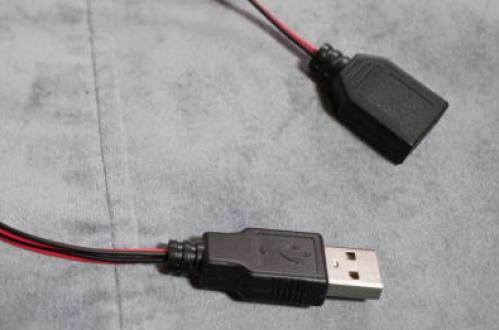
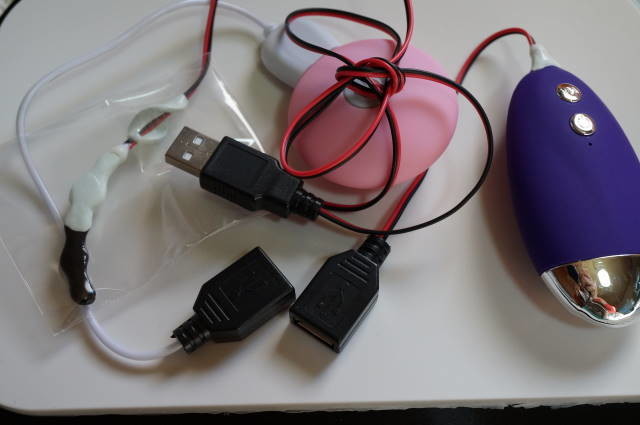
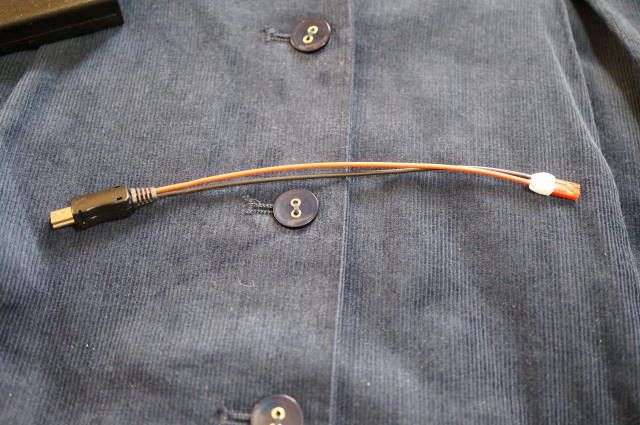
In an entry published in November 2019, USB fitting instead of the supplied controller cost ¥500 (about $3 at ¥156 = $1, rate as of 2026-09-04) excluding tax when buying a chip. Mr. Okada also described a conversion cable for an existing chip with a small controller plug. Its quoted components were ¥1,000 (about $6 at ¥156 = $1, rate as of 2026-09-04) at that plug end and ¥500 (about $3 at ¥156 = $1, rate as of 2026-09-04) at the USB end, excluding tax.
The diary gave the complete cable price as ¥1,500 (about $10 at ¥156 = $1, rate as of 2026-09-04) excluding tax. Mr. Okada offered that separate cable for owners of the earlier plug-equipped chips.
(Source: ok-lab's diary, published November 2019)
https://ok-lab.hatenablog.com/entry/2019/11/23/162919
USB power offered a portable battery option in December 2019
In an entry published in December 2019, a customer requested one ceramic vibrating chip with two different USB-fitted controllers. The diary records the order for a controller (a device that changes vibration) of each type. Mr. Okada explained that USB fittings also allowed a power bank to serve as the power source.
He favored separate controllers because they could serve later purchases and help identify the source of a fault. His recommendation was to have more than one controller available, although he acknowledged the greater initial expense.
(Source: ok-lab's diary, published December 2019)
https://ok-lab.hatenablog.com/entry/2019/12/28/131319
USB power failed when controller wiring was reversed in February 2020
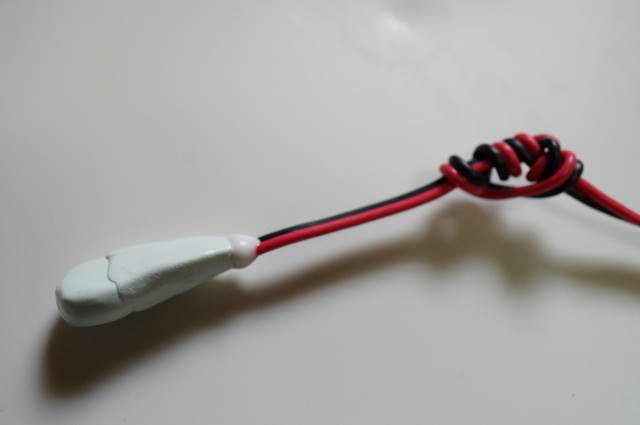
In an entry published in February 2020, Mr. Okada described a newer motor that would not run with a USB-fitted controller. He traced the failure to reversed positive and negative connections inside the controller's wiring. Older motors had worked despite the reversal, so earlier shipments could contain the unnoticed fault.
He said new-motor shipments would undergo an electrical test before dispatch. Mr. Okada offered to correct affected white connector cables returned to OK Lab.
(Source: ok-lab's diary, published February 2020)
https://ok-lab.hatenablog.com/entry/2020/02/22/145216
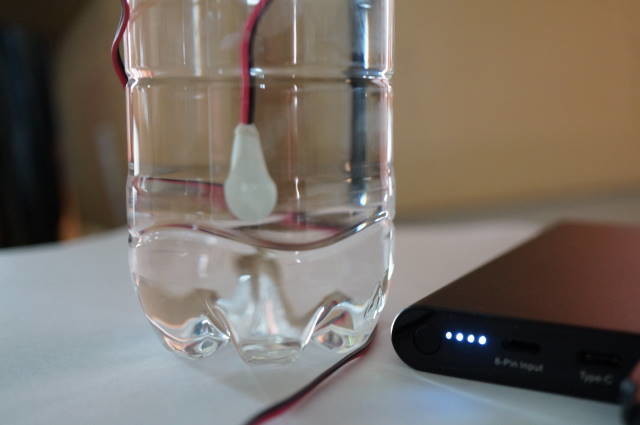
A power bank kept the test motor running beyond 24 hours
In an entry published in February 2020, Mr. Okada ended an endurance test because the motor showed no sign of stopping. He reported more than 24 hours of continuous operation from a fully charged power bank.
This was the bottle-based endurance test described in the preceding entry, where the motor also struck the container as it vibrated. Mr. Okada recommended the newer motor; the follow-up said subsequent 10mm motor orders would receive it.
(Source: ok-lab's diary, published February 2020)
https://ok-lab.hatenablog.com/entry/2020/02/22/145216
(Source: ok-lab's diary, published February 2020)
https://ok-lab.hatenablog.com/entry/2020/02/29/155031
The wireless USB power prototype was unavailable for sale in November 2021
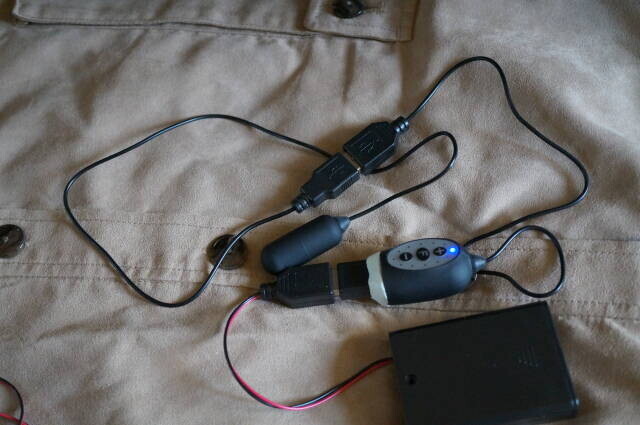
In an entry published in November 2021, Mr. Okada received a prototype box using Bluetooth (a wireless connection for control commands). Its developer described a USB input for power and a separate USB socket for the vibrating chip. Compatible software could send control commands to the box.
Mr. Okada said the box would accompany a USB-fitted chip being sent to a customer. Its developer said it could not be sold at that time, citing several unspecified factors.
(Source: ok-lab's diary, published November 2021)
https://ok-lab.hatenablog.com/entry/2021/11/13/123751
USB power tests exposed battery, heating, and controller limits in May 2022
In an entry published in May 2022, Mr. Okada reported rapid battery drain from a multi-motor build using 6mm motors. His AAA battery controller lasted about 3 hours, while the USB-rechargeable controller lasted less than 1 hour. At 5V, he reported excessive motor heating outside the body.
He reported no heat strong enough to feel hot during his own internal tests. Mr. Okada also ruled out the Bluetooth controller for this build because it appeared to damage its 6mm motors.
(Source: ok-lab's diary, published May 2022)
https://ok-lab.hatenablog.com/entry/2022/05/28/123218
The maker's answer to USB power for vibrating chips
Mr. Okada's answers depended on the motor, controller, and intended strength of vibration.
USB power testing accompanied a decision against exposed motor metal
In an entry published in February 2020, Mr. Okada also reported a separate problem with a partly covered test motor. After nausea and headaches during his own test, he questioned the effects of exposing motor metal to body tissue. Mr. Okada therefore said he would make no vibrating chips with any motor metal exposed.
(Source: ok-lab's diary, published February 2020)
https://ok-lab.hatenablog.com/entry/2020/02/22/145216
USB power was optional when the maker favored lower voltage
In an entry published in March 2020, Mr. Okada offered an optional USB connection for a custom motor-only chip. The added charge was ¥500 (about $3 at ¥156 = $1, rate as of 2026-09-04), with no tax treatment specified there.
He warned that people especially sensitive to prostate stimulation might develop headaches during prolonged vibration. For those people, Mr. Okada favored lower voltage and said partly depleted batteries could provide enough power.
(Source: ok-lab's diary, published March 2020)
https://ok-lab.hatenablog.com/entry/2020/03/07/152901
Changing incoming voltage did not adjust USB power vibration strength
In an entry published in November 2021, Mr. Okada tested a conversion adapter (a supply changing household electricity into device power). The adapter was described as converting 100V to 5V. Motor rotation stayed unchanged when he raised its input from 100V to 130V, or lowered it to 50V.
He reported that its output remained 5V despite those input changes. Mr. Okada concluded that changing the incoming household voltage would not control vibration strength with that adapter.
(Source: ok-lab's diary, published November 2021)
https://ok-lab.hatenablog.com/entry/2021/11/06/125812
USB power was one option for the three-motor test
In an entry published in May 2022, Mr. Okada separately tested a build containing three motors slightly over 8mm. He reported that this arrangement worked with the Bluetooth controller, unlike the smaller-motor build. At its minimum vibration setting, he reported about 10 hours of continuous use.
He also described direct USB power as an option in that test. For this particular multi-motor arrangement, Mr. Okada favored the Bluetooth controller because it allowed a low vibration setting.
(Source: ok-lab's diary, published May 2022)
https://ok-lab.hatenablog.com/entry/2022/05/28/123218
The later USB power system offered replaceable motors and battery operation
In an entry published in April 2023, Mr. Okada described a separate motor system offering battery or USB power. It had a three-battery box, a controller offering 120 vibration modes, and USB connections for interchangeable motors. He wanted fine strength adjustment and multiple motors for his external support device.
Prices excluding tax were ¥5,000 (about $32 at ¥156 = $1, rate as of 2026-09-04) for the basic set and ¥1,000 (about $6 at ¥156 = $1, rate as of 2026-09-04) for its 2m extension. A USB splitter cable (a branching cable serving multiple motors) cost ¥1,500 (about $10 at ¥156 = $1, rate as of 2026-09-04); a USB egg-shaped motor cost ¥1,000 (about $6 at ¥156 = $1, rate as of 2026-09-04), both excluding tax. Mr. Okada specified a cylindrical motor for the support because egg-shaped motors slipped out.
(Source: ok-lab's diary, published April 2023)
https://ok-lab.hatenablog.com/entry/2023/04/29/123107
How USB power for vibrating chips changed over time
| Published | What the diary said then |
|---|---|
| Nov 2019 | USB fitting expanded to three connector types. |
| Dec 2019 | Separate controllers were proposed for reuse across future chip purchases. |
| Feb 2020 | New-motor shipments would receive electrical checks before dispatch. |
| Feb 2020 | The new motor became the stated choice for future 10mm orders. |
| Mar 2020 | A custom version replaced the 1.5V switchless battery box with a switched 3V box. |
| Nov 2021 | A donated wireless control prototype added software-based control. |
| May 2022 | A separate battery experiment reportedly ran about 24 hours using two D batteries. |
| Apr 2023 | The later motor system added USB branching and interchangeable motors. |
The diary does not say what the current state is.
OK Prostate Chip products related to USB power for vibrating chips
The current list includes USB fitting and products involved in the earlier customer requests.
Products that appear in these entries
| Product (official name) | Price incl. tax | Relation to this topic |
|---|---|---|
| USB connector fitting (USB端子付け加工(核振チップオプション)) | ¥550 (about $4 at ¥156 = $1, rate as of 2026-09-04) | In December 2019, a customer requested this option for two controllers accompanying one vibrating chip. |
| Electronic controller upgrade (ICコントローラに変更(核振チップオプション)) | ¥2,200 (about $14 at ¥156 = $1, rate as of 2026-09-04) | In December 2019, this option appeared in the request for interchangeable USB-fitted controllers. |
| Medium-length ceramic vibrating chip (OKプロステート核振チップ 陶器素材セミロングタイプ) | ¥6,600 (about $42 at ¥156 = $1, rate as of 2026-09-04) | In December 2019, this was the chip ordered alongside the two controllers. |
| Plain motor-only vibrating chip (OKプロステート核振チップ プレーン(胎児チップ)) | ¥3,300 (about $21 at ¥156 = $1, rate as of 2026-09-04) | In February 2020, its historical price was the starting point for a custom USB-powered motor quotation. |
The USB connector fitting is listed in OK Lab's own online store.
The electronic controller upgrade is listed in the company's own online store.

(Source: ok-lab's diary, published December 2019)
https://ok-lab.hatenablog.com/entry/2019/12/28/131319
(Source: ok-lab's diary, published February 2020)
https://ok-lab.hatenablog.com/entry/2020/02/22/145216
Products the diary mentioned as alternatives
The diary names no alternative.
Custom conversion cable, twisted-cable chip, ceramic conversion quote, multi-motor test builds, and the later external motor system:
No matching product can be confirmed on the current list.
Common worries about USB power for vibrating chips
The reader questions concern controller compatibility, historical fitting charges, and household power.
"Will USB power make my chip compatible with R-1?"
In an entry published in November 2019, a customer asked about using an R-1 controller made by another company. Mr. Okada explained that the chip motor accepted only power wires, while USB cables could also contain data wires. The customer supplied equipment for testing.
The corrected entry says R-1 required its dedicated cable. Mr. Okada therefore put the proposed R-1-compatible product launch on hold.
(Source: ok-lab's diary, published November 2019)
https://ok-lab.hatenablog.com/entry/2019/11/23/162919
"What was quoted for a new power bank motor?"
In an entry published in February 2020, a customer requested a newer motor, a 2-wire cable, and USB power fitting. Mr. Okada quoted ¥4,400 (about $28 at ¥156 = $1, rate as of 2026-09-04) for that build and ¥4,800 (about $31 at ¥156 = $1, rate as of 2026-09-04) including the stated ¥400 (about $3 at ¥156 = $1, rate as of 2026-09-04) handling fee. The customer intended to supply power from a portable battery.
The diary does not record how that customer's completed build felt in use. Mr. Okada based his offer on the plain motor-only chip with an additional charge for the requested arrangement.
(Source: ok-lab's diary, published February 2020)
https://ok-lab.hatenablog.com/entry/2020/02/22/145216
"Was conversion to USB power ever quoted as free?"
In an entry published in February 2020, a customer requested a USB-powered vibrating conversion of a ceramic curved-twist chip. Mr. Okada's quotation listed replacing the controller with a USB connector as free. That statement belonged to this particular ceramic-chip quotation.
The diary does not record whether that quoted build was purchased. Mr. Okada also limited the request for additional motors to resin chips, rather than the proposed ceramic version.
(Source: ok-lab's diary, published February 2020)
https://ok-lab.hatenablog.com/entry/2020/02/29/155031
"Could USB power come from a household outlet?"
In an entry published in November 2021, a customer wanted household-powered vibration as part of a remotely controlled arrangement. Mr. Okada described a 100V-to-5V adapter with a USB-A socket (the power socket type named in his reply). The chip in his answer had a matching USB-A plug.
He said this arrangement could provide vibration from a 100V supply. The power source he proposed was a phone-style conversion adapter.
(Source: ok-lab's diary, published November 2021)
https://ok-lab.hatenablog.com/entry/2021/11/06/125812
Buying from outside Japan

OK Lab ships internationally to countries covered by Japan Post's EMS courier service. Overseas orders are paid in advance by PayPal. Each order carries a ¥400 (about $3 at ¥156 = $1, rate as of 2026-09-04) handling fee, and EMS shipping is charged on top. These terms come from OK Lab's official sales-terms page (written here as plain text, not a link: ok-lab.net/docs/law), checked on September 7, 2026; confirm them on the official store before you order, because they can change.
Summary of this article
| What you wanted to know | The answer |
|---|---|
| In short | USB power appeared in several forms, with limits tied to particular equipment. |
| About this product | OK Lab makes the urethral device in Japan and prices it in yen. |
| Key terms | A power source supplies electricity; a controller changes the motor's vibration. |
| What happens | The diary records connector faults, endurance tests, unavailable prototypes, and motor-specific problems. |
| The maker's answer | His responses included factory correction, lower voltage, and different controller arrangements. |
| Changes over time | The entries progress from connector options to wireless control and branching motor systems. |
| Related products | Current list prices identify individual products, while custom builds remain separate. |
| Common worries | Compatibility and charges depended on the specific request and publication date. |
| Buying outside Japan | The stated terms use PayPal, a handling fee, and separately charged EMS shipping. |
Source: ok-lab's diary (Okada Comfortable Life Laboratory). The original entries are in Japanese; quotations on this page are translated. Photos and videos are on the original entries.
This article is a summary of the maker's development diary. The product is not a medical device and no result is guaranteed. If anything feels wrong or worries you, see a doctor. Prices, specifications and cautions change, so confirm the latest information on the official blog and the official site. Questions about ordering and shipping go to the seller.