![Can shape-memory wire support a vibrating chip? | The connection design matters [OK Prostate Chip]](/img/a/T0063/eyecatch.svg)
This page is based on entries from "ok-lab's diary" (https://ok-lab.hatenablog.com/), the Japanese development diary written by Mr. Okada, founder of OK Lab, a small company in Japan (Okada Comfortable Life Laboratory). Only the entries about "shape-memory supports and vibration motors" are summarized here, in order of publication. Past prices and sizes are as written at the time. Current prices come from the official product list (retrieved September 4, 2026). Quotations are translated from Japanese.
Note: This page is a personal reading log by someone with no connection to the maker or the seller. It reflects the source entries as of their publication dates and makes no guarantee of accuracy or safety. The product is not a medical device; talk to a doctor about any health decision. Check the official site for current information. This page contains advertising.
In short
Shape-memory vibrating chips combine motor vibration with a wire support or a connection between chips.
Mr. Okada favors a support loop that can move independently of most of the power cable.
The current product list includes the ceramic vibrating base; the diary's custom-build prices are historical.
About this product
The OK Prostate Chip is a small device that is placed in the urethra (the urine passage) so that it acts on the prostate; the maker sells it in several shapes, sizes and materials. It is made and sold by OK Lab (Okada Comfortable Life Laboratory), a small company in Japan, through its own online store, and prices are in Japanese yen (JPY).
The maker's development diary, "ok-lab's diary", is written in Japanese. This page is an English summary of it, and every quotation is translated. OK Lab ships internationally, so readers outside Japan can order (see "Buying from outside Japan" below).
Product names on this page are plain-English descriptions. The official Japanese product name is shown once in the product table so you can find the same item in the store.
Before you read: key terms
| Term | Plain-English meaning |
|---|---|
| Urethra | The urine passage where the chip is placed to act on the prostate. |
| Shape-memory wire | Alloy wire used as a curved support or a connection between chip sections. |
| Twin-motor chips | Two connected chip sections with a motor in each, intended to produce linked vibration. |
| Lock-on chips | Diary builds using a curved support intended to keep the chip at the desired position. |
| Support loop | Covered wire forming a loop in the bulbar urethra as part of the chip's support. |
| Bulbar urethra | The named location for the rear chip or support loop. The diary does not explain this. |
| Parallel cable | Paired power leads supplying the motor; their movement matters where they meet the support. |
| Motor housing | Resin around and behind the motor, including the attachment area for the support wire. |
| Petal stopper | A wire-loop attachment intended to help limit unwanted chip movement. |
| Electrode chip | A chip connected to a lead for electrical stimulation, used in the May 2026 support prototype. |
| USB connector | A power connector; the diary distinguishes versions described as suitable for boiling. |
What happens: shape-memory vibrating chips
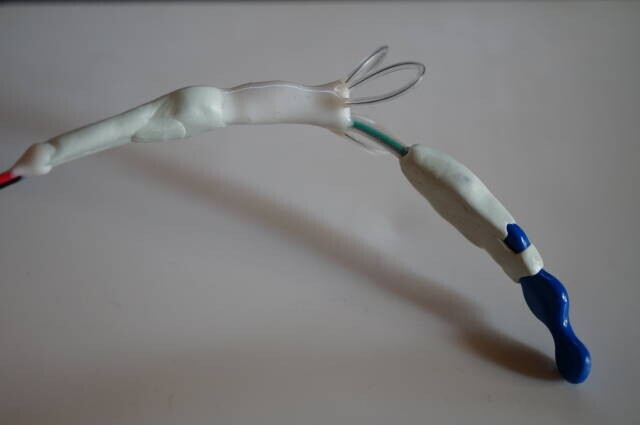
The OK Prostate Chip is a small device placed in the urethra so that it acts on the prostate. Here, shape-memory wire (alloy wire forming a curved support) accompanies one vibrating chip or connects two motor-equipped chip sections. In the paired design, those sections are intended for the prostate area and the bulbar urethra. A lock-on support (a covered wire loop) sits behind the vibrating chip alongside its power cable.
Twin-motor chips became possible with a wire linking two motors
In an entry published in June 2024, Mr. Okada introduced twin-motor chips (two connected chip sections, each with a motor). The prototype paired an M-size short ceramic chip with a roughly M-size short resin chip and two 8mm motors. He said the wire transmitted vibration between the motors more strongly than an ordinary cable connection.
According to him, this made linked vibration newly available, although he left judgments about the sensation to customers. He reported comfort during his own extended test. Mr. Okada said the leading chip could, in principle, be chosen freely.
(Source: ok-lab's diary, published June 2024)
https://ok-lab.hatenablog.com/entry/2024/06/22/122918
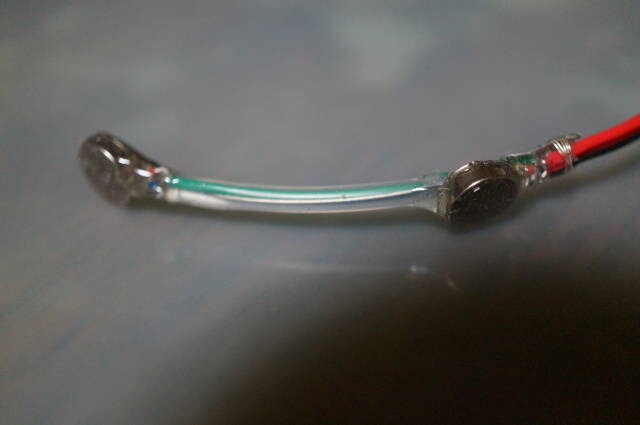
Twin-motor chips had separate charges for both ends and their connection
The June 2024 prototype's published price was ¥14,000 (about $90 at ¥156 = $1, rate as of 2026-09-04) excluding tax. Its prostate section cost ¥5,000, (about $32 at ¥156 = $1, rate as of 2026-09-04) the rear section ¥4,000, (about $26 at ¥156 = $1, rate as of 2026-09-04) and the shape-memory wire connection ¥3,000, (about $19 at ¥156 = $1, rate as of 2026-09-04) all excluding tax.
The cable connection and shared tube cover each cost ¥1,000 (about $6 at ¥156 = $1, rate as of 2026-09-04) excluding tax. Mr. Okada explained that choosing a different leading chip changed that section's price.
(Source: ok-lab's diary, published June 2024)
https://ok-lab.hatenablog.com/entry/2024/06/22/122918
Shape-memory vibrating chips needed more resin behind the motor
An entry published in April 2025 described a longer motor housing (the resin section supporting the motor and wire connection). The resin behind the motor increased from about 5-7mm to about 15mm.
With the motor included, the connection structure occupied about 25mm from the rear end. Mr. Okada advised allowing for a shorter leading tip; the prototype's ceramic section was about 10mm shorter to preserve overall length.
(Source: ok-lab's diary, published April 2025)
https://ok-lab.hatenablog.com/entry/2025/04/26/122909
Lock-on chips had a base price plus optional extras
The April 2025 entry priced the basic short ceramic lock-on chip at ¥11,000 (about $70 at ¥156 = $1, rate as of 2026-09-04) excluding tax, starting with a ¥5,000 (about $32 at ¥156 = $1, rate as of 2026-09-04) vibrating base. It added ¥1,000 (about $6 at ¥156 = $1, rate as of 2026-09-04) for the extended housing, ¥4,000 (about $26 at ¥156 = $1, rate as of 2026-09-04) for the support structure, and ¥1,000 (about $6 at ¥156 = $1, rate as of 2026-09-04) for its two cable connections, all excluding tax. Options excluding tax cost ¥3,000 (about $19 at ¥156 = $1, rate as of 2026-09-04) for the petal stopper and ¥2,000 (about $13 at ¥156 = $1, rate as of 2026-09-04) for the 20cm silicone tube.
The USB connector described as suitable for boiling added ¥500 (about $3 at ¥156 = $1, rate as of 2026-09-04) excluding tax. The complete prototype was ¥16,500 (about $106 at ¥156 = $1, rate as of 2026-09-04) excluding tax. Mr. Okada presented the stopper, tube, and connector as additions to the minimum configuration.
(Source: ok-lab's diary, published April 2025)
https://ok-lab.hatenablog.com/entry/2025/04/26/122909
Twin-motor chips gained petal stoppers in a completed custom build
In an entry published in November 2025, a customer requested twin-motor chips with a petal stopper (a wire-loop attachment intended to limit movement). Mr. Okada reported completing this previously unmade combination; the diary does not record the customer's experience with it. The quoted prostate section, using second-generation resin and an 8mm motor, cost ¥8,800 (about $56 at ¥156 = $1, rate as of 2026-09-04); the short resin section with another 8mm motor cost ¥4,400 (about $28 at ¥156 = $1, rate as of 2026-09-04).
Wire connection cost ¥3,300 (about $21 at ¥156 = $1, rate as of 2026-09-04); cable connection, tube cover, and the USB fitting suitable for boiling each cost ¥1,100 (about $7 at ¥156 = $1, rate as of 2026-09-04). An electronic controller cost ¥2,200, (about $14 at ¥156 = $1, rate as of 2026-09-04) and the 3 stopper petals cost ¥3,300 (about $21 at ¥156 = $1, rate as of 2026-09-04). Mr. Okada's quote required the customer to accept a revised stopper position, discussed below.
(Source: ok-lab's diary, published November 2025)
https://ok-lab.hatenablog.com/entry/2025/11/08/122932
The maker's answer to shape-memory vibrating chips
Mr. Okada's responses address motor alignment, independent cable movement, and strain at the support connection.
Twin-motor chips could have imperfect alignment at crossed joints
In the June 2024 entry, Mr. Okada described a manufacturing difficulty with a flat motor beside a chip aligned with the wire's curve. That arrangement required a crossed joint, which he said might not meet at the exact intended angle.
He had made similar joints before, so his reply described a limitation rather than an outright refusal. Mr. Okada said aligning the chip and motor in the same direction was easier to make.
(Source: ok-lab's diary, published June 2024)
https://ok-lab.hatenablog.com/entry/2024/06/22/122918
Lock-on chips kept the support loop separate from most cable movement
In an entry published in April 2025, a customer wanted shape-memory wire to help position a short ceramic vibrating chip. Staff initially said the proposed wire-and-cable combination would be difficult; Mr. Okada described attaching other materials alongside that wire as almost impossible. His earlier successful approaches enclosed wire in silicone tubing or contained one wire loop within a parallel-cable structure (paired motor power leads).
The prototype kept the cable and covered support loop joined at only the loop's two ends, leaving their other sections free to move. It was shown as a completed prototype, with a petal stopper among its options. Mr. Okada's proposed answer was to let the wire and cable retain their separate movement.
(Source: ok-lab's diary, published April 2025)
https://ok-lab.hatenablog.com/entry/2025/04/26/122909

Lock-on chips prompted a warning about strain on power cables
In an entry published in May 2026, an electrode-chip customer requested a lock-on arrangement made with two parallel power cables. Staff declined to recommend that arrangement, saying it placed heavy strain on vibrating-chip cables and made wire breaks more likely. Mr. Okada wrote that the earlier motor prototype had received no subsequent orders.
Mr. Okada then made an electrode version (a chip connected to a lead for electrical stimulation) using the earlier prototype's connection principle. He thought it would remain stable with less cable strain, but the diary does not record the customer's later experience. Staff's recommendation was the separate support structure shown in April 2025, rather than the requested cable-based lock-on arrangement.
(Source: ok-lab's diary, published May 2026)
https://ok-lab.hatenablog.com/entry/2026/05/16/122906
How shape-memory vibrating chips changed over time
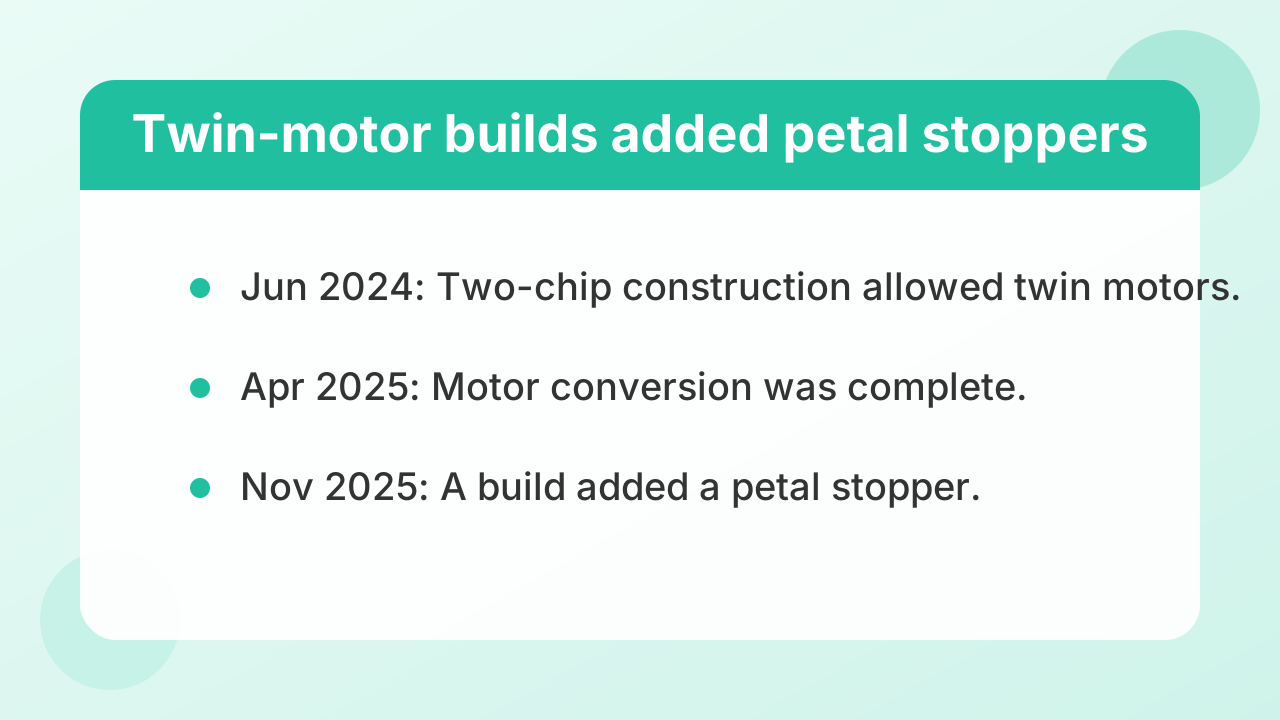
| Published | What the diary said then |
|---|---|
| Jun 2024 | Two-chip construction allowed twin motors where the three-chip design remained difficult. |
| Jun 2024 | Connecting wire lengths were offered at 2cm, 3cm, 4cm, or 5cm. |
| Apr 2025 | The prototype included a 4mm silicone tube around the cable. |
| Apr 2025 | Motor conversion was complete; a resin electrode version remained an untested possibility. |
| Jun 2025 | Stopper omission was possible; changing the shortened tip's material remained uncertain. |
| Nov 2025 | A completed twin-motor build added a petal stopper. |
| May 2026 | No suitable boilable plug was stocked, so the electrode prototype used an intervening USB connection. |
The diary does not say what the current state is.
OK Prostate Chip products related to shape-memory vibrating chips
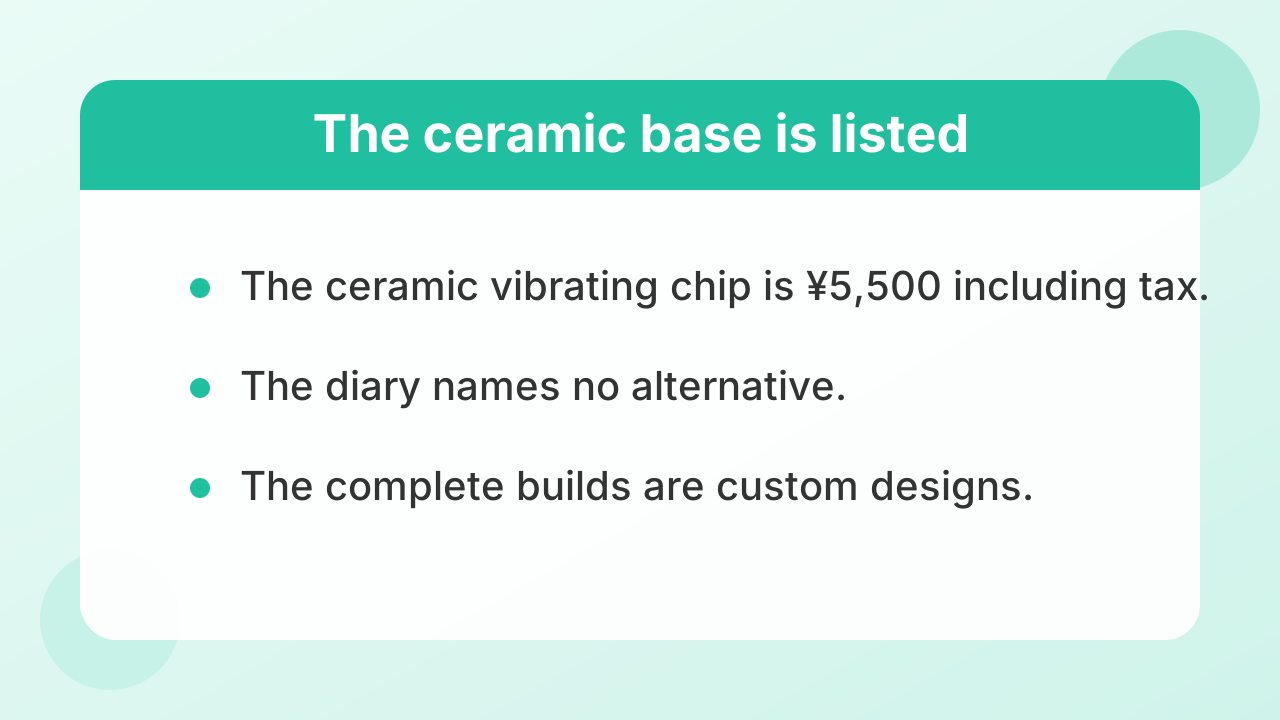
The current list confirms the short ceramic vibrating base used for the April 2025 request.
Products that appear in these entries
| Product (official name) | Price incl. tax | Relation to this topic |
|---|---|---|
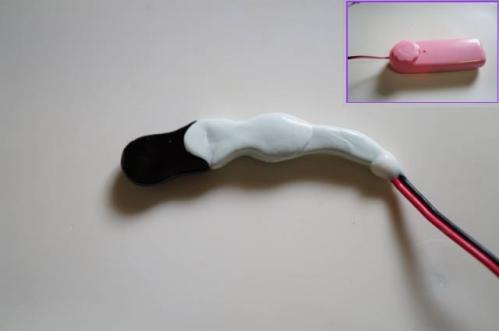
| Short ceramic vibrating chip (OKプロステート核振チップ 陶器素材ショートタイプ) | ¥5,500 (about $35 at ¥156 = $1, rate as of 2026-09-04) | In April 2025, the customer named this product as the proposed base for a custom shape-memory support. |
The short ceramic vibrating chip is sold through OK Lab's own online store.
(Source: ok-lab's diary, published April 2025)
https://ok-lab.hatenablog.com/entry/2025/04/26/122909
Products the diary mentioned as alternatives
The diary names no alternative.
The complete twin-motor and support-loop builds are custom designs described in the diary. No matching product can be confirmed on the current list.
Common worries about shape-memory vibrating chips
The diary answers questions about omitting the stopper, changing tip materials, and locating petals beside a motor.
"Can lock-on chips come without the petal stopper?"
In an entry published in June 2025, a customer asked to omit the petal stopper from the complete prototype. The diary does not record whether this revised order was completed. Mr. Okada confirmed that the version without the stopper could be made.
(Source: ok-lab's diary, published June 2025)
https://ok-lab.hatenablog.com/entry/2025/06/07/122954
"Can lock-on chips use resin or stainless steel?"
In the June 2025 entry, the customer also asked about replacing the ceramic tip with resin or stainless steel. The diary does not record a price or completed version in either material.
Mr. Okada had not shortened the second-generation resin before, and thought his equipment would struggle to cut stainless steel. He advised that ceramic was the material he could definitely make in the required shorter form.
(Source: ok-lab's diary, published June 2025)
https://ok-lab.hatenablog.com/entry/2025/06/07/122954
"Can twin-motor chips carry petals directly beside the rear motor?"
In the November 2025 entry, the customer wanted petals at the front of the rear chip. Mr. Okada said the motor occupied that area, leaving no suitable base for directly attaching the petals.
His proposed version kept the 3cm space between chips, with petals fixed about 12mm from the rear chip's front end. Mr. Okada offered that position with thick rubber covering the section between the petals and motor.
(Source: ok-lab's diary, published November 2025)
https://ok-lab.hatenablog.com/entry/2025/11/08/122932
Buying from outside Japan
OK Lab ships internationally to countries covered by Japan Post's EMS courier service. Overseas orders are paid in advance by PayPal.
Each order carries a ¥400 (about $3 at ¥156 = $1, rate as of 2026-09-04) handling fee, and EMS shipping is charged on top. These terms come from OK Lab's official sales-terms page (written here as plain text, not a link: ok-lab.net/docs/law), checked on September 7, 2026; confirm them on the official store before you order, because they can change.
Summary of this article
| What you wanted to know | The answer |
|---|---|
| What is the short answer? | The diary describes wire-supported vibration, with different limits for each connection design. |
| What is the underlying product? | A urethral device made by OK Lab in Japan and priced in Japanese yen. |
| What do the terms mean? | Twin motors provide vibration; covered wire, loops, and stoppers form parts of the support. |
| What did the prototypes change? | They linked motors, extended motor housings, and later combined twin motors with petal stoppers. |
| What did the maker propose? | Easier motor alignment and separate movement for the support wire and power cable. |
| How did the designs develop? | These entries run from June 2024 twin motors to a May 2026 electrode-support build. |
| What is listed today? | The short ceramic vibrating base is listed at ¥5,500 (about $35 at ¥156 = $1, rate as of 2026-09-04) including tax. |
| Which custom choices were answered? | Stopper omission was possible; shorter ceramic tips were confirmed, while other materials remained uncertain. |
| How do overseas orders work? | Advance PayPal payment, a ¥400 (about $3 at ¥156 = $1, rate as of 2026-09-04) handling fee, and additional Japan Post EMS shipping charges. |
Source: ok-lab's diary (Okada Comfortable Life Laboratory). The original entries are in Japanese; quotations on this page are translated. Photos and videos are on the original entries.
This article is a summary of the maker's development diary. The product is not a medical device and no result is guaranteed. If anything feels wrong or worries you, see a doctor. Prices, specifications and cautions change, so confirm the latest information on the official blog and the official site. Questions about ordering and shipping go to the seller.