![Can I add features to a vibrating chip? | Size and connections limit the options [OK Prostate Chip]](/img/a/T0062/eyecatch.svg)
This page is based on entries from "ok-lab's diary" (https://ok-lab.hatenablog.com/), the Japanese development diary written by Mr. Okada, founder of OK Lab, a small company in Japan (Okada Comfortable Life Laboratory). Only the entries about "limits when adding features to vibrating chips" are summarized here, in order of publication. Past prices and sizes are as written at the time. Current prices come from the official product list (retrieved September 4, 2026). Quotations are translated from Japanese.
Note: This page is a personal reading log by someone with no connection to the maker or the seller. It reflects the source entries as of their publication dates and makes no guarantee of accuracy or safety. The product is not a medical device; talk to a doctor about any health decision. Check the official site for current information. This page contains advertising.
In short
Added motors, electrodes, and stoppers can increase size or conflict with a vibrating chip's connections.
Mr. Okada changed layouts, restricted combinations, and sometimes declined custom requests.
Standard products remain listed; the latest stopper proposal still carried a warning about added thickness.
If you see blood in your urine, even a small amount or for the first time, do not wait and see. See a urologist right away.
If you suddenly cannot urinate, or the device cannot be removed, do not try to fix it yourself. Go to a medical facility, including emergency care, immediately.
About this product

The OK Prostate Chip is a small device that is placed in the urethra (the urine passage) so that it acts on the prostate; the maker sells it in several shapes, sizes and materials. It is made and sold by OK Lab (Okada Comfortable Life Laboratory), a small company in Japan, through its own online store, and prices are in Japanese yen (JPY). The maker's development diary, "ok-lab's diary", is written in Japanese. This page is an English summary of it, and every quotation is translated. OK Lab ships internationally, so readers outside Japan can order (see "Buying from outside Japan" below). Product names on this page are plain-English descriptions. The official Japanese product name is shown once in the product table so you can find the same item in the store.
Before you read: key terms
| Term | Plain-English meaning |
|---|---|
| Vibrating chip | A chip with a motor, intended to provide vibration. |
| Electrode | A contact used to deliver electrical stimulation. |
| Resin | Material used to form parts and cover motor connections. |
| Biocompatible resin | A named chip material. The diary does not explain this. |
| Four-wire support | An earlier cable structure used to support connected parts and transmit vibration. |
| Shape-memory wire / nitinol | Wire used for curved supports and connections that can recover their shape. |
| Stopper | An attachment intended to limit movement or help maintain a position. |
| Movable joint | A flexible connection between a chip and motor, intended to allow bending. |
| Twin-wire design | Two exposed parallel wires connecting a chip and motor, intended to transmit vibration. |
| Twist | A twisted chip shape intended to change stimulation. |
What happens: adding features to a vibrating chip
The OK Prostate Chip is a small device placed in the urethra (the urine passage) to stimulate the prostate. Motorized versions add vibration; custom designs may also include electrodes (contacts for electrical stimulation), shaped surfaces, or stoppers intended to limit movement. These parts sit on the chip, around its motor, or along its cable. Mr. Okada describes limits involving size, waterproofing, attachment strength, and the space needed to connect different parts.
A vibrating chip stopper became relevant after unintended movement into the bladder
In an entry published in September 2019, a customer discussing a three-motor order reported that an L-size chip had fallen into their bladder. The customer said it came out after a while, without describing how. The workshop suggested an external cable stopper as possible protection against complete inward movement, expressing an expectation rather than a confirmed result.
(Source: ok-lab's diary, published September 2019)
https://ok-lab.hatenablog.com/entry/2019/09/28/140637
Vibrating chip waterproofing remained unresolved for the requested resin in October 2021
In an entry published in October 2021, a prospective buyer asked about a vibrating chip made from biocompatible resin (the requested chip material). Mr. Okada said this was possible outside the motor section, but waterproofing that section with this material remained unresolved. The customer postponed buying pending improvements, and Mr. Okada supported their cautious consideration.
(Source: ok-lab's diary, published October 2021)
https://ok-lab.hatenablog.com/entry/2021/10/02/125825
Electrodes made a vibrating chip too thick for some existing users
In an entry published in April 2022, Mr. Okada discussed requests combining multiple motors with electrodes. The electrode wiring added another layer over the completed motor section, substantially increasing thickness. He cautioned that customers who could barely accommodate an ordinary vibrating chip might find the combined design unsuitable.
(Source: ok-lab's diary, published April 2022)
https://ok-lab.hatenablog.com/entry/2022/04/02/123050
A vibrating chip stopper was cancelled because its cable was incompatible
In a separate case published in April 2022, a customer requested a ceramic medium-length vibrating chip with a thicker, stiffer cable. The workshop accepted the cable change but cancelled the parallel-cable stopper because it could not fit that cable. The diary does not record how the completed combination felt in use; the workshop's answer excluded the incompatible stopper.
(Source: ok-lab's diary, published April 2022)
https://ok-lab.hatenablog.com/entry/2022/04/02/123050
Thick vibrating chip connections prompted a change away from four-wire support
In an entry published in June 2022, a customer reported that bulky connections prevented several earlier chips from fitting. Mr. Okada acknowledged that four-wire support (an earlier supporting cable structure) and ordinary cable connections had added about 2mm at the rear.
He said the earlier four-wire support had ended and described newer, thinner connections relying on metal for strength. He proposed that newer connection approach for thinner builds, with further developments dependent on testing.
(Source: ok-lab's diary, published June 2022)
https://ok-lab.hatenablog.com/entry/2022/06/11/123420
Removing one motor made a combined vibrating chip less bulky
In an entry published in June 2024, a customer wanted a smaller electrode-and-motor chip after finding the previous version bulky. Mr. Okada produced a two-motor version using 8mm motors that were 2mm thick, leaving the tip without a motor.
The finished maximum dimensions were 11mm wide and 6.5mm thick; the entry does not report the customer's subsequent experience. Mr. Okada considered it potentially suitable for customers who could accommodate his larger ceramic chips.
(Source: ok-lab's diary, published June 2024)
https://ok-lab.hatenablog.com/entry/2024/06/08/123008
Vibrating chip motor size limited texture before quality concerns ended the order
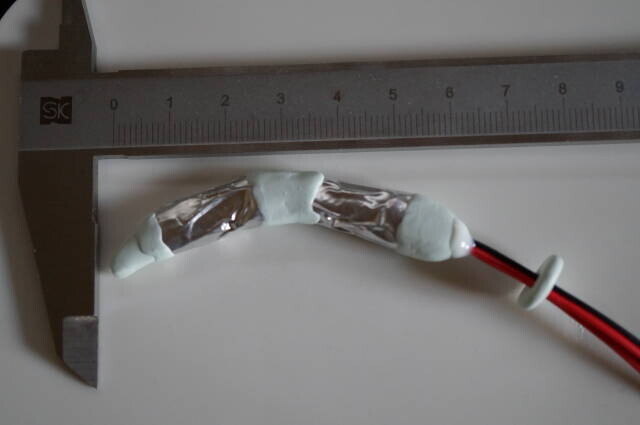
In entries published in January 2025, a customer repeatedly revised a request for a textured motorized chip. The 8mm motor assembly occupied 14mm: 1mm of covering resin, the motor itself, and 5mm of connections; finished width was about 10mm. Staff initially doubted the small surface details, but Mr. Okada later drew a feasible design priced like the screw-shaped version.
He subsequently warned that externally sourced motors could be defective, with substantial variation in durability and operating noise. Despite the earlier design approval, he declined the entire custom request. He suggested considering a simple standard vibrating model instead, while acknowledging the limits of his performance assessments.
(Source: ok-lab's diary, published January 2025)
https://ok-lab.hatenablog.com/entry/2025/01/11/122910
(Source: ok-lab's diary, published January 2025)
https://ok-lab.hatenablog.com/entry/2025/01/18/123007
(Source: ok-lab's diary, published January 2025)
https://ok-lab.hatenablog.com/entry/2025/01/25/122940
The maker's answer to adding features to a vibrating chip
The diary describes changing layouts, rejecting incompatible parts, and limiting motor or wire choices.
Vibrating chip power and finished dimensions both limited combined designs
In an entry published in June 2022, a customer who had reported being unable to urinate asked about a three-motor, two-electrode chip. Mr. Okada estimated about 8mm thickness, with width exceeding 12mm where electrodes covered a 10mm motor.
He said multiple motors vibrated substantially more at 4.5V or above than at 3V, while warning that prolonged operation at 6V was dangerous. The diary does not record whether this order was completed. Mr. Okada also suggested considering another prototype once its testing and pricing were available.
(Source: ok-lab's diary, published June 2022)
https://ok-lab.hatenablog.com/entry/2022/06/04/123036
A vibrating chip wire needed room to move independently from its cable
In an entry published in April 2025, a customer wanted a curved support combined with a short ceramic vibrating chip. Mr. Okada said shape-memory wire (wire used to recover a set shape) was extremely difficult to combine alongside other materials, including parallel and twisted cables.
His prototype kept the support loop and power cable largely independent. The attachment required about 15mm of resin beyond the motor, so the forward chip section was shortened by about 10mm. Mr. Okada offered this separate-loop arrangement in response to the request.
(Source: ok-lab's diary, published April 2025)
https://ok-lab.hatenablog.com/entry/2025/04/26/122909
An integrated vibrating chip stopper looked possible but remained a proposal
In an entry published in October 2025, Mr. Okada described an integrated stopper made for an electrode order. He thought its nitinol wire could share the resin anchorage surrounding a motor, potentially extending the idea to every vibrating chip. This was a proposed possibility; Mr. Okada invited requests for the arrangement.
(Source: ok-lab's diary, published October 2025)
https://ok-lab.hatenablog.com/entry/2025/10/18/122911
A movable vibrating chip joint required larger motors and ceramic parts
In an entry published in February 2026, Mr. Okada presented a movable joint (a flexible connection between chip and motor). Its wire connection allowed thinner resin coverage, with joint diameters from about 3mm to 5mm.
He excluded 6mm motors because he doubted connection reliability; the design supported 8mm or 10mm motors and ceramic chips only. Published additional charges were ¥4,000 (about $26 at ¥156 = $1, rate as of 2026-09-04) tax excluded for short or medium-length ceramic chips, and ¥5,000 (about $32 at ¥156 = $1, rate as of 2026-09-04) tax excluded for extended or long types. Mr. Okada cautioned that strong or prolonged bladder vibration might be harmful.
(Source: ok-lab's diary, published February 2026)
https://ok-lab.hatenablog.com/entry/2026/02/14/121602
Twin-wire vibrating chip add-ons restricted surface shapes and exposed metal
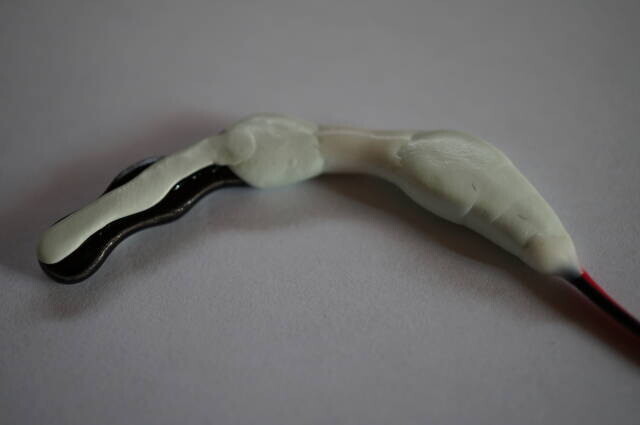
In another entry published in February 2026, Mr. Okada reported reduced vibration in a 15cm covered movable prototype. He attributed this to thicker wire and a closely fitting tube, then described a twin-wire design (two exposed parallel connecting wires).
With 0.4mm wire, twists and raised bumps were generally unavailable. With 0.3mm wire, bumps were generally possible, although irregular arrangements could remain incompatible. Mr. Okada warned that the exposed-wire design was unsuitable for people with metal allergies.
(Source: ok-lab's diary, published February 2026)
https://ok-lab.hatenablog.com/entry/2026/02/21/122935
If you see blood in your urine, even a small amount or for the first time, do not wait and see. See a urologist right away.
If you suddenly cannot urinate, or the device cannot be removed, do not try to fix it yourself. Go to a medical facility, including emergency care, immediately.
How adding features to a vibrating chip changed over time
| Published | What the diary said then |
|---|---|
| Sep 2019 | Covered 8mm and 10mm motors reached maximum widths of 10mm and 12mm. |
| Oct 2021 | Motor waterproofing remained unresolved for the requested resin. |
| Apr 2022 | Adding two electrodes, wiring, and a plug was quoted at ¥6,600 (about $42 at ¥156 = $1, rate as of 2026-09-04). |
| May 2022 | Multiple-motor prototypes had only undergone vibration testing outside the body. |
| Jun 2022 | Earlier four-wire support ended; newer connections reduced bulk. |
| Jun 2024 | A smaller combined electrode-and-motor design became possible. |
| Jan 2025 | Raised dots on a flat chip were priced at ¥1,000 (about $6 at ¥156 = $1, rate as of 2026-09-04) tax excluded. |
| Apr 2025 | Curved-support connections required more length behind the motor. |
| Feb 2026 | Movable joints supported ceramic chips and excluded 6mm motors. |
| May 2026 | An apple-shaped cable stopper was considered possible, with increased shaft thickness. |

OK Prostate Chip products related to adding features to a vibrating chip
The current list includes standard products named in these requests.
Products that appear in these entries
| Product (official name) | Price incl. tax | Relation to this topic |
|---|---|---|
| Short ceramic vibrating chip (OKプロステート核振チップ 陶器素材ショートタイプ) | ¥5,500 (about $35 at ¥156 = $1, rate as of 2026-09-04) | In April 2025, a customer selected this standard product as the starting point for a curved-support request. |
| Medium-length ceramic vibrating chip (OKプロステート核振チップ 陶器素材セミロングタイプ) | ¥6,600 (about $42 at ¥156 = $1, rate as of 2026-09-04) | In April 2022, this product appeared in the thicker-cable order whose stopper was cancelled. |
| Parallel-cable stopper option (平行ケーブル用ストッパー追加(オプション)) | ¥1,100 (about $7 at ¥156 = $1, rate as of 2026-09-04) | In April 2022, this option was cancelled because it could not fit the requested cable. |
(Source: ok-lab's diary, published April 2022)
https://ok-lab.hatenablog.com/entry/2022/04/02/123050
(Source: ok-lab's diary, published April 2025)
https://ok-lab.hatenablog.com/entry/2025/04/26/122909

Products the diary mentioned as alternatives
The diary names no alternative.
Two availability limits apply to the historical designs.
- Earlier four-wire support: Mr. Okada said it had ended in June 2022.
- Custom combined chips, textured builds, curved supports, movable joints, twin-wire versions, and apple-shaped stoppers: No matching product can be confirmed on the current list.
Common worries about adding features to a vibrating chip
Each proposed stopper or motor position had its own construction limits.
"Can vibrating chip add-ons include motors at both ends?"
In an entry published in June 2024, Mr. Okada compared motor positions in a connected-chip design. The motor section could not have a twist (a twisted chip shape), leaving his prototype partly flat. He reported a milder sensation from the changed position and offered one motor in either the bladder-side or prostate-side section because two locations were then impractical.
(Source: ok-lab's diary, published June 2024)
https://ok-lab.hatenablog.com/entry/2024/06/15/123132
"Can a vibrating chip stopper sit directly over the motor?"
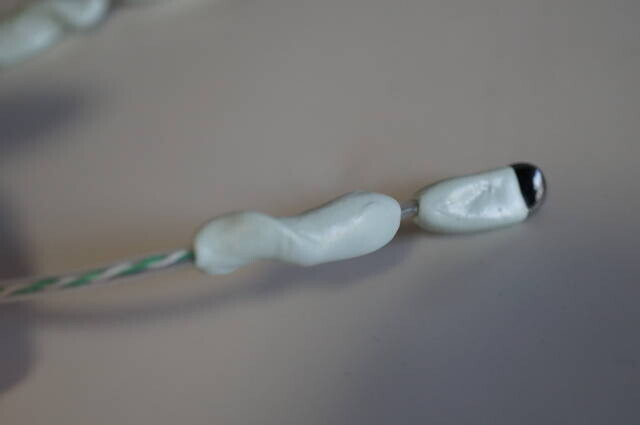
In an entry published in November 2025, a customer requested a petal-shaped stopper at the forward end of a motorized rear chip. The workshop refused that position because the motor occupied the space needed for the stopper's base.
The workshop provided a quotation conditional on the customer's acceptance of the revised proposal. The workshop proposed a position about 12mm from that tip, within the 3cm gap between chips.
(Source: ok-lab's diary, published November 2025)
https://ok-lab.hatenablog.com/entry/2025/11/08/122932
"Will an apple-shaped vibrating chip stopper make positioning easier?"
In an entry published in May 2026, a customer asked about an apple-shaped stopper to hold the vibrating section at a chosen position. Staff said it could be made, but placing it on the cable would make the shaft substantially thicker. The diary does not record whether the customer ordered it; staff offered the combination with a warning that insertion would become more difficult.
(Source: ok-lab's diary, published May 2026)
https://ok-lab.hatenablog.com/entry/2026/05/02/122917
Buying from outside Japan

OK Lab ships internationally to countries covered by Japan Post's EMS courier service. Overseas orders are paid in advance by PayPal. Each order carries a ¥400 (about $3 at ¥156 = $1, rate as of 2026-09-04) handling fee, and EMS shipping is charged on top. These terms come from OK Lab's official sales-terms page (written here as plain text, not a link: ok-lab.net/docs/law), checked on September 7, 2026; confirm them on the official store before you order, because they can change.
Summary of this article
| What you wanted to know | The answer |
|---|---|
| What is the short answer? | Additional features can increase size or conflict with connections. |
| What is this product? | A device made in Japan for placement in the urethra, with motorized versions. |
| Which terms matter? | Motors, electrodes, supporting wires, joints, and stoppers have different roles. |
| What happened in the cases? | Requests led to larger dimensions, changed designs, cancelled options, and one declined custom order. |
| How did the maker respond? | Mr. Okada changed layouts and restricted materials, motor sizes, or attachments. |
| What changed over time? | Some connections became slimmer, while newer designs introduced their own limits. |
| Which products are listed today? | The named standard ceramic vibrating chips and parallel-cable stopper remain on the supplied list. |
| Can any stopper fit any position? | The motor, mounting space, and cable can prevent the requested placement. |
| How does overseas buying work? | Advance PayPal payment, a ¥400 (about $3 at ¥156 = $1, rate as of 2026-09-04) handling fee, and additional EMS shipping apply. |
Source: ok-lab's diary (Okada Comfortable Life Laboratory). The original entries are in Japanese; quotations on this page are translated. Photos and videos are on the original entries.
This article is a summary of the maker's development diary. The product is not a medical device and no result is guaranteed. If anything feels wrong or worries you, see a doctor. Prices, specifications and cautions change, so confirm the latest information on the official blog and the official site. Questions about ordering and shipping go to the seller.