![Is the vibrating motor waterproof? | Its protective covering has limits [OK Prostate Chip]](/img/a/T0055/eyecatch.svg)
This page is based on entries from "ok-lab's diary" (https://ok-lab.hatenablog.com/), the Japanese development diary written by Mr. Okada, founder of OK Lab, a small company in Japan (Okada Comfortable Life Laboratory). Only the entries about "motor waterproofing" are summarized here, in order of publication. Past prices and sizes are as written at the time. Current prices come from the official product list (retrieved September 4, 2026). Quotations are translated from Japanese.
Note: This page is a personal reading log by someone with no connection to the maker or the seller. It reflects the source entries as of their publication dates and makes no guarantee of accuracy or safety. The product is not a medical device; talk to a doctor about any health decision. Check the official site for current information. This page contains advertising.
In short
- The maker reports leaks and failures when a motor's protective covering is damaged or too thin.
- Mr. Okada favors protected connections and warns that motor sealing does not protect every controller.
- An exposed-metal prototype was withdrawn because Mr. Okada could not guarantee the metal's safety inside the body.
If you see blood in your urine, even a small amount or for the first time, do not wait and see. See a urologist right away.
If you suddenly cannot urinate, or the device cannot be removed, do not try to fix it yourself. Go to a medical facility, including emergency care, immediately.
About this product

The OK Prostate Chip is a small device that is placed in the urethra (the urine passage) so that it acts on the prostate; the maker sells it in several shapes, sizes and materials. It is made and sold by OK Lab (Okada Comfortable Life Laboratory), a small company in Japan, through its own online store, and prices are in Japanese yen (JPY). The maker's development diary, "ok-lab's diary", is written in Japanese. This page is an English summary of it, and every quotation is translated. OK Lab ships internationally, so readers outside Japan can order (see "Buying from outside Japan" below). Product names on this page are plain-English descriptions. The official Japanese product name is shown once in the product table so you can find the same item in the store.
Before you read: key terms
| Term | Plain-English meaning |
|---|---|
| Urethra | The urine passage; the location intended for the chips discussed here. |
| Motor | The small component that produces vibration in a vibrating chip. |
| Resin | The covering material used to protect the motor and its connections. |
| Battery box | A battery holder supplying power to the motor. |
| Controller | A unit used to control the chip's vibration. |
| Linear motor | A motor whose weight moves back and forth, proposed for a custom vibrating chip. |
| Biocompatible resin | A named material proposed for chip bodies and motor coverings. The diary does not explain this. |
| Bluetooth controller | The app-controlled unit discussed as a way to control chip vibration. |
What happens: motor waterproofing
The OK Prostate Chip is a urethral device that the maker describes as a prostate massager. The vibrating versions discussed here contain a small motor intended to produce vibration inside the urethra, the urine passage. Resin (the protective covering material) surrounds the motor, while a cable connects it to a battery box or controller. These entries examine leaks, fragile connections, and the extra size added by that covering.
Motor waterproofing developed alongside efforts to protect fragile electrical connections
In an entry published in December 2018, Mr. Okada reported destructive testing of about 100 vibrator units across 3 types. Every failure occurred at the connection to the motor. He described the tiny wire attachments as vulnerable to an accidental pull.
His revised design moved the motor connections and cable joint into the chip's center. He believed this reduced the possibility of breakage. Mr. Okada favored protecting the cable covering together with the electrical connection.
(Source: ok-lab's diary, published December 2018)
https://ok-lab.hatenablog.com/entry/20181229/1546064791
A twisted prototype leaked during testing of its waterproof seal
An entry published in February 2019 follows a request for a twisted, double-ended resin vibrating chip. Mr. Okada initially declined because of manufacturing difficulties, then attempted a prototype. Its shape was successful, but waterproof testing found a leak.
The prototype was reinforced, and both motors were operating at publication. Mr. Okada suspected the twist also strained wiring buried inside partly hardened resin. He discouraged this twisted design because he expected reduced performance.
(Source: ok-lab's diary, published February 2019)
https://ok-lab.hatenablog.com/entry/2019/02/23/142754
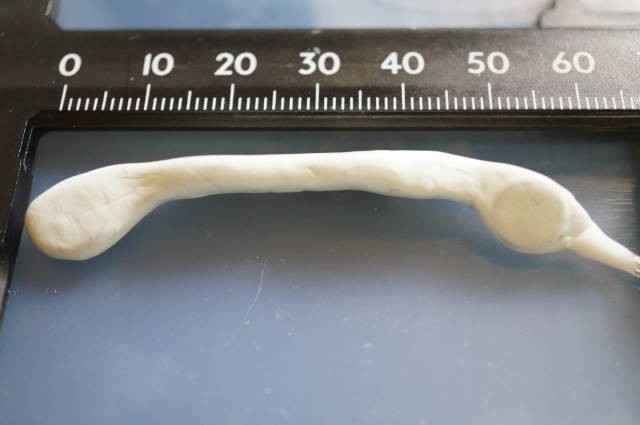
Thinner resin reduced motor waterproofing margins without guaranteeing lasting strength
In an entry published in August 2019, a customer requested a thinner 8mm motor assembly because its thickness prevented insertion. Mr. Okada said the thinnest motor was about 4mm thick, becoming about 6mm with protective resin.
He offered a thinner covering, and the finished alteration measured 5mm. The customer had requested that work after reporting that the original assembly still did not fit. The diary does not record how the altered chip felt in use. Mr. Okada cautioned that strength would decrease and long-term durability remained unguaranteed, despite waterproof testing before shipment.
(Source: ok-lab's diary, published August 2019)
https://ok-lab.hatenablog.com/entry/2019/08/10/125102
Water damage remained a problem for controllers despite motor protection
In an entry published in September 2019, Mr. Okada reported tests on a switchless 1.5V battery box (a holder supplying motor power). He said it continued driving vibration while submerged for one hour. He also reported no problem during one week that included bath and shower exposure.
His claim applied specifically to that switchless box. Mr. Okada warned that both the IC controller (an electronic vibration-control unit) and the pink vibrator's controller would fail when wet.
(Source: ok-lab's diary, published September 2019)
https://ok-lab.hatenablog.com/entry/2019/09/07/135854
Motor waterproofing tests did not settle concerns about exposed metal
In an entry published in February 2020, a customer asked whether reduced motor covering could keep a vibrating ceramic chip within 10mm width. Mr. Okada said the sides needed resin too, making that width impossible. His partly covered prototype measured 10.3mm and had shown no waterproofing problem in short tests.
The customer accepted a custom build following his reply. Mr. Okada separately reported no waterproofing concern after one week of testing the partly exposed prototype. Nevertheless, he ruled out further exposed-metal designs because he could not guarantee the metal's safety inside the body.
(Source: ok-lab's diary, published February 2020)
https://ok-lab.hatenablog.com/entry/2020/02/22/145216
A failed waterproof seal was suspected after an exposed motor stopped
In an entry published in October 2021, a customer wanted to use an 8mm motor but found it too large. An alteration left much of the motor's metal exposed, and it stopped working. Mr. Okada suspected that its waterproof protection had been lost.
The diary does not record a repair or working replacement for this customer. Mr. Okada proposed exploring an external vibration source for people who could not accommodate his enclosed motors.
(Source: ok-lab's diary, published October 2021)
https://ok-lab.hatenablog.com/entry/2021/10/09/125823
The maker's answer to motor waterproofing
Mr. Okada's responses included motor replacement, conditional custom work, and abandoning designs whose protection he could not support.
Motor waterproofing concerns led to an offered replacement instead of reshaping
In an entry published in March 2019, a customer asked about reshaping a vibrating chip whose rear section would not fit. Mr. Okada declined reshaping work on a chip already used in the urethra. He warned that excessive material removal could destroy its waterproof protection.
Motor-unit replacement cost ¥3,000 (about $19 at ¥156 = $1, rate as of 2026-09-04) excluding tax, as published in March 2019. The diary does not record whether this customer accepted the service. Mr. Okada offered replacement with an 8mm motor unit as the response available from his workshop.
(Source: ok-lab's diary, published March 2019)
https://ok-lab.hatenablog.com/entry/2019/03/09/150813
Custom motor waterproofing had to pass testing before completed delivery
In an entry published in May 2020, a customer requested a custom chip around a supplied linear motor (a motor with a back-and-forth moving weight). Mr. Okada estimated that its roughly 10.5mm minimum width would become at least about 12mm after resin covering. He could not promise adequate connection strength or waterproofing before examining it.
He distinguished returning an unsuitable unit, delivering unfinished work, and completing a tested product. The motor arrived and the customer authorized work, but the diary does not record completed delivery. Mr. Okada made successful waterproof testing a condition for delivery as a finished product.
(Source: ok-lab's diary, published May 2020)
https://ok-lab.hatenablog.com/entry/2020/05/30/125906
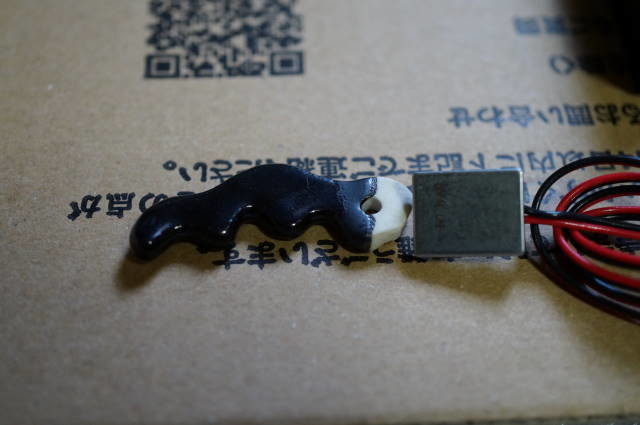
Fragile wiring limited motor waterproofing with the proposed alternative resin
An entry published in October 2021 describes Mr. Okada's doubts about motor waterproofing with biocompatible resin (the material proposed for chip bodies). He said tiny wires on 8mm motors could detach or break under very little force. Protective work and motor assembly took 3 days, with further controller work afterward.
He considered the proposed resin seal theoretically possible but declined to pursue it because of the motor's fragility. His earlier wire-driven experiment had already been halted after unexplained bleeding. Mr. Okada instead favored developing a chip component that received vibration from a separate external vibrator.
(Source: ok-lab's diary, published October 2021)
https://ok-lab.hatenablog.com/entry/2021/10/16/125843
Motor waterproofing tests informed Mr. Okada's explanation of escaping bubbles
In an entry published in September 2025, a customer reported bubbles from a short ceramic twist chip, followed by breakage before that session. The customer reported about 4 months of ownership and around 10 uses. Mr. Okada compared the bubbles with observations from his motor seal tests.
He interpreted bubbles in his boiling-water motor tests as escaping air through a failed seal, and their absence as retained waterproofing. He suspected the customer's ceramic chip contained a crack with trapped air. Mr. Okada regarded escaping bubbles as a useful warning when assessing damage hidden beneath resin.
(Source: ok-lab's diary, published September 2025)
https://ok-lab.hatenablog.com/entry/2025/09/20/122912
If you see blood in your urine, even a small amount or for the first time, do not wait and see. See a urologist right away.
If you suddenly cannot urinate, or the device cannot be removed, do not try to fix it yourself. Go to a medical facility, including emergency care, immediately.
How motor waterproofing changed over time
| Published | What the diary said then |
|---|---|
| Dec 2018 | Revised designs placed vulnerable electrical connections inside the chip. |
| Feb 2019 | A twisted prototype leaked; Mr. Okada discouraged that design. |
| Mar 2019 | A smaller replacement motor was offered for a chip that would not fit. |
| Aug 2019 | A thinner covering came with an explicit durability reservation. |
| Sep 2019 | Water tolerance depended on the power unit; electronic controllers remained vulnerable. |
| Feb 2020 | Exposed-metal designs were withdrawn despite reassuring short tests. |
| Oct 2021 | Waterproofing the motor with biocompatible resin remained technically unresolved. |
| Jan 2022 | Separate controller sales replaced the assumption that an integrated waterproof assembly was essential. |
| Sep 2025 | Mr. Okada explained his interpretation of bubbles during motor seal tests. |

The diary does not say what the current state is.
OK Prostate Chip products related to motor waterproofing

The current list includes the ceramic chip whose breakage prompted the September 2025 explanation of motor seal testing.
Products that appear in these entries
| Product (official name) | Price incl. tax | Relation to this topic |
|---|---|---|
| Short ceramic twist chip (OKプロステートチップ 陶器素材ショートタイプ ツイスト) | ¥4,400 (about $28 at ¥156 = $1, rate as of 2026-09-04) | In September 2025, its owner's report of bubbles and breakage prompted Mr. Okada's comparison with motor waterproofing tests. |
(Source: ok-lab's diary, published September 2025)
https://ok-lab.hatenablog.com/entry/2025/09/20/122912
Products the diary mentioned as alternatives
The diary names no alternative.
The partly exposed motor prototype was discontinued in February 2020 because Mr. Okada could not guarantee the exposed metal's safety.
(Source: ok-lab's diary, published February 2020)
https://ok-lab.hatenablog.com/entry/2020/02/22/145216
The twisted resin prototype, altered motor assemblies, custom linear-motor build, and modified Bluetooth controller: No matching product can be confirmed on the current list.
Common worries about motor waterproofing

The replies distinguish exposed metal, material choices, and the controller's own waterproofing and compatibility limits.
"Does exposed motor metal mean its waterproof seal has failed?"
In an entry published in January 2020, a customer sought help with a vibrating chip that would not fit. Mr. Okada initially suggested possible explanations and alternatives. A later reply reported that a size alteration had allowed it to fit but exposed some motor metal.
The diary does not record its subsequent waterproof performance. Mr. Okada thought exposed metal might be acceptable away from a joint, but favored adhesive sealing when the exposed area was a seam.
(Source: ok-lab's diary, published January 2020)
https://ok-lab.hatenablog.com/entry/2020/01/25/150127
"Can biocompatible resin provide motor waterproofing throughout the chip?"
In an entry published in October 2021, a prospective customer asked for a vibrating chip made from biocompatible resin. Mr. Okada said that material could be used for parts other than the motor. He had no established technique for waterproofing the motor section with it at that time.
The customer had decided to delay buying while waiting for material improvements. Mr. Okada endorsed putting safety first and considering the purchase carefully.
(Source: ok-lab's diary, published October 2021)
https://ok-lab.hatenablog.com/entry/2021/10/02/125825
"Can a waterproof controller be purchased separately from the chip?"
An entry published in January 2022 records a request to buy the Bluetooth controller (the app-controlled vibration unit) separately. Mr. Okada had initially treated a fully waterproof, integrated assembly as essential. He then changed the standard offering to a separate controller, while considering a cheaper version without waterproofing.
The diary does not record a final waterproof specification for that cheaper version. His compatibility findings were specific: 8mm motors worked, while 10mm motors did not. Mr. Okada warned that 6mm motors broke after connection to that controller.
(Source: ok-lab's diary, published January 2022)
https://ok-lab.hatenablog.com/entry/2022/01/22/123342
Buying from outside Japan

OK Lab ships internationally to countries covered by Japan Post's EMS courier service. Overseas orders are paid in advance by PayPal. Each order carries a ¥400 (about $3 at ¥156 = $1, rate as of 2026-09-04) handling fee, and EMS shipping is charged on top. These terms come from OK Lab's official sales-terms page (written here as plain text, not a link: ok-lab.net/docs/law), checked on September 7, 2026; confirm them on the official store before you order, because they can change.
Summary of this article
| What you wanted to know | The answer |
|---|---|
| What is the short answer? | The diary records limits to motor protection and separate limits for controllers. |
| What is this product? | A device made by OK Lab in Japan for placement in the urethra. |
| What protects the motor? | Resin surrounds the motor and protects its connections. |
| What has gone wrong? | Recorded problems include prototype leaks and a motor failure after its metal became exposed. |
| What responses did the maker describe? | Replacement, conditional custom work, and withdrawal of an exposed-metal design. |
| Did the position change over time? | Early confidence in short tests was followed by specific restrictions and unresolved material questions. |
| What current product appears here? | The short ceramic twist chip is listed at ¥4,400 (about $28 at ¥156 = $1, rate as of 2026-09-04) including tax. |
| What did customer questions establish? | Fit, material choice, and controller compatibility each had separate limitations. |
| How do overseas orders work? | Advance PayPal payment, a ¥400 (about $3 at ¥156 = $1, rate as of 2026-09-04) handling fee, and additional EMS shipping. |
| What remains unknown? | These historical accounts do not establish today's motor waterproofing specifications. |
Source: ok-lab's diary (Okada Comfortable Life Laboratory). The original entries are in Japanese; quotations on this page are translated. Photos and videos are on the original entries.
This article is a summary of the maker's development diary. The product is not a medical device and no result is guaranteed. If anything feels wrong or worries you, see a doctor. Prices, specifications and cautions change, so confirm the latest information on the official blog and the official site. Questions about ordering and shipping go to the seller.