![Does motor position change how vibration feels? | The maker reports differences, with limits [OK Prostate Chip]](/img/a/T0053/eyecatch.svg)
This page is based on entries from "ok-lab's diary" (https://ok-lab.hatenablog.com/), the Japanese development diary written by Mr. Okada, founder of OK Lab (Okada Comfortable Life Laboratory). Only the entries about "motor position and vibration" are summarized here, in order of publication. Past prices and sizes are as written at the time. Current prices come from the official product list (retrieved September 4, 2026). Quotations are translated from Japanese.
Note: This page is a personal reading log by someone with no connection to the maker or the seller. It reflects the source entries as of their publication dates and makes no guarantee of accuracy or safety. The product is not a medical device; talk to a doctor about any health decision. Check the official site for current information. This page contains advertising.
In short
OK Lab, a small company in Japan, reports that motor placement changes where vibration is felt.
Mr. Okada explored different connections and positions, while warning against excessive heat and prolonged bladder vibration.
The current list includes standard vibrating chips; February 2026 entries describe additional custom designs.
About this product

The OK Prostate Chip is a small device that is placed in the urethra (the urine passage) so that it acts on the prostate; the maker sells it in several shapes, sizes and materials.
It is made and sold by OK Lab (Okada Comfortable Life Laboratory), a small company in Japan, through its own online store, and prices are in Japanese yen (JPY). The maker's development diary, "ok-lab's diary", is written in Japanese. This page is an English summary of it, and every quotation is translated.
OK Lab ships internationally, so readers outside Japan can order (see "Buying from outside Japan" below). Product names on this page are plain-English descriptions. The official Japanese product name is shown once in the product table so you can find the same item in the store.
Before you read: key terms
| Term | Plain-English meaning |
|---|---|
| Motor position | The motor's location within an arrangement, chosen to direct vibration toward particular areas. |
| Urinary sphincters | Muscles described as inner and outer positioning points; the diary discusses them holding narrow connectors. |
| Stopper or support | An additional part intended to help stabilize the chip or its cable. |
| Retrieval thread | A line attached to the device for retrieval and positional control. |
| 4-wire support | A cable with four supporting wires, described as carrying vibration between connected parts. |
| Controller | A device that sets vibration strength or pattern. |
| Shape-memory wire, or nitinol | Wire that returns toward a set shape, used for flexible connections and vibration transmission. |
| Perineal area | An additional vibration target named in the diary. The diary does not explain this. |
| Articulated sound | A jointed urethral instrument used as the basis for a proposed bladder-targeted vibrating device. |
What happens: motor position and vibration
The OK Prostate Chip is a small device placed in the urethra (the urine passage) to act on the prostate. Vibrating versions have a motor attached to the chip or connected to it by wire. The entries describe arrangements intended to vibrate the prostate, bladder, or parts of the penis. Mr. Okada also reports vibration traveling through connections, meaning that the place containing the motor was not always the only place that moved.
Motor position affected how clearly Mr. Okada could locate prostate vibration
In an entry published in December 2019, Mr. Okada described clearer prostate sensation with one motor near the prostate and another outside the body. He said the location became clearer whichever motor started first.
With a vibrating chip and an egg-shaped anal vibrator, however, he could no longer distinguish the urethral prostate location. He suspected those vibration sources were too close together.
(Source: ok-lab's diary, published December 2019)
https://ok-lab.hatenablog.com/entry/2019/12/07/162608
External motor position still allowed vibration to reach the distant chip
In an entry published in May 2022, a customer requested an external motor and a prostate chip without its own motor. Staff confirmed that the external motor was intended to target the head of the penis.
Mr. Okada reported that the completed device's tip still vibrated with its motor 23cm away. He attributed this to 4-wire support (a cable containing four supporting wires), which carried vibration along its length. The diary does not record how the completed device felt to that customer.
(Source: ok-lab's diary, published May 2022)
https://ok-lab.hatenablog.com/entry/2022/05/14/123043
Matching vibration strength at separate locations did not provide enough contrast
In an entry published in May 2022, Mr. Okada reported that his linked multi-motor prototype had not brought him to orgasm. He thought equal vibration strength at the prostate and head of the penis left too little contrast.
A revised design had only been tested outside the body; this entry contains no internal-test result for it. He proposed separate controllers (devices setting vibration strength and pattern) to give those areas different rhythms and strengths.
(Source: ok-lab's diary, published May 2022)
https://ok-lab.hatenablog.com/entry/2022/05/28/123218
Motor position near the prostate produced gentler bladder vibration in testing
In an entry published in June 2024, Mr. Okada tested a 6mm motor in the prostate section nearest the bladder. The prototype had connected bladder, prostate, and lower-urethral sections. He reported gentler bladder vibration through shape-memory wire (wire that returns toward a set shape), compared with direct bladder vibration.
According to his report, the wire also transmitted movement to the other connected chips. He offered bladder-side or prostate-side motor placement at the same price, with one motor in that three-part design at publication.
(Source: ok-lab's diary, published June 2024)
https://ok-lab.hatenablog.com/entry/2024/06/15/123132
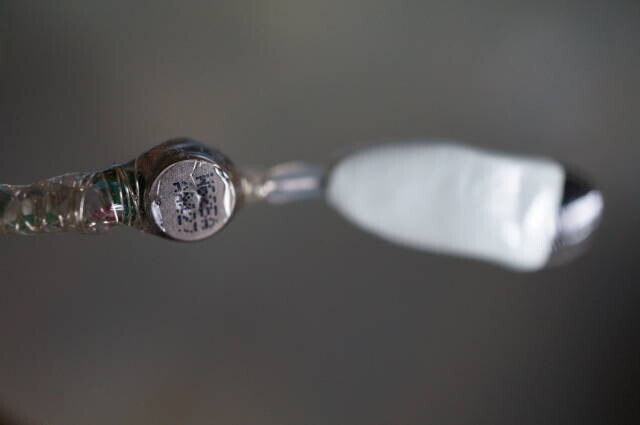
Flexible connections changed vibration location and raised concerns about duration
In an entry published in February 2026, Mr. Okada described a flexible nitinol connection between the chip and motor. Its narrow section corresponded to the urinary sphincters (muscles described as positioning boundaries).
At the outer sphincter, he described motor vibration at the perineal area and chip vibration at the prostate. At the inner sphincter, he described the motor vibrating the prostate and the chip vibrating the bladder.
In his tongue comparison, the ceramic tip seemed to vibrate more strongly than the motor itself. He cautioned that prolonged bladder vibration might be harmful.
(Source: ok-lab's diary, published February 2026)
https://ok-lab.hatenablog.com/entry/2026/02/14/121602
External motor position remained possible after a longer covered connection weakened vibration
In a later entry published in February 2026, a 15cm covered connection greatly reduced vibration in Mr. Okada's test. He blamed thicker wire and a tight-fitting tube that restricted movement.
A revised prototype had uncovered parallel wires, which he reported moving in waves and transmitting vibration to the chip. His external-motor arrangement kept the motor outside the penis while the ceramic tip provided vibration internally at the prostate.
He considered this relevant when motor size had ruled out conventional vibrating chips. He cautioned that the exposed-wire design was unsuitable for people with metal allergies.
(Source: ok-lab's diary, published February 2026)
https://ok-lab.hatenablog.com/entry/2026/02/21/122935
The maker's answer to motor position and vibration
Mr. Okada changed motor placement, supporting parts, and connections to address specific problems, with different limits for each design.
Two motors prompted a warning against prolonged vibration in February 2019
In an entry published in February 2019, Mr. Okada described a resin prototype with an 8mm motor at each end. He found its stimulation too strong for continuous vibration and reported discomfort when the resin remained in place without vibrating.
Its published price was ¥8,000 (about $51 at ¥156 = $1, rate as of 2026-09-04) excluding tax, comprising a ¥3,000 (about $19 at ¥156 = $1, rate as of 2026-09-04) body and ¥5,000 (about $32 at ¥156 = $1, rate as of 2026-09-04) motor installation, both excluding tax. Mr. Okada limited his recommendation for this design to short periods and favored an ordinary single-motor chip for longer placement.
(Source: ok-lab's diary, published February 2019)
https://ok-lab.hatenablog.com/entry/2019/02/09/152257
Tip motor position addressed the narrow rear connection on resin chips
In an entry published in January 2020, Mr. Okada moved the motor to the leading end of resin chips. He said the cable section behind a rear motor was too narrow for the sphincter to hold effectively. Resin allowed wiring inside the chip; ceramic could not support that internal routing.
He considered the new shape steadier, with vibration more precisely directed at the bladder boundary. He described an apparent combined massage effect on the prostate and bladder muscles. These were custom-order designs when published.
(Source: ok-lab's diary, published January 2020)
https://ok-lab.hatenablog.com/entry/2020/01/04/155235
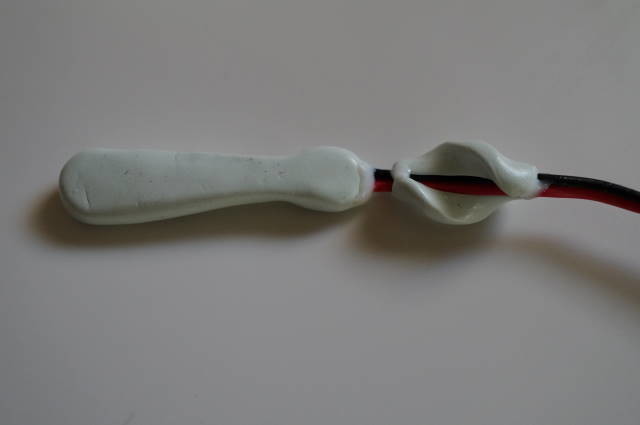
Two supporting cables helped stabilize motor position during Mr. Okada's tests
In an entry published in March 2020, a customer requested supports compatible with 2 cables. The request concerned a parallel stopper (a positioning part) and a screw-shaped support. Mr. Okada initially said testing was needed, then made a combined prototype.
He reported stable motor positions at the inner urinary sphincter, outer urinary sphincter, and center of the prostate. His assessment favored the combined supports, although the diary does not record how the customer's finished arrangement felt.
(Source: ok-lab's diary, published March 2020)
https://ok-lab.hatenablog.com/entry/2020/03/21/143802
Tip motor position gave the articulated design a different intended target
In an entry published in January 2023, Mr. Okada described a bladder-targeted design based on an articulated sound (a jointed urethral instrument). He said conventional rear motors rarely vibrated the bladder directly, prompting a motor at the leading end instead.
The diary does not record a customer's experience with this new design. Mr. Okada suggested a 6mm motor or thin 8mm motor for a narrower profile.
(Source: ok-lab's diary, published January 2023)
https://ok-lab.hatenablog.com/entry/2023/01/28/122843
How motor position and vibration changed over time
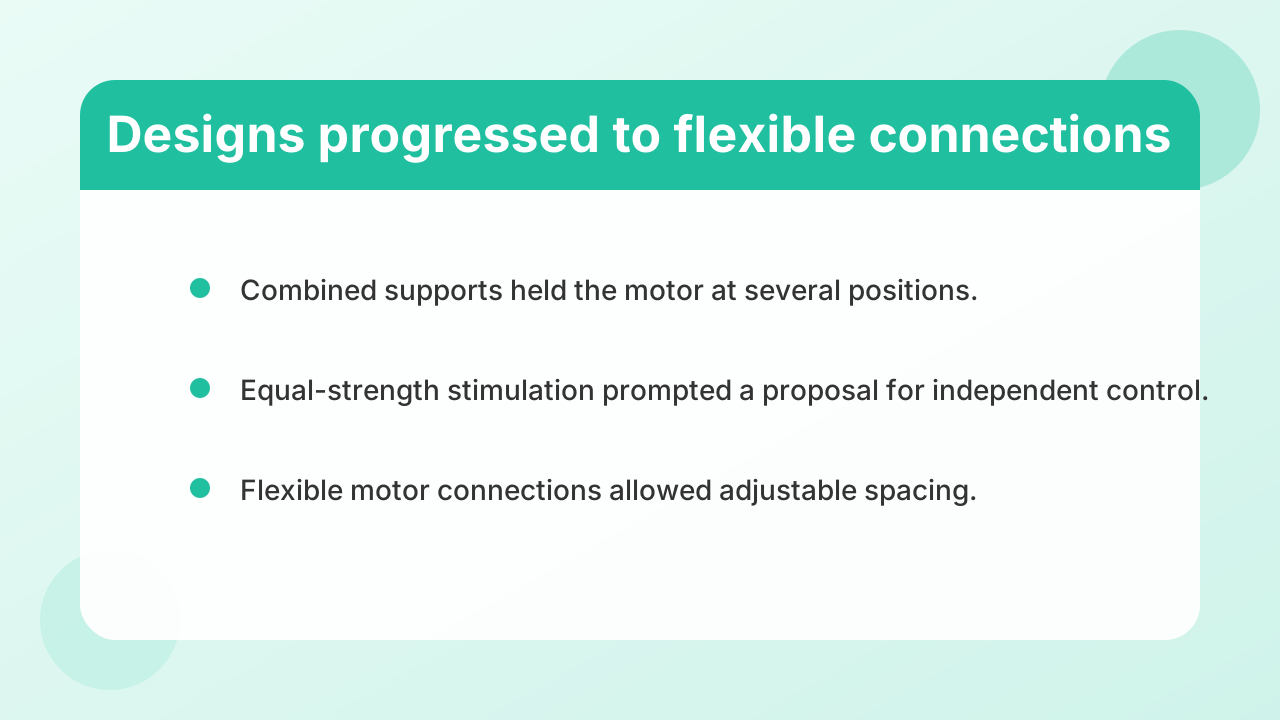
| Published | What the diary said then |
|---|---|
| Feb 2019 | A dual-ended resin prototype brought a warning about prolonged vibration. |
| Aug 2019 | A customer's overheating report prompted Mr. Okada's rejection of 9V. |
| Jan 2020 | A custom plain short resin design with a leading motor cost ¥4,000 (about $26 at ¥156 = $1, rate as of 2026-09-04) excluding tax. |
| Mar 2020 | Combined supports held the motor at several positions in Mr. Okada's tests. |
| May 2022 | Equal-strength stimulation prompted a proposal for independent control. |
| Jan 2023 | An articulated design put the motor at the leading end for bladder vibration. |
| Jun 2024 | A separate two-chip design made linked twin-motor vibration possible with shape-memory wire. |
| Feb 2026 | Flexible motor connections allowed thinner resin coverage and adjustable spacing. |
| Feb 2026 | Reduced vibration through a longer covered connection led to an uncovered-wire prototype. |
OK Prostate Chip products related to motor position and vibration
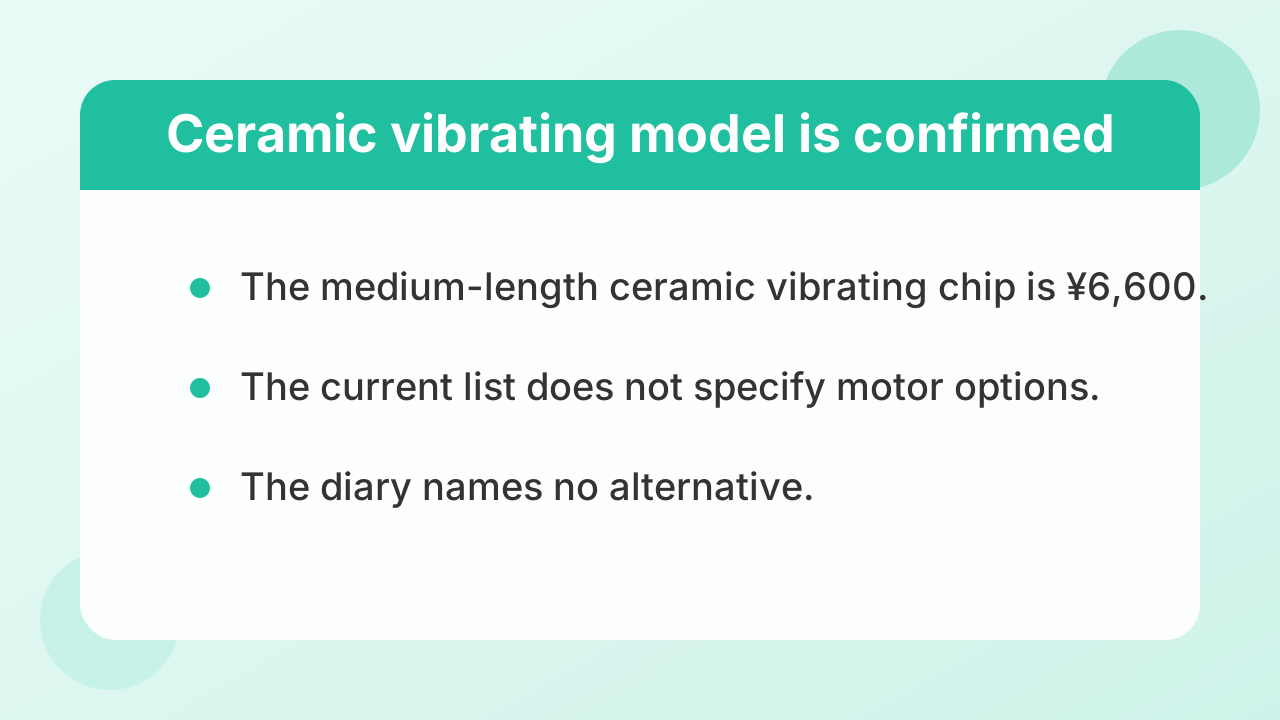
The supplied current list confirms a standard ceramic vibrating model explicitly named in an entry about a thin motor.
Products that appear in these entries
| Product (official name) | Price incl. tax | Relation to this topic |
|---|---|---|
| Medium-length ceramic vibrating chip (OKプロステート核振チップ 陶器素材セミロングタイプ) | ¥6,600 (about $42 at ¥156 = $1, rate as of 2026-09-04) | An August 2022 order named this model and requested a thin 8mm motor, 2mm thick. |
The entry identified that motor as a newly received thin version. The current list supplies the product name and price, but does not specify motor options.
(Source: ok-lab's diary, published August 2022)
https://ok-lab.hatenablog.com/entry/2022/08/06/123150
Products the diary mentioned as alternatives
The diary names no alternative.
For the custom builds and prototypes described above: No matching product can be confirmed on the current list.
Common worries about motor position and vibration
The reader questions concern steadier positioning, closer motor spacing, and whether shared power weakens vibration.
"Can a retrieval thread help stabilize motor position?"
In an entry published in February 2019, a customer requested an added retrieval thread (a line attached to the device) for a stopper arrangement. Mr. Okada made and tested one; the diary does not record how that customer found it.
He described the short chip's motor as lying within the prostate when the whole chip occupied that area. The long chip's motor normally sat outside the sphincter in his description. Mr. Okada favored the added thread for positional control alongside the existing cable.
(Source: ok-lab's diary, published February 2019)
https://ok-lab.hatenablog.com/entry/2019/02/02/153358
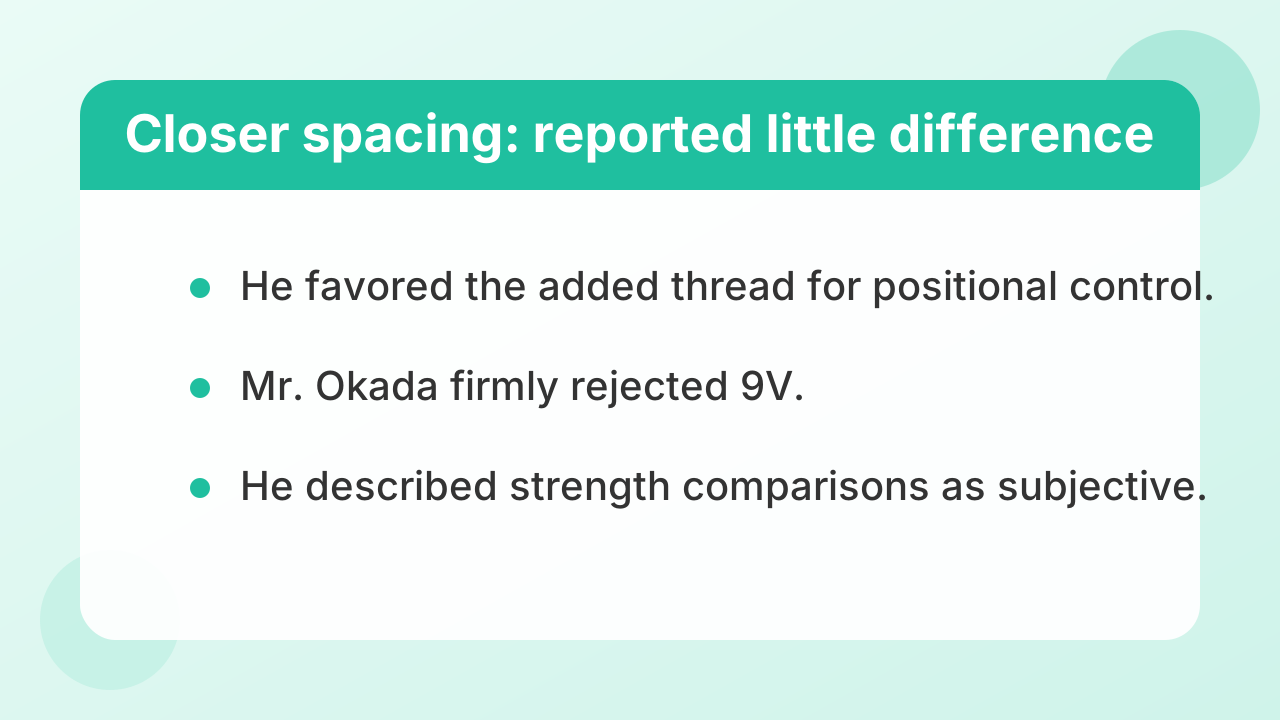
"Will closer motor spacing make vibration feel stronger?"
In an entry published in August 2019, a customer expected closer motor spacing to produce stronger vibration. They reported little difference between the medium-length three-motor chip and their previous longer three-motor model.
The same customer described continuous vibration becoming hot enough to risk a burn after trying higher voltage. The diary does not record whether an injury was confirmed. Mr. Okada firmly rejected 9V and suspected heat damage to the urethra.
(Source: ok-lab's diary, published August 2019)
https://ok-lab.hatenablog.com/entry/2019/08/10/125102
"Will two motors weaken vibration from one controller?"
In an entry published in January 2025, a customer considering a custom device asked whether two motors would reduce each other's vibration. Mr. Okada expected little weakening with one controller and two motors, and possibly some with about five. He said separate controllers might help provide different vibration patterns.
He also described the strength comparisons as subjective and said video sound was unreliable for judging them. Citing inconsistent motor quality, he declined the whole custom commission despite earlier discussions about making it. He instead suggested a simple stock vibrating chip for comparing motors.
(Source: ok-lab's diary, published January 2025)
https://ok-lab.hatenablog.com/entry/2025/01/25/122940
Buying from outside Japan

OK Lab ships internationally to countries covered by Japan Post's EMS courier service. Overseas orders are paid in advance by PayPal. Each order carries a ¥400 (about $3 at ¥156 = $1, rate as of 2026-09-04) handling fee, and EMS shipping is charged on top. These terms come from OK Lab's official sales-terms page (written here as plain text, not a link: ok-lab.net/docs/law), checked on September 7, 2026; confirm them on the official store before you order, because they can change.
Summary of this article
| What you wanted to know | The answer |
|---|---|
| What is the short answer? | Mr. Okada reports that placement changes perceived vibration, with limits and cautions. |
| What is this product? | A urethral device made and sold by OK Lab in Japan. |
| Which terms explain the arrangements? | Motor position, supporting parts, controllers, and wires describe different functions. |
| What happened in the tests? | Vibration sometimes traveled beyond the motor; stronger or closer sources did not always feel better. |
| What changes did the maker propose? | Different motor locations, stabilizing supports, and connections for specific targets. |
| How did the designs develop? | Entries progressed from attached motors to linked and flexible arrangements. |
| What current product is identified? | The table names a ceramic vibrating model and its current price in Japanese yen. |
| What concerned customers? | Stable positioning, motor spacing, overheating, and vibration with shared control. |
| How are overseas purchases handled? | Advance PayPal payment, an order handling fee, and additional EMS shipping charges. |
Source: ok-lab's diary (Okada Comfortable Life Laboratory). The original entries are in Japanese; quotations on this page are translated. Photos and videos are on the original entries.
This article is a summary of the maker's development diary. The product is not a medical device and no result is guaranteed. If anything feels wrong or worries you, see a doctor. Prices, specifications and cautions change, so confirm the latest information on the official blog and the official site. Questions about ordering and shipping go to the seller.