![Is my prostate chip too long? | Length and shortening depend on the design [OK Prostate Chip]](/img/a/T0049/eyecatch.svg)
This page is based on entries from "ok-lab's diary" (https://ok-lab.hatenablog.com/), the Japanese development diary written by Mr. Okada, founder of OK Lab, a small company in Japan (Okada Comfortable Life Laboratory). Only the entries about "chip length and shortening" are summarized here, in order of publication. Past prices and sizes are as written at the time. Current prices come from the official product list (retrieved September 4, 2026). Quotations are translated from Japanese.
Note: This page is a personal reading log by someone with no connection to the maker or the seller. It reflects the source entries as of their publication dates and makes no guarantee of accuracy or safety. The product is not a medical device; talk to a doctor about any health decision. Check the official site for current information. This page contains advertising.
In short
- Chip length can mean the individual piece, the connecting gap, or the whole assembly.
- The maker describes custom shortening, with different limits for ceramic, resin, and stainless steel.
- Current component products are listed below, but the latest shortening case concerns a custom build.
About this product
The OK Prostate Chip is a small device that is placed in the urethra (the urine passage) so that it acts on the prostate; the maker sells it in several shapes, sizes and materials. It is made and sold by OK Lab (Okada Comfortable Life Laboratory), a small company in Japan, through its own online store, and prices are in Japanese yen (JPY). The maker's development diary, "ok-lab's diary", is written in Japanese. This page is an English summary of it, and every quotation is translated. OK Lab ships internationally, so readers outside Japan can order (see "Buying from outside Japan" below). Product names on this page are plain-English descriptions. The official Japanese product name is shown once in the product table so you can find the same item in the store.
Before you read: key terms
| Term | Plain-English meaning |
|---|---|
| Urethra | The urine passage; the maker describes it as the location for the device. |
| Sphincter region | The area described as gripping the chip; a reference point for discussing connections, position, and strain. |
| Unit | One individual section of a linked design; its length was central to the maker's flexible-chip proposal. |
| Shape-memory wire | A curved alloy connector joining the main chip and a rear support piece. |
| Support chip | A small rear piece forming the other end of the shape-memory connection. |
| Screw-shaped auxiliary chip | An additional supporting piece intended to resist movement toward the bladder. |
| Mesh stopper | A mesh restraint also intended to resist movement toward the bladder. |
| Hybrid lock-on | A curved retaining attachment paired with the main chip. |
| Motor | The powered component attached to certain chips; its presence affects the assembly's length. |
| Blue chip | A diary label for chips considered for motor attachments. The diary does not explain this. |
| Membranous and bulbar urethra | Names used to discuss where an attachment might sit within the urine passage. The diary does not explain this. |
What happens: prostate chip length
The OK Prostate Chip is a small device placed in the urethra (the urine passage) to act on the prostate. Length can mean the chip's body, the gap between linked pieces, or the complete assembly. The diary discusses shorter rear sections, longer narrow sections, and connections that add length behind the main chip. These changes concern where the device sits near the prostate and sphincter region (the area described as gripping the chip).
The linked design reduced chip length while offering different gaps
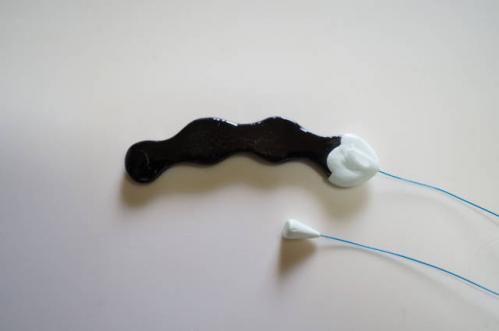
In an entry published in October 2019, Mr. Okada introduced a linked pair whose individual pieces were 10 mm shorter than standard. Both pieces lacked the usual end bump, placing the connection near the original chip's narrow sphincter section. Planned gaps were approximately 2 mm, 5 mm, and 8 mm.
Proposed prices, tax excluded, were ¥6,000 (about $38 at ¥156 = $1, rate as of 2026-09-04) for two short pieces and ¥7,000 (about $45 at ¥156 = $1, rate as of 2026-09-04) for a semi-long piece paired with a short one. Mr. Okada wrote that a longer gap felt easier during extended wear in his own experience. He recommended a short second piece, while allowing a curved semi-long second piece as a custom request.
(Source: ok-lab's diary, published October 2019)
https://ok-lab.hatenablog.com/entry/2019/10/26/145539
Flexible connections made individual chip length central to the maker's claim
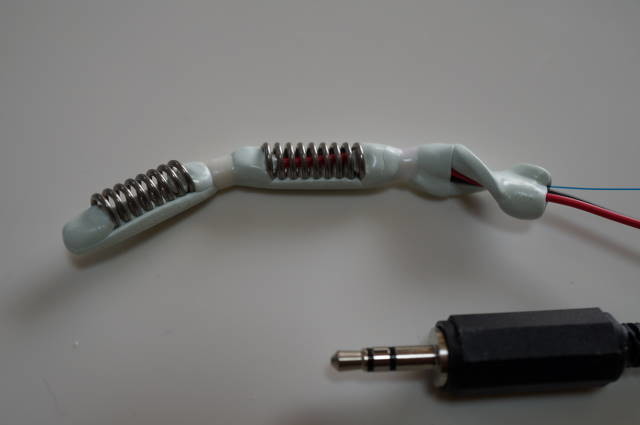
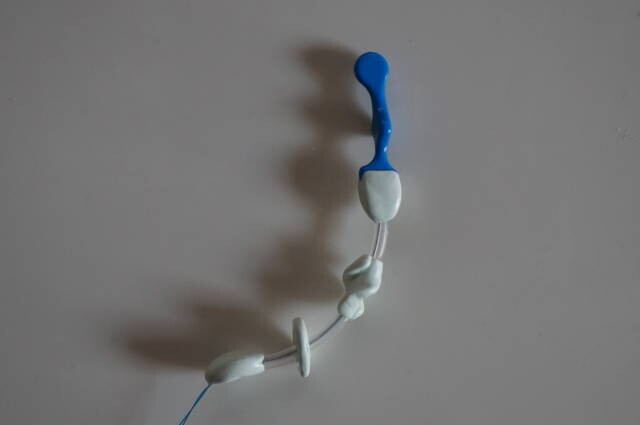
In an entry published in January 2021, Mr. Okada described a flexible assembly containing two ring chips and a screw-shaped auxiliary chip (an additional restraint). The rubber connections allowed the separate sections to bend, which he believed made a longer overall assembly workable.
Because the rubber joints lacked an established strength record, the design also included a nylon thread running through the complete assembly. His length guidance concerned each unit (one individual section) measuring 30 mm or less; he claimed that condition made long assemblies usable by anyone.
(Source: ok-lab's diary, published January 2021)
https://ok-lab.hatenablog.com/entry/2021/01/02/123619
The extended prototype changed chip length but still needed breakage testing
In an entry published in June 2022, Mr. Okada described a ceramic prototype with its narrow sphincter section extended about 10 mm. He reported a milder feeling and less stimulation of that region during his own trial. He still described the extended semi-long/short design as a prototype, with insufficient testing for sale. Mr. Okada said repeated tests of where it would break were needed before deciding whether to sell it.
(Source: ok-lab's diary, published June 2022)
https://ok-lab.hatenablog.com/entry/2022/06/18/123201
A shape-memory connection added to chip length behind the main piece
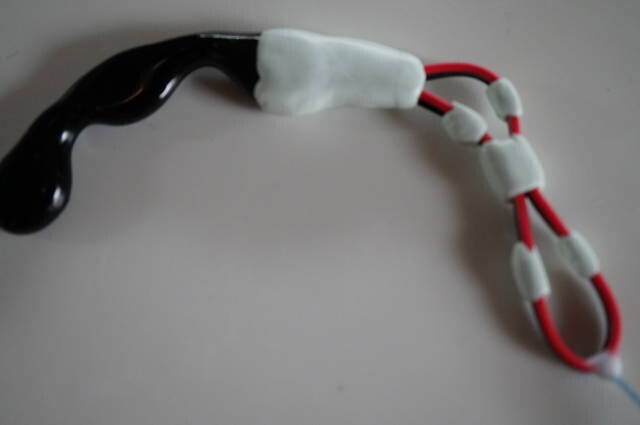
In an entry published in April 2024, Mr. Okada described shape-memory wire (a curved alloy connector) joining the main chip and a support chip (a rear piece). He said all blue, stainless-steel, and ceramic chips could serve as the main piece. The rear connection added approximately 5-7 mm to the original chip length.
Proposed wire lengths between the pieces were 4 cm, 5 cm, and 6 cm. The wire section would curve approximately 70–90 degrees; Mr. Okada said a short section curved through 90 degrees would be too springy. He advised stopping use if the outer resin covering a connection broke.
(Source: ok-lab's diary, published April 2024)
https://ok-lab.hatenablog.com/entry/2024/04/13/123053
A shorter chip brought the compact hybrid assembly to about 60 mm
In an entry published in February 2025, Mr. Okada described the shortest hybrid lock-on design (a chip with a curved retaining attachment). Its front piece was an M-size ceramic chip prepared for a motor (the powered component), 10 mm shorter than the ordinary ceramic short.
With a shortened retaining section, the whole assembly measured about 60 mm. Mr. Okada thought its flexibility could suit people already able to accommodate an ordinary chip of about 40 mm.
(Source: ok-lab's diary, published February 2025)
https://ok-lab.hatenablog.com/entry/2025/02/15/122943
The maker's answer to prostate chip length
Mr. Okada's answers depend on the design, material, and state of testing.
Chip length options remained while the maker revised spacing and curves
In an entry published in November 2019, Mr. Okada reported seeking advice from someone he described as a urethral specialist. That person favored the shortest gap and thought the curve was excessive. Mr. Okada initially questioned that concern, then adopted a gentler curve and reduced the gap choices to close and slightly separated.
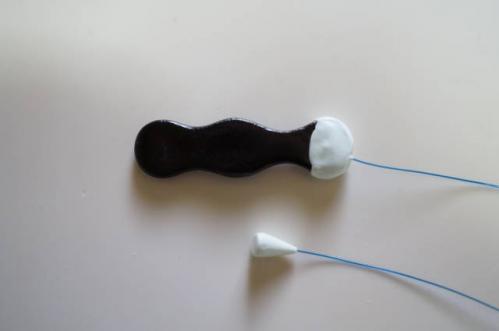
He paused regular sales because he had not completed enough testing, accepting custom requests only. The usual pieces were about 1 cm shorter, but standard-length pieces remained a possible request. Mr. Okada said customers wanting standard length needed to state that preference separately.
(Source: ok-lab's diary, published November 2019)
https://ok-lab.hatenablog.com/entry/2019/11/02/132358
Shape-memory chip length changes came with separately priced connections and supports
In an entry published in April 2024, Mr. Okada set out proposed, tax-excluded charges for the shape-memory design. The wire-and-support connection was ¥3,000 (about $19 at ¥156 = $1, rate as of 2026-09-04), and a tube cover was ¥1,000 (about $6 at ¥156 = $1, rate as of 2026-09-04). A screw-shaped auxiliary chip was ¥3,000 (about $19 at ¥156 = $1, rate as of 2026-09-04); a mesh stopper (a mesh restraint) was ¥2,000 (about $13 at ¥156 = $1, rate as of 2026-09-04).
These extras were priced separately from the main chip. The diary described both restraints as intended to resist movement toward the bladder. Mr. Okada favored the screw-shaped support as the first restraint and the mesh stopper as backup.
(Source: ok-lab's diary, published April 2024)
https://ok-lab.hatenablog.com/entry/2024/04/13/123053
Chip shortening was confirmed for ceramic, but other materials remained uncertain
In an entry published in June 2025, a customer asked about replacing a short ceramic chip with resin or stainless steel. Mr. Okada said the proposed build depended on shortening an existing chip. He confirmed ceramic was possible, but had no experience shortening the second-generation resin and could not confirm feasibility.
He thought stainless steel would be difficult with his available equipment. The diary does not record whether a resin or stainless-steel version was completed. Mr. Okada's answer supported ceramic for this request, while leaving the other materials unresolved.
(Source: ok-lab's diary, published June 2025)
https://ok-lab.hatenablog.com/entry/2025/06/07/122954
How prostate chip length changed over time
| Published | What the diary said then |
|---|---|
| Oct 2019 | The linked design used shortened pieces and offered different connecting gaps. |
| Nov 2019 | Gentler curves replaced the earlier shape; regular sales paused pending more testing. |
| Jan 2021 | Flexible joints shifted the maker's length guidance toward individual units. |
| Jun 2022 | Staff reported a successful shortening trial on a narrow-backed blue chip. |
| Jun 2022 | An extended ceramic prototype still needed breakage testing before any sales decision. |
| Apr 2024 | Shape-memory connections added length behind the main chip. |
| Feb 2025 | A compact hybrid combined a shorter front chip with a shorter retaining section. |
| May 2025 | A customer reported deeper positioning and requested a shorter gap. |
| Jun 2025 | Ceramic shortening was confirmed; second-generation resin and stainless steel remained unresolved. |
| May 2026 | A request below SS length led to a custom shortening proposal. |
OK Prostate Chip products related to prostate chip length
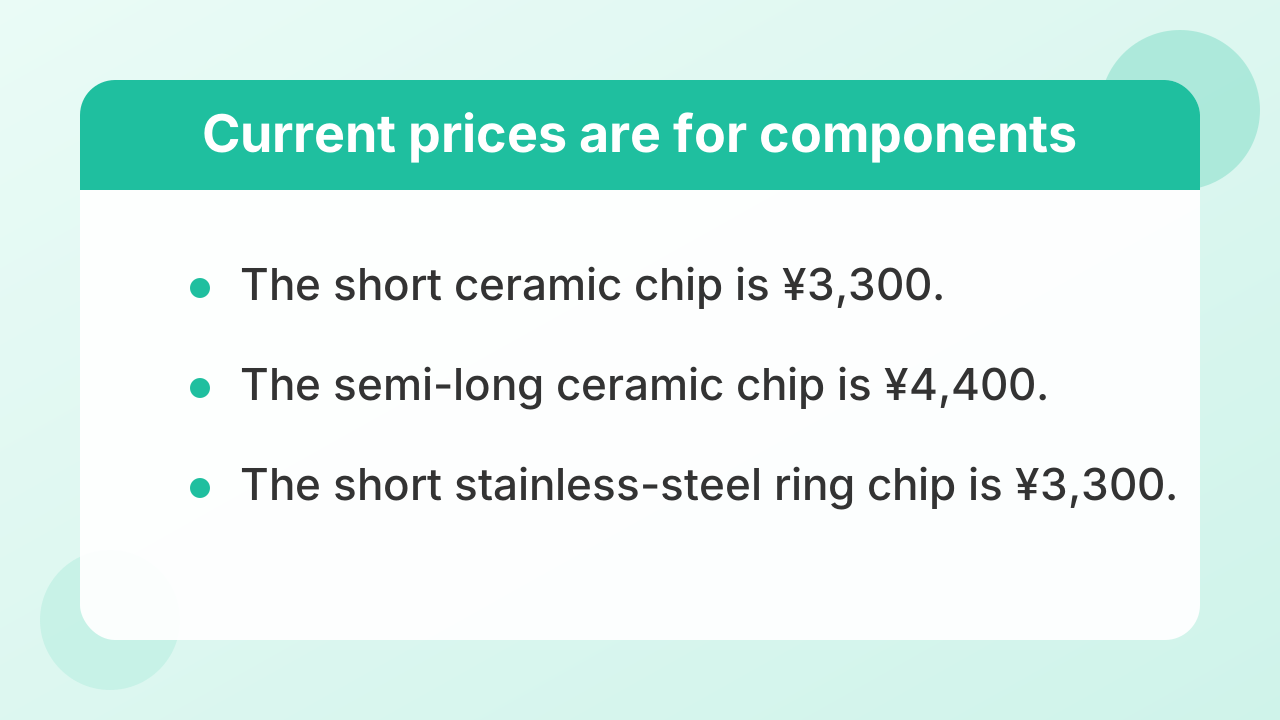
These current component prices do not establish the availability or price of the historical custom assemblies.
Products that appear in these entries
| Product (official name) | Price incl. tax | Relation to this topic |
|---|---|---|
| Short ceramic chip (OKプロステートチップ 陶器素材ショートタイプ) | ¥3,300 (about $21 at ¥156 = $1, rate as of 2026-09-04) | November 2019 named this product as a component in the custom twin-chip ordering example. |
| Semi-long ceramic chip (OKプロステートチップ 陶器素材セミロングタイプ) | ¥4,400 (about $28 at ¥156 = $1, rate as of 2026-09-04) | November 2019 paired this product with a short ceramic chip in the custom ordering example. |
| Short stainless-steel ring chip (OKプロステートチップ ステンレスリング ショートタイプ) | ¥3,300 (about $21 at ¥156 = $1, rate as of 2026-09-04) | January 2021 named this product in the customer exchange that helped prompt the flexible linked design. |
| Screw-shaped auxiliary chip option (スクリュー型補助チップ追加オプション) | ¥3,300 (about $21 at ¥156 = $1, rate as of 2026-09-04) | January 2021 included this option in the discussion leading to the flexible linked assembly. |
The short ceramic chip is listed in OK Lab's own online store.
The semi-long ceramic chip is listed in OK Lab's own online store.
(Source: ok-lab's diary, published November 2019)
https://ok-lab.hatenablog.com/entry/2019/11/02/132358
(Source: ok-lab's diary, published January 2021)
https://ok-lab.hatenablog.com/entry/2021/01/02/123619
Products the diary mentioned as alternatives
The diary names no alternative.
The entries also discuss custom linked, extended, shape-memory, hybrid, and shortened SS builds, plus blue-chip and angel-and-devil labels. No matching product can be confirmed on the current list.
Common worries about prostate chip length
The reader questions concern room for a motor, unexpectedly deep positioning, and lengths below the existing SS size.
"Can a shorter chip make room for a motor?"
In an entry published in June 2022, a customer asked whether motor attachment required shortening both ceramic and blue chips (an unexplained product-family label). OK Lab staff said earlier blue-chip builds had retained their length, making the finished assembly longer by the motor's size. Their new trial shortened a blue chip with a narrow rear, so they thought shortening was generally possible.
They also thought ceramic designs could be shortened, except the angel-and-devil designs. The diary does not record whether every blue-chip shape was tested. Staff cautioned that a motor straddling the sphincter was unsuitable for prolonged use because they believed it imposed strain.
(Source: ok-lab's diary, published June 2022)
https://ok-lab.hatenablog.com/entry/2022/06/11/123420
"Could chip length explain why mine goes deeper than expected?"
In an entry published in May 2025, a customer reported that a ceramic chip with a hybrid lock-on attachment sat deeper than expected. The customer suspected the bend occupied the membranous rather than bulbar urethra (two regions named in the diary), but expressed uncertainty.
They requested a gap about 1 cm shorter between the attachment and chip, suggesting a shorter chip base as another possibility. Mr. Okada considered the idea promising and awaited feedback; the entry does not record whether the change solved the problem.
(Source: ok-lab's diary, published May 2025)
https://ok-lab.hatenablog.com/entry/2025/05/31/122940
"Is a shorter chip available below the ceramic SS size?"
In an entry published in May 2026, a customer wanted something shorter than a previously supplied SS ceramic short. They also wanted a more pronounced narrow section and larger retaining parts.
Mr. Okada replied that he had no shorter piece than that SS chip. The diary does not record how the modified chip felt in use. His proposed solution was a custom SS chip shortened by 5 mm.
(Source: ok-lab's diary, published May 2026)
https://ok-lab.hatenablog.com/entry/2026/05/23/122904
Buying from outside Japan
OK Lab ships internationally to countries covered by Japan Post's EMS courier service. Overseas orders are paid in advance by PayPal. Each order carries a ¥400 (about $3 at ¥156 = $1, rate as of 2026-09-04) handling fee, and EMS shipping is charged on top. These terms come from OK Lab's official sales-terms page (written here as plain text, not a link: ok-lab.net/docs/law), checked on September 7, 2026; confirm them on the official store before you order, because they can change.
Summary of this article
| What you wanted to know | The answer |
|---|---|
| What is the short answer? | Length depends on the piece, connection, and complete assembly; shortening depends on the material. |
| What is this product? | A device made by OK Lab in Japan, placed in the urine passage to act on the prostate. |
| Which terms matter? | Individual units, connecting gaps, support pieces, and retaining attachments describe different parts of the design. |
| What happens with chip length? | The diary records shortened pieces, extended narrow sections, and connections that increase overall length. |
| What does the maker suggest? | His answers include revised curves, custom length requests, material-specific limits, and further prototype testing. |
| What changed over time? | Later entries added flexible connections and shorter custom builds, while leaving some material questions unresolved. |
| Which current products relate? | The listed ceramic pieces, ring chip, and auxiliary option appeared as components in the historical discussions. |
| What did customers ask? | Whether motors require shorter chips, whether spacing affects position, and whether something shorter than SS exists. |
| How do overseas orders work? | The stated terms use advance PayPal payment, a handling fee, and separate EMS shipping charges. |
Source: ok-lab's diary (Okada Comfortable Life Laboratory). The original entries are in Japanese; quotations on this page are translated. Photos and videos are on the original entries.
This article is a summary of the maker's development diary. The product is not a medical device and no result is guaranteed. If anything feels wrong or worries you, see a doctor. Prices, specifications and cautions change, so confirm the latest information on the official blog and the official site. Questions about ordering and shipping go to the seller.