![Could the chip's thread come loose? | Why the maker moved beyond glue [OK Prostate Chip]](/img/a/T0036/eyecatch.svg)
This page is based on entries from "ok-lab's diary" (https://ok-lab.hatenablog.com/), the Japanese development diary written by Mr. Okada, founder of OK Lab, a small company in Japan (Okada Comfortable Life Laboratory). Only the entries about "switching from adhesive bonding to tied connections" are summarized here, in order of publication. Past prices and sizes are as written at the time. Current prices come from the official product list (retrieved September 4, 2026). Quotations are translated from Japanese.
Note: This page is a personal reading log by someone with no connection to the maker or the seller. It reflects the source entries as of their publication dates and makes no guarantee of accuracy or safety. The product is not a medical device; talk to a doctor about any health decision. Check the official site for current information. This page contains advertising.
In short
Threads pulling free and resin peeling away prompted changes to the chip's attachment.
Mr. Okada moved toward ties, reinforcement, and internal holes instead of relying on adhesive alone.
Current listings include later products discussed here, but do not confirm every historical attachment detail.
About this product

The OK Prostate Chip is a small device that is placed in the urethra (the urine passage) so that it acts on the prostate; the maker sells it in several shapes, sizes and materials. It is made and sold by OK Lab (Okada Comfortable Life Laboratory), a small company in Japan, through its own online store, and prices are in Japanese yen (JPY). The maker's development diary, "ok-lab's diary", is written in Japanese. This page is an English summary of it, and every quotation is translated. OK Lab ships internationally, so readers outside Japan can order (see "Buying from outside Japan" below). Product names on this page are plain-English descriptions. The official Japanese product name is shown once in the product table so you can find the same item in the store.
Before you read: key terms
| Term | Plain-English meaning |
|---|---|
| Urethra | The urine passage, where the device is placed to act on the prostate. |
| Thread attachment | The joint holding nylon thread to a chip; these entries discuss preventing separation there. |
| Epoxy resin | An adhesive material used to secure thread and cover the connection. |
| Mechanical fastening | A physical connection, such as a tie, intended to hold parts together without depending entirely on adhesion. |
| Aluminum reinforcement | Metal within the resin around the thread, intended to strengthen the joint and reduce peeling. |
| Flexible cord | A soft internal core used to link chips in the April 2021 prototypes. |
| 3D design | A three-dimensional design used here to create chips with internal thread-holding holes. |
| Biocompatible resin | Resin the maker describes as compatible with living tissue, used for chip bodies and auxiliary parts. |
| Suture thread | Thread used to stitch tissue; OK Lab selected nylon suture thread for its chip connections. |
| Auxiliary chip | An additional chip; the screw-shaped version helped retain the silver chip's tied thread. |
What happens: why chip threads come loose
The OK Prostate Chip is a small device placed in the urethra (urine passage) to act on the prostate. Its thread attachment is the joint between the chip and the nylon thread connected to it. These entries follow changes to that joint, including resin coatings, ties, metal reinforcement, and holes inside the chip. Mr. Okada describes these changes as responses to threads pulling free or resin peeling away from the chip.
A tightening loop addressed the bulky knot problem in chip thread attachment
In an entry published in May 2018, Mr. Okada explains why earlier tying attempts had failed: the knots stuck out too far. His revised connection combined a loose, tightening loop in the chip's recess with a resin covering. This avoided the prominent knot that had made his earlier attempts unusable.
In his reported test, the thread moved about 1mm before the loop tightened around the chip. It then remained attached under the strongest pull his staff member applied. Testing had begun only the previous day, but Mr. Okada had already adopted the connection in some products.
(Source: ok-lab's diary, published May 2018)
https://ok-lab.hatenablog.com/entry/20180519/1526708081
Failed glass bonding tests pushed chip thread attachment toward physical ties
An entry published in June 2018 reports that grooved glass performed worse than smooth glass in resin-peeling tests. Mr. Okada then found a strong bond between detached resin and glass using Aron, an adhesive. However, that bond failed during boiling at 100 degrees.
According to his account, the adhesive's official information gave 80 degrees as its limit. These results led him to distrust chemical adhesion as the basis of this connection. He announced a move toward resin ties that would hold the parts together physically.
(Source: ok-lab's diary, published June 2018)
https://ok-lab.hatenablog.com/entry/20180602/1527922643
A resin tie strengthened glass chip thread attachment without establishing absolute safety
In an entry published in June 2018, Mr. Okada describes a revised glass connection with an additional resin tie around the resin-held thread. A chip returned for a thread-length change gave him an opportunity for a destructive test. He reports that the thread remained attached even when most of the resin had peeled away.
That result concerned the returned chip tested in this entry. Mr. Okada describes its connection as successful in that test. He cautions that handmade products were not uniform, so the result did not establish absolute safety.
(Source: ok-lab's diary, published June 2018)
https://ok-lab.hatenablog.com/entry/20180616/1529136608
The maker also reported a fix for resin chip threads pulling free
In an entry published in July 2018, Mr. Okada says loop ties had solved glass-chip thread detachment. He also states that resin chips had received measures he believed would prevent their threads from pulling free. He withholds the resin design details as manufacturing knowledge, so this entry does not explain that connection's construction.
(Source: ok-lab's diary, published July 2018)
https://ok-lab.hatenablog.com/entry/20180728/1532762071
Exposed aluminum created irritation despite a stronger chip thread attachment
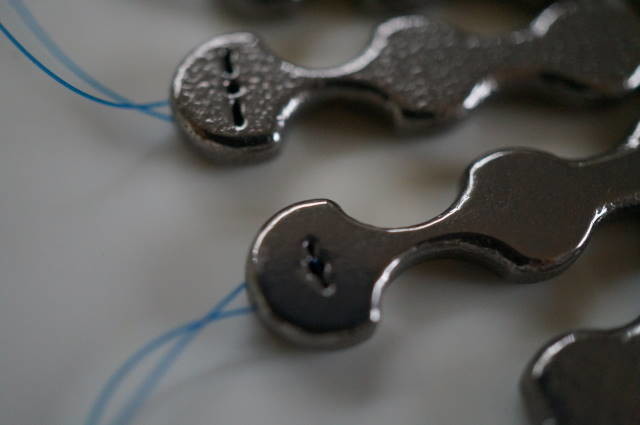
In an entry published in August 2019, a customer reports irritation from a silver-colored projection at a ceramic chip's resin connection. Mr. Okada identifies exposed fixing metal and acknowledges a production oversight. The connection used aluminum reinforcement (metal supporting the resin around the thread), which he says reduced peeling and strengthened the joint.
He explains that aluminum could rise slightly while the resin hardened, leaving metal exposed if inspection missed it. The diary does not record whether the repair was completed. Mr. Okada asks the customer to return the chip for repair.
(Source: ok-lab's diary, published August 2019)
https://ok-lab.hatenablog.com/entry/2019/08/31/131337
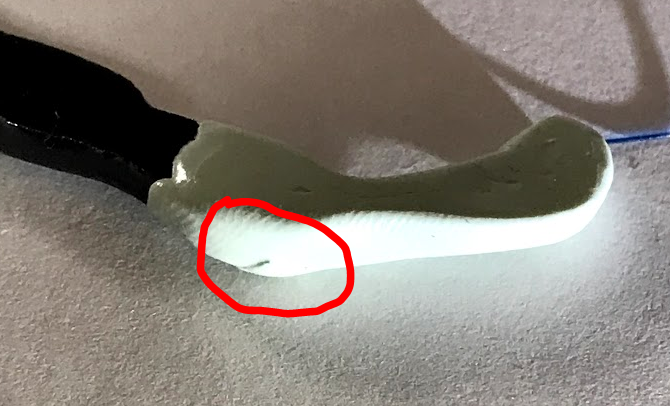
Internal holes allowed titanium chip thread attachment without adhesive resin
In an entry published in June 2021, Mr. Okada reveals a short titanium prototype whose internal holes hold nylon thread without adhesive. The attachment fits inside the chip's end, in an area about 3mm thick and 6mm wide. He says the seated thread stays fixed under pushing and pulling.
He further claims that a remaining strand can maintain the connection if the other strand breaks. Only the short version had been prototyped when this entry appeared. He planned to extend this attachment to all future 3D-designed chips (chips planned as three-dimensional shapes).
(Source: ok-lab's diary, published June 2021)
https://ok-lab.hatenablog.com/entry/2021/06/12/125849
The maker's answer to chip threads coming loose
The maker developed physical ways to hold the thread, while later designs reduced or eliminated adhesive at the connection.
Combining physical fastening with adhesive changed the approach to chip thread attachment
An entry published in May 2018 includes advice from a reader experienced in adhesives, which Mr. Okada credits with changing his thinking. The contributor warns that small, smooth bonding surfaces cannot offer 100% reliability with any adhesive. He also describes epoxy resin (an adhesive material) peeling readily from flexible resin.
The contributor warns that inaccurate proportions in small adhesive batches can reduce strength. His proposed combination was mechanical fastening (physical restraint by a tie or similar connection) plus adhesive, with each supporting the other's weaknesses. Mr. Okada adopts that principle for his revised connection.
(Source: ok-lab's diary, published May 2018)
https://ok-lab.hatenablog.com/entry/20180519/1526708081
Wire and resin supported chip thread attachment in flexible cord prototypes
An entry published in April 2021 describes Mr. Okada testing a flexible cord (a soft linking core) between ceramic and screw-shaped chips. The connection contained nylon thread inside the cord, with wire and resin securing the assembly. He reports a milder feel than with his earlier linked stainless-steel rings.
This was his personal test, still underway when the entry appeared. Historical customization included chip spacing from 3mm–30mm. Mr. Okada said customers could choose the leading ceramic chip and the number of auxiliary chips (additional linked parts).
(Source: ok-lab's diary, published April 2021)
https://ok-lab.hatenablog.com/entry/2021/04/10/125809
Removing resin from thread attachment was expected to reduce replacement costs
In an entry published in June 2021, Mr. Okada links the new attachment to cheaper thread replacement. Without a resin joint, the work involved fewer production steps. He estimated replacement at about half the price then charged, only for the relevant 3D-designed titanium and biocompatible-resin products.
He also expected faster dispatch because there was no wait for the resin to harden. For returned chips, he likewise described replacement without waiting for a resin joint to harden. Mr. Okada still advised periodic thread replacement because disinfection wears the thread.
(Source: ok-lab's diary, published June 2021)
https://ok-lab.hatenablog.com/entry/2021/06/12/125849
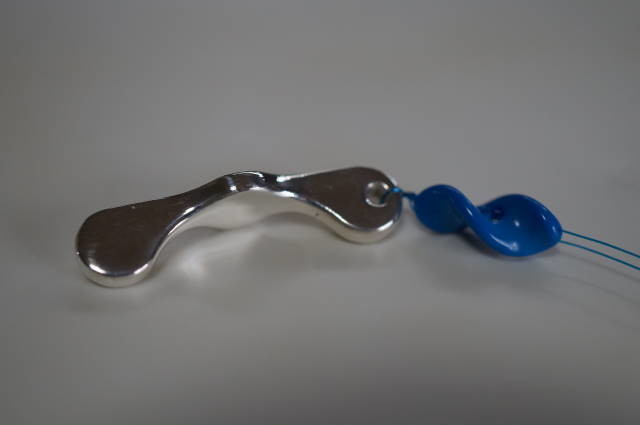
A silver chip's tied thread attachment used an auxiliary part without adhesive
In an entry published in August 2021, Mr. Okada describes a silver giveaway chip with a directly tied thread. An 8mm screw-shaped auxiliary chip made from biocompatible resin (resin described as compatible with living tissue) retained the tie. Mr. Okada chose this arrangement because he believed an adhesive-resin joint would undermine the silver chip's compatibility with tissue.
The entry records dispatch to a giveaway winner. The diary does not record how the recipient found it in use.
(Source: ok-lab's diary, published August 2021)
https://ok-lab.hatenablog.com/entry/2021/08/21/125838
How chip thread attachment changed over time
| Published | What the diary said then |
|---|---|
| May 2018 | A tightening loop replaced the earlier bulky-knot approach. |
| Jun 2018 | Failed glass-bonding tests prompted a move toward physical ties. |
| Jun 2018 | A returned chip passed a destructive test; handmade variation remained a caution. |
| Jul 2018 | Mr. Okada reported resin-chip detachment measures but withheld construction details. |
| Aug 2019 | Aluminum reinforcement reduced peeling in his account, but exposed metal caused a complaint. |
| Apr 2021 | Flexible-cord work: ¥1,000 (about $6 at ¥156 = $1, rate as of 2026-09-04) × 4 or ¥1,000 (about $6 at ¥156 = $1, rate as of 2026-09-04) × 2, tax excluded. |
| Jun 2021 | Internal thread-holding holes eliminated adhesive from the new prototype's attachment. |
| Aug 2021 | A silver giveaway chip used a direct tie retained by an auxiliary chip. |
| Sep 2021 | Staff declined coating across a tied resin-chip connection because they expected peeling. |
The diary does not say what the current state is.
OK Prostate Chip products related to chip thread attachment
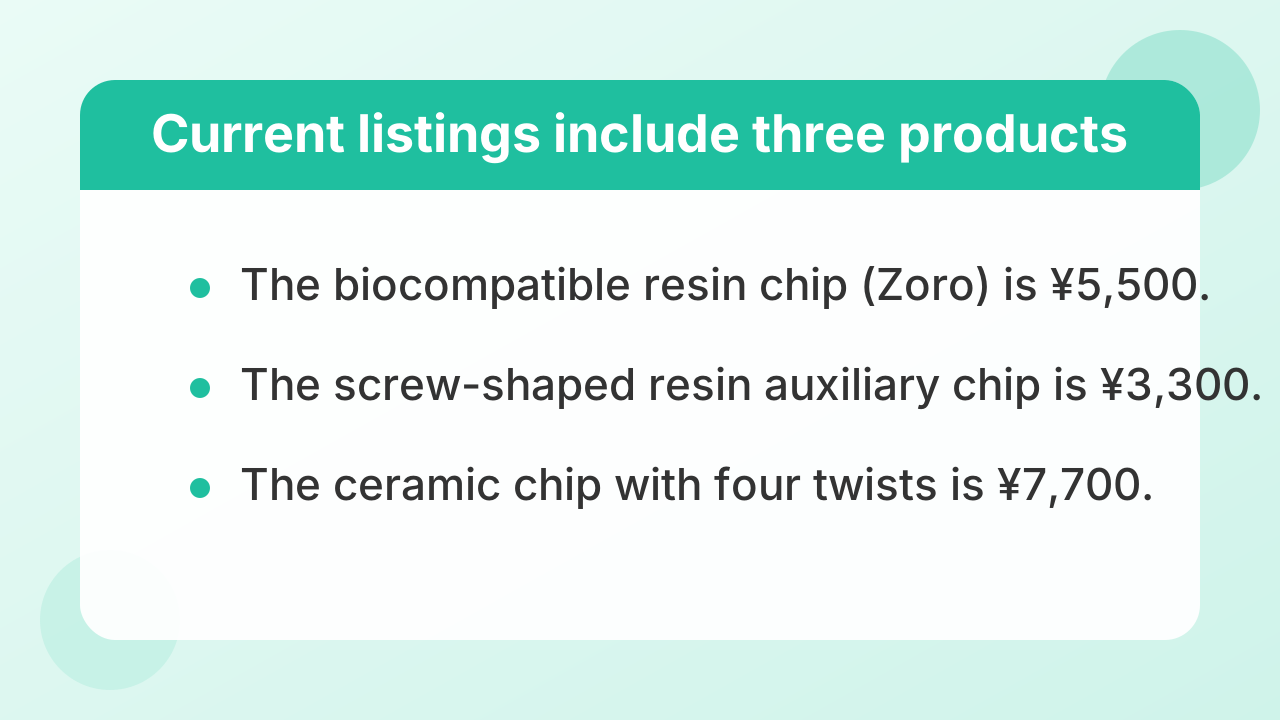
The current list includes three products discussed in the September 2021 coating questions.
Products that appear in these entries
| Product (official name) | Price incl. tax | Relation to this topic |
|---|---|---|
| Biocompatible resin chip (Zoro) (OKプロステートチップ 凶悪ゾロ(生体適合樹脂)) | ¥5,500 (about $35 at ¥156 = $1, rate as of 2026-09-04) | In September 2021, a customer asked about coating the thread between this chip and an auxiliary chip. |
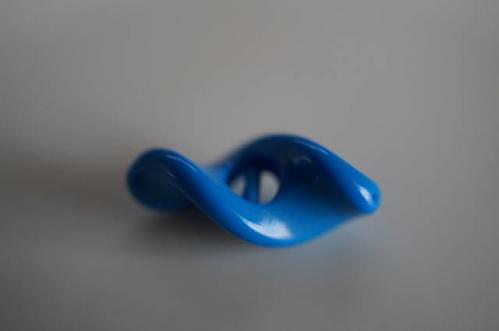
| Screw-shaped auxiliary chip in biocompatible resin (スクリュー型補助チップ追加オプション(生体適合樹脂)) | ¥3,300 (about $21 at ¥156 = $1, rate as of 2026-09-04) | In September 2021, staff explained that its tied connection limited coating near the joint. |
| Long ceramic chip with four twists (OKプロステートチップ 陶器素材ロングタイプ 4点ツイスト) | ¥7,700 (about $49 at ¥156 = $1, rate as of 2026-09-04) | In September 2021, a customer asked about coating its connection to a screw-shaped resin auxiliary chip. |
The screw-shaped auxiliary chip in biocompatible resin is listed in the company's own online store.
(Source: ok-lab's diary, published September 2021)
https://ok-lab.hatenablog.com/entry/2021/09/04/125843
Products the diary mentioned as alternatives
The diary names no alternative.
The entries also describe a short titanium prototype, flexible-cord assemblies, and a silver giveaway chip. No matching product can be confirmed on the current list.
Common worries about chip thread attachment
The reader questions concern detachment, thread material, and whether coating can cover a tied connection.
"Can glass chip threads pull free from their resin connection?"
An entry published in December 2018 records a prospective buyer asking whether a glass model's resin connection could pull apart. Mr. Okada confirms that the resin was epoxy and that detachment had been reported. He says the revised glass connection used a tie, which he expected to prevent the thread pulling free.
The customer also asked about fishing line, pointing to its strength and thinness. Mr. Okada explains that OK Lab chose nylon suture thread (thread used to stitch tissue) for what he considered gentler contact. He had not tested fishing line; the diary does not record a purchase or an outcome in use.
(Source: ok-lab's diary, published December 2018)
https://ok-lab.hatenablog.com/entry/20181222/1545459719
"Can rubber coating cover a tied resin chip thread attachment?"
In an entry published in September 2021, a customer asks about coating between the resin chip (Zoro) and a screw-shaped auxiliary chip. OK Lab's staff explain that this resin chip's thread is tied to it, without an adhesive bond. They expect excessive movement at that joint to strain and peel a coating spanning the connection. On that basis, they decline the requested coating.
(Source: ok-lab's diary, published September 2021)
https://ok-lab.hatenablog.com/entry/2021/09/04/125843
"Can ceramic chip thread coating continue across the auxiliary connection?"
A follow-up published in September 2021 asks about joining the long ceramic chip with four twists to a resin screw-shaped auxiliary chip. Staff say coating is possible on the ceramic side, but not across the auxiliary chip's tied connection. Their limited offer was coating ending a few millimeters before that auxiliary chip.
The diary briefly considers an epoxy-based workaround, then withdraws it because bonding to the resin chip was considered poor. No completed order or subsequent use is recorded for this request. The final answer supports only the limited coating, leaving the tied resin connection uncovered.
(Source: ok-lab's diary, published September 2021)
https://ok-lab.hatenablog.com/entry/2021/09/04/125843
Buying from outside Japan

OK Lab ships internationally to countries covered by Japan Post's EMS courier service. Overseas orders are paid in advance by PayPal. Each order carries a ¥400 (about $3 at ¥156 = $1, rate as of 2026-09-04) handling fee, and EMS shipping is charged on top. These terms come from OK Lab's official sales-terms page (written here as plain text, not a link: ok-lab.net/docs/law), checked on September 7, 2026; confirm them on the official store before you order, because they can change.
Summary of this article
| What you wanted to know | The answer |
|---|---|
| What is the short answer? | The diary describes a shift toward physical thread retention after attachment problems. |
| What is this product? | A urethral device made by OK Lab in Japan, sold through its own store in JPY. |
| What do the connection terms mean? | Resin bonds surfaces; ties, reinforcement, and internal holes provide other forms of support. |
| What happened to the attachments? | The maker reported detachment and peeling problems, followed by design changes and tests. |
| What was the maker's response? | Combined fastening, reinforced joints, and later attachments without adhesive; thread replacement still mattered. |
| How did the design change over time? | These entries trace changes from May 2018 through September 2021. |
| Which related products are listed today? | The resin chip (Zoro), resin screw-shaped auxiliary chip, and long ceramic chip with four twists. |
| What did customers ask? | Whether glass connections could separate and whether coating could cross tied joints. |
| How does buying abroad work? | Advance PayPal payment, a ¥400 (about $3 at ¥156 = $1, rate as of 2026-09-04) handling fee, and additional EMS shipping charges. |
Source: ok-lab's diary (Okada Comfortable Life Laboratory). The original entries are in Japanese; quotations on this page are translated. Photos and videos are on the original entries.
This article is a summary of the maker's development diary. The product is not a medical device and no result is guaranteed. If anything feels wrong or worries you, see a doctor. Prices, specifications and cautions change, so confirm the latest information on the official blog and the official site. Questions about ordering and shipping go to the seller.