![Can a flexible urethral sound stay stable? | Bending did not solve every placement problem [OK Prostate Chip]](/img/a/T0047/eyecatch.svg)
This page is based on entries from "ok-lab's diary" (https://ok-lab.hatenablog.com/), the Japanese development diary written by Mr. Okada, founder of OK Lab, a small company in Japan (Okada Comfortable Life Laboratory). Only the entries about "4-line floating support" are summarized here, in order of publication. Past prices and sizes are as written at the time. Current prices come from the official product list (retrieved September 4, 2026). Quotations are translated from Japanese.
Note: This page is a personal reading log by someone with no connection to the maker or the seller. It reflects the source entries as of their publication dates and makes no guarantee of accuracy or safety. The product is not a medical device; talk to a doctor about any health decision. Check the official site for current information. This page contains advertising.
In short
Flexible urethral sounds bent in several directions, but Mr. Okada later reported unstable placement and urine leakage.
His revisions changed wire protection, shaft stiffness and the connection between the sound and chip.
No matching product can be confirmed on the current list.
About this product

The OK Prostate Chip is a small device that is placed in the urethra (the urine passage) so that it acts on the prostate; the maker sells it in several shapes, sizes and materials. It is made and sold by OK Lab (Okada Comfortable Life Laboratory), a small company in Japan, through its own online store, and prices are in Japanese yen (JPY). The maker's development diary, "ok-lab's diary", is written in Japanese. This page is an English summary of it, and every quotation is translated. OK Lab ships internationally, so readers outside Japan can order (see "Buying from outside Japan" below). Product names on this page are plain-English descriptions. The official Japanese product name is shown once in the product table so you can find the same item in the store.
Before you read: key terms
| Term | Plain-English meaning |
|---|---|
| Urethra | The urine passage; it is also the passage where the diary describes placing the chip and sound. |
| Flexible urethral sound | A shaft placed within the urethra; Mr. Okada developed flexible versions for support and prostate stimulation. |
| 4-line floating support | A cable containing electrical cords and wires inside tubes; it supports the chip while allowing bends in different directions. |
| Parallel cable | Two electrical cords joined side by side; they form part of the floating support's central structure. |
| Epoxy resin | The coating around the cable; it forms firm sections and was also part of Mr. Okada's wire-protection design. |
| Gatekeeper | A support piece associated with the penis; the version discussed here was intended to maintain compressed placement. |
| Urinary sphincter | The closing structure discussed in the tests; it holds back urine, but Mr. Okada reported incomplete closure around one prototype. |
| 8-hole floating sphincter sound | A longer support connected to a separate chip through thread; its holes were intended to stabilize the connection and spacing. |
| Cushioning tube | Tubing included with the proposed thread connection; the diary describes its purpose as cushioning between the chip and sound. |
What happens: flexible urethral sounds
The OK Prostate Chip is a small device placed in the urethra, the urine passage, to act on the prostate. A flexible urethral sound (an internal support shaft) developed from the maker's bendable cable connecting a chip. Its wires sit inside silicone tubes, with firmer resin sections around them. Mr. Okada explored this structure for placement with the penis compressed toward the body, and later for upward positioning.
4-line floating support added diagonal bending and retained irregular curves
The 4-line floating support (a cable with movable internal wires) debuted in an entry published in October 2022. It could bend vertically, sideways and diagonally, while retaining irregular curves. Its wires sat loosely inside silicone tubes beside a parallel cable (two joined electrical cords).
Mr. Okada attributed the greater freedom to the wires moving without directly touching that cable. By then, OK Lab had announced the earlier 6-line support's discontinuation; a subsequent request was accepted with its problems acknowledged. Mr. Okada favored the newer support for placement with the penis compressed toward the body.
(Source: ok-lab's diary, published October 2022)
https://ok-lab.hatenablog.com/entry/2022/10/15/123011
4-line floating support prices depended on length within fixed production limits
In an entry published in October 2022, OK Lab set the support's minimum at about 4cm and maximum at 20cm. Each end needed around 1cm for sealing, and the maker ruled out lengths outside those limits. Prices were ¥6,000 (about $38 at ¥156 = $1, rate as of 2026-09-04) up to 10cm, plus ¥500 (about $3 at ¥156 = $1, rate as of 2026-09-04) for each additional 1cm; these prices excluded tax.
A 20cm version was ¥11,000 (about $70 at ¥156 = $1, rate as of 2026-09-04) excluding tax, as published in October 2022. The 2-line section behind the support could reach 7cm, and adding a thread behind the 4-line section was free. Mr. Okada advised against paying for this precision merely to make a vibrating model easier to position.
(Source: ok-lab's diary, published October 2022)
https://ok-lab.hatenablog.com/entry/2022/10/15/123011
An integrated gatekeeper made flexible urethral sounds difficult to position
In an entry published in October 2022, Mr. Okada described an unfinished gatekeeper (a support for holding the compressed penis in position). It was firmly joined to the 4-line floating support, leaving only the gaps between firm sections able to bend. Keeping the gatekeeper attached to silicone-tube underwear made placement difficult, according to his report.
He changed the arrangement so the gatekeeper and underwear were separate. The diary describes the gatekeeper's shape as still under development at that point. Mr. Okada also proposed a shorter support after judging his earlier, tightly curved test piece too long.
(Source: ok-lab's diary, published October 2022)
https://ok-lab.hatenablog.com/entry/2022/10/22/122828
Flexible urethral sounds developed slack despite gaining movement near the tip
In an entry published in December 2022, Mr. Okada compared a mostly rigid stainless-steel prototype with a more flexible version. He reported that the earlier shaft reached only the urinary sphincter (the closure that holds back urine). The revised prototype had about 5-6cm of 4-line floating support near its tip.
Mr. Okada reported that this section bent beyond the sphincter and that the prototype reached the bladder. However, pressure from the compressed urethra made placement unstable, with slack requiring attention after every urination. He cautioned that the ability to bend was also a weakness under that pressure.
(Source: ok-lab's diary, published December 2022)
https://ok-lab.hatenablog.com/entry/2022/12/10/123048
Urine leakage limited flexible urethral sounds in Mr. Okada's own test
In an entry published in December 2022, Mr. Okada reported a problem during his own test of the flexible urethral sound. When its segmented section lay within the sphincter, he said the closure could remain incomplete and urine could leak. He wondered whether people whose sphincters closed more firmly might avoid that problem.
For his own use, he judged the sound impractical for continuous placement. He also concluded that directly attaching a Prostate Chip would not provide stable placement in that arrangement. Mr. Okada instead proposed separating the chip and sound, with a thread connection between them.
(Source: ok-lab's diary, published December 2022)
https://ok-lab.hatenablog.com/entry/2022/12/24/122944
The maker's answer to flexible urethral sounds
Mr. Okada revised wire protection, controlled where the shaft could bend, and developed a separate chip connection.
Closer resin spacing aimed to protect the 4-line floating support wires
In an entry published in October 2022, Mr. Okada described three protective features in the 4-line floating support. These were gaps of about 1mm, thicker epoxy resin coating (the material forming hard sections), and wires contained within tubes. He thought these features would limit protrusion if a wire broke, while stressing that safety was not guaranteed.
A later entry published in October 2022 described gaps that were almost gone, yet still allowed bending. Mr. Okada compared the movable wires between sections to cushioning and thought the revision reduced concern about wire injuries. His earlier purchasing advice was that anyone concerned about safety should avoid buying the support.
(Source: ok-lab's diary, published October 2022)
https://ok-lab.hatenablog.com/entry/2022/10/15/123011
(Source: ok-lab's diary, published October 2022)
https://ok-lab.hatenablog.com/entry/2022/10/29/122854
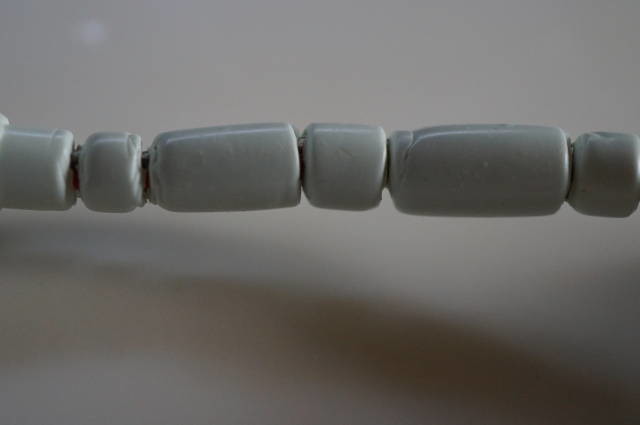
Flexible urethral sounds gained firm sections around an entirely floating core
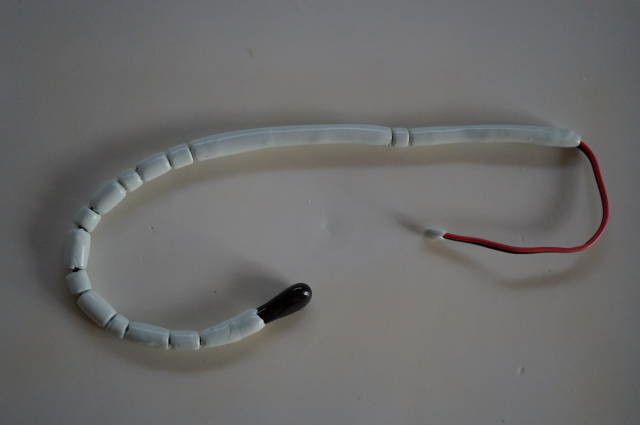
In an entry published in December 2022, Mr. Okada replaced the earlier rigid shaft with 4-line floating support throughout. The design used two 1mm electrical cords beside silicone tubes with 1mm outer diameters and 0.5mm inner diameters. Each tube held a 0.35mm nylon-coated wire, producing a base about 2mm across.
An epoxy resin coating brought the outer diameter to about 5mm. He specified complete resin coverage where bending was unwanted, with uncovered sections providing movement as wires slid inside their tubes. Mr. Okada proposed this combination because an entirely unbending shaft had proved inconvenient for fixed placement in the urethra.
(Source: ok-lab's diary, published December 2022)
https://ok-lab.hatenablog.com/entry/2022/12/17/122643
The 8-hole floating sphincter sound kept chip and shaft as separate parts
An entry published in December 2022 introduced an 8-hole floating sphincter sound (a longer support connected to a chip by thread). Mr. Okada described it as combining a screw-shaped helper's chip-moving role with a stopper's holding role. It had 4 holes toward the chip and 4 toward the opening, intended to prevent thread movement and stabilize spacing.
The entry described compatibility with either two threads or one, and about 10cm of cushioning tube supplied with a separately purchased sound. Sales of both the flexible sound and the 8-hole version were announced for the following year in December 2022. Mr. Okada presented the separated arrangement as his preferred proposal for compressed placement, with the chip and sound remaining distinct parts.
(Source: ok-lab's diary, published December 2022)
https://ok-lab.hatenablog.com/entry/2022/12/24/122944
How flexible urethral sounds changed over time
| Published | What the diary said then |
|---|---|
| Oct 2022 | Floating wires allowed diagonal bends while retaining the resulting shape. |
| Oct 2022 | Earlier 6-line support was discontinued, with an exception accepted after its problems were acknowledged. |
| Oct 2022 | The gatekeeper and underwear were separated after their attached arrangement proved difficult. |
| Oct 2022 | Resin sections moved closer together while the support retained flexibility. |
| Dec 2022 | A flexible tip gained movement, but pressure caused unstable placement. |
| Dec 2022 | Floating support replaced the rigid shaft; resin determined which sections stayed firm. |
| Dec 2022 | Leakage made continuous placement impractical in Mr. Okada's test. |
| Dec 2022 | An 8-hole thread-connected design appeared; sales were announced for the following year. |
OK Prostate Chip products related to flexible urethral sounds
No current product is directly tied to this topic.
Common worries about flexible urethral sounds
(The material contains no questions from readers.)
Buying from outside Japan

OK Lab ships internationally to countries covered by Japan Post's EMS courier service. Overseas orders are paid in advance by PayPal. Each order carries a ¥400 (about $3 at ¥156 = $1, rate as of 2026-09-04) handling fee, and EMS shipping is charged on top. These terms come from OK Lab's official sales-terms page (written here as plain text, not a link: ok-lab.net/docs/law), checked on September 7, 2026; confirm them on the official store before you order, because they can change.
Summary of this article
| What you wanted to know | The answer |
|---|---|
| What is the main finding? | Greater flexibility did not prevent unstable placement or leakage in Mr. Okada's tests. |
| What is the OK Prostate Chip? | A small urethral device made by OK Lab in Japan, intended to act on the prostate. |
| What does floating support mean? | Wires move inside silicone tubes, allowing the support to bend between firm sections. |
| What problems appeared? | Attached underwear complicated placement; later prototypes developed slack or interfered with closure around the sound. |
| What did Mr. Okada change? | Wire protection, the distribution of firm sections, and the connection between sound and chip. |
| When did these changes occur? | The supplied entries document development from October through December 2022. |
| Are these builds confirmed on the current list? | No matching product can be confirmed on the current list. |
| Are reader questions answered here? | The material contains no questions from readers about these designs. |
| How do overseas purchases work? | Advance PayPal payment, a ¥400 (about $3 at ¥156 = $1, rate as of 2026-09-04) handling fee, and additional EMS shipping apply under the supplied sales terms. |
| What does this account establish? | It records the maker's evolving designs and personal test results, including his reasons for revising them. |
Source: ok-lab's diary (Okada Comfortable Life Laboratory). The original entries are in Japanese; quotations on this page are translated. Photos and videos are on the original entries.
This article is a summary of the maker's development diary. The product is not a medical device and no result is guaranteed. If anything feels wrong or worries you, see a doctor. Prices, specifications and cautions change, so confirm the latest information on the official blog and the official site. Questions about ordering and shipping go to the seller.