![How do linked prostate chips work? | Thread, tubing, or wire joins separate chips [OK Prostate Chip]](/img/a/T0035/eyecatch.svg)
This page is based on entries from "ok-lab's diary" (https://ok-lab.hatenablog.com/), the Japanese development diary written by Mr. Okada, founder of OK Lab, a small company in Japan (Okada Comfortable Life Laboratory). Only the entries about "linked prostate chips" are summarized here, in order of publication. Past prices and sizes are as written at the time. Current prices come from the official product list (retrieved September 4, 2026). Quotations are translated from Japanese.
Note: This page is a personal reading log by someone with no connection to the maker or the seller. It reflects the source entries as of their publication dates and makes no guarantee of accuracy or safety. The product is not a medical device; talk to a doctor about any health decision. Check the official site for current information. This page contains advertising.
In short
- Linked chips can bend between sections, but the diary records tangling, breakage, and unintended movement.
- Mr. Okada explored separate threads, flexible connections, and revised attachment points to address these problems.
- Individual resin parts remain listed, while later diary entries describe additional connection designs.
If you see blood in your urine, even a small amount or for the first time, do not wait and see. See a urologist right away. If you suddenly cannot urinate, or the device cannot be removed, do not try to fix it yourself. Go to a medical facility, including emergency care, immediately.
About this product

The OK Prostate Chip is a small device that is placed in the urethra (the urine passage) so that it acts on the prostate; the maker sells it in several shapes, sizes and materials. It is made and sold by OK Lab (Okada Comfortable Life Laboratory), a small company in Japan, through its own online store, and prices are in Japanese yen (JPY). The maker's development diary, "ok-lab's diary", is written in Japanese. This page is an English summary of it, and every quotation is translated. OK Lab ships internationally, so readers outside Japan can order (see "Buying from outside Japan" below). Product names on this page are plain-English descriptions. The official Japanese product name is shown once in the product table so you can find the same item in the store.
Before you read: key terms
| Term | Plain-English meaning |
|---|---|
| Linked chips | Connected chip bodies forming an assembly that bends between sections. |
| Bulbar urethra | Wider urine-passage section where the diary places the rear chip. |
| Sphincter | Muscle controlling the opening and closing of the urine passage. |
| Internal urethral sphincter | Bladder-boundary muscle; the diary says it blocks semen entering the bladder during ejaculation. |
| Retrieval thread | Line attached to a chip, intended for retrieval. |
| Tail | A silicone tube with nylon threads inside, used to support linked auxiliary chips. |
| Tail stopper | Small part intended to hold an auxiliary chip's position on the tail. |
| Shape-memory wire | Wire returning to its curved shape, used for flexible connections. |
| Pulley link | A thread guide on a support, connecting chips through a shared line. |
| Screw support | Spiral-shaped auxiliary chip used in linked assemblies. |
What happens: linked prostate chips
The OK Prostate Chip is a small device placed in the urethra (urine passage) to act on the prostate. Linked chips have separate bodies joined by thread or wire. One occupies the prostate region; another can occupy the bulbar urethra (a wider part of the urine passage). Mr. Okada describes these connections as ways to accommodate bends while reducing strain around the sphincter (a muscle controlling the passage).
Linked chips emerged after a long-chip tester reported muscle injury
In an entry published in December 2017, a long-chip tester reported sphincter damage after several days of continuous, 24-hour wear. Mr. Okada associated the injury with the load created when a long chip shifted position. He introduced a thread-linked pair to reduce that load and restricted the long model to short use.
(Source: ok-lab's diary, published December 2017)
https://ok-lab.hatenablog.com/entry/20171231/1514712104
Close spacing made linked chips easier to handle but riskier
An entry published in January 2018 described linked chips with 0–2mm spacing and an overall length of 5cm or more. Mr. Okada said easier handling also made unintended entry into the bladder easier, so he did not recommend them to beginners. He also warned that ejaculation with a chip crossing the internal urethral sphincter (the bladder-boundary muscle) could send semen into the bladder.
(Source: ok-lab's diary, published January 2018)
https://ok-lab.hatenablog.com/entry/20180114/1515943724
Separate linked chips could overlap despite having independent retrieval threads
An entry published in March 2018 described separate chips, each with its own retrieval thread (a line intended to bring a device back out). Mr. Okada wrote that a report of entanglement and a hospital visit had prompted the change. He claimed independent threads allowed safer retrieval with half the force of a single-thread pair.
However, the separate chips could lie side by side in the bulbar urethra. Alignment depended on light front-thread tension, according to Mr. Okada. He cautioned that the two-thread arrangement could be confusing without a good understanding of its design.
(Source: ok-lab's diary, published March 2018)
https://ok-lab.hatenablog.com/entry/20180317/1521275320
Resin-coated linked chips introduced selectable gaps and separate combination prices
In an entry published in October 2019, the resin-coated wire pair (Rei) was announced with selectable spacing. Planned prices excluding tax were ¥6,000 (about $38 at ¥156 = $1, rate as of 2026-09-04) for two short chips and ¥7,000 (about $45 at ¥156 = $1, rate as of 2026-09-04) for a medium-length front with a short rear. The specialized front chip (Awakening) with a short rear was ¥8,000 (about $51 at ¥156 = $1, rate as of 2026-09-04); a long front with a short rear was ¥9,000 (about $58 at ¥156 = $1, rate as of 2026-09-04). Mr. Okada recommended a short chip as the rear component.
(Source: ok-lab's diary, published October 2019)
https://ok-lab.hatenablog.com/entry/2019/10/26/145539
Rubber-linked chips broke at extreme angles, prompting a tubing-based alternative
In an entry published in December 2023, Mr. Okada reported rubber-joint breakage when a custom pair (Umiushi 5) was connected at extreme angles. His response was a gentler connection angle. He then proposed curved auxiliary chips on a tail (a silicone tube containing nylon backup threads).
Published prices excluding tax were ¥5,000 (about $32 at ¥156 = $1, rate as of 2026-09-04) for plain or flat curved supports, and ¥6,000 (about $38 at ¥156 = $1, rate as of 2026-09-04) for the twisted version. Mr. Okada cautioned that curved supports were difficult to reposition and initially expected spacing to be fixed before shipment.
(Source: ok-lab's diary, published December 2023)
https://ok-lab.hatenablog.com/entry/2023/12/30/122243
Dedicated stoppers made curved linked chips adjustable after shipment
In an entry published in January 2024, Mr. Okada reported revised curved chips with dedicated tail stoppers (small parts intended to hold spacing). The change made the curved chips repositionable, and each stopper was priced at ¥500 (about $3 at ¥156 = $1, rate as of 2026-09-04) excluding tax. Mr. Okada favored the flat curved version for handling and identified stoppers as necessary when a gap was wanted.
(Source: ok-lab's diary, published January 2024)
https://ok-lab.hatenablog.com/entry/2024/01/06/123004
Elastic-wire linked chips moved farther than Mr. Okada intended
In an entry published in March 2024, Mr. Okada tested ceramic chips connected by shape-memory wire (wire that returns to its curved shape). He reported that the front chip advanced more than 3cm and entered the bladder with almost no force. He cautioned that its slipperiness might make it unsuitable for staying in a fixed position and planned further tests before sales.
(Source: ok-lab's diary, published March 2024)
https://ok-lab.hatenablog.com/entry/2024/03/16/123023
Pulley-linked chips paired an inner device with a shallower partner
In an entry published in July 2025, Mr. Okada described a pulley link (a thread guide pairing two chips) on a shape-memory gatekeeper support. His example placed one chip near the prostate and another near the penis head, allowing the shallower position to indicate the deeper one.
The guide's inner diameter was 0.5mm, accommodating two 0.24mm threads. Published prices excluding tax were ¥4,000 (about $26 at ¥156 = $1, rate as of 2026-09-04) for the fixed guide and ¥5,000 (about $32 at ¥156 = $1, rate as of 2026-09-04) for the sliding version. For a single-chip arrangement, Mr. Okada warned that the thread might escape and an added safety component might be needed.
(Source: ok-lab's diary, published July 2025)
https://ok-lab.hatenablog.com/entry/2025/07/12/122911
Four-joint linked chips joined ceramic bodies with a slimmer connection
In an entry published in January 2026, Mr. Okada introduced a four-joint connection between ceramic chips. His design combined covered wire and flexible gaps, with attachments extending along the ceramic bodies.
The published price was the two chip prices plus ¥6,000 (about $38 at ¥156 = $1, rate as of 2026-09-04) excluding tax, with earliest delivery about 2 weeks after a request. Drying and assembly explained the wait, according to Mr. Okada. He suggested smaller ceramic combinations as potentially easier to handle.
(Source: ok-lab's diary, published January 2026)
https://ok-lab.hatenablog.com/entry/2026/01/10/122922
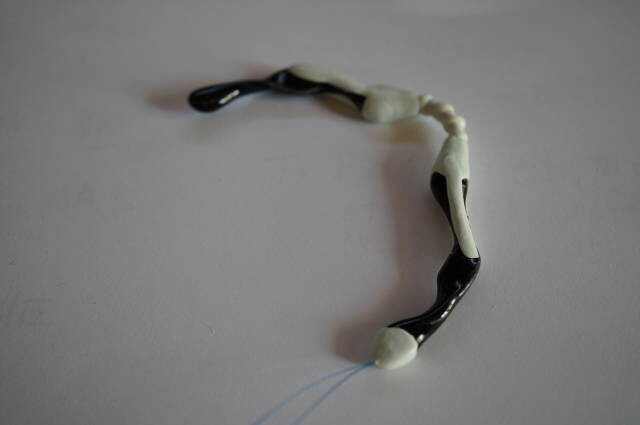
The maker's answer to linked prostate chips
Mr. Okada changed spacing, flexible links, and attachment points in response to different connection problems.
Repaired linked chips gained space intended to reduce leverage
In an entry published in March 2019, a repair changed an older linked pair from zero spacing to about 3mm. Mr. Okada believed the original gap allowed excessive leverage on the thread. The entry does not record how the repaired device felt in later use. In his accompanying durability reply, Mr. Okada favored careful handling to avoid shortening service life.
(Source: ok-lab's diary, published March 2019)
https://ok-lab.hatenablog.com/entry/2019/03/23/173222
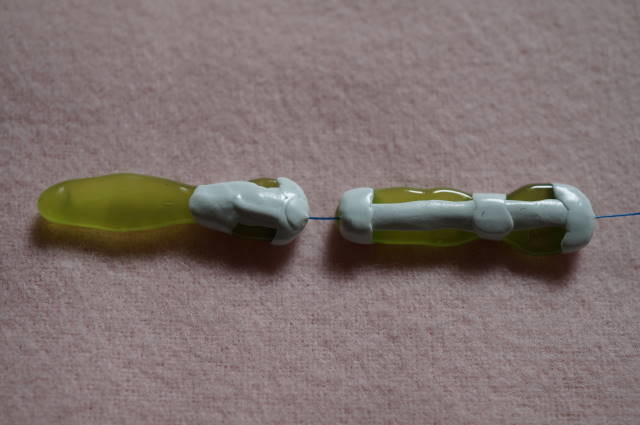
Flexible thread let resin linked chips separate slightly under tension
An entry published in May 2021 described Mr. Okada's trial of three resin screw supports (spiral-shaped auxiliary chips). Internal holes allowed thread to stretch, while fixed points limited gaps to about 1mm. He said his extended trial had not produced tissue pinching between chips. Mr. Okada proposed this assembly as a substitute for difficult stainless-steel ring connections.
(Source: ok-lab's diary, published May 2021)
https://ok-lab.hatenablog.com/entry/2021/05/15/130037
Angled wire-linked chips offered another approach to staying positioned
In an entry published in April 2024, Mr. Okada compared an earlier pair that slipped out during urination with a prototype angled about 90 degrees. He reported better positioning of its front and rear chips.
The published connection cost was ¥3,000 (about $19 at ¥156 = $1, rate as of 2026-09-04) excluding tax, additional to both chip prices; a tube cover added ¥1,000 (about $6 at ¥156 = $1, rate as of 2026-09-04) excluding tax. Wire length options were 3cm, 4cm, and 5cm. Mr. Okada invited interested customers to consider this connection with the compatible chip types.
(Source: ok-lab's diary, published April 2024)
https://ok-lab.hatenablog.com/entry/2024/04/20/122856
Central attachment expanded linked chips' combinations but complicated bladder retrieval
In an entry published in April 2024, Mr. Okada explained a central attachment for the retrieval thread. This allowed all chip types at either end, including pairs of resin or stainless-steel chips.
He warned that an entire pair, about 10cm long, might not be retrievable if it entered the bladder. He proposed a tip hole for the retrieval thread as a design precaution. Mr. Okada favored the central connection overall and invited questions about the revised design.
(Source: ok-lab's diary, published April 2024)
https://ok-lab.hatenablog.com/entry/2024/04/27/122924
If you see blood in your urine, even a small amount or for the first time, do not wait and see. See a urologist right away. If you suddenly cannot urinate, or the device cannot be removed, do not try to fix it yourself. Go to a medical facility, including emergency care, immediately.
How linked prostate chips changed over time
| Published | What the diary said then |
|---|---|
| Jan 2018 | Linked and long versions launched. |
| Mar 2018 | An independently sliding rear chip was proposed to avoid fixed-spacing compromises. |
| Jul 2018 | Two rotating 3cm sections formed a bending, roughly 6cm-long assembly. |
| Oct 2019 | Two twisted 0.45mm wires gained nylon backup and a thin resin coating. |
| Jan 2020 | Nylon backup addressed the possibility of a connecting cable breaking without warning. |
| Sep 2021 | Modular connections allowed rear screw sections to remain when the front chip changed. |
| Dec 2023 | Tangling meant thread-linked multi-chip models were scarcely being sold. |
| Apr 2024 | Longer wire links placed the rear chip 3–5cm from the sphincter. |
| Jul 2025 | A new paired-chip thread connection concealed thread ends inside both chips. |
| Jan 2026 | Four-joint prototypes aimed for about 90 degrees, with individual variation. |
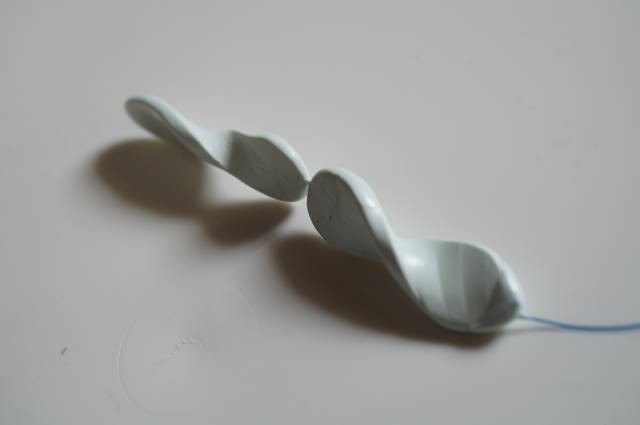
The diary does not say what the current state is.
OK Prostate Chip products related to linked prostate chips
The current list includes a separate rear chip and a resin screw-support option.
Products that appear in these entries
| Product (official name) | Price incl. tax | Relation to this topic |
|---|---|---|
| Separate-type resin rear chip (OKプロステートチップ 樹脂素材セパレートタイプ♀チップ) | ¥2,750 (about $18 at ¥156 = $1, rate as of 2026-09-04) | March 2018 describes this independent rear component and its inability to stop the front chip advancing into the bladder. |
(Source: ok-lab's diary, published March 2018)
https://ok-lab.hatenablog.com/entry/20180317/1521275320
Products the diary mentioned as alternatives
| Product (official name) | Price incl. tax | Relation to this topic |
|---|---|---|
| Resin screw support (スクリュー型補助チップ追加オプション(生体適合樹脂)) | ¥3,300 (about $21 at ¥156 = $1, rate as of 2026-09-04) | In May 2021, Mr. Okada proposed linked resin supports as a substitute for difficult stainless-steel ring connections. |
(Source: ok-lab's diary, published May 2021)
https://ok-lab.hatenablog.com/entry/2021/05/15/130037
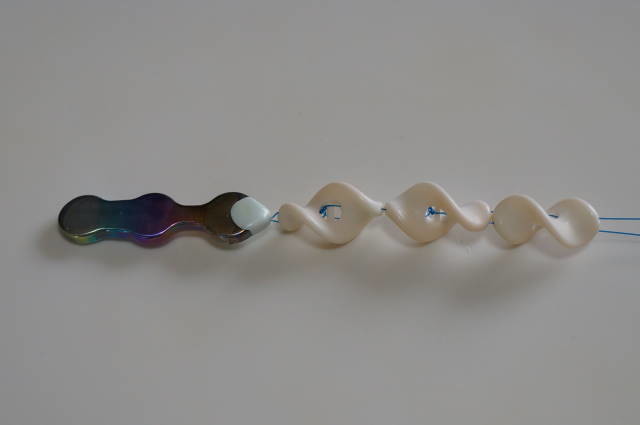
The older linked design was discontinued, according to the March 2019 entry. The January 2026 entry also recalls discontinuing thread-linked glass pairs because of tangles.
(Source: ok-lab's diary, published March 2019)
https://ok-lab.hatenablog.com/entry/2019/03/23/173222
(Source: ok-lab's diary, published January 2026)
https://ok-lab.hatenablog.com/entry/2026/01/10/122922
Resin-coated pair (Rei), rubber-linked pair (Umiushi 5), and curved supports: No matching product can be confirmed on the current list. Tail stoppers, wire-linked assemblies, pulley gatekeepers, and four-joint dual prototypes: No matching product can be confirmed on the current list. Specialized multi-link ceramic versions: No matching product can be confirmed on the current list.
Common worries about linked prostate chips
The diary records questions about durability, movement through thread links, and extra connection holes.
"Do linked chips have a known lifespan?"
In an entry published in March 2019, a customer asked about resin-chip lifespan and frequent thread detachment. Mr. Okada said he had no lifespan statistics and attributed the old linked design's breakage risk to chips acting as levers.
He said improved products had generated no thread-detachment reports by that date. The exchange does not record a later outcome for this customer. Mr. Okada cautioned that few repair requests did not establish durability, since owners might replace broken chips instead.
(Source: ok-lab's diary, published March 2019)
https://ok-lab.hatenablog.com/entry/2019/03/23/173222
"Can linked chips move together through flexible thread?"
In an entry published in October 2021, a prospective customer postponed buying and questioned whether thread links could transmit movement. Mr. Okada replied that parallel nylon threads, spaced apart and fixed at both ends, held their shape better than one thread.
He said broader safety conclusions would require substantially more user reports. No later purchase or use outcome appears in this exchange. Mr. Okada endorsed the customer's decision to put safety first and consider carefully.
(Source: ok-lab's diary, published October 2021)
https://ok-lab.hatenablog.com/entry/2021/10/02/125825
"Can linked chips gain an extra connection hole?"
In an entry published in July 2025, a customer requested an extra front connection hole in a resin chip for a linked arrangement. Mr. Okada said production might be possible but commercially unlikely without sufficient demand. The exchange does not record whether the requested resin design was made. Mr. Okada suggested specialized multi-link ceramic chips already sold then for the requested connection concept.
(Source: ok-lab's diary, published July 2025)
https://ok-lab.hatenablog.com/entry/2025/07/05/122905
Buying from outside Japan

OK Lab ships internationally to countries covered by Japan Post's EMS courier service. Overseas orders are paid in advance by PayPal. Each order carries a ¥400 (about $3 at ¥156 = $1, rate as of 2026-09-04) handling fee, and EMS shipping is charged on top. These terms come from OK Lab's official sales-terms page (written here as plain text, not a link: ok-lab.net/docs/law), checked on September 7, 2026; confirm them on the official store before you order, because they can change.
Summary of this article
| What you wanted to know | The answer |
|---|---|
| The short answer | Connections evolved as problems appeared. |
| What the product is | A urethral device made by OK Lab in Japan. |
| What the terms mean | Threads, tubes, and wires connect or support separate chip bodies. |
| What happened | The diary records injury, tangling, breakage, and unintended movement. |
| The maker's response | Revised spacing, flexible links, and different attachment points. |
| Changes over time | Thread links developed into several wire-based arrangements. |
| Current related products | Individually listed resin rear chips and screw supports. |
| Common worries | Lifespan remains unquantified; connection questions prompted design changes. |
| Ordering outside Japan | Advance PayPal payment, EMS shipping, and the stated handling fee. |
Source: ok-lab's diary (Okada Comfortable Life Laboratory). The original entries are in Japanese; quotations on this page are translated. Photos and videos are on the original entries.
This article is a summary of the maker's development diary. The product is not a medical device and no result is guaranteed. If anything feels wrong or worries you, see a doctor. Prices, specifications and cautions change, so confirm the latest information on the official blog and the official site. Questions about ordering and shipping go to the seller.