![Can a chip connect without knots? | Direct joints still used backup thread [OK Prostate Chip]](/img/a/T0039/eyecatch.svg)
This page is based on entries from "ok-lab's diary" (https://ok-lab.hatenablog.com/), the Japanese development diary written by Mr. Okada, founder of OK Lab, a small company in Japan (Okada Comfortable Life Laboratory). Only the entries about "knot-free chip connections" are summarized here, in order of publication. Past prices and sizes are as written at the time. Current prices come from the official product list (retrieved September 4, 2026). Quotations are translated from Japanese.
Note: This page is a personal reading log by someone with no connection to the maker or the seller. It reflects the source entries as of their publication dates and makes no guarantee of accuracy or safety. The product is not a medical device; talk to a doctor about any health decision. Check the official site for current information. This page contains advertising.
In short
- Direct chip-to-tube joints carried the load, with thread retained as backup.
- The maker developed reinforced connections after earlier joints slipped or needed greater strength.
- Related ceramic chips remain listed, while the diary records discontinuations among earlier wire-based designs.
About this product

The OK Prostate Chip is a small device that is placed in the urethra (the urine passage) so that it acts on the prostate; the maker sells it in several shapes, sizes and materials. It is made and sold by OK Lab (Okada Comfortable Life Laboratory), a small company in Japan, through its own online store, and prices are in Japanese yen (JPY).
The maker's development diary, "ok-lab's diary", is written in Japanese. This page is an English summary of it, and every quotation is translated. OK Lab ships internationally, so readers outside Japan can order (see "Buying from outside Japan" below).
Product names on this page are plain-English descriptions. The official Japanese product name is shown once in the product table so you can find the same item in the store.
Before you read: key terms
| Term | Plain-English meaning |
|---|---|
| Chip-to-tube connection | A joint between the chip's rear end and tubing, intended to hold those parts together directly. |
| Male and female connectors | A projecting end and matching receiving opening, used to join two pieces. |
| Nylon thread | A synthetic cord used for flexible links between chips or as backup inside a tube connection. |
| Flexible connection | A thread-linked arrangement intended to allow small changes in the gaps between chip pieces. |
| Support chip | An additional chip used alongside the main chip, here for linked assemblies or support inside tubing. |
| Gatekeeper | A tube-holding component, discussed as a way to secure tubing and limit rotation. |
| Lock key | A fastening part that the diary describes as securing tubing tightly to a Gatekeeper. |
| Silicone pessary | Mr. Okada's name for an assembly combining a prostate chip and tubing intended to remain in the urethra. |
| Electrode | A chip connected to an electrical cable; the October entry concerns protecting its electrical connections. |
What happens: knot-free chip connections
The OK Prostate Chip is a device designed to remain in the urethra around the prostate. The July 2022 direct joint connected silicone tubing to the chip's rear end. Nylon thread (a synthetic cord) remained as a backup if the joint separated or the tube broke. The entries also describe earlier connections between chip pieces and later tube coverings for electrical cables.
May 2021's first knot-free connection fitted closely but separated easily
In an entry published in May 2021, Mr. Okada described a first twin-chip prototype whose halves met closely. He reported no suction between them, so they separated easily despite their close fit. His response was to add male and female connectors (a projecting end and matching recess) between the pieces.
(Source: ok-lab's diary, published May 2021)
https://ok-lab.hatenablog.com/entry/2021/05/08/125938
June 2021's titanium knot-free connection held its mating pieces tightly
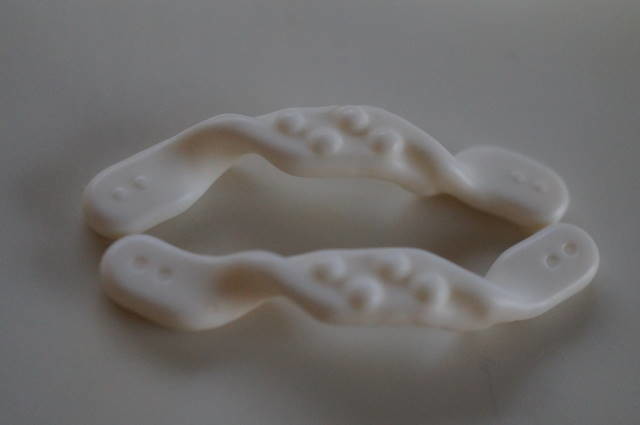
In an entry published in June 2021, Mr. Okada described a second titanium twin prototype with rounded corners. It added 1 mm of thickness and 2 mm of width to the earlier design. Its dimensions were 40 mm long, 6 mm wide, and 7.5 mm thick with the pieces overlapping.
Mr. Okada reported that its mating parts held together tightly, requiring force to separate. Nylon thread was embedded in this prototype; the planned connection with internal thread channels was not yet used.
(Source: ok-lab's diary, published June 2021)
https://ok-lab.hatenablog.com/entry/2021/06/12/125849
Knot-free chip connections addressed slipping thread in July 2022
An entry published in July 2022 reported a problem with the blue safety connector previously considered the best option. Mr. Okada found that its thread gradually shifted. He suspected the thread-linked ends could not form the firm connection he wanted.
The replacement design joined tubing with an inner diameter of 3 mm directly to the chip's enlarged rear connector. Mr. Okada reported that pulling alone did not seem likely to separate this joint. He assigned the remaining thread a backup role if the connection failed or the tubing broke.
(Source: ok-lab's diary, published July 2022)
https://ok-lab.hatenablog.com/entry/2022/07/23/123014
August 2022's thinner chip-to-tube connection needed bonding and resin reinforcement
In an entry published in August 2022, Mr. Okada changed the silicone tube's outer diameter from 3 mm to 2 mm. The new inner diameter was 1 mm. He judged a connector sized for the thinner tube unlikely to have enough strength.
The revised joint therefore required complete bonding between tube and chip, with resin reinforcement covering the joint's outside. He also described a sliding holder for a loop of tubing. Mr. Okada brought these features together under the name silicone pessary (his term for the combined chip-and-tube assembly).
(Source: ok-lab's diary, published August 2022)
https://ok-lab.hatenablog.com/entry/2022/08/13/122909
January 2023's knot-free connection restart followed discontinuations over broken wire
In an entry published in January 2023, Mr. Okada said the previous year's older four-wire, six-wire, and silicone-pessary designs had been discontinued. He linked those decisions to reports of broken wire or wire that appeared close to breaking. The restart kept thread inside the chip's attached tube and treated wire as a separate, replaceable element.
The customer-assembled version included a larger end-cap tube. Mr. Okada believed the retained thread addressed concerns about limited wire movement within the tube. He said the redesign started from the assumption that wire would eventually break.
(Source: ok-lab's diary, published January 2023)
https://ok-lab.hatenablog.com/entry/2023/01/07/123115
The maker's answer to knot-free chip connections
The maker explored controlled flexibility, supported joints, and reinforced tubing as different responses to connection problems.
Flexible chip connections used nylon stretch to allow limited movement
In an entry published in May 2021, Mr. Okada explored flexible connections in a resin assembly with three screw-shaped support chips. Internal channels allowed the thread to stretch within the pieces. Each chip had a fixed point near its middle, leaving only the intervening stretch of thread free to extend.
He reported gaps of about 1 mm at most, with the pieces meeting again when the tension ended. During extended testing, he reported no trapping of the tissue lining between the pieces. Mr. Okada offered this resin approach as a substitute for a difficult stainless-ring assembly.
(Source: ok-lab's diary, published May 2021)
https://ok-lab.hatenablog.com/entry/2021/05/15/130037
A supported chip-to-tube connection was intended to limit sharp bending
In an entry published in July 2022, Mr. Okada described a reinforced chip-to-tube connection with an extra support chip. This additional piece sat inside the tube, slightly behind the main chip.
Basic-joint machining cost ¥500 (about $3 at ¥156 = $1, rate as of 2026-09-04) for ceramic or ¥1,000 (about $6 at ¥156 = $1, rate as of 2026-09-04) for blue resin, excluding tax, as published in July 2022. The reinforced joint cost ¥1,000 (about $6 at ¥156 = $1, rate as of 2026-09-04) or ¥1,500, (about $10 at ¥156 = $1, rate as of 2026-09-04) respectively, excluding tax. Mr. Okada presented the reinforced design as a way to limit sharp bending immediately behind the chip.
(Source: ok-lab's diary, published July 2022)
https://ok-lab.hatenablog.com/entry/2022/07/23/123014
The maker associated chip-to-tube connection control with one particular holder
In an entry published in July 2022, Mr. Okada distinguished securing tubing from holding an electrical cable. He described a lock key (a fastening part) that tightly joined tubing to a Gatekeeper (a tube-holding component). He thought this would prevent the tube from rotating.
Among the company's designs, he credited only the named tube-holder variant (Unicorn Gatekeeper) and direct connection with theoretically preventing chip rotation. The diary does not record a measured test of that claim. Mr. Okada also said the older Gatekeeper, with a 4 mm opening, could hold the tubing without purchasing that variant.
(Source: ok-lab's diary, published July 2022)
https://ok-lab.hatenablog.com/entry/2022/07/30/122933
Extra work raised reinforced chip-to-tube connection charges in August 2022
An entry published in August 2022 revised reinforced chip-to-tube connection prices because the work had become more demanding. Machining charges became ¥2,000 (about $13 at ¥156 = $1, rate as of 2026-09-04) for ceramic chips and ¥2,500 (about $16 at ¥156 = $1, rate as of 2026-09-04) for blue resin chips, excluding tax. Tube connection cost ¥1,000 (about $6 at ¥156 = $1, rate as of 2026-09-04) for up to 20 cm, plus ¥500 (about $3 at ¥156 = $1, rate as of 2026-09-04) for each additional 10 cm, excluding tax.
The maximum tube length was 40 cm; replacing thread with wire did not change the chip's price. A loop holder cost ¥1,000 (about $6 at ¥156 = $1, rate as of 2026-09-04) excluding tax and was available only as a part fitted before shipping. Mr. Okada told customers to use this revised pricing in place of the earlier announcement.
(Source: ok-lab's diary, published August 2022)
https://ok-lab.hatenablog.com/entry/2022/08/13/122909
How knot-free chip connections changed over time
| Published | What the diary said then |
|---|---|
| May 2021 | Matching connector shapes were added after the first twin prototype separated easily. |
| May 2021 | Internal thread channels allowed limited movement between connected resin pieces. |
| Jun 2021 | A later titanium prototype was planned with internal thread channels. |
| Jul 2022 | Direct tube joints addressed shifting thread in the earlier safety-connector arrangement. |
| Aug 2022 | Thinner tubing required bonded joints and additional resin reinforcement. |
| Jan 2023 | The restart abandoned direct wire attachment to chips or cables. |
| Oct 2023 | Compatibility between the protective tube covering and paired stainless electrodes remained untested. |
The diary does not say what the current state is.
OK Prostate Chip products related to knot-free chip connections
The listed ceramic chips have their own prices, separate from the historical custom connection charges.
Products that appear in these entries
| Product (official name) | Price incl. tax | Relation to this topic |
|---|---|---|
| Short ceramic chip (OKプロステートチップ 陶器素材ショートタイプ) | ¥3,300 (about $21 at ¥156 = $1, rate as of 2026-09-04) | An August 2022 prototype combined a short ceramic chip with a screw-shaped support and silicone tubing. |
| Short twisted ceramic chip (OKプロステートチップ 陶器素材ショートタイプ ツイスト) | ¥4,400 (about $28 at ¥156 = $1, rate as of 2026-09-04) | In July 2022, a customer considering linked short twisted ceramic chips asked whether tubing required a holder. |
(Source: ok-lab's diary, published August 2022)
https://ok-lab.hatenablog.com/entry/2022/08/13/122909
(Source: ok-lab's diary, published July 2022)
https://ok-lab.hatenablog.com/entry/2022/07/30/122933
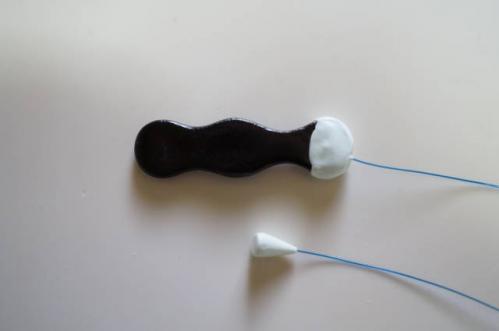
The short ceramic chip is listed in OK Lab's own online store.
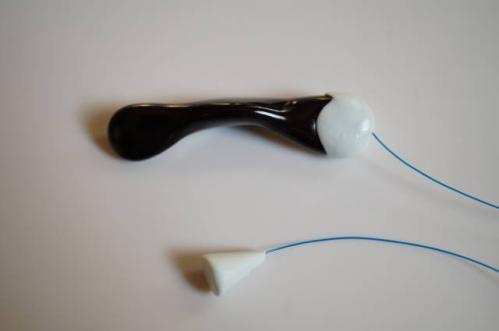
The short twisted ceramic chip is listed in OK Lab's own online store.
Products the diary mentioned as alternatives
The diary names no alternative.
Historical twin prototypes, flexible resin test assemblies, and custom connection builds:
No matching product can be confirmed on the current list.
Common worries about knot-free chip connections
Customers asked about tube holders, adapting existing chips, and protecting electrical cables; the replies addressed different designs.
"Does a chip-to-tube connection require a Gatekeeper?"
In an entry published in July 2022, a customer considering linked short twisted ceramic chips asked whether silicone tubing required a Gatekeeper. Staff said it was optional, though potentially convenient for longer use. They thought the customer's existing unit would work with 4 mm tubing.
Staff warned that bladder placement greatly increased the risk of the assembly moving fully inside the body. The diary does not record whether this proposed order was completed. Staff said some protection against inward movement was needed outside the head of the penis.
(Source: ok-lab's diary, published July 2022)
https://ok-lab.hatenablog.com/entry/2022/07/30/122933
"Can existing chips gain a knot-free connection?"
In an entry published in August 2022, a customer proposed adapting previously purchased chips with a small safety connector. Staff first pointed to the earlier unsuccessful version of that idea. After a revised proposal involving adhesive, staff said the existing safety connector might work and called adaptation of an owned chip a good idea.
They were not planning a service to modify customers' existing chips. The diary does not record a completed conversion or a result from use. For a new order, staff favored the reinforced direct joint because they expected lower production costs and less work.
(Source: ok-lab's diary, published August 2022)
https://ok-lab.hatenablog.com/entry/2022/08/20/122920
"Can a chip-to-tube connection protect an electrical cable?"
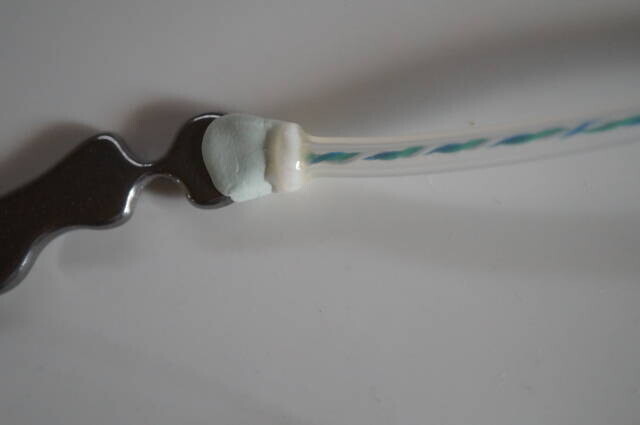
In an entry published in October 2023, a customer asked for a twisted electrical cable inside the maker's nylon-thread tubing. Staff initially refused: the cable would not fit, and they had no way to stabilize it inside a larger tube. Mr. Okada reconsidered and made a prototype using tubing approximately 2 mm inside and 4 mm outside.
He reported a stable result after roughly 5 days of work, including drying time. The published extra charge was ¥2,000 (about $13 at ¥156 = $1, rate as of 2026-09-04), excluding tax, above the existing nylon-reinforced stainless electrode price. Mr. Okada proposed this covering to protect the fine wires near their connection points.
(Source: ok-lab's diary, published October 2023)
https://ok-lab.hatenablog.com/entry/2023/10/07/123003
Buying from outside Japan

OK Lab ships internationally to countries covered by Japan Post's EMS courier service. Overseas orders are paid in advance by PayPal.
Each order carries a ¥400 (about $3 at ¥156 = $1, rate as of 2026-09-04) handling fee, and EMS shipping is charged on top. These terms come from OK Lab's official sales-terms page (written here as plain text, not a link: ok-lab.net/docs/law), checked on September 7, 2026; confirm them on the official store before you order, because they can change.
Summary of this article
| What you wanted to know | The answer |
|---|---|
| What is the main answer? | Direct tube joints retained thread as backup; the connection design continued changing. |
| What is the product? | OK Lab makes the urethral device in Japan and sells it in Japanese yen. |
| Which connection terms matter? | The entries distinguish mating connectors, flexible thread links, tube holders, and protective coverings. |
| What problems appeared? | Early pieces separated easily, thread shifted, thinner connectors needed reinforcement, and some wire designs broke. |
| What did the maker change? | He explored flexible links, supported joints, tube restraints, and reinforced connections. |
| How did development progress? | These entries trace experiments from May 2021 through October 2023. |
| Which related products are listed? | The short ceramic chip and short twisted ceramic chip; their prices exclude historical custom connection work. |
| What did customers ask? | Whether holders were necessary, existing chips could be adapted, and tubing could protect electrical cables. |
| How do overseas orders work? | Advance PayPal payment, a ¥400 (about $3 at ¥156 = $1, rate as of 2026-09-04) handling fee, and additional EMS shipping charges apply. |
Source: ok-lab's diary (Okada Comfortable Life Laboratory). The original entries are in Japanese; quotations on this page are translated. Photos and videos are on the original entries.
This article is a summary of the maker's development diary. The product is not a medical device and no result is guaranteed. If anything feels wrong or worries you, see a doctor. Prices, specifications and cautions change, so confirm the latest information on the official blog and the official site. Questions about ordering and shipping go to the seller.