![Are flexible prostate chip connections safe? | The diary also records failures [OK Prostate Chip]](/img/a/T0038/eyecatch.svg)
This page is based on entries from "ok-lab's diary" (https://ok-lab.hatenablog.com/), the Japanese development diary written by Mr. Okada, founder of OK Lab, a small company in Japan (Okada Comfortable Life Laboratory). Only the entries about "thread at the bend for safety" are summarized here, in order of publication. Past prices and sizes are as written at the time. Current prices come from the official product list (retrieved September 4, 2026). Quotations are translated from Japanese.
Note: This page is a personal reading log by someone with no connection to the maker or the seller. It reflects the source entries as of their publication dates and makes no guarantee of accuracy or safety. The product is not a medical device; talk to a doctor about any health decision. Check the official site for current information. This page contains advertising.
In short
- Thread connections allow bending, but the diary also records a reported sphincter injury and failed prototypes.
- Mr. Okada favors flexible links, cushioning, and reinforcement for different connection problems.
- No current product is directly tied to this topic.
About this product

The OK Prostate Chip is a small device that is placed in the urethra (the urine passage) so that it acts on the prostate; the maker sells it in several shapes, sizes and materials. It is made and sold by OK Lab (Okada Comfortable Life Laboratory), a small company in Japan, through its own online store, and prices are in Japanese yen (JPY).
The maker's development diary, "ok-lab's diary", is written in Japanese. This page is an English summary of it, and every quotation is translated. OK Lab ships internationally, so readers outside Japan can order (see "Buying from outside Japan" below).
Product names on this page are plain-English descriptions. The official Japanese product name is shown once in the product table so you can find the same item in the store.
Before you read: key terms
| Term | Plain-English meaning |
|---|---|
| Thread connection | A thread link between solid parts, intended to let them bend relative to each other. |
| Sphincter | The urine-controlling muscle discussed as gripping the device; flexible connections were intended to reduce strain there. |
| Joint spacing | The gap between connected chip sections, varied in the diary to change flexibility and sensation. |
| Jointed sound | A segmented instrument placed in the urine passage, discussed for stimulation around the prostate or bladder. |
| Resin | Material used for solid chip sections and coatings, forming parts or covering connections in these designs. |
| Cartilage | The diary's comparison for cushioning between hard sections; tubing or rubber serves that role in these designs. |
| Metal fatigue | Weakening associated with repeated stress, used in the diary to explain a broken stainless connection. |
| Suture thread | Thread used for stitches, tested here as a softer material for joining chips. |
| Electrode | An electrical contact on a chip, used in the diary's wired designs. |
| Parallel cable | Two electrical wires joined side by side, used in connections between electrode chips. |
| Retention | Staying in the intended position; the diary discusses how connecting material affects this. |
What happens: thread connection safety
The OK Prostate Chip is a small device placed in the urethra (the urine passage) to act on the prostate. Thread connects solid sections where the assembly needs to bend. Some links sit near the sphincter (the muscle associated here with urine control), while others connect additional parts. Mr. Okada describes the flexible link as a way to reduce strain when the device's position or angle changes.
Thread connections were meant to bend where rigid instruments could resist movement
In an entry published in October 2017, Mr. Okada explained that the device used thread wherever its angle changed. He considered this an answer to worries about rigid instruments resisting changes along the urine passage. He also warned that his own absence of infection provided no guarantee for others. His accompanying advice emphasized cleanliness, without claiming his personal experience established safety.
(Source: ok-lab's diary, published October 2017)
https://ok-lab.hatenablog.com/entry/20171026/1508989298
A long-chip injury led to thread connections across the sphincter area
In an entry published in December 2017, a tester reported sphincter injury after several days of wearing the long chip 24 hours daily. His own favorable testing did not involve uninterrupted day-and-night wear. He suspected the long chip had restricted movement and placed excessive force on the sphincter.
His redesign placed thread between two chips at that point, which he said greatly reduced the load. The diary does not record the tester's recovery. Mr. Okada initially proposed restricting the long version to short use.
(Source: ok-lab's diary, published December 2017)
https://ok-lab.hatenablog.com/entry/20171231/1514712104
Thread connections replaced the planned long chip after spacing tests
In an entry published in January 2018, Mr. Okada described joint spacing tests involving roughly 20 prototypes. He reported little sphincter strain with about 10 mm between chips, but found the sensation less satisfying. A gap of about 3 mm restored some sensation; at 0 mm, the tips touched while about 2 mm of thread remained visible.
He canceled the planned one-piece long chip and proposed connected short sections instead. No matching product can be confirmed on the current list. Mr. Okada's preferred replacement used touching sections that could still bend, with spacing options planned for buyers.
(Source: ok-lab's diary, published January 2018)
https://ok-lab.hatenablog.com/entry/20180106/1515230584

Thread connections gained priority after stainless wire broke during testing
In an entry published in October 2019, Mr. Okada abandoned stainless-steel connections after approximately 3 weeks of testing ended in breakage. He attributed the break to metal fatigue (weakening under repeated stress) concentrated at the same bending point. Thicker nylon survived his pulling test, and he used two strands as a precaution.
He reported that suture thread (thread used for stitches) felt softer than fishing line when compared using his tongue. No matching product can be confirmed on the current list. Mr. Okada favored multiple suture strands, while leaving their number and production method for further testing.
(Source: ok-lab's diary, published October 2019)
https://ok-lab.hatenablog.com/entry/2019/10/12/125944
Reinforced thread connections followed an electrode prototype that broke too quickly
In an entry published in August 2024, Mr. Okada recalled an earlier electrode prototype (chips with electrical contacts) whose single-wire connection broke quickly. Judging that design impractical, he proposed parallel cable (paired electrical wires) reinforced with nylon thread for the new two-chip assembly. Tax-excluded prices were ¥10,000 (about $64 at ¥156 = $1, rate as of 2026-09-04) minimum, ¥1,000 (about $6 at ¥156 = $1, rate as of 2026-09-04) for resin (a coating material), and ¥500 (about $3 at ¥156 = $1, rate as of 2026-09-04) per 5 cm of rear-cable stitching.
Stitching was available up to 25 cm, and omitting the plug reduced the price by ¥1,000 (about $6 at ¥156 = $1, rate as of 2026-09-04). No matching product can be confirmed on the current list. Mr. Okada favored shorter chips for beginners and limited resin-covered gaps to 10 mm because longer coatings lacked consistent quality.
(Source: ok-lab's diary, published August 2024)
https://ok-lab.hatenablog.com/entry/2024/08/10/122913
Stiff joints halted development of the first flexible chip prototype
In an entry published in January 2026, Mr. Okada described Prototype 1 of a jointed-wire design as a failure. A joint had become fixed during manufacture, while very small gaps left the finished piece difficult to bend. He marked it as not for sale and had no plans for an improved version because of the work involved.
No matching product can be confirmed on the current list. Mr. Okada favored spreading bending loads across several joints.
(Source: ok-lab's diary, published January 2026)
https://ok-lab.hatenablog.com/entry/2026/01/03/122924
The maker's answer to thread connection safety
Mr. Okada's approach combines flexible links, cushioning, and reinforcement, each addressing a different problem.
Cushioned flexible joints addressed gaps between hard resin sections
In an entry published in February 2023, Mr. Okada added cushioning to a jointed sound (a segmented instrument for the urine passage). He described 1 mm tubing arranged in a double layer between resin sections, intended to act like cartilage (a joint cushion). The surcharge was ¥1,000 (about $6 at ¥156 = $1, rate as of 2026-09-04) tax excluded per 10 cm, or ¥2,000 (about $13 at ¥156 = $1, rate as of 2026-09-04) tax excluded for the maximum 18 cm length.
The charges covered cushioning added to the base instrument. No matching product can be confirmed on the current list. Mr. Okada recommended the cushioned version because he wanted greater protection at the gaps between hard sections.
(Source: ok-lab's diary, published February 2023)
https://ok-lab.hatenablog.com/entry/2023/02/11/123054
An elastic thread connection carried a separate factory assembly charge
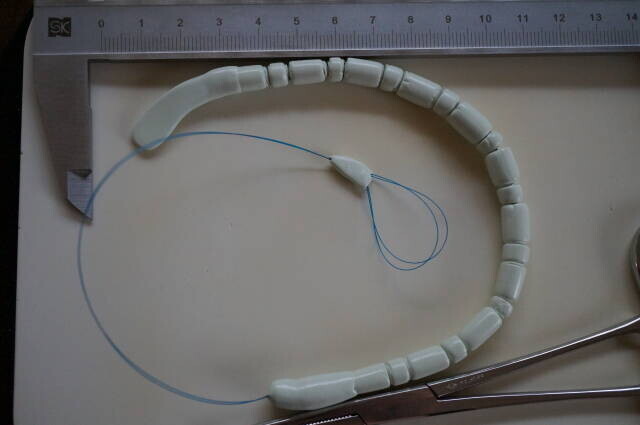
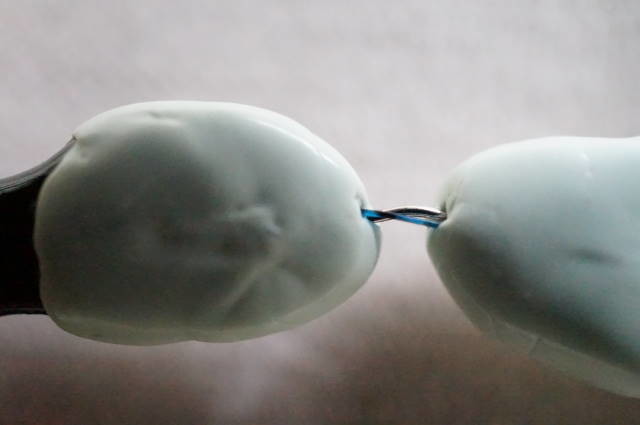
In an entry published in March 2023, Mr. Okada described a flexible blue connector joining a chip to a silicone-covered metal sound. He credited nylon's stretch and silicone's elasticity, but said hidden holes made factory assembly difficult. The connector cost ¥1,500 (about $10 at ¥156 = $1, rate as of 2026-09-04) tax excluded; this assembly cost ¥1,000 (about $6 at ¥156 = $1, rate as of 2026-09-04), giving the diary's stated total of ¥2,500 (about $16 at ¥156 = $1, rate as of 2026-09-04) tax excluded.
Without factory assembly, the price remained ¥1,500 (about $10 at ¥156 = $1, rate as of 2026-09-04). No matching product can be confirmed on the current list. Mr. Okada favored this connector between the chip and sound, describing its tightening loop as an advantage.
(Source: ok-lab's diary, published March 2023)
https://ok-lab.hatenablog.com/entry/2023/03/04/123042
Four flexible joints became standard after comparisons with fewer bends
In an entry published in January 2026, Mr. Okada made four cushioned joints standard, describing them as more flexible than two. He said extreme bends could crack the rubber without affecting the inner wire or resin coating. Tax-excluded component prices were ¥3,000 (about $19 at ¥156 = $1, rate as of 2026-09-04) for the shaft, ¥4,000 (about $26 at ¥156 = $1, rate as of 2026-09-04) for the stopper, and ¥2,000 (about $13 at ¥156 = $1, rate as of 2026-09-04) or ¥3,000 (about $19 at ¥156 = $1, rate as of 2026-09-04) for flat or twisted resin ends.
A ceramic end added its own price plus a ¥1,000 (about $6 at ¥156 = $1, rate as of 2026-09-04) connection charge, also tax excluded. No matching product can be confirmed on the current list. Mr. Okada favored spreading the bending load over a roughly 20 mm section, supported by an approximately 4 mm shaft.
(Source: ok-lab's diary, published January 2026)
https://ok-lab.hatenablog.com/entry/2026/01/03/122924
How thread connection safety changed over time
| Published | What the diary said then |
|---|---|
| Oct 2017 | Mr. Okada explained why angle-changing sections used thread. |
| Dec 2017 | A reported sphincter injury prompted a paired-chip redesign. |
| Jan 2018 | The planned one-piece long chip was canceled. |
| Oct 2019 | Broken stainless wire shifted development toward thread connections. |
| Feb 2023 | Joint cushioning became an extra-cost modification. |
| Mar 2023 | Difficult connector assembly carried a higher charge. |
| Aug 2024 | A revised electrode design combined paired cable and nylon reinforcement. |
| Dec 2024 | Staff explained why thread remained standard for limiting movement transfer. |
| Jan 2026 | Four cushioned joints became the preferred standard. |
| Jun 2026 | Staff distinguished damaged cushioning from the intact thread connection. |
OK Prostate Chip products related to thread connection safety
No current product is directly tied to this topic.
Common worries about thread connection safety
The diary's customer exchanges cover custom sizing, movement, and damaged coverings.
"Can a flexible jointed sound be made wider?"
In an entry published in February 2023, a customer had requested a wider version of the jointed sound. OK Lab made it about 7-8 mm in diameter; the standard described then was 5-6 mm. The customer reported initial difficulty, followed by comfortable use after becoming accustomed to it.
The diary does not record a longer-term outcome for that customer. No matching product can be confirmed on the current list. Mr. Okada's recommendation in that entry concerned the later cushioned version.
(Source: ok-lab's diary, published February 2023)
https://ok-lab.hatenablog.com/entry/2023/02/11/123054
"Would wire improve a thread connection's ability to stay put?"
In an entry published in December 2024, a customer asked whether a loop-based device could use silicone-covered wire instead of thread. Staff said it was possible, but warned that a stiffer link could make the whole device follow movements of the penis. They expected poorer retention (staying in place) and explained that thread was therefore standard in that section.
The customer's follow-up specified thread while requesting a revised estimate; the diary does not record a completed order. No matching product can be confirmed on the current list. Staff favored thread there, and Mr. Okada asked for the proposed overall dimensions to be reconsidered.
(Source: ok-lab's diary, published December 2024)
https://ok-lab.hatenablog.com/entry/2024/12/28/122907
"Does damaged rubber mean a thread connection has failed?"
In an entry published in June 2026, a customer asked whether use should stop after rubber detached from a stopper-to-chip connection. The customer said the chip and thread remained joined. Staff described tubing and rubber as cushions, saying the lost coating restored the earlier thread-only arrangement without reducing strength.
The diary does not record what happened after that reply. No matching product can be confirmed on the current list. Staff treated the damaged rubber as dispensable and warned against contact between sharp objects and the nylon thread.
(Source: ok-lab's diary, published June 2026)
https://ok-lab.hatenablog.com/entry/2026/06/13/122909
Buying from outside Japan

OK Lab ships internationally to countries covered by Japan Post's EMS courier service. Overseas orders are paid in advance by PayPal. Each order carries a ¥400 (about $3 at ¥156 = $1, rate as of 2026-09-04) handling fee, and EMS shipping is charged on top. These terms come from OK Lab's official sales-terms page (written here as plain text, not a link: ok-lab.net/docs/law), checked on September 7, 2026; confirm them on the official store before you order, because they can change.
Summary of this article
| What you wanted to know | The answer |
|---|---|
| Why use thread connections? | Mr. Okada describes them as flexible links at points where solid sections need to change angle. |
| What is the product? | A device placed in the urine passage, made and sold by OK Lab in Japan, with prices in JPY. |
| What do the connection terms mean? | Thread joins parts; spacing describes the gap; rubber or tubing can provide cushioning. |
| What problems were reported? | The diary records a long-chip injury, broken connections, and a prototype that became too stiff. |
| How did the maker respond? | Development moved toward linked sections, reinforced connections, and cushioned joints. |
| What changed over time? | The diary moves from thread-based bending claims in October 2017 to damaged-covering explanations in June 2026. |
| Which current products are confirmed here? | No current product is directly tied to this topic. |
| What did customers ask? | Whether wider sizes were possible, whether wire would work, and whether damaged rubber meant a failed connection. |
| How do overseas orders work? | Advance PayPal payment, a ¥400 (about $3 at ¥156 = $1, rate as of 2026-09-04) handling fee, and additional Japan Post EMS shipping charges. |
| Does bending establish safety? | The diary records favorable design claims alongside a reported sphincter injury and failed prototypes. |
Source: ok-lab's diary (Okada Comfortable Life Laboratory). The original entries are in Japanese; quotations on this page are translated. Photos and videos are on the original entries.
This article is a summary of the maker's development diary. The product is not a medical device and no result is guaranteed. If anything feels wrong or worries you, see a doctor. Prices, specifications and cautions change, so confirm the latest information on the official blog and the official site. Questions about ordering and shipping go to the seller.