![Could my prostate chip wire break? | Reinforcement still has limits [OK Prostate Chip]](/img/a/T0042/eyecatch.svg)
This page is based on entries from "ok-lab's diary" (https://ok-lab.hatenablog.com/), the Japanese development diary written by Mr. Okada, founder of OK Lab, a small company in Japan (Okada Comfortable Life Laboratory). Only the entries about "wire cores and precautions against breakage" are summarized here, in order of publication. Past prices and sizes are as written at the time. Current prices come from the official product list (retrieved September 4, 2026). Quotations are translated from Japanese.
Note: This page is a personal reading log by someone with no connection to the maker or the seller. It reflects the source entries as of their publication dates and makes no guarantee of accuracy or safety. The product is not a medical device; talk to a doctor about any health decision. Check the official site for current information. This page contains advertising.
In short
The maker expects some connecting wires to break eventually, even when another material surrounds them.
His measures include backup thread, covered wires, and limits on replacement services.
Several historical supports were discontinued; the current product list does not establish availability of their custom replacements.
If you see blood in your urine, even a small amount or for the first time, do not wait and see. See a urologist right away. If you suddenly cannot urinate, or the device cannot be removed, do not try to fix it yourself. Go to a medical facility, including emergency care, immediately.
About this product

The OK Prostate Chip is a small device that is placed in the urethra (the urine passage) so that it acts on the prostate; the maker sells it in several shapes, sizes and materials. It is made and sold by OK Lab (Okada Comfortable Life Laboratory), a small company in Japan, through its own online store, and prices are in Japanese yen (JPY). The maker's development diary, "ok-lab's diary", is written in Japanese. This page is an English summary of it, and every quotation is translated. OK Lab ships internationally, so readers outside Japan can order (see "Buying from outside Japan" below). Product names on this page are plain-English descriptions. The official Japanese product name is shown once in the product table so you can find the same item in the store.
Before you read: key terms
| Term | Plain-English meaning |
|---|---|
| Wire core | Internal wire supporting a chip body or a connection between parts. |
| Nylon thread | A connecting strand used as a backup when metal wire breaks. |
| Silicone tube | A soft sleeve covering wire, intended to contain broken ends. |
| Parallel cable | Two joined electrical wires, used for both connection strength and carrying current. |
| Metal fatigue | Damage from repeated strain, discussed by Mr. Okada as an explanation for wire failure. |
| Nitinol | The elastic wire used to form the wings and reinforce the chip. |
| Plastic deformation | Permanent bending; avoiding it is the maker's stated approach to preventing fatigue in the wings. |
| Electrode | An electrical contact; the paired aluminum design uses cables to carry current between parts. |
What happens: prostate chip wire breakage
The OK Prostate Chip is a small device placed in the urethra (the urine passage) to act on the prostate. A wire core (an internal reinforcing wire) supports some resin bodies or connections between chip parts. Other designs cover wire with a silicone tube (a soft sleeve) or add nylon thread (a backup connecting strand). The diary discusses both urethral devices and separate anal chips, whose wire reinforcement sits inside the resin.
An embedded wire core did not rule out resin cracks
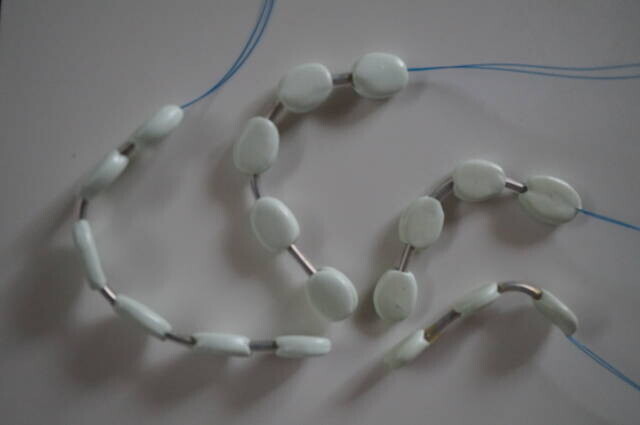
In an entry published in October 2018, Mr. Okada says every anal chip then contained embedded stainless steel wire. He thought anal chips faced much greater force than urethral chips, whose resin he considered sufficiently strong for ordinary use.
He describes the reinforcement as preventing complete breakage. Mr. Okada nevertheless warns that forced bending could still crack the surrounding resin.
(Source: ok-lab's diary, published October 2018)
https://ok-lab.hatenablog.com/entry/20181005/1538740535
A twisted wire core joined the resin-covered paired chip
In an entry published in October 2019, Mr. Okada announces the resin-covered paired chip (Rei). Its connection contains two twisted 0.45mm wires, plus separate nylon thread.
He reports that earlier stiff connections caused strain during prolonged placement, whether made from steel or nylon. The released design covers the connection with thin resin, which he acknowledges could crack under strong force. The published price for two short sections was ¥6,000 (about $38 at ¥156 = $1, rate as of 2026-09-04) excluding tax. Mr. Okada recommends a short rear section as the standard pairing.
(Source: ok-lab's diary, published October 2019)
https://ok-lab.hatenablog.com/entry/2019/10/26/145539
A wire core inside cord required an outer rubber coating
In an entry published in March 2021, Mr. Okada revisits a customer's request for a more durable connection. His prototype cord contains 0.5mm stainless steel wire instead of its original 24 copper strands.
He reports that the wire holds a changed shape, while the surrounding silicone rubber tends to spring back. Without copper, this cord cannot serve as an electrode (an electrical contact). The diary does not record the customer's experience with the completed prototype. Mr. Okada specifies rubber coating as an essential part of the finished construction.
(Source: ok-lab's diary, published March 2021)
https://ok-lab.hatenablog.com/entry/2021/03/27/130138
A hidden wire core shared its cord with backup thread
In an entry published in April 2021, a customer requests a linked chip with no visible thread. Mr. Okada presents a four-chip prototype with nylon thread inside the cord instead of copper.
Only the connection between the first and second chips also contains stainless steel wire. That wire measures 0.3mm, allowing both materials to fit inside the cord. Mr. Okada believes the cord would contain a broken wire; the entry records no customer report about durability.
(Source: ok-lab's diary, published April 2021)
https://ok-lab.hatenablog.com/entry/2021/04/10/125809
A covered wire core still had a finite service life
In an entry published in August 2022, Mr. Okada tests doubled 0.3mm wire inside silicone tubing. The tube measures 3mm outside and 2mm inside.
He reports that the wire did not pierce the tube in his test. His safety judgment depends on broken wire remaining enclosed; he explicitly identifies a protruding end as dangerous. Mr. Okada says eventual wire breakage marks the product's end of life.
(Source: ok-lab's diary, published August 2022)
https://ok-lab.hatenablog.com/entry/2022/08/06/123150
A freely moving wire core followed discontinued 6-line supports
In an entry published in October 2022, Mr. Okada introduces floating-wire 4-line support, a cable with wire moving freely inside tubes. He says the conventional 6-line support had been withdrawn from sale. The new wires could slide inside silicone tubes alongside a parallel cable (two joined electrical wires).
Its 3 barriers were resin spacing of about 1mm, thicker resin, and tubes enclosing the wires. He thought freedom to move would reduce metal fatigue (wire weakening from repeated strain). Mr. Okada nevertheless advises anyone worried about its safety against buying it.
(Source: ok-lab's diary, published October 2022)
https://ok-lab.hatenablog.com/entry/2022/10/15/123011
A bendable wire core left the bead chip vulnerable to damage
In an entry published in June 2023, Mr. Okada introduces a bendable bead chip (Cool Beads). Its 1.2mm stainless steel core has tubing measuring 1mm inside and 2mm outside between the beads. He reports that repeated bending does not restore a perfectly straight shape.
He also warns that a chip lodged in the bladder might not be removable without hospital care. Mr. Okada cautions that force from tools can crack or detach the resin.
(Source: ok-lab's diary, published June 2023)
https://ok-lab.hatenablog.com/entry/2023/06/24/123110
Elastic wings brought a different claim about wire breakage
In an entry published in September 2025, Mr. Okada introduces a wing attachment (Angel Wings) made from nitinol, an elastic wire. He says the wings involve no plastic deformation (permanent bending), unlike an earlier petal design. He consequently claims this design avoids metal fatigue from repeated bending.
He expects any broken wire to remain inside its tube. A continuous wire forms both the wings and reinforcement along the main chip. Mr. Okada favors 0.1mm wire over 0.15mm for a gentler feel.
(Source: ok-lab's diary, published September 2025)
https://ok-lab.hatenablog.com/entry/2025/09/27/123018
The maker's answer to prostate chip wire breakage
The maker combines backup connections with design limits, while acknowledging that wire durability can remain unknown.
Backup thread addressed wire breakage without making continued use acceptable
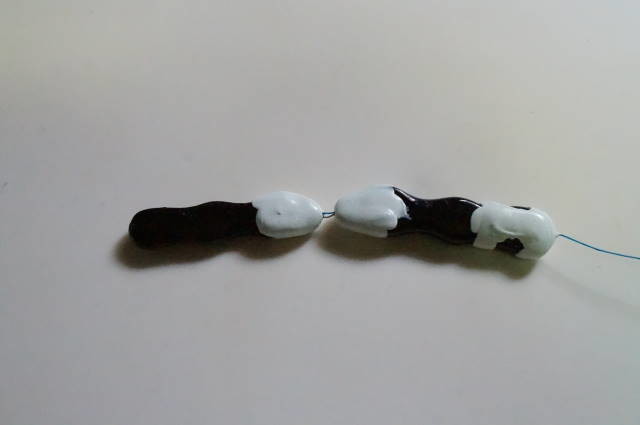
In an entry published in September 2019, Mr. Okada explicitly expects the paired chip's stainless steel connection to break eventually. He embeds nylon thread that takes over only after the metal connection fails. Its purpose is to keep the front chip connected.
He believes the closely spaced chips would cover the broken ends. However, he warns that those ends could damage the nylon, making continued use dangerous. Mr. Okada therefore asks customers to request thread replacement after wire failure.
(Source: ok-lab's diary, published September 2019)
https://ok-lab.hatenablog.com/entry/2019/09/28/140637
Thinner stainless steel wire reduced stiffness but left durability uncertain
In an entry published in January 2021, Mr. Okada describes rubber-coating difficulties with connection spans of 3mm or more. Bare wire removes that coating-related length restriction, with nylon thread embedded alongside it. He says the 0.5mm wire's durability remains unknown because prolonged use has not established its lifespan.
He expects metal fatigue, rather than corrosion, to cause eventual failure. He also warns that longer spans are more likely to fold. Mr. Okada favors 0.5mm over the multipurpose stainless steel wire's 0.7mm, which he finds too resistant to bending for prolonged placement.
(Source: ok-lab's diary, published January 2021)
https://ok-lab.hatenablog.com/entry/2021/01/23/130107
Wire breakage did not qualify every assembly for replacement
In an entry published in August 2022, Mr. Okada limits ordinary replacement service to standard nylon thread. He says wire-filled silicone tubes and 4-line or 6-line assemblies are generally excluded.
Their wire and chip are fixed together in resin, making separation harder than with nylon alone. He explains that the force involved can damage the chip, making the replacement service financially unworkable. Mr. Okada invites individual inquiries about especially valued custom builds, without promising replacement.
(Source: ok-lab's diary, published August 2022)
https://ok-lab.hatenablog.com/entry/2022/08/06/123150
If you see blood in your urine, even a small amount or for the first time, do not wait and see. See a urologist right away. If you suddenly cannot urinate, or the device cannot be removed, do not try to fix it yourself. Go to a medical facility, including emergency care, immediately.
How prostate chip wire breakage changed over time

| Published | What the diary said then |
|---|---|
| Oct 2018 | Anal chips contained reinforcement wire; the maker still acknowledged possible resin cracks. |
| Sep 2019 | Backup nylon addressed expected connection failure; replacement was requested after breakage. |
| Oct 2019 | The paired design launched with twisted wire, backup nylon, and a resin covering. |
| Jan 2021 | Thinner wire was preferred, but its durability remained unknown. |
| Apr 2021 | A prototype hid nylon inside cord, with wire only between its first two chips. |
| Aug 2022 | Wire failure meant end of life; ordinary replacement covered standard nylon only. |
| Oct 2022 | Floating-wire support followed the conventional 6-line support's withdrawal. |
| Jun 2023 | Unresolved wire strength problems had ended conventional 4-line support. |
| Aug 2024 | Separated cable strands were restricted to fully resin-embedded sections. |
| Sep 2025 | The wing design avoided permanent bending, which the maker linked to avoiding fatigue. |
OK Prostate Chip products related to prostate chip wire breakage
The current list includes multipurpose wire, whose stiffness drew a specific caution in the January 2021 discussion.
Products that appear in these entries
| Product (official name) | Price incl. tax | Relation to this topic |
|---|---|---|
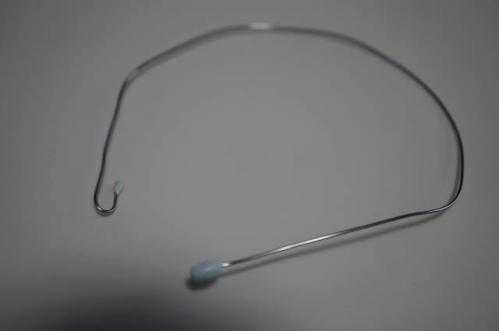
| Multipurpose stainless steel wire (多目的ステンレスワイヤー) | ¥550 (about $4 at ¥156 = $1, rate as of 2026-09-04) | In January 2021, Mr. Okada judged its 0.7mm wire too stiff for prolonged placement as a chip connection. |
The multipurpose stainless steel wire is listed in OK Lab's own online store.
(Source: ok-lab's diary, published January 2021)
https://ok-lab.hatenablog.com/entry/2021/01/23/130107
Products the diary mentioned as alternatives
The diary names no alternative.
The resin-covered paired chip (Rei) and wire-core cord prototypes: No matching product can be confirmed on the current list. The wire-filled tube and floating-wire support: No matching product can be confirmed on the current list.
The bendable bead chip (Cool Beads), reinforced vibration cable, and wing attachment (Angel Wings): No matching product can be confirmed on the current list. Paired aluminum electrodes and large anal prototypes: No matching product can be confirmed on the current list.
The conventional 6-line support was discontinued by October 2022. The June 2023 entry confirms discontinuation of conventional 4-line support.
Common worries about prostate chip wire breakage
Customer questions expose limits involving larger prototypes, discontinued supports, and thinner connecting cables.
"Could a wire core support a larger anal chip?"

In an entry published in October 2018, a customer asks about a spiral anal chip measuring 90mm–100mm. Mr. Okada agrees to make samples, describing the request as outside ordinary retail sizes. The 80mm prototype contains 1.2mm wire, while he chooses 1.6mm for the 90mm version because the thinner core seems inadequate.
The diary does not record how these prototypes felt in use. Mr. Okada asks for additional time because making them requires a larger workbench.
(Source: ok-lab's diary, published October 2018)
https://ok-lab.hatenablog.com/entry/20181013/1539409481
"Can wire supports discontinued over wire breakage be made again?"
In an entry published in June 2023, a customer asks for the previous 4-line support after finding it comfortable. Mr. Okada explains that unresolved wire strength problems led to its discontinuation. His proposed replacement uses 1.2mm wire beside an internal cable section, beginning 5mm behind the chip and extending about 8cm.
The diary records a prototype, but no account of this customer's later experience. Mr. Okada warns that cable damage could separate it from the wire, so his design includes rounded wire ends.
(Source: ok-lab's diary, published June 2023)
https://ok-lab.hatenablog.com/entry/2023/06/10/123053
"Would thinner cables need a wire core for strength?"
In an entry published in August 2024, a customer asks whether a paired aluminum electrode could use thinner cables. Mr. Okada replies that separating the joined strands sharply weakens the cable, based on his experience. He therefore limits single-strand use to sections completely embedded in resin.
He says the paired electrode also has backup nylon alongside its connecting cable. The diary does not record a thinner version being made. Mr. Okada excluded elastic wire to keep prices down and favors intact parallel cable for connections without another cover.
(Source: ok-lab's diary, published August 2024)
https://ok-lab.hatenablog.com/entry/2024/08/17/122842
Buying from outside Japan

OK Lab ships internationally to countries covered by Japan Post's EMS courier service. Overseas orders are paid in advance by PayPal. Each order carries a ¥400 (about $3 at ¥156 = $1, rate as of 2026-09-04) handling fee, and EMS shipping is charged on top. These terms come from OK Lab's official sales-terms page (written here as plain text, not a link: ok-lab.net/docs/law), checked on September 7, 2026; confirm them on the official store before you order, because they can change.
Summary of this article
| What you wanted to know | The answer |
|---|---|
| What is the short answer? | The diary describes reinforcement and backup connections, alongside expected failures. |
| What is the product? | A urethral device made and sold by OK Lab in Japan. |
| What do the key terms mean? | Wire provides support; nylon provides backup; tubing covers wire. |
| What can happen? | Wire can break, and reinforced resin can still crack. |
| What measures did the maker describe? | Backup thread, less stiff wire, covered connections, and restricted replacement services. |
| What changed over time? | Some wire supports were discontinued; later designs changed how wire was supported. |
| What current product appears here? | Multipurpose stainless steel wire costs ¥550 (about $4 at ¥156 = $1, rate as of 2026-09-04) including tax on the supplied current list. |
| What did customers ask? | Whether larger prototypes, earlier supports, or thinner cables were possible. |
| How does overseas buying work? | Advance PayPal payment, a ¥400 (about $3 at ¥156 = $1, rate as of 2026-09-04) handling fee, and additional EMS shipping. |
Source: ok-lab's diary (Okada Comfortable Life Laboratory). The original entries are in Japanese; quotations on this page are translated. Photos and videos are on the original entries.
This article is a summary of the maker's development diary. The product is not a medical device and no result is guaranteed. If anything feels wrong or worries you, see a doctor. Prices, specifications and cautions change, so confirm the latest information on the official blog and the official site. Questions about ordering and shipping go to the seller.