![Can a prostate chip break inside the body? | Reinforcement is not a guarantee [OK Prostate Chip]](/img/a/T0045/eyecatch.svg)
This page is based on entries from "ok-lab's diary" (https://ok-lab.hatenablog.com/), the Japanese development diary written by Mr. Okada, founder of OK Lab, a small company in Japan (Okada Comfortable Life Laboratory). Only the entries about "preventing breakage and controlling how parts fail" are summarized here, in order of publication. Past prices and sizes are as written at the time. Current prices come from the official product list (retrieved September 4, 2026). Quotations are translated from Japanese.
Note: This page is a personal reading log by someone with no connection to the maker or the seller. It reflects the source entries as of their publication dates and makes no guarantee of accuracy or safety. The product is not a medical device; talk to a doctor about any health decision. Check the official site for current information. This page contains advertising.
In short
- Reinforcement does not rule out broken chips, damaged wires, or peeling coatings.
- Mr. Okada's approach aims to keep damaged parts connected, with structural failure marking the end of use.
- The current list includes the ceramic model whose reinforced coating reportedly peeled in June 2026.
If you see blood in your urine, even a small amount or for the first time, do not wait and see. See a urologist right away. If you suddenly cannot urinate, or the device cannot be removed, do not try to fix it yourself. Go to a medical facility, including emergency care, immediately.
About this product

The OK Prostate Chip is a small device that is placed in the urethra (the urine passage) so that it acts on the prostate; the maker sells it in several shapes, sizes and materials. It is made and sold by OK Lab (Okada Comfortable Life Laboratory), a small company in Japan, through its own online store, and prices are in Japanese yen (JPY). The maker's development diary, "ok-lab's diary", is written in Japanese. This page is an English summary of it, and every quotation is translated. OK Lab ships internationally, so readers outside Japan can order (see "Buying from outside Japan" below). Product names on this page are plain-English descriptions. The official Japanese product name is shown once in the product table so you can find the same item in the store.
Before you read: key terms
| Term | Plain-English meaning |
|---|---|
| Reinforcement | Added coating, wire, or thread intended to limit damage or keep broken parts connected. |
| Silicone | Material used as a flexible covering or adhesive to cushion connections and surround wire. |
| Epoxy resin | A hard adhesive coating used to secure and cover parts; Mr. Okada describes it as brittle. |
| Nitinol | The diary's shape-memory wire, used for flexible supports that return toward their original shape. |
| Retrieval thread | A cord attached for removal; later designs also use it to keep separated components connected. |
| Joint | A flexible gap between covered sections, intended to let an assembly bend. |
| Petal loop | A projecting wire loop used as a stopper to help hold a device in position. |
What happens: prostate chip breakage
The OK Prostate Chip is a small device placed in the urethra, the urine passage, to act on the prostate. Reinforcement means added coatings, wire, or thread intended to control what happens after damage. The diary describes coverings around narrow sections and connections intended to hold broken parts together. These features concern parts inside the body, where detached tips and exposed wires appeared in customer reports.
Glass chip breakage was expected, even with a protective coating
In an entry published in October 2017, Mr. Okada explained why he had returned to glass after experimenting with other materials. His design concentrated possible breakage at a deliberately weak, narrow section covered with resin.
He considered that coating protection for the skin at the instant of breakage, rather than a promise that glass could not break. It was not intended to support continued use afterward. Mr. Okada called for prompt removal and no further use of a broken chip.
(Source: ok-lab's diary, published October 2017)
https://ok-lab.hatenablog.com/entry/20171025/1508901076
Wire breakage marked the end of the reinforced tube's service life
An entry published in August 2022 described wire-filled silicone tubing, a flexible covering around the wire. The tube measured 3mm outside and 2mm inside, with doubled 0.3mm stainless wire.
Mr. Okada expected the internal wire eventually to break. OK Lab generally declined replacement of these connections and the 4-wire and 6-wire versions because the work could damage the chip. Routine replacement service covered only standard nylon retrieval thread, the attached cord for removal. Mr. Okada advised treating failure of the weakest part as the end of the product's life.
(Source: ok-lab's diary, published August 2022)
https://ok-lab.hatenablog.com/entry/2022/08/06/123150
Four reports led Mr. Okada to rethink chip breakage protection
In an entry published in March 2025, Mr. Okada counted 4 customers reporting breakage of loop-based wire devices. Some had reported failures of multiple items. He suspected permanent bends had weakened the wire, but acknowledged that factory-shaped wire could not carry an absolute guarantee either.
His proposed answer was double wire: if one strand broke, the remaining strand would preserve the shape. He abandoned the goal of supplying something that could never break. Mr. Okada recommended double-wire versions after previous failures and called for disposal when one wire broke.
(Source: ok-lab's diary, published March 2025)
https://ok-lab.hatenablog.com/entry/2025/03/08/123016
Ceramic chip breakage once left a tip inside the bladder
An entry published in June 2025 recalled a sea slug ceramic chip (Umiushi 2) breaking inside a customer's body. Its tip remained in the bladder until a doctor retrieved it; the accident's date was not given.
Mr. Okada abandoned a rubber-only coating trial after one day, then adopted 0.2mm shape-memory wire along both sides of ceramic chips. Silicone and epoxy resin, a hard adhesive coating, secured the reinforcement. He believed the wire could prevent tip separation even if the ceramic cracked. He described flat standard chips as providing the most stable reinforcement.
(Source: ok-lab's diary, published June 2025)
https://ok-lab.hatenablog.com/entry/2025/06/07/122954
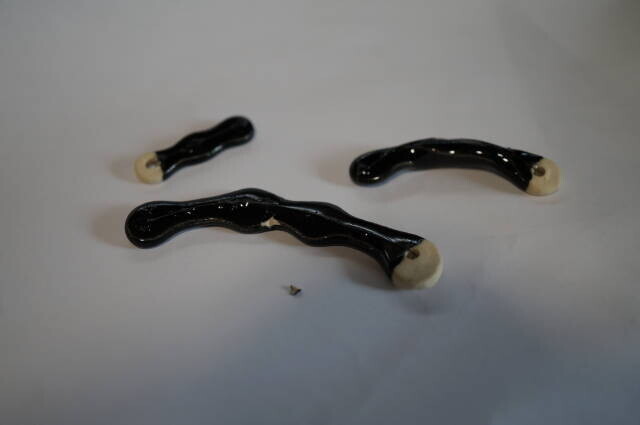
Nylon backing became another proposed safeguard against wire breakage
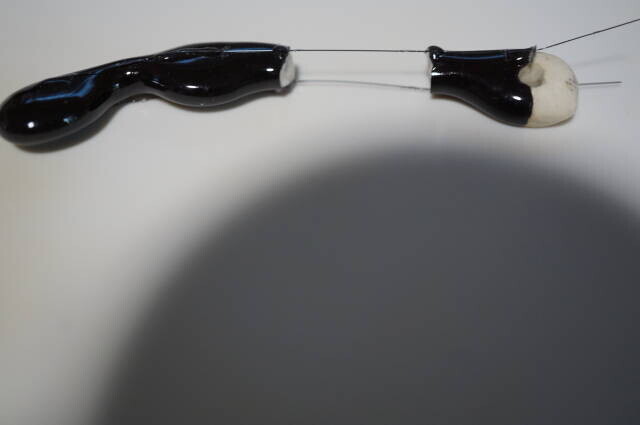
In an entry published in November 2025, Mr. Okada described adding nylon alongside nitinol, the diary's shape-memory wire. The prototype used joints, flexible gaps between covered sections, measuring 1mm or less.
He expected broken wire ends to remain recessed between resin sections, away from the skin. The nylon would still connect the parts after wire failure. Mr. Okada said this jointed design needed further checks.
(Source: ok-lab's diary, published November 2025)
https://ok-lab.hatenablog.com/entry/2025/11/22/122910
Continuous wires linked dual ceramic chips for chip breakage protection
An entry published in January 2026 described ceramic pairs connected through 4 flexible joints. Continuous doubled wires extended through the connection and along the ceramic pieces. Mr. Okada believed this could keep the assembly together if ceramic broke.
The published connection charge was ¥6,000 (about $38 at ¥156 = $1, rate as of 2026-09-04) excluding tax, in addition to both chips' prices. The shortest estimated lead time was about 2 weeks after a request. Mr. Okada suggested smaller ceramic pairs as potentially easier to use.
(Source: ok-lab's diary, published January 2026)
https://ok-lab.hatenablog.com/entry/2026/01/10/122922
Connector damage prompted gentler bends before revised chip breakage reinforcement
An entry published in January 2026 reviewed the paired sea slug ceramic design (Umiushi 5). Earlier connection failures had led Mr. Okada to limit its bend to approximately 45 degrees or less. He reported that trouble reports stopped at that angle.
The new revision replaced the earlier internal cord with nitinol wire and made full ceramic reinforcement standard. Mr. Okada believed its flexible connection could support a bend of approximately 90 degrees.
(Source: ok-lab's diary, published January 2026)
https://ok-lab.hatenablog.com/entry/2026/01/31/122917
The maker's answer to prostate chip breakage
The maker's measures aim to keep parts connected after damage, while acknowledging that greater strength can introduce different risks.
Stronger retrieval threads introduced another risk alongside chip breakage
An entry published in May 2018 described planned extra reinforcement for the thread attachment. Mr. Okada considered a thread releasing under sufficient force a possible protective feature.
He warned that a stronger attachment could transfer damaging force to the bladder or urethra when a large chip was trapped. The additional adhesive also introduced material risks beyond those of the original construction. His caution was that stronger attachment could bring new dangers, including bladder injury.
(Source: ok-lab's diary, published May 2018)
https://ok-lab.hatenablog.com/entry/20180513/1526181573
Extra thread attachments addressed what happens when a chip comes apart
An entry published in December 2025 described an assembly divided into a chip unit, straight shaft, and heart-shaped stopper. Staff noticed that the shaft might become separate if its main connections detached.
The revised layout included additional short tubes securing the shaft and stopper to the thread. Mr. Okada intended these attachments to keep those parts connected even after the main connectors separated. He also reported that a trial without flexible joints caused too much discomfort for prolonged use.
(Source: ok-lab's diary, published December 2025)
https://ok-lab.hatenablog.com/entry/2025/12/13/122917
Flexible connections extended chip breakage reinforcement into movable ceramic designs
In an entry published in January 2026, Mr. Okada described a movable ceramic prototype with separated sections held together by wire. Its approximately 15mm gap included a central rubber-covered section of approximately 5mm.
According to Mr. Okada, the rubber limited movement while allowing some bending. The published specifications restricted this construction to suitable ceramic shapes without raised bumps, because the wire needed space along the chip.
(Source: ok-lab's diary, published January 2026)
https://ok-lab.hatenablog.com/entry/2026/01/17/122907
If you see blood in your urine, even a small amount or for the first time, do not wait and see. See a urologist right away. If you suddenly cannot urinate, or the device cannot be removed, do not try to fix it yourself. Go to a medical facility, including emergency care, immediately.
How prostate chip breakage changed over time
| Published | What the diary said then |
|---|---|
| May 2018 | Extra thread-attachment reinforcement was planned at ¥1,000 (about $6 at ¥156 = $1, rate as of 2026-09-04) excluding tax. |
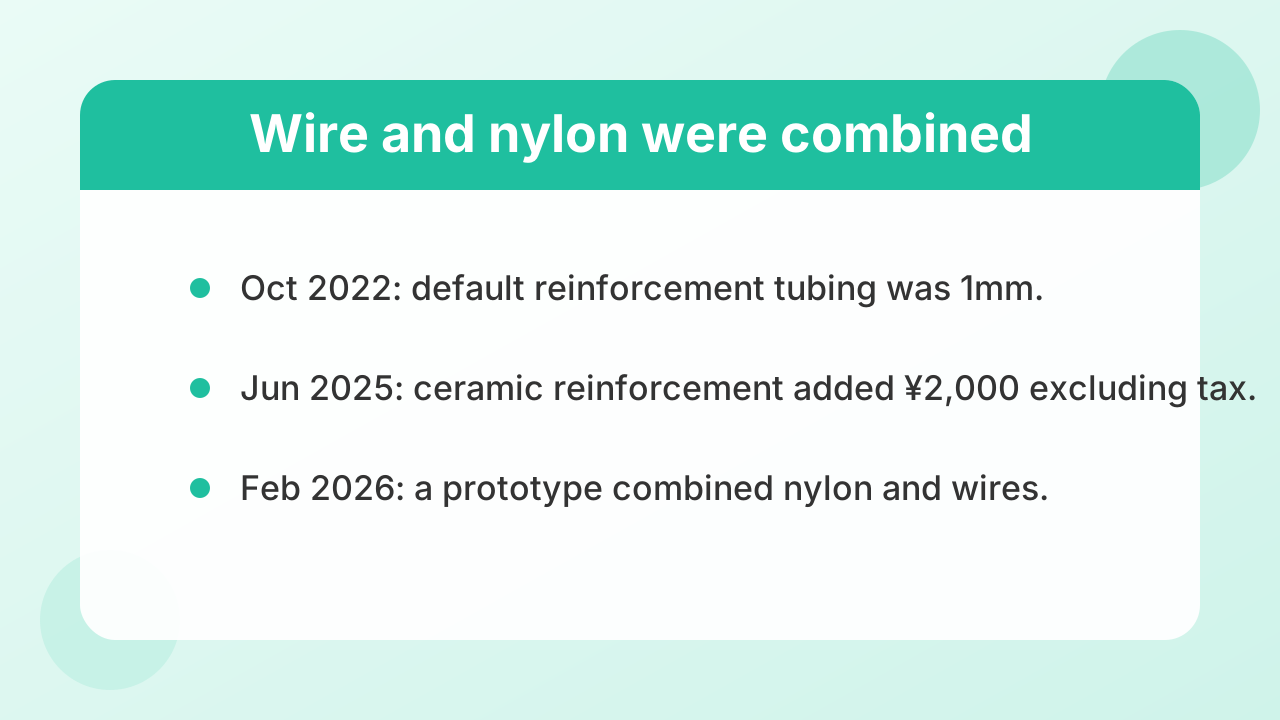
| Oct 2022 | Default reinforcement tubing was 1mm; the first 2mm request was recorded. |
| Apr 2023 | Mr. Okada thought the revised base plate's broader central area would reduce breakage. |
| Jun 2025 | Ceramic wire reinforcement added ¥2,000 (about $13 at ¥156 = $1, rate as of 2026-09-04) excluding tax, regardless of shape. |
| Aug 2025 | Revised petal loops retained their ¥1,000 (about $6 at ¥156 = $1, rate as of 2026-09-04) price per petal. |
| Dec 2025 | Shafts: ¥2,000 (about $13 at ¥156 = $1, rate as of 2026-09-04) through 100mm; ¥3,000 (about $19 at ¥156 = $1, rate as of 2026-09-04) through 150mm; ¥4,000 (about $26 at ¥156 = $1, rate as of 2026-09-04) through 200mm, excluding tax. |
| Jan 2026 | The revised paired-chip design added ¥4,000 (about $26 at ¥156 = $1, rate as of 2026-09-04) excluding tax with full reinforcement. |
| Feb 2026 | A prototype combined two nylon threads and two wires; no sales were planned then. |
| May 2026 | The experimental resin assembly received a provisional parts-only quote; production remained unsettled. |
OK Prostate Chip products related to prostate chip breakage
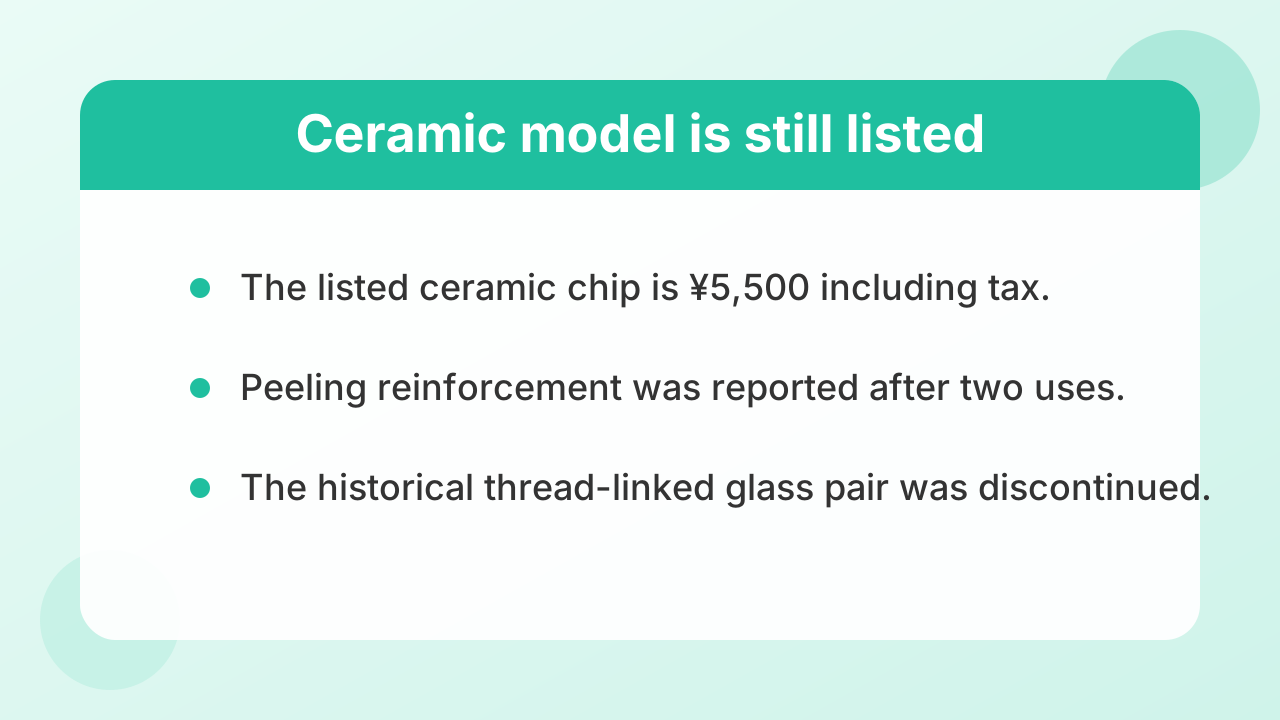
The current list includes the ceramic base model involved in the peeling-coating report, without confirming its historical reinforcement options.
Products that appear in these entries
| Product (official name) | Price incl. tax | Relation to this topic |
|---|---|---|
| Medium-length twisted ceramic chip (OKプロステートチップ 陶器素材セミロングタイプ コブラツイスト) | ¥5,500 (about $35 at ¥156 = $1, rate as of 2026-09-04) | In June 2026, a customer reported peeling reinforcement on this model after two uses. |
The medium-length twisted ceramic chip is listed in OK Lab's own online store.
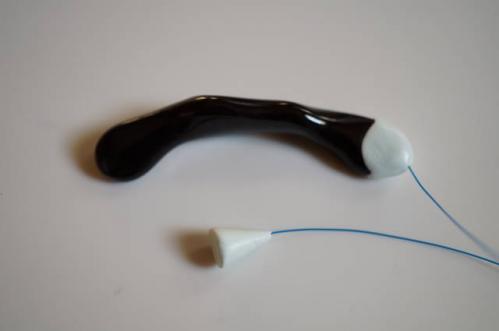
(Source: ok-lab's diary, published June 2026)
https://ok-lab.hatenablog.com/entry/2026/06/20/122903
Products the diary mentioned as alternatives
The diary names no alternative.
Historical wire-only builds, jointed assemblies, movable prototypes, and sea slug custom chips:
No matching product can be confirmed on the current list.
No longer sold: the historical thread-linked glass pair. An entry published in January 2026 says it had been discontinued because its connecting threads tangled.
(Source: ok-lab's diary, published January 2026)
https://ok-lab.hatenablog.com/entry/2026/01/10/122922
Common worries about prostate chip breakage
Readers asked about weak resin sections, detached side loops, and whether peeling reinforcement required repair.
"Does reinforcement stop resin chip breakage?"
In an entry published in June 2024, a customer questioned the narrow section of a resin chip connected to a springy wire. Mr. Okada acknowledged that his tests could break the resin at that narrow section. He nevertheless thought attachment at only one end would not greatly change its breakability compared with the chip alone.
He expected silicone beneath the epoxy to keep the connection together initially if its outer coating cracked. Based on his experience, he said epoxy needed at least several months to reach full strength. Mr. Okada advised stopping use when epoxy cracks appeared and avoiding excessive force during approximately the first 3 months.
(Source: ok-lab's diary, published June 2024)
https://ok-lab.hatenablog.com/entry/2024/06/15/123132
"Can petal-loop wire breakage cause an injury?"
In an entry published in August 2025, a customer reported a petal loop's base attachment failing after about 2 weeks. Petal loops are projecting wire loops intended to help hold the device in position. Staff offered repair, and the customer later confirmed receiving the repaired item.
The same customer also reported both side loops detaching on another device, with an internal wire catching and cutting the lining. Mr. Okada attributed the problem to repeated bending at permanently shaped wire sections; the diary does not record the second repair's outcome. He initially proposed thicker rubber protection, then described a revised construction intended to avoid permanent wire bends.
(Source: ok-lab's diary, published August 2025)
https://ok-lab.hatenablog.com/entry/2025/08/30/122943
"Can chip coating peeling qualify for repair?"
In an entry published in June 2026, a customer reported white epoxy peeling from a reinforced medium-length twisted ceramic chip after 2 uses. Adhesive was exposed, and another raised area left nitinol wire accessible. The customer asked whether it remained usable or qualified for replacement.
Staff said reinforcement already combined resin and rubber, so they believed one layer coming away need not cause a major problem. However, they could not judge this customer's chip from the description; the diary does not record an inspection or repair result. Their advice was to return it for assessment, with repair offered if necessary.
(Source: ok-lab's diary, published June 2026)
https://ok-lab.hatenablog.com/entry/2026/06/20/122903
Buying from outside Japan

OK Lab ships internationally to countries covered by Japan Post's EMS courier service. Overseas orders are paid in advance by PayPal. Each order carries a ¥400 (about $3 at ¥156 = $1, rate as of 2026-09-04) handling fee, and EMS shipping is charged on top. These terms come from OK Lab's official sales-terms page (written here as plain text, not a link: ok-lab.net/docs/law), checked on September 7, 2026; confirm them on the official store before you order, because they can change.
Summary of this article
| What you wanted to know | The answer |
|---|---|
| In short: can reinforced chips fail? | The diary records broken components and peeling coatings despite reinforcement. |
| What is the product? | A urethral device made by OK Lab in Japan, with prices in JPY. |
| What do the technical terms mean? | Coatings, wires, threads, and joints serve different covering, connecting, and bending roles. |
| What happened in these cases? | Reports included wire failures, a retained ceramic tip, and damaged reinforcement. |
| What was the maker's answer? | Keep components connected after damage and recognize structural failure as the end of use. |
| How did the design change? | Later designs added backup wires, nylon connections, and flexible joints. |
| What current product appears here? | The medium-length twisted ceramic base model is listed at ¥5,500 (about $35 at ¥156 = $1, rate as of 2026-09-04) including tax. |
| What concerned customers? | Narrow sections breaking, side loops detaching, and coatings peeling. |
| How are overseas orders handled? | Advance PayPal payment, a ¥400 (about $3 at ¥156 = $1, rate as of 2026-09-04) handling fee, and additional EMS shipping. |
| What is the overall answer? | Mr. Okada's reinforcement concepts do not establish that a device cannot break. |
Source: ok-lab's diary (Okada Comfortable Life Laboratory). The original entries are in Japanese; quotations on this page are translated. Photos and videos are on the original entries.
This article is a summary of the maker's development diary. The product is not a medical device and no result is guaranteed. If anything feels wrong or worries you, see a doctor. Prices, specifications and cautions change, so confirm the latest information on the official blog and the official site. Questions about ordering and shipping go to the seller.