![Why is the chip connection covered? | Resin, rubber, and tubing have different jobs [OK Prostate Chip]](/img/a/T0043/eyecatch.svg)
This page is based on entries from "ok-lab's diary" (https://ok-lab.hatenablog.com/), the Japanese development diary written by Mr. Okada, founder of OK Lab, a small company in Japan (Okada Comfortable Life Laboratory). Only the entries about "covering connections with resin and tubing" are summarized here, in order of publication. Past prices and sizes are as written at the time. Current prices come from the official product list (retrieved September 4, 2026). Quotations are translated from Japanese.
This article is about chip connection covers, and summarizes their different jobs, design changes, and customer reports. It also covers the maker's advice, related products, repair, and buying from outside Japan.
Note: This page is a personal reading log by someone with no connection to the maker or the seller. It reflects the source entries as of their publication dates and makes no guarantee of accuracy or safety. The product is not a medical device; talk to a doctor about any health decision. Check the official site for current information. This page contains advertising.
In short
- Connection covers serve different purposes, including cushioning, securing parts, and limiting folding.
- Mr. Okada changed materials and attachment designs after reports of bulky joints, overlapping chips, and damage.
- Current listings include related components, but do not confirm every historical custom assembly.
If you see blood in your urine, even a small amount or for the first time, do not wait and see. See a urologist right away.
If you suddenly cannot urinate, or the device cannot be removed, do not try to fix it yourself. Go to a medical facility, including emergency care, immediately.
About this product
The OK Prostate Chip is a small device that is placed in the urethra (the urine passage) so that it acts on the prostate; the maker sells it in several shapes, sizes and materials. It is made and sold by OK Lab (Okada Comfortable Life Laboratory), a small company in Japan, through its own online store, and prices are in Japanese yen (JPY). The maker's development diary, "ok-lab's diary", is written in Japanese. This page is an English summary of it, and every quotation is translated. OK Lab ships internationally, so readers outside Japan can order (see "Buying from outside Japan" below). Product names on this page are plain-English descriptions. The official Japanese product name is shown once in the product table so you can find the same item in the store.
Before you read: key terms
| Term | Plain-English meaning |
|---|---|
| Urethra | The urine passage, where the device is placed. |
| Sphincter | The muscle described as gripping a narrow device section to help hold it in place. |
| Epoxy resin | A hard-setting material used to cover and secure connections. |
| Silicone rubber | A flexible material used for cushioning, sealing, or controlling movement, depending on the design. |
| Silicone tube | A soft sleeve around thread or wire, used for covering or cushioning. |
| Electrode | An electrical contact on a chip, used to deliver electrical stimulation. |
| Nylon thread | A linking thread used to keep device parts connected. |
| Shape-memory wire | Wire that returns toward its original shape, used for flexible connections. |
| Screw-shaped auxiliary chip | A twisted supporting part connected behind a main chip. |
What happens: prostate chip connection covers
The OK Prostate Chip is a small device placed in the urethra (the urine passage) to act on the prostate. These entries describe covers around thread, wire, and cable connections between chip parts, including narrow sections near the muscle gripping the device. Mr. Okada uses resin, rubber, and tubing to secure connections, cushion contact, or limit folding. The intended role depends on the particular design.
A resin cover complicated close electrode spacing in May 2019
In an entry published in May 2019, a customer wanted closely spaced electrodes (electrical contacts) on a linked pair. Mr. Okada estimated that each attachment needed about 5 mm of resin coverage, leaving roughly 15 mm between electrodes. The customer preferred 10 mm, accepting additional thickness.
Mr. Okada reported achieving that spacing, but remained concerned about cable durability. He asked the customer to weigh close spacing against strength.
(Source: ok-lab's diary, published May 2019)
https://ok-lab.hatenablog.com/entry/2019/05/11/152432
Full resin covers followed concerns about rigid connections in October 2019
In an entry published in October 2019, Mr. Okada attributed strain during extended wear to rigid connections pressing against the sphincter (the gripping muscle). His resin-linked pair used epoxy resin (a hard-setting covering material) across the connection. Inside were two 0.45 mm wires and nylon thread (a linking thread).
He acknowledged that the thin resin could crack under strong force. For this design, Mr. Okada recommended a short second chip.
(Source: ok-lab's diary, published October 2019)
https://ok-lab.hatenablog.com/entry/2019/10/26/145539
A resin cover on one side became standard in December 2019
In an entry published in December 2019, a customer wanted a screw-shaped auxiliary chip (a twisted supporting part) attached to a vibrating chip's cable. Mr. Okada abandoned the initial attachment idea because of strength concerns. The adopted design covered only one cable face; complete burial would have left the surrounding resin too thin.
He reported a favorable test lasting about 3 days. He specified a minimum 2 mm gap and said the attachment had to be ordered with the vibrating chip.
(Source: ok-lab's diary, published December 2019)
https://ok-lab.hatenablog.com/entry/2019/12/21/150646
Rubber coating addressed spring chip overlap in October 2020
In an entry published in October 2020, Mr. Okada reported overlapping in an experimental spring-chip pair. He connected this problem with trouble involving an earlier glass pair. His replacement design covered the linking thread with rubber, and he reported easier insertion during testing. His proposed measure was rubber coating to make folding at the connection harder.
(Source: ok-lab's diary, published October 2020)
https://ok-lab.hatenablog.com/entry/2020/10/24/115457
Rubber covers did not prevent difficult removal in March 2021
In an entry published in March 2021, Mr. Okada reported difficulty removing a three-part stainless-steel ring assembly after about 3 days. Removal took approximately 20 minutes. The connection contained 0.5 mm wire and nylon thread beneath rubber coating.
He reported no bleeding afterward, but the difficult removal remained unexplained. Mr. Okada asked readers to wait for further testing of the connection designs.
(Source: ok-lab's diary, published March 2021)
https://ok-lab.hatenablog.com/entry/2021/03/20/130148
Thinner chip connections followed a customer's size complaint in June 2022
In an entry published in June 2022, a customer reported that bulky cable attachments prevented several chips from fitting. Earlier four-wire and parallel-cable attachments overlapped the chip beneath resin, adding about 2 mm compared with thread connections. Mr. Okada described a newer metal-based attachment that avoided this overlap.
He said its finished thickness approached that of a thread-connected chip. Mr. Okada offered this thinner attachment approach for subsequent builds.
(Source: ok-lab's diary, published June 2022)
https://ok-lab.hatenablog.com/entry/2022/06/11/123420
Rubber coating stabilized an electrode joint behind the chip in April 2023
In an entry published in April 2023, a customer needed an electrode chip no thicker than 7 mm. Mr. Okada initially refused because the existing jointed design reached 7 mm or more. He then offered a connection whose bending section began behind the chip.
The completed chip matched the earlier electrode size, and added rubber appeared to stabilize the connection. Mr. Okada presented this layout as an option for customers considering a jointed electrode design.
(Source: ok-lab's diary, published April 2023)
https://ok-lab.hatenablog.com/entry/2023/04/01/122841
Rubber covers failed to prevent petal-loop damage in August 2025
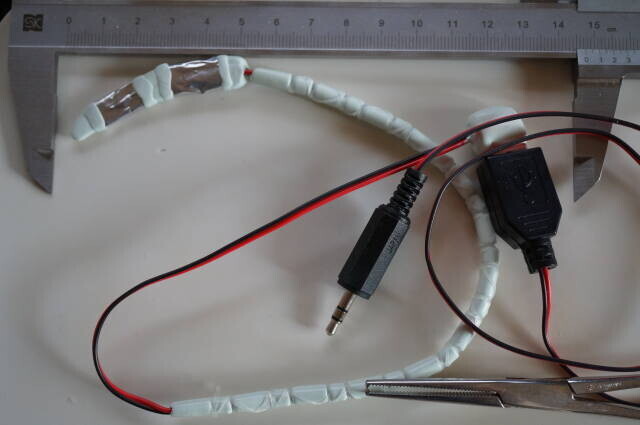
In an entry published in August 2025, a customer reported petal-loop bonding failure after about 2 weeks and requested repair. In a follow-up, the same customer reported wire pulling free from another device's side loops and cutting the lining. Production staff attributed possible breakage to repeated bending of short, permanently bent wire.
Staff considered stopping petal-loop sales if further reports accumulated; later in the entry, Mr. Okada described a revised straight-wire design. The customer confirmed receiving the first repaired item. The company offered further repair for the reported damage.
(Source: ok-lab's diary, published August 2025)
https://ok-lab.hatenablog.com/entry/2025/08/30/122943
Reported breakage limited an older covered connection's angle by January 2026
In an entry published in January 2026, Mr. Okada reviewed the angled ceramic pair known as Umiushi 5. Following connection damage reports, the older design was being made with bends no greater than approximately 45 degrees. He said reports stopped after that restriction.
The new design replaced its cable core with shape-memory wire (wire that returns toward its original shape), allowing thinner attachments. Mr. Okada proposed this revised connection with reinforcement as standard.
(Source: ok-lab's diary, published January 2026)
https://ok-lab.hatenablog.com/entry/2026/01/31/122917
The maker's answer to prostate chip connection covers
The diary assigns different jobs to covers, so the connection's construction matters as much as its outer material.
Rubber covers were requested when thin linked chips could fold together
In an entry published in May 2021, a customer requested a short twisted ceramic chip joined to another thin chip by thread alone. The requested gap was about 5 mm. Mr. Okada warned that thin linked chips could fold over each other inside the urethra. He asked for rubber coating to be added to that connection.
(Source: ok-lab's diary, published May 2021)
https://ok-lab.hatenablog.com/entry/2021/05/15/130037
Smaller silicone tube covers required extra resin reinforcement in August 2022
In an entry published in August 2022, the silicone tube (a soft sleeve) changed from 3 mm to 2 mm outside diameter. Its inside diameter was 1 mm. Mr. Okada explained that the smaller tube required a thinner attachment point, whose strength concerned him. His specified response was additional resin reinforcement over the tube at the attachment.
(Source: ok-lab's diary, published August 2022)
https://ok-lab.hatenablog.com/entry/2022/08/13/122909
Silicone tube cushions were proposed to resist connection folding at short gaps
In another entry published in August 2022, Mr. Okada described a compressed tube acting as a spring between connected chips. He reported a milder feeling than exposed thread during approximately 3 days of testing. He also acknowledged that sufficient force could still fold the assembly. His supported specification was 2–6 mm spacing; longer gaps lacked the same testing.
(Source: ok-lab's diary, published August 2022)
https://ok-lab.hatenablog.com/entry/2022/08/27/123001
Cracked resin covers prompted Mr. Okada's advice to stop use
In an entry published in June 2024, a customer questioned the strength of a wire-linked balancing chip. Mr. Okada described silicone rubber (a flexible coating) beneath epoxy as a cushion for the wire's movement. He acknowledged that force exceeding the epoxy's strength could crack it. Mr. Okada advised stopping use if cracks appeared in the epoxy.
(Source: ok-lab's diary, published June 2024)
https://ok-lab.hatenablog.com/entry/2024/06/15/123132
If you see blood in your urine, even a small amount or for the first time, do not wait and see. See a urologist right away.
If you suddenly cannot urinate, or the device cannot be removed, do not try to fix it yourself. Go to a medical facility, including emergency care, immediately.
How prostate chip connection covers changed over time
| Published | What the diary said then |
|---|---|
| May 2019 | A 1.2 mm parallel cable needed at least 10 mm to bend in testing. |
| Oct 2019 | Both pieces of the resin-linked pair were shortened by 10 mm. |
| Dec 2019 | The cable-mounted auxiliary attachment cost ¥3,000, (about $19 at ¥156 = $1, rate as of 2026-09-04) excluding tax. |
| Oct 2020 | Coated prototype gaps measured approximately 1.5 mm between springs and 3 mm before the auxiliary. |
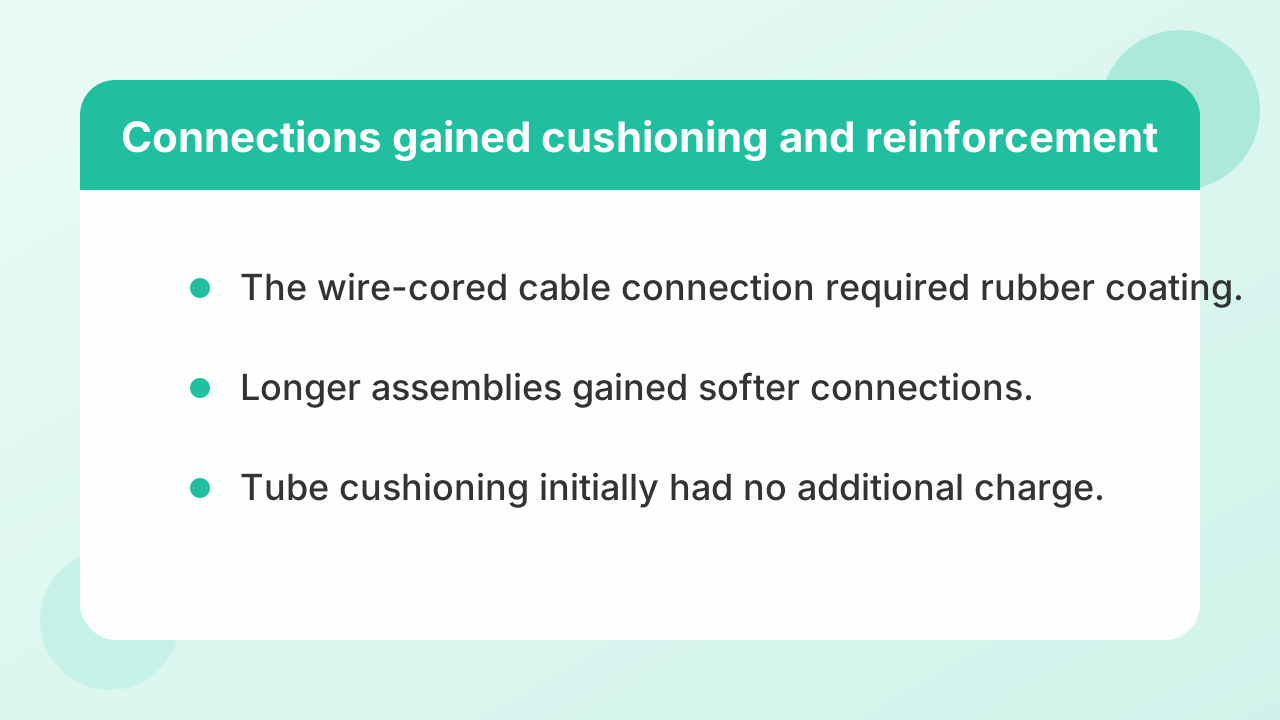
| Mar 2021 | Rubber coating became mandatory for the wire-cored cable connection. |
| Apr 2021 | Longer assemblies gained softer connections after the wire core proved too stiff. |
| Aug 2022 | Tube cushioning was initially supplied by request without an additional charge. |
| Jan 2026 | Revised pair processing cost ¥4,000 (about $26 at ¥156 = $1, rate as of 2026-09-04) with reinforcement or ¥3,000 (about $19 at ¥156 = $1, rate as of 2026-09-04) without, excluding tax. |
| Aug 2026 | A jointed assembly covered joint gaps with tubing, leaving wire and thread exposed inside resin. |
OK Prostate Chip products related to prostate chip connection covers
The current list confirms related individual components, with the prices below including tax.
The chip products featured in these entries
| Product (official name) | Price incl. tax | Relation to this topic |
|---|---|---|
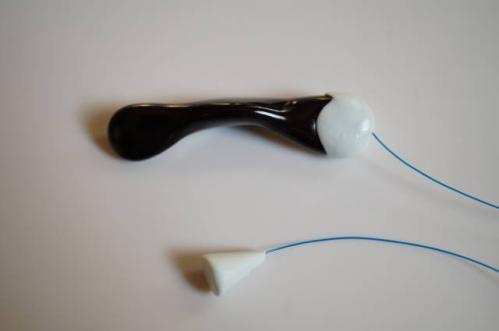
| Short twisted ceramic chip (OKプロステートチップ 陶器素材ショートタイプ ツイスト) | ¥4,400 (about $28 at ¥156 = $1, rate as of 2026-09-04) | In May 2021, a custom pair using this chip prompted Mr. Okada's request for a rubber-coated connection. |
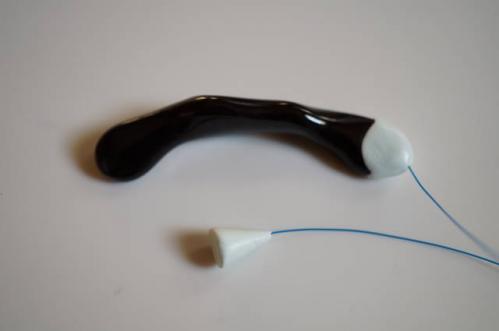
| Medium-length twisted ceramic chip (OKプロステートチップ 陶器素材セミロングタイプ コブラツイスト) | ¥5,500 (about $35 at ¥156 = $1, rate as of 2026-09-04) | In June 2026, a customer reported peeling epoxy on this chip's added reinforcement. |
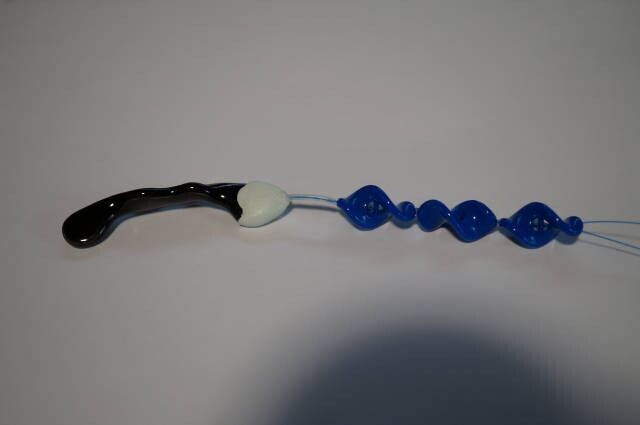
| Second-generation resin screw-shaped auxiliary chip (スクリュー型補助チップ追加オプション(第二世代生体適合樹脂)) | ¥3,500 (about $22 at ¥156 = $1, rate as of 2026-09-04) | In June 2026, a completed custom assembly used three of these parts with tube cushions between them. |
The short twisted ceramic chip is listed in OK Lab's own online store.
The medium-length twisted ceramic chip is listed in OK Lab's own online store.
The second-generation resin screw-shaped auxiliary chip is listed in OK Lab's own online store.

(Source: ok-lab's diary, published May 2021)
https://ok-lab.hatenablog.com/entry/2021/05/15/130037
(Source: ok-lab's diary, published June 2026)
https://ok-lab.hatenablog.com/entry/2026/06/20/122903
(Source: ok-lab's diary, published June 2026)
https://ok-lab.hatenablog.com/entry/2026/06/13/122909
Alternative chip products mentioned in the diary
The diary names no alternative.
Historical custom assemblies, including the resin-linked pair, spring-chip assembly, petal-loop devices, and angled ceramic pair: No matching product can be confirmed on the current list.
An earlier glass linked pair was reported discontinued following overlap trouble in the entry published in October 2020.
(Source: ok-lab's diary, published October 2020)
https://ok-lab.hatenablog.com/entry/2020/10/24/115457
Common worries about prostate chip connection covers
The diary's replies depend on what lies beneath the cover and whether it carries structural load.
"Does rubber coating make the chip connection rigid?"
In an entry published in September 2024, a customer asked whether rubber coating would make an electrode pair difficult to bend. Mr. Okada said rubber around twisted cable alone remained very floppy. A tube-covered core would be considerably firmer, although still bendable. He recommended parallel cable between the chips because he considered it better for strength and finished thickness.
(Source: ok-lab's diary, published September 2024)
https://ok-lab.hatenablog.com/entry/2024/09/14/123119
"Does a zero-gap chip connection still bend?"
In an entry published in June 2026, a customer questioned flexibility and thread strain at 0 mm spacing. Mr. Okada said orders through the company's own online store automatically received tubing at gaps of approximately 10 mm or less. A nominal zero gap therefore still contained cushioning space.
He also corrected staff's earlier reassurance: individual suitability could not be judged from the customer's proposed dimensions. Mr. Okada asked customers to settle unanswered specification questions before paying.
(Source: ok-lab's diary, published June 2026)
https://ok-lab.hatenablog.com/entry/2026/06/06/122905
"Does peeling rubber coating mean the stopper connection failed?"
In an entry published in June 2026, a customer asked whether a detachable apple-shaped stopper remained usable after its rubber connection peeled. The nylon thread was still attached. Mr. Okada explained that this thin coating provided cushioning; it did not supply the connection's strength.
Staff considered peeling a return to the earlier thread-only design, rather than loss of structural strength. They asked the customer to clarify if their interpretation of the damage was mistaken.
(Source: ok-lab's diary, published June 2026)
https://ok-lab.hatenablog.com/entry/2026/06/13/122909
"Can a peeling resin cover be repaired?"
In an entry published in June 2026, a customer reported epoxy peeling after 2 uses, exposing rubber and part of the reinforcement wire. The customer asked about continued use or replacement. Staff said the written description was insufficient to determine whether the condition interfered with use.
Mr. Okada explained that this reinforcement combined rubber bonding with an epoxy cover. The company offered inspection and repair where needed, including renewed epoxy coverage at concerning exposed areas.
(Source: ok-lab's diary, published June 2026)
https://ok-lab.hatenablog.com/entry/2026/06/20/122903
Buying from outside Japan
OK Lab ships internationally to countries covered by Japan Post's EMS courier service. Overseas orders are paid in advance by PayPal. Each order carries a ¥400 (about $3 at ¥156 = $1, rate as of 2026-09-04) handling fee, and EMS shipping is charged on top. These terms come from OK Lab's official sales-terms page (written here as plain text, not a link: ok-lab.net/docs/law), checked on September 7, 2026; confirm them on the official store before you order, because they can change.
Summary of this article
| What you wanted to know | The answer |
|---|---|
| What is the short answer? | Covers can cushion, secure, or limit movement, depending on the connection. |
| What is the product? | A urethral device made and sold by OK Lab in Japan. |
| What do the terms mean? | Resin, rubber, tubing, thread, and wire have different roles in the described connections. |
| What happened in the cases? | Bulk, overlap, difficult removal, and damage led to revised designs. |
| What did the maker propose? | Different attachment methods, flexible coverings, cushioning, and stopping use when epoxy cracks appear. |
| What changed over time? | Covered connections evolved through changes to cores, gaps, attachment thickness, and reinforcement. |
| Which products are listed today? | Related ceramic chips and an auxiliary part appear on the supplied current list. |
| What about damaged covers? | The replies distinguish cushioning from structural attachment; one peeling case required inspection. |
| How does overseas buying work? | Advance PayPal payment, a ¥400 (about $3 at ¥156 = $1, rate as of 2026-09-04) handling fee, and additional EMS shipping apply under the supplied terms. |
Source: ok-lab's diary (Okada Comfortable Life Laboratory). The original entries are in Japanese; quotations on this page are translated. Photos and videos are on the original entries.
This article is a summary of the maker's development diary. The product is not a medical device and no result is guaranteed. If anything feels wrong or worries you, see a doctor. Prices, specifications and cautions change, so confirm the latest information on the official blog and the official site. Questions about ordering and shipping go to the seller.