![Will the cable between my chips bend or break? | Reinforcement helped, but failures remained possible [OK Prostate Chip]](/img/a/T0041/eyecatch.svg)
This page is based on entries from "ok-lab's diary" (https://ok-lab.hatenablog.com/), the Japanese development diary written by Mr. Okada, founder of OK Lab, a small company in Japan (Okada Comfortable Life Laboratory). Only the entries about "parallel and twisted chip connections" are summarized here, in order of publication. Past prices and sizes are as written at the time. Current prices come from the official product list (retrieved September 4, 2026). Quotations are translated from Japanese.
Note: This page is a personal reading log by someone with no connection to the maker or the seller. It reflects the source entries as of their publication dates and makes no guarantee of accuracy or safety. The product is not a medical device; talk to a doctor about any health decision. Check the official site for current information. This page contains advertising.
In short
- Parallel and twisted cables changed flexibility, but the diary records electrical failures and limited joint life.
- Mr. Okada's responses included nylon reinforcement, paired wires, closer supports, and restrictions on custom connections.
- A February 2026 entry shows tube-covered twisted cables added to paired chips usually connected by parallel cable.
About this product
The OK Prostate Chip is a small device that is placed in the urethra (the urine passage) so that it acts on the prostate; the maker sells it in several shapes, sizes and materials. It is made and sold by OK Lab (Okada Comfortable Life Laboratory), a small company in Japan, through its own online store, and prices are in Japanese yen (JPY). The maker's development diary, "ok-lab's diary", is written in Japanese. This page is an English summary of it, and every quotation is translated. OK Lab ships internationally, so readers outside Japan can order (see "Buying from outside Japan" below). Product names on this page are plain-English descriptions. The official Japanese product name is shown once in the product table so you can find the same item in the store.
Before you read: key terms
| Term | Plain-English meaning |
|---|---|
| Urethra | The urine passage; the diary describes chips and portions of their connections occupying it. |
| Parallel cable | Joined electrical wires running side by side, used to connect chips or carry current. |
| Twisted cable | Wires wound together, sometimes with nylon thread, for electrical and physical connections. |
| Nylon reinforcement | Additional thread intended to support a connection if its electrical wires fail. |
| Electrode chip | A chip carrying electrical current, used for electrical stimulation. |
| Support wire | A wire used to support placement of the chip in the maker's tests. |
| USB connector | An electrical connector used between a vibrating chip's cable and external control equipment. |
| AWG32 | The label given to fine wires carrying current. The diary does not explain this. |
What happens: prostate chip cable strength
The OK Prostate Chip is a small device placed in the urethra (the urine passage) to act on the prostate. Parallel cable (joined electrical wires) links chip sections or powers a motor or electrode chip (a chip carrying electrical current). Twisted cable (wires wound together) sometimes includes nylon reinforcement (thread supporting the connection). These connections can sit between chips in the urethra or extend behind them toward an external connector.
Parallel cable needed more space after nylon reinforcement was added
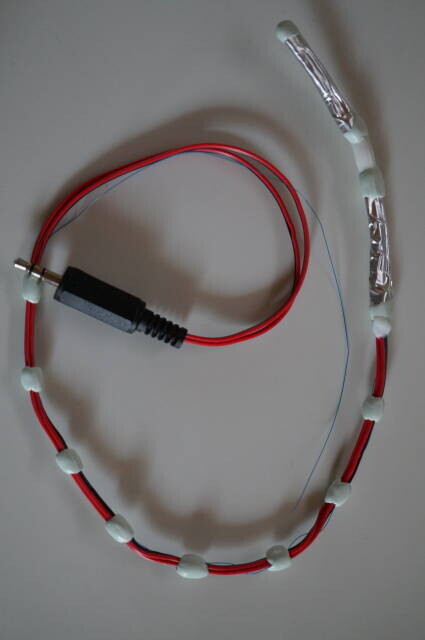
In an entry published in May 2019, a customer pointed out that a paired electrode build lacked the requested nylon connection. Mr. Okada had misunderstood the request and supplied an electrical connection alone, then remade the pair. He explained that parallel cable needed at least about 10mm between chips because its joined wires resisted bending.
Adding nylon beside the electrical lead also restricted bending in some directions, making the revised gap about 2mm longer than before. Mr. Okada favored the additional connection because he believed it improved safety.
(Source: ok-lab's diary, published May 2019)
https://ok-lab.hatenablog.com/entry/2019/05/18/150144
Parallel cable gained an electrical backup through a second USB lead
In an entry published in February 2020, a customer asked about an extra cable for retrieval. Mr. Okada developed a motor connection with two cables, each having its own USB connector (an electrical connector for external equipment). The initial purpose was to preserve electrical operation if one cable failed.
The published additions were ¥1,000 (about $6 at ¥156 = $1, rate as of 2026-09-04) excluding tax for the cable and ¥500 (about $3 at ¥156 = $1, rate as of 2026-09-04) excluding tax for the USB connector. The diary stated a combined surcharge of ¥1,500 (about $10 at ¥156 = $1, rate as of 2026-09-04) excluding tax. Mr. Okada favored this version after reporting better resistance to displacement during his own tests.
(Source: ok-lab's diary, published February 2020)
https://ok-lab.hatenablog.com/entry/2020/02/08/151653
Thinner parallel wire improved flexibility while supporting more pushing force
In an entry published in October 2021, Mr. Okada changed one 0.7mm support wire (a wire supporting placement) to two parallel 0.5mm wires. He reported that the thinner pair retained flexibility while transmitting pushing force better than the thicker single wire. His first placement test failed, while the next succeeded.
He also reported that the chip later moved out of the bladder during urination. Mr. Okada said broader guidance would depend on further testing without problems.
(Source: ok-lab's diary, published October 2021)
https://ok-lab.hatenablog.com/entry/2021/10/02/125825
Rubber chip connections lost springiness after only seven reported uses
In an entry published in June 2022, a customer requested repair of a rubber-jointed model (Sea Slug Ver.5). The customer recalled only 7 uses, yet the connecting rubber had lost much of its springiness. Mr. Okada replied that its lifespan appeared to be 2 years or less, with repair requiring work comparable to remaking it.
The diary does not record completion of this customer's repair. Mr. Okada said future buyers should be told about that lifespan before deciding whether to order.
(Source: ok-lab's diary, published June 2022)
https://ok-lab.hatenablog.com/entry/2022/06/18/123201
Twisted cable promised softness before its electrical lifespan was known
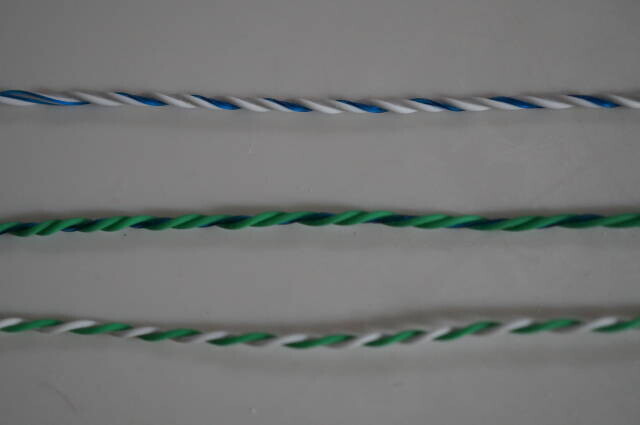
In an entry published in August 2023, Mr. Okada introduced fine electrical wires twisted together with nylon thread. He described the roughly 1mm cable as soft and potentially stronger under tension than the previous parallel cable. However, he warned that its AWG32 wires could break internally and interrupt the electrical connection.
Long-duration test results were unavailable, and he thought electrical failure might occur sooner than with parallel cable. Proposed surcharges over existing prices were ¥4,000 (about $26 at ¥156 = $1, rate as of 2026-09-04) excluding tax for powered versions and ¥3,000 (about $19 at ¥156 = $1, rate as of 2026-09-04) excluding tax for nonpowered cord versions. Mr. Okada made order acceptance conditional on another week of testing without problems.
(Source: ok-lab's diary, published August 2023)
https://ok-lab.hatenablog.com/entry/2023/08/19/123214
Twisted cable reached paired chips normally built with parallel connections
In an entry published in February 2026, one customer requested both side-by-side and end-to-end electrode pairs with tube-covered twisted cables. Mr. Okada completed both arrangements, including a paired-chip construction normally made with parallel cable. He described the latter connection as difficult to make.
The diary records completed pieces but does not describe how they felt in use. Mr. Okada suggests considering appearance alongside function.
(Source: ok-lab's diary, published February 2026)
https://ok-lab.hatenablog.com/entry/2026/02/07/122919
The maker's answer to prostate chip cable strength
Mr. Okada changed reinforcement and connection designs while acknowledging wear, electrical failure, and limits on what he could make reliably.
Parallel cable replaced rigid links after the ceramic thickness problem was resolved
In an entry published in January 2020, Mr. Okada changed the linked ceramic design to parallel cable for improved safety and appearance. Earlier glass connections had raised reliability concerns, while cable alongside ceramic made the assembly too thick. The adopted ceramic construction contained only the cable's metal wires along that section, resolving the added thickness.
Mr. Okada reported that the resulting connection resisted destructive testing. He also specified nylon reinforcement as an additional safeguard.
(Source: ok-lab's diary, published January 2020)
https://ok-lab.hatenablog.com/entry/2020/01/18/132849
Twisted wire connections still had a stated replacement interval
In an entry published in October 2021, Mr. Okada compared 0.3mm wire connections in destructive bending tests. Twisted pairs seemed harder to bend and break than parallel wires, but eventually broke too. Adding nylon to the twisted pair made little difference in those comparisons.
He suggested that reduced bending might improve durability. His stated replacement interval was 10 uses or roughly 100 accumulated hours, with earlier replacement for sharply bent sections.
(Source: ok-lab's diary, published October 2021)
https://ok-lab.hatenablog.com/entry/2021/10/23/125707
Whole parallel cable replaced a single-lead connection after early electrical failure
In an entry published in August 2024, Mr. Okada recalled an early paired-electrode prototype that soon lost its electrical connection. Only one lead from a parallel cable had linked its chips, and he had judged that design impractical. The new aluminum-electrode proposal retained the whole parallel cable, with nylon reinforcement and optional resin protection between chips.
The published minimum price was ¥10,000 (about $64 at ¥156 = $1, rate as of 2026-09-04) excluding tax, with the resin cover costing another ¥1,000 (about $6 at ¥156 = $1, rate as of 2026-09-04) excluding tax. Mr. Okada limited resin-covered gaps to 10mm, citing difficulty achieving consistent quality over longer sections.
(Source: ok-lab's diary, published August 2024)
https://ok-lab.hatenablog.com/entry/2024/08/10/122913
Parallel cable supports moved closer together after the joined leads buckled
In an entry published in August 2024, Mr. Okada revised the joined cables behind the aluminum-electrode pair. Resin fixing points moved from 5cm intervals to 2.5cm intervals because the cable had bent under pushing force. The joining charge remained ¥500 (about $3 at ¥156 = $1, rate as of 2026-09-04) excluding tax per 5cm. His published specification adopted the closer spacing for subsequent builds.
(Source: ok-lab's diary, published August 2024)
https://ok-lab.hatenablog.com/entry/2024/08/17/122842
How prostate chip cable strength changed over time
| Published | What the diary said then |
|---|---|
| May 2019 | A single-lead prototype bent with about 3mm between its chips. |
| Jan 2020 | Previously unannounced cable connections gained support after a favorable placement test. |
| Jan 2021 | Flexible ring joints gained a continuous nylon backup as standard. |
| Oct 2021 | Untwisted contact points aimed to reduce simultaneous wire breakage. |
| Jun 2022 | Standard fifth-version rubber joints were receiving reinforcement; glass-linked variants remained unassessed. |
| Oct 2023 | Twin stainless electrodes gained separate white and green cable combinations. |
| Jun 2024 | A motorized prototype combined front twisted wiring with rear parallel cable. |
| Aug 2024 | A stainless electrode prototype used nylon-bound parallel cables instead of twisted cable. |
| Aug 2024 | A curved cable-loop prototype remained too lightly tested for an active recommendation. |
| Sep 2024 | A motorized version specified 35cm cables, with a joined section up to 20cm. |
OK Prostate Chip products related to prostate chip cable strength
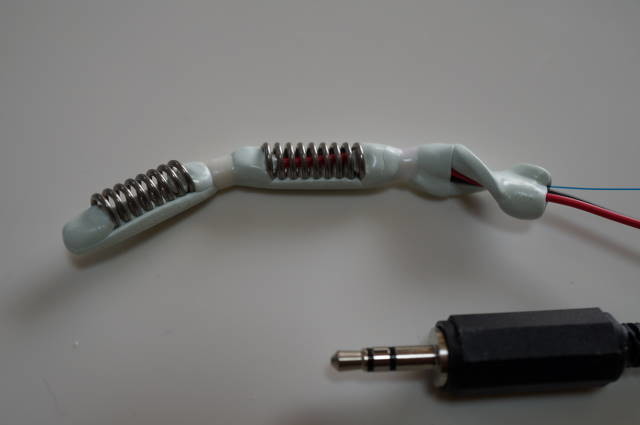
The current list contains a ring chip and screw-shaped support used in a cable-linked prototype.
Products that appear in these entries
| Product (official name) | Price incl. tax | Relation to this topic |
|---|---|---|
| Short stainless-steel ring chip (OKプロステートチップ ステンレスリング ショートタイプ) | ¥3,300 (about $21 at ¥156 = $1, rate as of 2026-09-04) | January 2021 used this ring in an electrode prototype with flexible, cable-based joints. |
| Screw-shaped support chip (スクリュー型補助チップ追加オプション) | ¥3,300 (about $21 at ¥156 = $1, rate as of 2026-09-04) | January 2021 added this support behind the second ring to test a joint containing two electrical wires. |
(Source: ok-lab's diary, published January 2021)
https://ok-lab.hatenablog.com/entry/2021/01/02/123619
Products the diary mentioned as alternatives
The diary names no alternative.
The diary also describes custom electrode assemblies, the rubber-jointed fifth version, and experimental wire supports. No matching product can be confirmed on the current list.
Common worries about prostate chip cable strength
"Can an ordinary twisted cable be attached to any chip?"
In an entry published in November 2022, a customer asked whether a supplied twisted cable could be attached to a chip. Mr. Okada was considering replacements because his preferred parallel cable had become unavailable, but questioned whether twisting could be sufficiently uniform. He could consider a motor connection and mentioned previous completed orders using customers' cables.
The diary does not record whether this particular request became a finished order. Mr. Okada generally declined supplied cables for motorless chips because he lacked a suitable connection method.
(Source: ok-lab's diary, published November 2022)
https://ok-lab.hatenablog.com/entry/2022/11/26/122622
"Does a tube-covered twisted cable match the stainless version's strength?"
In an entry published in July 2024, a customer requested twisted cable for a resin electrode chip. OK Lab staff cautioned that fine wires increased breakage concerns and that parallel cable could not be fitted to that design. The customer then asked whether tubing and an integrated connector end would give strength comparable to the stainless version.
Mr. Okada reported a completed piece with an electrical connection confirmed by a meter. The diary does not record a comparative strength test. Staff favored an integrated connector end because they had strength concerns about separate ends.
(Source: ok-lab's diary, published July 2024)
https://ok-lab.hatenablog.com/entry/2024/07/20/123059
"Can twisted cable end in a plug instead of buttons?"
In an entry published in July 2025, a customer needed a plug because their equipment did not accept the stainless electrode's button connectors. Staff initially rejected a simple connector swap because it would compromise waterproofing. They then offered a sealed transition at the tube's end, from twisted cable to red-and-black parallel cable leading to a plug.
Mr. Okada reported that this version could now be made, with the extra work increasing its cost. The diary does not state the surcharge or describe the customer's experience in use. The maker's offer depended on preserving waterproofing at the transition.
(Source: ok-lab's diary, published July 2025)
https://ok-lab.hatenablog.com/entry/2025/07/05/122905
Buying from outside Japan
OK Lab ships internationally to countries covered by Japan Post's EMS courier service. Overseas orders are paid in advance by PayPal. Each order carries a ¥400 (about $3 at ¥156 = $1, rate as of 2026-09-04) handling fee, and EMS shipping is charged on top. These terms come from OK Lab's official sales-terms page (written here as plain text, not a link: ok-lab.net/docs/law), checked on September 7, 2026; confirm them on the official store before you order, because they can change.
Summary of this article
| What you wanted to know | The answer |
|---|---|
| What is the short answer? | Reinforcement changed flexibility and strength, but failures remained possible. |
| What is this product? | A urethral device made and sold by OK Lab in Japan. |
| What do the cable terms mean? | Parallel wires sit together; twisted wires wind together, sometimes with nylon. |
| What happened in the reported cases? | Designs changed after bending problems, electrical failures, and worn rubber joints. |
| How did the maker respond? | Additional reinforcement, revised supports, replacement intervals, and limits on custom work. |
| Did one connection replace every earlier design? | Later entries still describe parallel, twisted, and combined cable constructions. |
| What related products are listed today? | The ring chip and screw-shaped support each cost ¥3,300 (about $21 at ¥156 = $1, rate as of 2026-09-04) including tax. |
| Can connectors be customized freely? | The diary records restrictions involving strength, attachment methods, and waterproofing. |
| How do overseas purchases work? | Advance PayPal payment, a ¥400 (about $3 at ¥156 = $1, rate as of 2026-09-04) handling fee, and additional EMS shipping charges. |
| What does this summary establish? | Dated development reports and current component prices; several custom builds lack confirmed listings. |
Source: ok-lab's diary (Okada Comfortable Life Laboratory). The original entries are in Japanese; quotations on this page are translated. Photos and videos are on the original entries.
This article is a summary of the maker's development diary. The product is not a medical device and no result is guaranteed. If anything feels wrong or worries you, see a doctor. Prices, specifications and cautions change, so confirm the latest information on the official blog and the official site. Questions about ordering and shipping go to the seller.