![Can the chip's retrieval thread come loose? | The maker's attachment claims have limits [OK Prostate Chip]](/img/a/T0037/eyecatch.svg)
This page is based on entries from "ok-lab's diary" (https://ok-lab.hatenablog.com/), the Japanese development diary written by Mr. Okada, founder of OK Lab, a small company in Japan (Okada Comfortable Life Laboratory). Only the entries about "thread holes and secure thread attachments" are summarized here, in order of publication. Past prices and sizes are as written at the time. Current prices come from the official product list (retrieved September 4, 2026). Quotations are translated from Japanese.
Note: This page is a personal reading log by someone with no connection to the maker or the seller. It reflects the source entries as of their publication dates and makes no guarantee of accuracy or safety. The product is not a medical device; talk to a doctor about any health decision. Check the official site for current information. This page contains advertising.
In short
- Thread detachment, thread breakage and peeling resin (the coating material) are separate problems in the diary.
- Mr. Okada describes enclosed knots, shaped holes and additional threads as different answers to those problems.
- The current product list includes the medium-length glass chip and an additional nylon-thread option.
About this product

The OK Prostate Chip is a small device that is placed in the urethra (the urine passage) so that it acts on the prostate; the maker sells it in several shapes, sizes and materials. It is made and sold by OK Lab (Okada Comfortable Life Laboratory), a small company in Japan, through its own online store, and prices are in Japanese yen (JPY). The maker's development diary, "ok-lab's diary", is written in Japanese. This page is an English summary of it, and every quotation is translated. OK Lab ships internationally, so readers outside Japan can order (see "Buying from outside Japan" below). Product names on this page are plain-English descriptions. The official Japanese product name is shown once in the product table so you can find the same item in the store.
Before you read: key terms
| Term | Plain-English meaning |
|---|---|
| Urethra | The urine passage; the chip occupies part of this passage near the prostate. |
| Retrieval thread | A line attached to the chip, intended to provide a connection for withdrawal. |
| Thread hole | An opening or internal passage in a chip, used to secure its thread connection. |
| Resin | Material used as a coating or filling around some thread connections to hold and cover them. |
| Kiln hole | An opening used to suspend a ceramic chip during firing, later used for its thread attachment. |
| Resin safety fitting | A small accessory on the thread, described as an end stop, loop holder or connector. |
| Nitinol | Shape-memory alloy wire, offered as another material for the chip's connecting thread. |
What happens: chip thread problems
The OK Prostate Chip is a small device placed in the urethra (the urine passage) to act on the prostate. A retrieval thread (the line attached for withdrawal) connects at the rear or, in later experiments, between linked chips. The diary describes knots, coatings and internal thread holes intended to stop that connection coming loose. Mr. Okada distinguishes attachment failure from thread breakage, while later entries also describe problems caused by more complex connections.
A tightening retrieval loop held during the maker's first pull test
In an entry published in May 2018, Mr. Okada reported an early pull test of a new retrieval-thread connection. The prototype combined a tightening loop with resin (the coating material covering the connection). In his staff test, the thread moved about 1mm before tightening, then remained attached under their strongest pull.
Testing had begun only the previous day, yet some products already used the arrangement. Following a reader's advice about adhesives, Mr. Okada favored a connection in which the loop and resin supported each other.
(Source: ok-lab's diary, published May 2018)
https://ok-lab.hatenablog.com/entry/20180519/1526708081
A retained retrieval thread outlasted its resin coating during dismantling
In an entry published in June 2018, Mr. Okada examined a glass chip returned for a thread-length change. He reported that the thread remained attached even after almost all the resin had separated. The workshop test ended with the loop severed.
Mr. Okada judged that single connection sound, while noting that handmade production could produce uneven results. His caution was that this example did not establish absolute safety for every chip.
(Source: ok-lab's diary, published June 2018)
https://ok-lab.hatenablog.com/entry/20180616/1529136608
A custom ceramic thread hole kept its knot enclosed
In an entry published in July 2019, a customer requested a custom ceramic chip with a specified thread attachment position. Mr. Okada agreed to try making the shape, but questioned where the thread was intended to emerge. He explained that a knot enclosed inside the ceramic hole was, in his view, unable to pull free.
The diary does not record whether this custom order was completed. Mr. Okada asked the customer to clarify the intended thread exit before proceeding.
(Source: ok-lab's diary, published July 2019)
https://ok-lab.hatenablog.com/entry/2019/07/20/151609
New thread holes removed resin from the titanium chip's attachment
In an entry published in June 2021, Mr. Okada disclosed a titanium-chip attachment with complex internal thread holes. Its three-dimensional design needed no resin; the rear section measured about 3mm thick and 6mm wide. He said the attachment kept the thread's connecting section inside the chip, without exposed thread along that surface.
At publication, only the short version had been prototyped. Mr. Okada advised periodic thread replacement because he said disinfection and similar treatment caused wear.
(Source: ok-lab's diary, published June 2021)
https://ok-lab.hatenablog.com/entry/2021/06/12/125849
A shrinking thread loop became useful for connecting another accessory
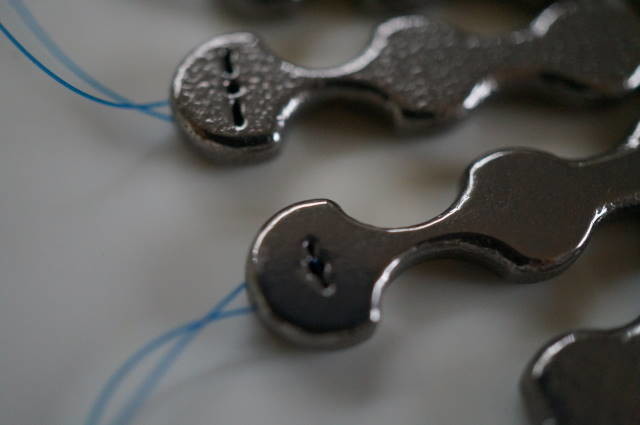
An entry published in March 2023 identified a weakness in the resin safety fitting (an accessory for holding or joining threads). A loop could shrink under tension from the thread below it, and would not expand again with its existing threading. Mr. Okada found that the same behavior helped secure the silicone tube on a metal accessory.
For this assembly, the obscured thread holes made workshop connection difficult. The charge was ¥1,000 (about $6 at ¥156 = $1, rate as of 2026-09-04) excluding tax for threading and ¥2,500 (about $16 at ¥156 = $1, rate as of 2026-09-04) excluding tax for the complete connection. Mr. Okada recommended the fitting for this particular connection, regarding its shrinking loop as useful there.
(Source: ok-lab's diary, published March 2023)
https://ok-lab.hatenablog.com/entry/2023/03/04/123042
Difficult stainless-steel thread holes temporarily restricted sales and ordering methods
In an entry published in July 2023, Mr. Okada described difficulties threading stainless-steel chips. Rough internal passages and a slightly turned-back exit obstructed the thread. He temporarily limited sales numbers and ordering arrangements because he could not predict which assemblies he could finish.
Orders were to be confirmed after successful assembly. Thread replacement cost ¥1,000 (about $6 at ¥156 = $1, rate as of 2026-09-04) excluding tax per chip, while a 4-thread option added ¥2,750 (about $18 at ¥156 = $1, rate as of 2026-09-04). Mr. Okada suggested 4 threads as an option because he expected the heavier chips to put greater strain on their threads.
(Source: ok-lab's diary, published July 2023)
https://ok-lab.hatenablog.com/entry/2023/07/08/122632
Nitinol chip threads arrived with extra charges and explicit reservations
In an entry published in August 2025, Mr. Okada announced nitinol (shape-memory alloy wire) threads for blue resin, stainless-steel and ceramic chips. Changing from nylon cost an extra ¥2,000 (about $13 at ¥156 = $1, rate as of 2026-09-04) excluding tax, with a maximum thread length of 35cm. His test lasted 3 days without reported problems, but he gave no guarantee against breakage.
He also acknowledged possible simultaneous failure of both threads. The resin safety fitting was incompatible with nitinol in that entry. Mr. Okada advised readers worried about breakage to postpone choosing nitinol while experience accumulated.
(Source: ok-lab's diary, published August 2025)
https://ok-lab.hatenablog.com/entry/2025/08/09/122924
A rear-to-rear thread connection introduced an additional folding hazard
In an entry published in August 2026, a customer asked about a safety fitting connecting threads running in opposite directions. Mr. Okada replied that the fitting's holes allowed both directions, unlike the chip's one-way thread holes. He found the requested layout less workable, then made a rear-to-rear prototype with 4 threads emerging at the central connection.
He warned that the joint could fold if the entire assembly entered the bladder, leaving the chips overlapping during attempted withdrawal. The entry records a prototype, without a customer trial of this new arrangement. Mr. Okada still favored the previous arrangement for the customer's original purpose.
(Source: ok-lab's diary, published August 2026)
https://ok-lab.hatenablog.com/entry/2026/08/29/122931
The maker's answer to chip thread problems
Mr. Okada's responses included refunds, different attachment structures and connections using more than one thread material.
The loose-thread response included new packaging and an offer of refunds
In an entry published in May 2018, Mr. Okada announced loop connections for shipments from May 24, 2018. New packaging distinguished these from earlier connections. He also accepted requests to convert older connections, while warning that demand might cause delays.
He believed the loop addressed complete thread detachment, but said resin peeling from glass remained unresolved. His workshop could not promise enough capacity for free replacements. For untreated goods shipped May 10–23, 2018, Mr. Okada offered worried purchasers returns and refunds.
(Source: ok-lab's diary, published May 2018)
https://ok-lab.hatenablog.com/entry/20180524/1527153380
The resin safety fitting offered another way to hold threads
In an entry published in November 2021, Mr. Okada reported a prototype resin safety fitting. Four internal passage systems were intended to make the thread grip itself through friction. He envisaged it working as an end stop, loop fitting or connector.
Planned prices were ¥1,500 (about $10 at ¥156 = $1, rate as of 2026-09-04) excluding tax for the part, plus ¥500 (about $3 at ¥156 = $1, rate as of 2026-09-04) for connection. He had ordered production, but sales were to start after delivery. Mr. Okada cautioned that length adjustment required skill with its threading.
(Source: ok-lab's diary, published November 2021)
https://ok-lab.hatenablog.com/entry/2021/11/06/125812
Separate nylon and nitinol thread connections became another ceramic option
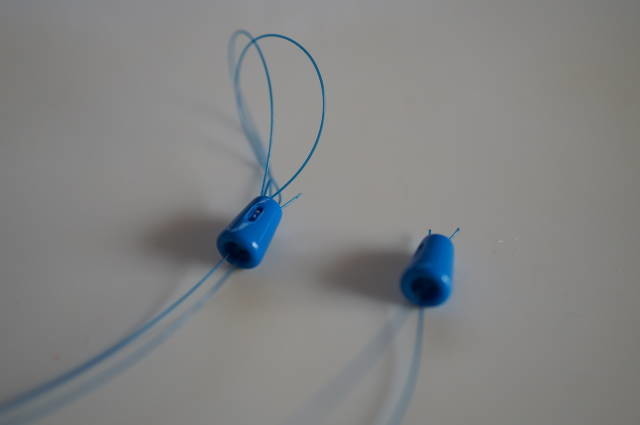
In an entry published later in August 2025, Mr. Okada reported that nitinol wire 0.15mm or thinner could be tied. He tested separate connections for nylon and 0.1mm nitinol on ceramic designs. He believed their different weaknesses would reduce the chance of both failing from the same cause.
His published ceramic connection fee was ¥1,000 (about $6 at ¥156 = $1, rate as of 2026-09-04) excluding tax, plus ¥500 (about $3 at ¥156 = $1, rate as of 2026-09-04) excluding tax per nitinol thread up to 35cm. Mr. Okada proposed separate nylon and nitinol connections as an additional precaution for ceramic chips.
(Source: ok-lab's diary, published August 2025)
https://ok-lab.hatenablog.com/entry/2025/08/30/122943
How chip thread problems changed over time
| Published | What the diary said then |
|---|---|
| May 2018 | Earlier hole-based connections developed unspecified problems after several days of testing. |
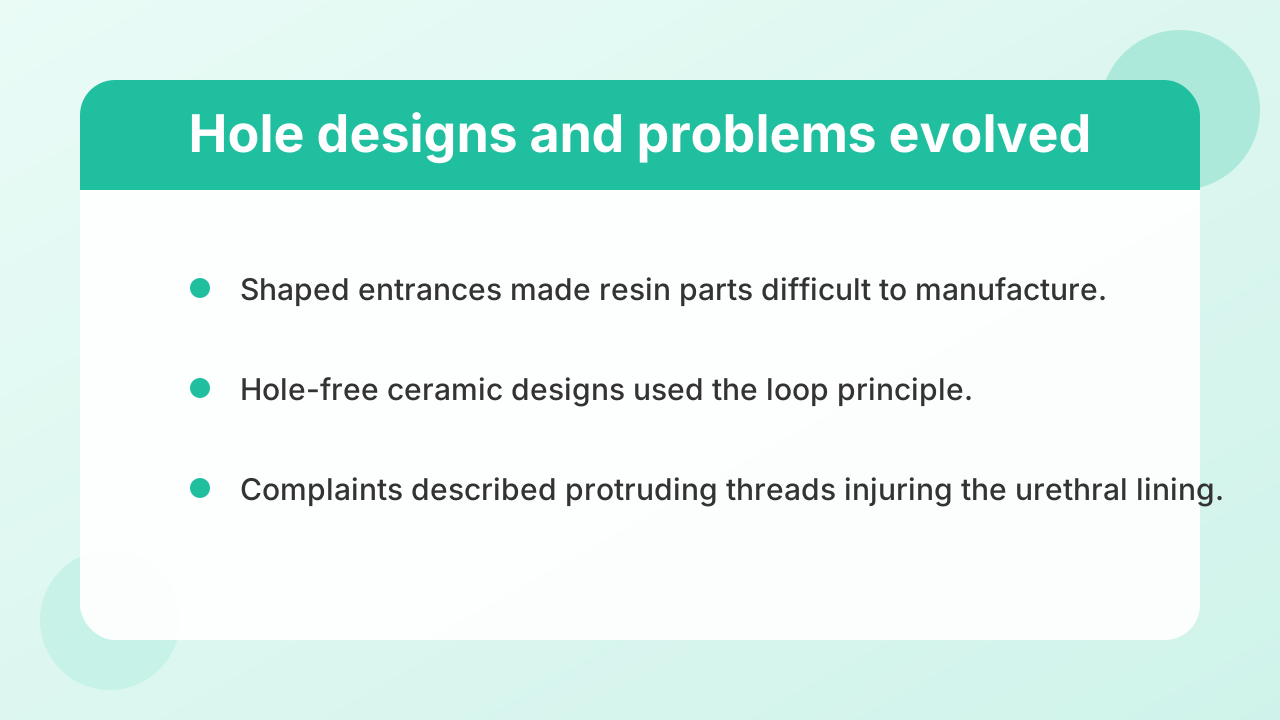
| Dec 2019 | Shaped thread-hole entrances made resin parts difficult to manufacture. |
| Feb 2020 | Hole-free ceramic designs used the loop principle already applied to glass. |
| Jun 2021 | Resin-free attachment was expected to roughly halve thread-replacement charges for selected 3D-designed chips. |
| Jul 2023 | Estimated steel passage dimensions: 0.5mm average internal diameter, curves describing circles about 5mm across. |
| Jul 2025 | Mr. Okada reported approval of the one-way thread-hole design for a patent. |
| Aug 2026 | Mr. Okada reported complaints about protruding threads injuring the urethral lining. |
For the temporary stainless-steel sales restrictions: The diary does not say what the current state is.
OK Prostate Chip products related to chip thread problems
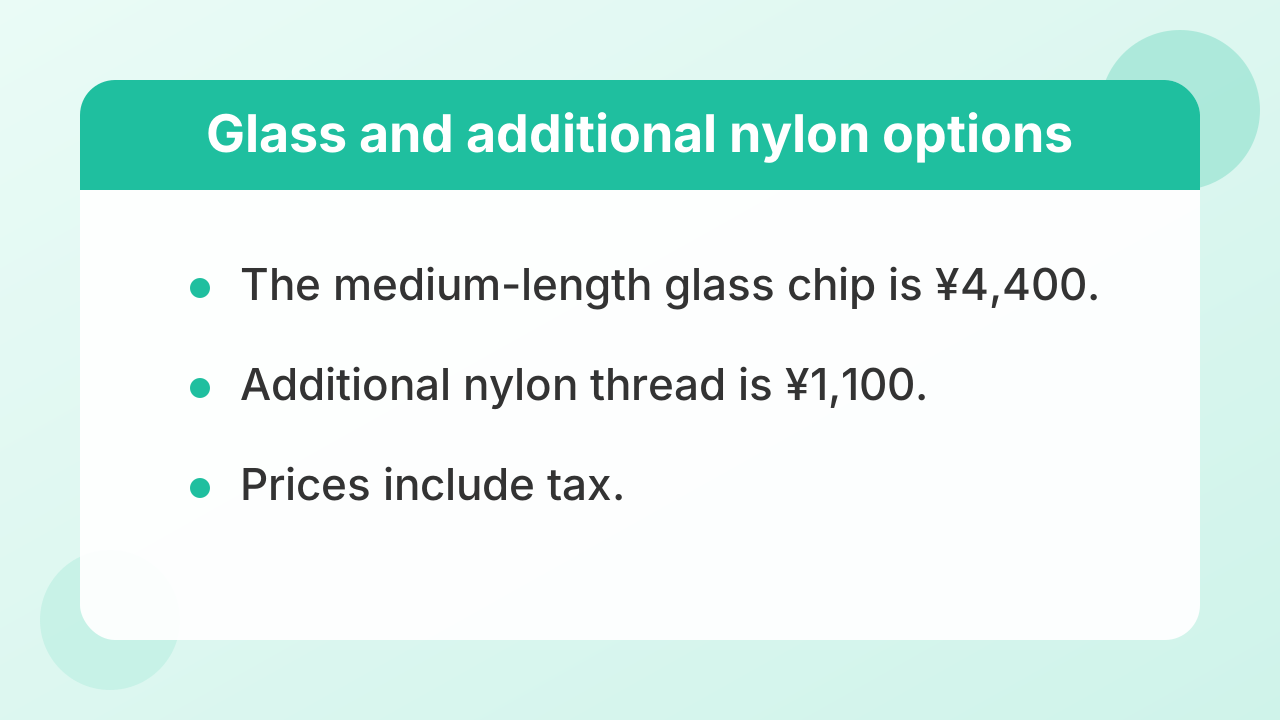
The current list includes a glass model discussed in a complaint and an added-nylon option.
Products that appear in these entries
| Product (official name) | Price incl. tax | Relation to this topic |
|---|---|---|
| Medium-length glass chip (OKプロステートチップ ガラス素材セミロングタイプ) | ¥4,400 (about $28 at ¥156 = $1, rate as of 2026-09-04) | In a May 2018 entry, a customer reported peeling resin on this glass model; Mr. Okada offered a return and refund. |
The medium-length glass chip is listed in the company's own online store.
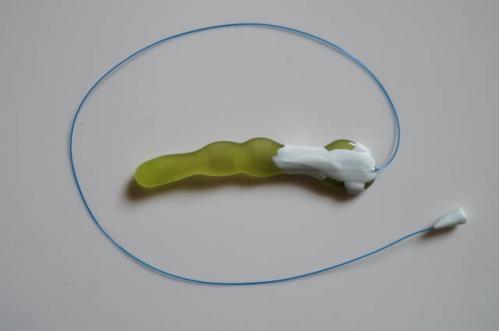
(Source: ok-lab's diary, published May 2018)
https://ok-lab.hatenablog.com/entry/20180524/1527153380
Products the diary mentioned as alternatives
| Product (official name) | Price incl. tax | Relation to this topic |
|---|---|---|
| Additional nylon thread (ナイロン糸追加(オプション)) | ¥1,100 (about $7 at ¥156 = $1, rate as of 2026-09-04) | In an August 2020 entry, Mr. Okada suggested two nylon threads instead of one for readers worried about thread damage. |
The additional nylon thread is listed in the company's own online store.
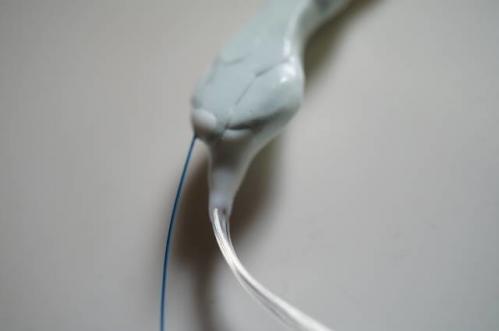
(Source: ok-lab's diary, published August 2020)
https://ok-lab.hatenablog.com/entry/2020/08/01/124144
Historical examples include custom ceramic designs, the titanium chip, early resin fitting, nitinol options and rear-to-rear prototype. No matching product can be confirmed on the current list.
Common worries about chip thread problems
Readers asked about uneven coatings, glue-only attachments and whether two visible threads were independent.
"Does an uneven glass-chip thread connection mean faulty manufacture?"
In an entry published in February 2020, a customer requested a replacement because the white resin felt uneven. Mr. Okada offered a remake for a manufacturing defect, or a refund if the finish matched normal production. After inspection, he classed it as standard: the covered thread ran from a recess toward the rear, leaving a visible outline.
He considered that outline acceptable while the thread itself stayed covered. The diary does not record whether the refund was completed. Mr. Okada offered a return and refund because remaking the product would produce a similar finish.
(Source: ok-lab's diary, published February 2020)
https://ok-lab.hatenablog.com/entry/2020/02/15/144151
"Is a ceramic chip thread held only by glue?"
In an entry published in August 2020, a customer asked whether a ceramic chip's rear attachment relied on glue alone. They wanted support like the glass design if that was the case. Mr. Okada described a knot inside a kiln hole (an opening used during ceramic firing), with resin preserving its shape.
He believed this prevented both detachment and loosening. However, he acknowledged that damaged nylon could still break. For readers anxious about that remaining risk, Mr. Okada recommended the two-thread option, which he regarded as substantially safer.
(Source: ok-lab's diary, published August 2020)
https://ok-lab.hatenablog.com/entry/2020/08/01/124144
"Are two titanium chip threads actually one piece?"
In an entry published in September 2021, a short titanium-chip owner asked whether the two visible threads were separate pieces. Mr. Okada explained that they were two ends of one length, with a middle knot trapped inside a confined section. He said a break on one side would not release the other.
He said separately obtained thread could be used, while legal concerns left the workshop's loose-thread sales undecided. The diary does not record whether this owner replaced the thread. Mr. Okada cautioned that fingertips alone would not manage the threading; a gripping tool was necessary.
(Source: ok-lab's diary, published September 2021)
https://ok-lab.hatenablog.com/entry/2021/09/11/125735
Buying from outside Japan

OK Lab ships internationally to countries covered by Japan Post's EMS courier service. Overseas orders are paid in advance by PayPal. Each order carries a ¥400 (about $3 at ¥156 = $1, rate as of 2026-09-04) handling fee, and EMS shipping is charged on top. These terms come from OK Lab's official sales-terms page (written here as plain text, not a link: ok-lab.net/docs/law), checked on September 7, 2026; confirm them on the official store before you order, because they can change.
Summary of this article
| What you wanted to know | The answer |
|---|---|
| What is the short answer? | Attachment failure, thread breakage and peeling coatings need separate consideration. |
| What is the product? | A urethral device made by OK Lab in Japan, priced in Japanese yen. |
| What do the terms mean? | Holes secure threads; resin can cover connections; safety fittings can hold or join threads. |
| What did the tests establish? | The diary records specific results alongside manufacturing limits and later design problems. |
| What did the maker offer? | Refunds, revised connections and options involving additional thread materials. |
| What changed over time? | Hole designs, production methods, replacement costs and reported problems evolved. |
| Which current products are related? | The medium-length glass chip and the additional nylon-thread option. |
| What did customers ask? | Whether uneven finishes were defects, whether glue alone held threads, and whether visible strands were independent. |
| How does overseas buying work? | Advance PayPal payment, EMS delivery and a separate handling fee, under the stated sales terms. |
Source: ok-lab's diary (Okada Comfortable Life Laboratory). The original entries are in Japanese; quotations on this page are translated. Photos and videos are on the original entries.
This article is a summary of the maker's development diary. The product is not a medical device and no result is guaranteed. If anything feels wrong or worries you, see a doctor. Prices, specifications and cautions change, so confirm the latest information on the official blog and the official site. Questions about ordering and shipping go to the seller.