![Is thicker nitinol wire better? | More spring force brings trade-offs [OK Prostate Chip]](/img/a/T0027/eyecatch.svg)
This page is based on entries from "ok-lab's diary" (https://ok-lab.hatenablog.com/), the Japanese development diary written by Mr. Okada.
He founded OK Lab, a small company in Japan, also called Okada Comfortable Life Laboratory.
Only entries about "nitinol wire thickness and spring force" are summarized here, in order of publication.
Past prices and sizes are as written at the time. Current prices come from the official product list (retrieved September 4, 2026).
Quotations are translated from Japanese.
Note: This page is a personal reading log by someone with no connection to the maker or the seller. It reflects the source entries as of their publication dates and makes no guarantee of accuracy or safety. The product is not a medical device; talk to a doctor about any health decision. Check the official site for current information. This page contains advertising.
In short
- The diary links thicker wire and doubled strands with stronger pressure and, sometimes, difficult placement.
- Mr. Okada's responses included factory-shaped bends and milder wire choices.
- The discussed stainless-steel tool is currently listed at ¥550 (about $4 at ¥156 = $1, rate as of 2026-09-04) including tax.
If you see blood in your urine, even a small amount or for the first time, do not wait and see. See a urologist right away.
If you suddenly cannot urinate, or the device cannot be removed, do not try to fix it yourself. Go to a medical facility, including emergency care, immediately.
About this product
The OK Prostate Chip is a small device that is placed in the urethra (the urine passage) so that it acts on the prostate; the maker sells it in several shapes, sizes and materials. It is made and sold by OK Lab (Okada Comfortable Life Laboratory), a small company in Japan, through its own online store, and prices are in Japanese yen (JPY). The maker's development diary, "ok-lab's diary", is written in Japanese. This page is an English summary of it, and every quotation is translated. OK Lab ships internationally, so readers outside Japan can order (see "Buying from outside Japan" below). Product names on this page are plain-English descriptions. The official Japanese product name is shown once in the product table so you can find the same item in the store.
Before you read: key terms
| Term | Plain-English meaning |
|---|---|
| Nitinol | A nickel-titanium shape-memory alloy; its wire connects device sections or forms flexible loops. |
| Spring force | The wire's push toward its remembered shape; used to support the device and apply pressure. |
| Chipless device | A wire-and-tube structure whose loops replace a solid prostate chip. |
| Prostate loop | The loop in the prostate section of the urethra; intended to apply outward pressure. |
| Support loop | A loop in the deeper, wider urethral section; intended to help hold the device's position. |
| Double wire | Two wire strands inside one tube; proposed for stronger spring force. |
| Double loop | A fuller loop arrangement, separate from wire count; the maker associates it with increased stiffness. |
| Sphincter | The urine-control muscle discussed around the loops; its closure matters for controlling urine. |
What happens: nitinol wire thickness
The OK Prostate Chip is a small device placed in the urethra to act on the prostate. Nitinol (a nickel-titanium shape-memory alloy) connects some chip sections and forms the loops of later designs. Mr. Okada describes spring force (the push toward a remembered shape) as central to how these structures work. The wire links the prostate section with a support section, or forms loops intended to hold position and press outward.
Early nitinol wire connections had separately priced support components
In entries published in April 2024, Mr. Okada described a curved wire connecting the main chip to a support chip. The wire was about 0.6mm thick, and he said it bent readily.
Planned prices excluded tax: ¥3,000 (about $19 at ¥156 = $1, rate as of 2026-09-04) for the shape-memory connection, ¥1,000 (about $6 at ¥156 = $1, rate as of 2026-09-04) for its tube cover, and ¥3,000 (about $19 at ¥156 = $1, rate as of 2026-09-04) for screw assistance. The connection charge covered adding the wire and support chip to a separately priced main chip. Mr. Okada advised against further use if the outer resin covering a connection broke.
(Source: ok-lab's diary, published April 2024)
https://ok-lab.hatenablog.com/entry/2024/04/06/122941
(Source: ok-lab's diary, published April 2024)
https://ok-lab.hatenablog.com/entry/2024/04/13/123053
The insertion-assistance accessory used thicker nitinol wire and specified lengths
In an entry published in October 2024, Mr. Okada introduced a 0.4mm insertion-assistance wire, an accessory intended to help advance a chip. Its design paired the accessory with the chip's retrieval thread. Lengths were 20cm, 25cm or 30cm, priced at ¥3,000 (about $19 at ¥156 = $1, rate as of 2026-09-04) excluding tax as published that month. Mr. Okada cautioned that abrupt bends could put excessive stress on the wire.
(Source: ok-lab's diary, published October 2024)
https://ok-lab.hatenablog.com/entry/2024/10/19/122847
A broken nitinol wire prompted refunds and a manufacturing change
In February 2025, a customer reported a 0.3mm chipless device (a wire-and-tube loop structure) breaking after 2 weeks. This was the second reported breakage, and staff could not identify its cause. Staff estimated that 0.4mm wire had nearly twice the metal area across a cut end, with almost twice the strength.
They said the thicker construction needed testing before it could be offered. The customer initially requested a replacement, then accepted a refund after staff warned that an identical replacement could fail again. Mr. Okada decided against discontinuation and offered refunds for early failures while seeking factory-shaped wire.
(Source: ok-lab's diary, published February 2025)
https://ok-lab.hatenablog.com/entry/2025/02/08/122932
Doubled nitinol wire proved too intense in the maker's test
In March 2025, Mr. Okada tested a 0.4mm double-wire prototype (two strands inside one tube) for stronger pulling force. He reported heart failure after about 2 hours and ended the test.
The March 2025 price plan raised the chipless device from ¥6,000 (about $38 at ¥156 = $1, rate as of 2026-09-04) to ¥8,000 (about $51 at ¥156 = $1, rate as of 2026-09-04), excluding tax. A bladder-loop version with doubled prostate and support wires was planned at ¥12,000 (about $77 at ¥156 = $1, rate as of 2026-09-04) excluding tax. Mr. Okada favored a 0.3mm double for himself, although he had not yet tested that prototype internally.
(Source: ok-lab's diary, published March 2025)
https://ok-lab.hatenablog.com/entry/2025/03/08/123016
Finer nitinol wire made longer extensions more flexible in tests
In April 2025, Mr. Okada combined 0.2mm wire and nylon thread inside an extension toward the urethral opening. He described the wire as almost thread-like in flexibility, thinner than the 0.24mm nylon thread.
As published that month, an extension using 2.5mm tubing cost ¥3,000 (about $19 at ¥156 = $1, rate as of 2026-09-04) excluding tax for lengths up to 10cm. The 1mm tubing version cost ¥4,000 (about $26 at ¥156 = $1, rate as of 2026-09-04) excluding tax for the same length limit. Mr. Okada proposed the finer wire to reduce resistance when a longer extension moved with the penis.
(Source: ok-lab's diary, published April 2025)
https://ok-lab.hatenablog.com/entry/2025/04/12/122910
An oversized nitinol wire build exposed an imbalance between loops
In April 2025, a customer reported failed placement of an oversized 0.4mm double-wire, double-loop build, using a fuller prostate-loop arrangement. Staff had warned that its 50mm prostate loop might prevent the sphincter (urine-control muscle) from closing fully. The customer had intended brief sessions.
Following staff replies, the customer reported successful placement, but chills from intense stimulation limited the session to under 30 minutes. Mr. Okada suspected the stiff prostate loop overwhelmed the single support loop, which collapsed instead of supporting it. He advised choosing a more modest specification before requesting the strongest construction.
(Source: ok-lab's diary, published April 2025)
https://ok-lab.hatenablog.com/entry/2025/04/12/122910
A thin nitinol wire spiral still produced strong resistance
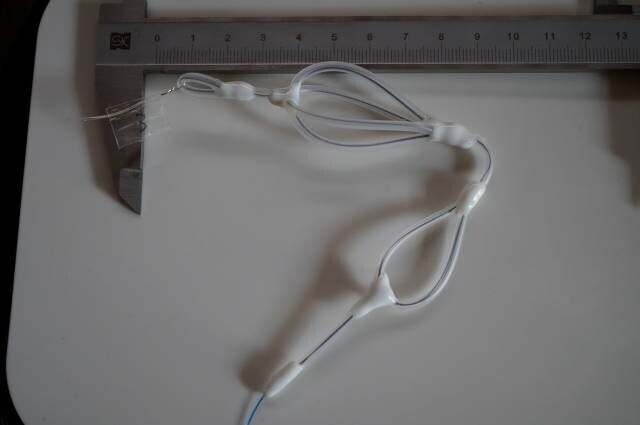
In July 2026, Mr. Okada described a prototype with a 0.15mm spiral around a shaft made from doubled 0.3mm wire. He judged its resistance to compression much greater than conventional loops. He reported sudden heart failure within minutes, with recovery taking about 1 hour.
Only one prototype had been made, and final specifications remained undecided. Mr. Okada cautioned that specifications and release would wait until additional examples could be made.
(Source: ok-lab's diary, published July 2026)
https://ok-lab.hatenablog.com/entry/2026/07/04/122918
The maker's answer to nitinol wire thickness
Mr. Okada's responses addressed the remembered bend, loop dimensions and wire thickness together.
The maker's nitinol wire reassurance depended on allowable bending limits
In an entry published in April 2024, Mr. Okada contrasted ordinary wire with thin shape-memory wire. He claimed the latter could flex with changes in posture, then recover without weakening from repeated bending. He limited this reassurance to deformation within the wire's allowable range.
(Source: ok-lab's diary, published April 2024)
https://ok-lab.hatenablog.com/entry/2024/04/13/123053
Factory-shaped nitinol wire introduced diameter choices and specified bend ranges
In February 2025, Mr. Okada ordered 8 factory-shaped wire variants, spanning 0.3mm and 0.4mm. The planned finished bends were approximately 75 degrees, 90 degrees, 105 degrees and 130 degrees. These were the intended angles of the covered assemblies.
March 2025 measurements subsequently showed about 150 degrees for the strongest finished 0.4mm version. The diary distinguished bare-wire bends from finished bends because the wire had room to move inside its tube. Mr. Okada cautioned that 0.4mm produced strong urethral pressure and favored 0.3mm for beginners.
(Source: ok-lab's diary, published February 2025)
https://ok-lab.hatenablog.com/entry/2025/02/22/122939
(Source: ok-lab's diary, published March 2025)
https://ok-lab.hatenablog.com/entry/2025/03/01/122825
Stiffer nitinol wire prompted a preference for shorter prostate loops
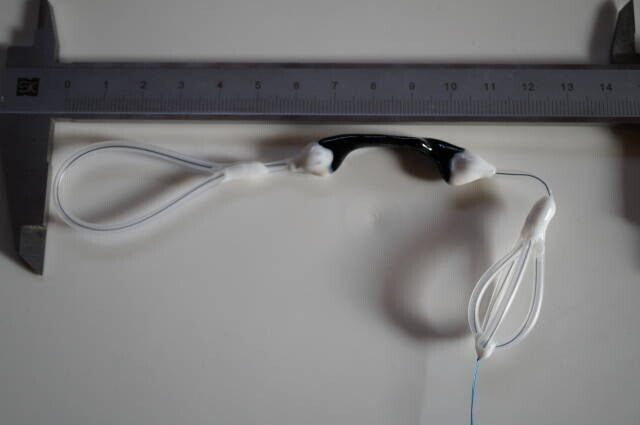
In February 2025, Mr. Okada compared 0.3mm and 0.4mm bladder-loop prototypes under compression. The thicker loops resisted flattening and did not bring their sides tightly together. He warned that an oversized prostate loop could therefore prevent full sphincter closure. Mr. Okada favored the customer's choice of a shorter prostate loop for this thicker construction.
(Source: ok-lab's diary, published February 2025)
https://ok-lab.hatenablog.com/entry/2025/02/15/122943
If you see blood in your urine, even a small amount or for the first time, do not wait and see. See a urologist right away.
If you suddenly cannot urinate, or the device cannot be removed, do not try to fix it yourself. Go to a medical facility, including emergency care, immediately.
How nitinol wire thickness changed over time
| Published | What the diary said then |
|---|---|
| Apr 2024 | Short connections used about 70 degrees because 90 degrees produced excessive spring force. |
| Sep 2024 | Mr. Okada rejected replacing a wire-supported section with cord lacking comparable shape retention. |
| Oct 2024 | A 0.3mm trial pursued thread-like flexibility unavailable from the existing 0.7mm wire. |
| Nov 2024 | Mr. Okada reported improved stability after introducing a bend of about 60 degrees. |
| Nov 2024 | The chipless specification combined 0.3mm wire with tubing of 2.5mm outside diameter. |
| Mar 2025 | Mr. Okada estimated doubled 0.3mm pressure at roughly one 0.4mm wire's level. |
| Nov 2025 | Mr. Okada found 0.1mm gentler than 0.15mm; larger flexible loops could weaken stopping performance. |
| May 2026 | A twin-screw connection used 0.2mm after concerns about 0.4mm force breaking resin. |
| Jun 2026 | Mr. Okada deferred thicker shafts because they would sacrifice flexibility. |
The diary does not say what the current state is.
OK Prostate Chip products related to nitinol wire thickness
The listed stainless-steel tool appears in an unresolved retrieval case.
Products that appear in these entries
| Product (official name) | Price incl. tax | Relation to this topic |
|---|---|---|
| Multi-purpose stainless-steel wire (多目的ステンレスワイヤー) | ¥550 (about $4 at ¥156 = $1, rate as of 2026-09-04) | In April 2026, staff warned that its hook could slip off an already retained chip. |
(Source: ok-lab's diary, published April 2026)
https://ok-lab.hatenablog.com/entry/2026/04/04/122916
Products the diary mentioned as alternatives
The diary names no alternative.
Custom nitinol assemblies, extensions and prototypes discussed above:
No matching product can be confirmed on the current list.
Common worries about nitinol wire thickness
The replies describe limits to stronger wire, sharper bends and compatibility with existing chips.
"Can a sharper nitinol wire bend prevent movement?"
In December 2024, a customer asked whether a 90-degree chipless design could stay in position without a stopper. Mr. Okada replied that 0.3mm wire had very weak spring force: even a 120-degree bend could straighten under slight pressure. He said no angle guaranteed protection against inward or outward movement.
He proposed a mesh stopper for limiting inward travel, while acknowledging that it would reduce the device's mild feel. His caution was that bend angle alone could not guarantee safety.
(Source: ok-lab's diary, published December 2024)
https://ok-lab.hatenablog.com/entry/2024/12/14/122948
"Is 0.3mm or 0.4mm nitinol wire better for longer sessions?"
In April 2025, a customer considering prolonged use asked how 0.3mm and 0.4mm doubles differed. Staff said both were possible, but people's responses to spring force varied. They reported that Mr. Okada could not tolerate prolonged use of the thicker double.
The customer chose 0.3mm; the diary does not record how that build felt in use. Staff declined to name either diameter as universally preferable.
(Source: ok-lab's diary, published April 2025)
https://ok-lab.hatenablog.com/entry/2025/04/12/122910
"Can blue screw chips take 0.4mm nitinol wire?"
In March 2026, a customer asked about linking blue screw chips with 0.4mm nitinol wire. Mr. Okada declined because it would not pass the crossing holes and might break the resin. A follow-up published later in March 2026 clarified that one continuous wire could not change diameter midway.
He thought a 0.3mm arrangement with two strands and a support loop was possible, with a quotation still to follow. The diary does not record completion of that order. Mr. Okada offered the thinner wire as the feasible alternative.
(Source: ok-lab's diary, published March 2026)
https://ok-lab.hatenablog.com/entry/2026/03/14/122910
(Source: ok-lab's diary, published March 2026)
https://ok-lab.hatenablog.com/entry/2026/03/21/122906
"Would thinner nitinol wire retrieve a stuck chip?"
In April 2026, a customer said a retained chip had still not passed after about 1 week. The customer asked about tools for retrieval, including an experimental grasping device. Staff warned that the existing multi-purpose stainless-steel wire's hook could slip off the chip.
Mr. Okada said the experimental grasping device was not designed to reach an already retained chip. He discussed a 0.2mm prototype, but the diary does not record successful retrieval for this customer. Mr. Okada cautioned that his proposal was not a dependable removal method.
(Source: ok-lab's diary, published April 2026)
https://ok-lab.hatenablog.com/entry/2026/04/04/122916
Buying from outside Japan
OK Lab ships internationally to countries covered by Japan Post's EMS courier service. Overseas orders are paid in advance by PayPal. Each order carries a ¥400 (about $3 at ¥156 = $1, rate as of 2026-09-04) handling fee, and EMS shipping is charged on top. These terms come from OK Lab's official sales-terms page (written here as plain text, not a link: ok-lab.net/docs/law), checked on September 7, 2026; confirm them on the official store before you order, because they can change.
Summary of this article
| What you wanted to know | The answer |
|---|---|
| What is the short answer? | The diary describes stronger pressure alongside limits in comfort, placement and construction. |
| What is this product? | A urethral device made and sold by OK Lab in Japan. |
| What do the terms mean? | Wire thickness, strand count and loop structure describe different parts of the design. |
| What happened in the cases? | Reports included breakage, difficult placement and stimulation the maker found excessive. |
| How did the maker respond? | Factory-shaped bends, shorter loops and thinner wire were among his responses. |
| What changed over time? | Development expanded from connecting wires to thinner loops, doubled strands and spirals. |
| What is currently listed? | The discussed stainless-steel tool costs ¥550 (about $4 at ¥156 = $1, rate as of 2026-09-04) including tax; custom nitinol builds remain unmatched. |
| What did customer questions establish? | Neither bend angle nor wire diameter supplied a universal answer. |
| How do overseas orders work? | Advance PayPal payment, a ¥400 (about $3 at ¥156 = $1, rate as of 2026-09-04) handling fee and additional EMS shipping charges. |
Source: ok-lab's diary (Okada Comfortable Life Laboratory). The original entries are in Japanese; quotations on this page are translated. Photos and videos are on the original entries.
This article is a summary of the maker's development diary. The product is not a medical device and no result is guaranteed. If anything feels wrong or worries you, see a doctor. Prices, specifications and cautions change, so confirm the latest information on the official blog and the official site. Questions about ordering and shipping go to the seller.