![Can an anchor keep my chip in place? | The first design was suspended [OK Prostate Chip]](/img/a/T0030/eyecatch.svg)
This page is based on entries from "ok-lab's diary" (https://ok-lab.hatenablog.com/), the Japanese development diary written by Mr. Okada, founder of OK Lab, a small company in Japan (Okada Comfortable Life Laboratory). Only the entries about keeping the chip in place with anchor chips and plain vibrating chips are summarized here, in order of publication. Past prices and sizes are as written at the time. Current prices come from the official product list (retrieved September 4, 2026). Quotations are translated from Japanese.
Note: This page is a personal reading log by someone with no connection to the maker or the seller. It reflects the source entries as of their publication dates and makes no guarantee of accuracy or safety. The product is not a medical device; talk to a doctor about any health decision. Check the official site for current information. This page contains advertising.
In short
The friction-based anchor sometimes failed to keep the chip in place.
Mr. Okada suspended that design; later two-cable prototype tests reportedly achieved steadier positioning.
A fabric sleeve from an early test appears on the current product list.
If you see blood in your urine, even a small amount or for the first time, do not wait and see. See a urologist right away.
If you suddenly cannot urinate, or the device cannot be removed, do not try to fix it yourself. Go to a medical facility, including emergency care, immediately.
About this product
The OK Prostate Chip is a small device that is placed in the urethra (the urine passage) so that it acts on the prostate; the maker sells it in several shapes, sizes and materials. It is made and sold by OK Lab (Okada Comfortable Life Laboratory), a small company in Japan, through its own online store, and prices are in Japanese yen (JPY). The maker's development diary, "ok-lab's diary", is written in Japanese. This page is an English summary of it, and every quotation is translated. OK Lab ships internationally, so readers outside Japan can order (see "Buying from outside Japan" below). Product names on this page are plain-English descriptions. The official Japanese product name is shown once in the product table so you can find the same item in the store.
Before you read: key terms
| Term | Plain-English meaning |
|---|---|
| Urethra | The urine passage, where the maker describes the chips being positioned. |
| Prostate | The intended target of the chip's action. The diary does not explain this. |
| Anchor chip | A second chip intended to resist movement and help another chip hold its position. |
| Electrode | An electrical contact on a chip, used in the electrical arrangements discussed in April 2019. |
| Button connector | An electrical terminal that Mr. Okada also proposed as an anchor when its electrical connection was unused. |
| Bulbar urethra | A named urethral region identified as an anchor location. The diary does not explain this. |
| External urinary sphincter | A structure used as a position boundary in a customer's account. The diary does not explain this. |
| Cowper's gland fluid | Fluid Mr. Okada associated with slippery movement and failed grip. The diary does not explain this. |
| Plain vibrating chip | A motor-equipped chip, nicknamed the fetal chip, tested to provide vibration at chosen positions. |
| Screw-shaped support | An auxiliary chip included in the combined vibration system. The diary does not explain this. |
| Parallel-cable stopper | A stopper tested with side-by-side cables to help maintain the chip's position. |
| Fabric penis sleeve | An external garment that Mr. Okada used to support the cable in his May 2019 tests. |
What happens: keeping a chip in place
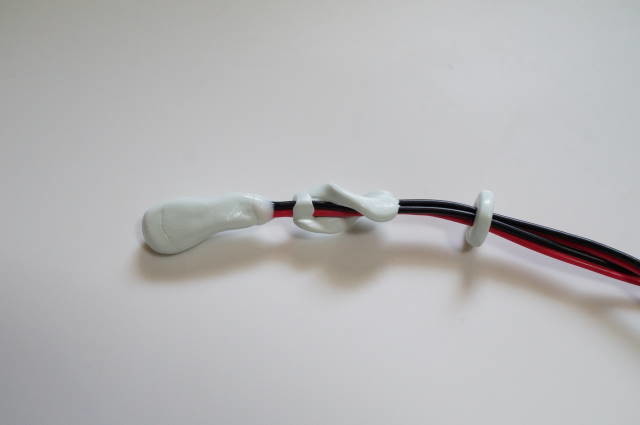
The OK Prostate Chip is a small device positioned inside the urethra to act on the prostate. The anchor discussed here was a second chip intended to hold the prostate chip's position through contact with its cable. Mr. Okada described anchor locations near the tip of the penis or in another urethral region. A later experiment combined a plain vibrating chip, support parts, and two cables to investigate steadier positioning.
An anchor chip seemed promising in early flat-cable tests
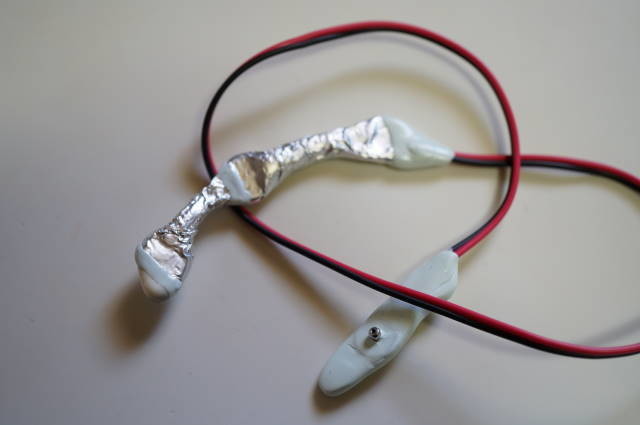
In an entry published in April 2019, Mr. Okada described a second chip acting as an anchor for the chip near the prostate. He attributed the hold to friction between that second chip and the cable.
His own tests reportedly showed little effect on urination with 2 chips inside the urethra because the cable was flat. Separate chips, each carrying an electrode (an electrical contact), also allowed independently chosen positions, according to his explanation. His single-electrode proposal additionally gave an unused button connector (an electrical terminal) an anchor role near the urethral opening.
(Source: ok-lab's diary, published April 2019)
https://ok-lab.hatenablog.com/entry/2019/04/27/153239
External support appeared to keep the anchor chip steady
In an entry published in May 2019, Mr. Okada reported about 3 days of testing a second chip as a stopper. He reported complete fixation and smooth urination in a taped-cable test with support outside the urethra. He also reported little cable movement with a fabric penis sleeve (an external garment used to support the cable).
An exposed cable loop had caused urine to splash, according to his account. He viewed a small chip and flexible cable as a possible way to accommodate body movement. However, Mr. Okada cautioned that a larger chip could injure the urethra during strenuous exercise.
(Source: ok-lab's diary, published May 2019)
https://ok-lab.hatenablog.com/entry/2019/05/04/162111
Unreliable grip stopped the anchor chip from reaching customer testing
In an entry published in May 2019, a customer asked to try the anchor prototype shown in earlier diary photographs. Mr. Okada replied that it sometimes failed to hold under particular conditions. He had found that thick Cowper's gland fluid (a secretion named in the diary) could make the friction anchor fail completely.
He reported that development was suspended. The diary does not record a later trial by this customer. Mr. Okada declined the request because he could not confidently offer the prototype for customer testing.
(Source: ok-lab's diary, published May 2019)
https://ok-lab.hatenablog.com/entry/2019/05/25/144939
Two cables held the plain vibrating chip during later tests
In an entry published in March 2020, a customer's questions led Mr. Okada to test a plain vibrating chip with two cables. This model carried the diary nickname fetal chip and provided vibration through a motor. Mr. Okada reported holding it at chosen positions during 3 days of testing.
He reported varying where the vibration acted, including at the center of the prostate. The diary does not record how this prototype worked for the customer. Mr. Okada favored a combined system containing the chip, a screw-shaped support, and a parallel-cable stopper, rather than treating the support parts separately.
(Source: ok-lab's diary, published March 2020)
https://ok-lab.hatenablog.com/entry/2020/03/21/143802
The maker's answer to keeping a chip in place
Mr. Okada's proposals changed after friction proved unreliable in his own tests.
The anchor chip suggestion favored a cheaper electrode model

In an entry published in April 2019, Mr. Okada distinguished the prostate chip's role from the second electrode chip's role. The second chip was intended for a different urethral position and did not need to reach the prostate.
The diary does not record a price for the proposed electrode-equipped resin build. For that separate anchor role, Mr. Okada suggested the cheapest short resin chip with an electrode.
(Source: ok-lab's diary, published April 2019)
https://ok-lab.hatenablog.com/entry/2019/04/27/153239
Parallel cables supported the anchor chip, but friction remained essential
In an entry published in May 2019, Mr. Okada described ceramic prototypes with the anchor in the bulbar urethra (a named urethral region). He attributed grip mainly to chip-to-silicone contact, which he compared to surfaces sticking together. He considered support from 2 parallel cables much more stable than an older paired-chip arrangement connected by nylon thread.
His extended tests reportedly showed little difference in urination or discomfort. He also reported an assembly limitation: strong chip-to-cable friction made the anchor difficult to position separately. His advice then favored external cable support, which he claimed prevented internal bending and eliminated slippage; his later May report withdrew that confidence.
(Source: ok-lab's diary, published May 2019)
https://ok-lab.hatenablog.com/entry/2019/05/11/152432
(Source: ok-lab's diary, published May 2019)
https://ok-lab.hatenablog.com/entry/2019/05/25/144939
The plain vibrating chip support test found stronger cables without changed sensation
In an entry published in March 2020, a customer asked whether a screw-shaped support could work with a two-cable vibrating chip. The support was an auxiliary chip in the proposed system; the diary does not explain its separate function. Mr. Okada's reported prototype incorporated both cables in that support.
He reported no particular change in how it felt, although he considered the stronger cable arrangement a benefit. His initial reply proposed prototype testing because the possible cable arrangements still needed examination.
(Source: ok-lab's diary, published March 2020)
https://ok-lab.hatenablog.com/entry/2020/03/21/143802
If you see blood in your urine, even a small amount or for the first time, do not wait and see. See a urologist right away.
If you suddenly cannot urinate, or the device cannot be removed, do not try to fix it yourself. Go to a medical facility, including emergency care, immediately.
How keeping a chip in place changed over time
| Published | What the diary said then |
|---|---|
| Apr 2019 | A second chip was proposed as a friction anchor beside a flat cable. |
| May 2019 | External cable support reportedly held the arrangement steady during the maker's early tests. |
| May 2019 | Ceramic prototypes used parallel cables; strong friction also complicated separate anchor positioning. |
| May 2019 | Thick gland fluid defeated the friction anchor, and development was suspended. |
| Mar 2020 | A two-cable vibrating assembly reportedly maintained chosen positions during a three-day prototype test. |
The diary does not say what the current state is.
OK Prostate Chip products related to keeping a chip in place
The current list includes the fabric sleeve used in an early cable-support test.
Products that appear in these entries
| Product (official name) | Price incl. tax | Relation to this topic |
|---|---|---|
| Fabric penis sleeve (ペニスレギンス) | ¥630 (about $4 at ¥156 = $1, rate as of 2026-09-04) | In May 2019, Mr. Okada reported little cable movement when this garment supported the cable during his own test. |
(Source: ok-lab's diary, published May 2019)
https://ok-lab.hatenablog.com/entry/2019/05/04/162111
Products the diary mentioned as alternatives
The diary names no alternative.
Historical anchor prototypes, electrode-equipped resin builds, custom curved chips, and two-cable vibrating assemblies:
No matching product can be confirmed on the current list.
Common worries about keeping a chip in place
The reader questions concern shifting position, chip shape, and compatibility with two cables.
"Why won't my short chip stay in place?"
In an entry published in May 2019, a customer described a short chip moving across the external urinary sphincter (a structure the diary does not define). The customer requested 27cm threads after finding that 25cm barely reached the tip of the penis. They described changes in sensation when the chip shifted and difficulty maintaining the intended position.
Mr. Okada replied that slippery Cowper's gland fluid could allow a chip to move across a sphincter despite its presence. The diary does not record whether the longer threads resolved this customer's difficulty. Mr. Okada's answer was that he had no solution when this slipperiness defeated the hold.
(Source: ok-lab's diary, published May 2019)
https://ok-lab.hatenablog.com/entry/2019/05/25/144939
"Would sharper curves stop my chip slipping out?"
In an entry published in May 2019, a customer wanted differently curved chips because their existing model kept slipping out. They wanted to compare a sharply curved version with a less curved long chip. Mr. Okada replied that the bow-shaped long design had a similar curve; he could not identify why the existing chip slipped.
He thought length might matter, citing his own difficulty with the S size. The diary does not record the result of the requested comparison. Mr. Okada cautioned that an extreme curve might leave a chip impossible to remove.
(Source: ok-lab's diary, published May 2019)
https://ok-lab.hatenablog.com/entry/2019/05/25/144939
"Can two cables work with the plain vibrating chip?"
In an entry published in March 2020, a customer asked about a parallel-cable stopper with a two-cable plain vibrating chip. This stopper was the component intended to help maintain the chip's position alongside its cables. Mr. Okada said he could probably make one, but practical performance needed testing.
His prototype report described a stiff stopper and some difficulty at the urethral opening. Once positioned, he considered it much steadier than the single-cable arrangement. In his initial reply, Mr. Okada asked the customer to allow time for testing.
(Source: ok-lab's diary, published March 2020)
https://ok-lab.hatenablog.com/entry/2020/03/21/143802
Buying from outside Japan
OK Lab ships internationally to countries covered by Japan Post's EMS courier service. Overseas orders are paid in advance by PayPal. Each order carries a ¥400 (about $3 at ¥156 = $1, rate as of 2026-09-04) handling fee, and EMS shipping is charged on top. These terms come from OK Lab's official sales-terms page (written here as plain text, not a link: ok-lab.net/docs/law), checked on September 7, 2026; confirm them on the official store before you order, because they can change.
Summary of this article
| What you wanted to know | The answer |
|---|---|
| What is the short answer? | The friction anchor failed under some conditions, leading Mr. Okada to suspend development. |
| What is the base product? | A small urethral device made by OK Lab in Japan and sold in Japanese yen. |
| What does an anchor mean here? | A second chip intended to resist movement through contact with the cable. |
| What happened in the tests? | Early holding claims gave way to failure reports; later testing involved a two-cable vibrating assembly. |
| What did the maker propose? | Separate anchor roles, cable support, and prototype testing, with changing judgments about reliability. |
| How did the approach change? | Friction-anchor development stopped in May 2019; a different combined prototype appeared in March 2020. |
| What current product appears here? | The fabric penis sleeve is listed at ¥630 (about $4 at ¥156 = $1, rate as of 2026-09-04) including tax. |
| What did customers ask? | They asked about shifting chips, different curves, and support parts compatible with two cables. |
| How do overseas orders work? | Advance PayPal payment, a ¥400 (about $3 at ¥156 = $1, rate as of 2026-09-04) handling fee, and additional EMS shipping charges. |
| What does the article establish overall? | The supplied entries document historical experiments and the maker's changing conclusions about holding a chip in place. |
Source: ok-lab's diary (Okada Comfortable Life Laboratory). The original entries are in Japanese; quotations on this page are translated. Photos and videos are on the original entries.
This article is a summary of the maker's development diary. The product is not a medical device and no result is guaranteed. If anything feels wrong or worries you, see a doctor. Prices, specifications and cautions change, so confirm the latest information on the official blog and the official site. Questions about ordering and shipping go to the seller.