![How do linked prostate chips work? | A springy wire joins two chips [OK Prostate Chip]](/img/a/T0029/eyecatch.svg)
This page is based on entries from "ok-lab's diary" (https://ok-lab.hatenablog.com/), the Japanese development diary written by Mr. Okada, founder of OK Lab, a small company in Japan (Okada Comfortable Life Laboratory). Only the entries about "linked prostate chips" are summarized here, in order of publication. Past prices and sizes are as written at the time. Current prices come from the official product list (retrieved September 4, 2026). Quotations are translated from Japanese.
Note: This page is a personal reading log by someone with no connection to the maker or the seller. It reflects the source entries as of their publication dates and makes no guarantee of accuracy or safety. The product is not a medical device; talk to a doctor about any health decision. Check the official site for current information. This page contains advertising.
In short
- A springy wire links two chips, allowing rocking movement while limiting folding.
- Mr. Okada highlights joint strength, extra-hole trade-offs, and the risks of flexible thread links.
- Current component prices are listed; the latest entries discuss custom thread-linked prototypes.
If you see blood in your urine, even a small amount or for the first time, do not wait and see. See a urologist right away. If you suddenly cannot urinate, or the device cannot be removed, do not try to fix it yourself. Go to a medical facility, including emergency care, immediately.
About this product

The OK Prostate Chip is a small device that is placed in the urethra (the urine passage) so that it acts on the prostate; the maker sells it in several shapes, sizes and materials. It is made and sold by OK Lab (Okada Comfortable Life Laboratory), a small company in Japan, through its own online store, and prices are in Japanese yen (JPY). The maker's development diary, "ok-lab's diary", is written in Japanese. This page is an English summary of it, and every quotation is translated. OK Lab ships internationally, so readers outside Japan can order (see "Buying from outside Japan" below). Product names on this page are plain-English descriptions. The official Japanese product name is shown once in the product table so you can find the same item in the store.
Before you read: key terms
| Term | Plain-English meaning |
|---|---|
| Urethra | The urine passage; the maker places the device here to act on the prostate. |
| Retrieval thread | A thread attached to a chip or connection, intended to provide a way to retrieve the device. |
| Resin | A material used to form chips; its narrow sections are discussed in the strength question. |
| Shape-memory wire | The springy link between chips, intended to allow rocking while resisting folding. |
| Central pivot | The thread's attachment area near the wire's middle, around which Mr. Okada describes the chips rocking. |
| Retention | Remaining in position; the diary discusses chip shapes intended to provide steadier support. |
| Silicone | A flexible material in the joint, intended to cushion forces from the wire. |
| Epoxy | The hard covering over the joint's silicone, intended to protect it and secure the connection. |
| Blue thread connector | A small part called Blue Safety in the diary, used to join threads in custom two-chip designs. |
| Six-hole stopper | An additional chip discussed as a barrier to both linked chips entering the bladder. |
What happens: linked prostate chips
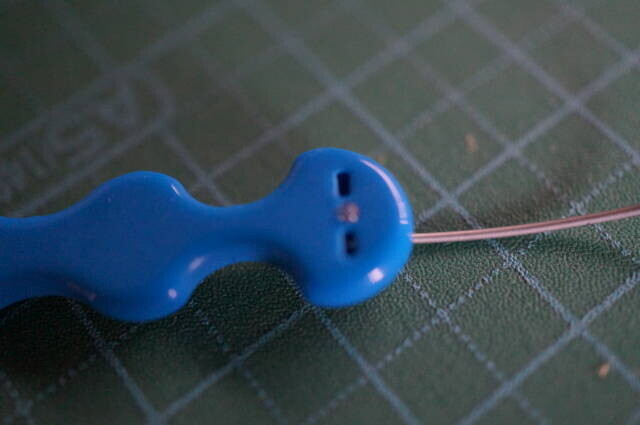
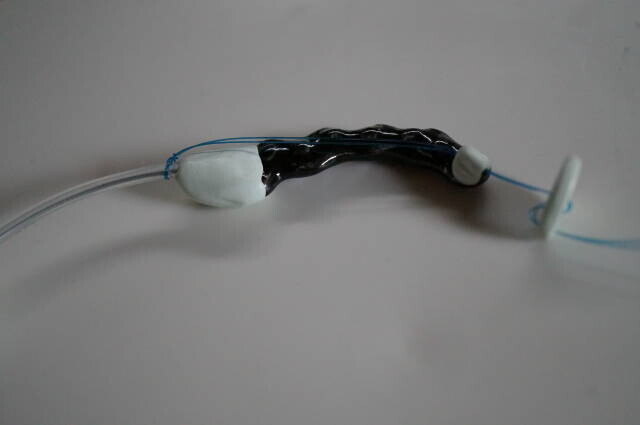
The OK Prostate Chip is a small device placed in the urethra to act on the prostate. In the April 2024 design, a springy wire joins two chips, with a thread attached near a central pivot (the wire's middle attachment area). Mr. Okada describes one chip near the prostate and the other in the lower urethral area, where it provides support. He reports that this arrangement allows rocking movement, while later entries discuss joint strength, additional parts, and problems with more flexible connections.
Linked prostate chips gained a central pivot for rocking movement
In an entry published in April 2024, Mr. Okada tested a shape-memory wire (a springy link) with the thread attached near its middle. This put the thread behind one chip but ahead of the other. He reported successful removal, despite previously assuming that a retrieval thread (a thread intended for removal) belonged only at a chip's rear.
He attributed the rocking movement to the central pivot and the wire's springiness. Mr. Okada recommended this wire-linked arrangement over the earlier ceramic two-chip design.
(Source: ok-lab's diary, published April 2024)
https://ok-lab.hatenablog.com/entry/2024/04/27/122924

Linked prostate chips offered broader combinations and selectable wire lengths
In an entry published in April 2024, Mr. Okada announced that either position could use any of the chip types. Previously, the second chip needed holes at both ends, restricting the choice. The wire lengths offered were 3cm, 4cm, and 5cm.
A specially shortened prototype had approximate individual chip lengths of 28 mm in L and 25 mm in S. These were dimensions of the example chips, not the complete assembly. Mr. Okada invited readers to ask staff about combinations they were considering.
(Source: ok-lab's diary, published April 2024)
https://ok-lab.hatenablog.com/entry/2024/04/27/122924
Flat linked prostate chips stayed steadier in the maker's tests
In an entry published in May 2024, Mr. Okada described a prototype with a flat curved chip at each end. He reported improved retention (remaining in position) and less sideways tilting. He associated the support provided by the lower chip with steadier positioning.
He also discussed a version with the lower curved chip facing the opposite way. Mr. Okada cautioned that this reversed arrangement produced too much stimulation for prolonged use.
(Source: ok-lab's diary, published May 2024)
https://ok-lab.hatenablog.com/entry/2024/05/04/122911
The maker reported easier removal with ceramic linked prostate chips
In an entry published in May 2024, Mr. Okada paired a short ceramic chip with a shaped ceramic chip (Sea Slug version 4). He reported that the combination retained the shaped chip's ability to stay positioned. He also said the earlier difficulty with removal was resolved in his trial.
That result came with a drawback concerning accidental loss of position. Mr. Okada warned that the pair could slip out easily when positioned shallowly.
(Source: ok-lab's diary, published May 2024)
https://ok-lab.hatenablog.com/entry/2024/05/04/122911
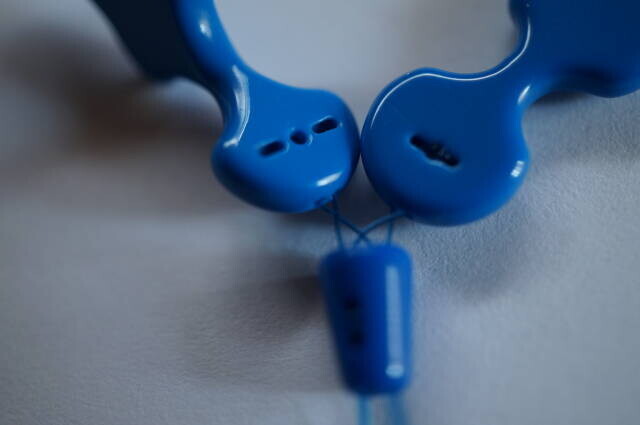
Thread-linked prostate chips required a connector and separate assembly charge
In an entry published in August 2026, Mr. Okada showed a prototype with a blue thread connector (Blue Safety). He said this connector was required for the proposed thread-linked construction. The assembly charge was ¥1,000 (about $6 at ¥156 = $1, rate as of 2026-09-04) tax excluded, in addition to the connector's normal selling price with its thread attachment.
He said ceramic chips with two threads could also be used in this construction. Unlike the wire connection, he reported that it did not hold the chips facing fixed directions. Mr. Okada cautioned that this was a custom proposal he could not offer as a standard product.
(Source: ok-lab's diary, published August 2026)
https://ok-lab.hatenablog.com/entry/2026/08/22/122905
Mr. Okada warned back-to-back linked prostate chips could fold after bladder entry
In an entry published in August 2026, a follow-up request sought a straighter version of the proposed thread connection. Mr. Okada considered the suggested arrangement less useful for rocking movement, then proposed a back-to-back design instead. He reported earlier complaints that threads emerging from chip ends had injured the lining of the urethra.
He thought locating the threads at the connection might reduce that particular problem. The diary does not record how this prototype felt in use. Mr. Okada warned that whole-device bladder entry could fold the connection, leaving both chips overlapping during attempted removal.
(Source: ok-lab's diary, published August 2026)
https://ok-lab.hatenablog.com/entry/2026/08/29/122931
The maker's answer to linked prostate chips
Mr. Okada describes design trade-offs and construction limits, including problems that the wire connection alone does not resolve.
Linked prostate chips prompted an extra-hole proposal for bladder entry
In an entry published in April 2024, Mr. Okada raised a limitation of the central retrieval thread. He warned that removal could become difficult if the whole assembly, about 10 cm long, entered the bladder. His concern involved the entire pair moving into the bladder, rather than only one chip's tip.
He proposed an additional hole at a chip end as a possible response. He believed an end-mounted thread could help in that situation; the passage records his expectation, not a successful test of whole-device bladder entry. Mr. Okada offered the extra-hole design as an option for customers concerned about this possibility.
(Source: ok-lab's diary, published April 2024)
https://ok-lab.hatenablog.com/entry/2024/04/27/122924
Tube covers increased joint thickness and cost for linked prostate chips
In an entry published in May 2024, Mr. Okada described bare-wire and tube-covered connections. The tube-covered joint was more than 1 mm thicker than the bare-wire version. The quoted connection fees were ¥3,000 (about $19 at ¥156 = $1, rate as of 2026-09-04) tax excluded for bare wire and ¥4,000 (about $26 at ¥156 = $1, rate as of 2026-09-04) tax excluded for a tube cover.
Both charges were additional to the prices of the two chips. These were the custom connection prices published in May 2024. For customers seeking a thinner connection, Mr. Okada recommended the bare-wire option.
(Source: ok-lab's diary, published May 2024)
https://ok-lab.hatenablog.com/entry/2024/05/04/122911
The maker identified joints as weak points in linked prostate chips
In an entry published in June 2024, Mr. Okada described silicone (flexible cushioning material) beneath epoxy (the hard joint covering). He believed excessive force could crack the epoxy while the silicone still held the connection together. He considered the wire joint the weakest point even in ceramic assemblies.
Mr. Okada advised stopping use if the epoxy showed cracks. Based on his repair experience, he said epoxy needed at least several months to reach full strength. He advised avoiding excessive force for about 3 months after manufacture.
(Source: ok-lab's diary, published June 2024)
https://ok-lab.hatenablog.com/entry/2024/06/15/123132
If you see blood in your urine, even a small amount or for the first time, do not wait and see. See a urologist right away. If you suddenly cannot urinate, or the device cannot be removed, do not try to fix it yourself. Go to a medical facility, including emergency care, immediately.
How linked prostate chips changed over time
| Published | What the diary said then |
|---|---|
| Apr 2024 | A central wire pivot opened up chip combinations previously limited by thread-hole placement. |
| May 2024 | Mr. Okada reported steadier positioning with flat support chips. |
| Jun 2024 | The maker identified joint cracking and slow strength development as construction concerns. |
| Nov 2024 | A custom extra-hole arrangement accommodated a stopper, with possible irritation from added bulk. |
| Aug 2026 | Staff explained the old thread-link design's discontinuation; a custom connector-based prototype followed. |
| Aug 2026 | A back-to-back proposal still risked folding after whole-device bladder entry. |
OK Prostate Chip products related to linked prostate chips
The current list includes individual components discussed in these entries.
Products that appear in these entries
| Product (official name) | Price incl. tax | Relation to this topic |
|---|---|---|
| Double-twist ceramic chip (OKプロステートチップ 陶器素材覚醒タイプ ダブルツイスト(ラブカチップ)) | ¥6,600 (about $42 at ¥156 = $1, rate as of 2026-09-04) | In November 2024, a customer specified this chip for the custom pair with an additional thread hole. |
| Six-hole stopper (六穴方式オプションチップ(括約筋ストッパーチップ)) | ¥2,200 (about $14 at ¥156 = $1, rate as of 2026-09-04) | In November 2024, staff confirmed this stopper could accompany the customer's extra-hole arrangement. |
The six-hole stopper is listed in OK Lab's own online store.
(Source: ok-lab's diary, published November 2024)
https://ok-lab.hatenablog.com/entry/2024/11/16/122924
Products the diary mentioned as alternatives
| Product (official name) | Price incl. tax | Relation to this topic |
|---|---|---|
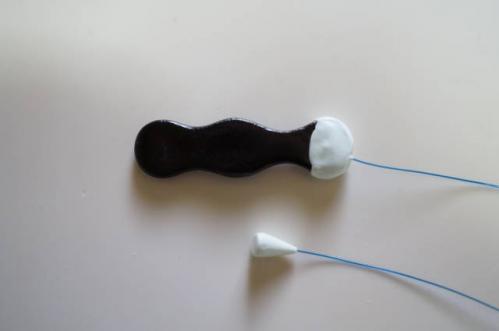
| Short ceramic chip (OKプロステートチップ 陶器素材ショートタイプ) | ¥3,300 (about $21 at ¥156 = $1, rate as of 2026-09-04) | In May 2024, Mr. Okada recommended this flat ceramic choice for steadier support on the lower urethral side. |
The short ceramic chip is listed in OK Lab's own online store.
(Source: ok-lab's diary, published May 2024)
https://ok-lab.hatenablog.com/entry/2024/05/04/122911
Complete custom assemblies and the blue thread connector: No matching product can be confirmed on the current list.
Common worries about linked prostate chips
The reader questions concern chip strength, the extra-hole arrangement, and whether staff would accept a thread-linked custom order.
"Can linked prostate chips break at narrow sections?"
In an entry published in June 2024, a reader asked about thin sections in resin (chip material) used for linked chips. Mr. Okada framed his answer as experience and judgment. He reported easy breakage at narrow sections during bending tests involving pliers at 2 points.
He thought a chip connected at only one end had roughly the same vulnerability there as a chip used alone. The diary does not record whether this reader later ordered a linked assembly. Mr. Okada's caution focused on the connection, which he considered the weakest part.
(Source: ok-lab's diary, published June 2024)
https://ok-lab.hatenablog.com/entry/2024/06/15/123132
"Does an extra hole change linked prostate chips?"
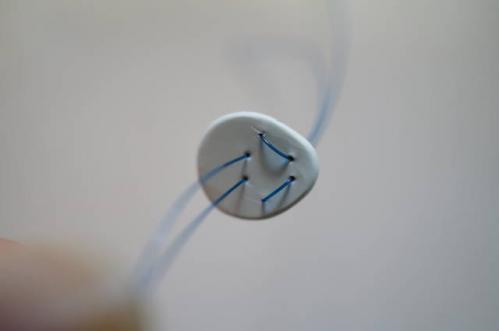
In an entry published in November 2024, a customer requested a double-twist ceramic chip paired with another ceramic chip, plus an extra hole and stopper. Staff said leaving the hole unused preserved the usual arrangement, while the thread's position on the wire remained movable. After staff confirmed the six-hole stopper was removable, the customer kept the order; the diary does not record their experience in use.
Mr. Okada thought the stopper could prevent both chips entering the bladder. He warned that the raised thread hole could itself irritate the urethra. He presented the stopper arrangement as an option for customers who accepted that extra bulk.
(Source: ok-lab's diary, published November 2024)
https://ok-lab.hatenablog.com/entry/2024/11/16/122924
"Will staff make linked prostate chips with nylon thread?"
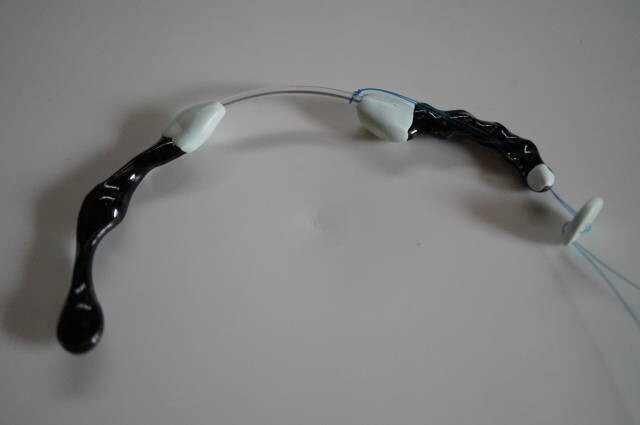
In an entry published in August 2026, a customer requested a short nylon connection between two chips. Staff explained that an earlier short-thread-linked design was discontinued after chips overlapped and tangled threads could not be untangled inside the urethra. They said the wire connection resisted bending because of those earlier failures.
The customer acknowledged similar problems during previous two-chip use and still wanted the custom build. Staff then accepted the request while asking for time to consider construction; the diary does not confirm delivery or customer testing. Staff cautioned that they regarded the proposed thread-linked design as high risk.
(Source: ok-lab's diary, published August 2026)
https://ok-lab.hatenablog.com/entry/2026/08/22/122905
Buying from outside Japan

OK Lab ships internationally to countries covered by Japan Post's EMS courier service. Overseas orders are paid in advance by PayPal. Each order carries a ¥400 (about $3 at ¥156 = $1, rate as of 2026-09-04) handling fee, and EMS shipping is charged on top. These terms come from OK Lab's official sales-terms page (written here as plain text, not a link: ok-lab.net/docs/law), checked on September 7, 2026; confirm them on the official store before you order, because they can change.
Summary of this article
| What you wanted to know | The answer |
|---|---|
| In short: what does the connection do? | The maker describes rocking movement through a springy link between two chips. |
| About this product: who makes it? | OK Lab, a small company in Japan, makes the urethral device. |
| Key terms: what is the pivot? | The thread's attachment area near the connecting wire's middle. |
| What happens with linked chips? | The diary records prototype benefits alongside slipping, injury, and folding concerns. |
| What is the maker's answer? | He discusses thickness choices, extra-hole trade-offs, and attention to joint condition. |
| What changed over time? | Wire designs gained options; later thread-linked proposals retained earlier folding concerns. |
| Which products are listed now? | Individual ceramic chips and the six-hole stopper appear on the supplied current list. |
| What did customers ask? | They asked about breakage, an extra hole, and custom thread connections. |
| How does overseas buying work? | The stated terms specify advance PayPal payment, a handling fee, and EMS shipping charges. |
Source: ok-lab's diary (Okada Comfortable Life Laboratory). The original entries are in Japanese; quotations on this page are translated. Photos and videos are on the original entries.
This article is a summary of the maker's development diary. The product is not a medical device and no result is guaranteed. If anything feels wrong or worries you, see a doctor. Prices, specifications and cautions change, so confirm the latest information on the official blog and the official site. Questions about ordering and shipping go to the seller.