![Will a prostate chip stay in place? | The maker reports better shape retention, with limits [OK Prostate Chip]](/img/a/T0026/eyecatch.svg)
This page is based on entries from "ok-lab's diary" (https://ok-lab.hatenablog.com/), the Japanese development diary written by Mr. Okada, founder of OK Lab, a small company in Japan (Okada Comfortable Life Laboratory). Only the entries about keeping a prostate chip in place with lock-on wire are summarized here, in order of publication. Past prices and sizes are as written at the time. Current prices come from the official product list (retrieved September 4, 2026). Quotations are translated from Japanese.
Note: This page is a personal reading log by someone with no connection to the maker or the seller. It reflects the source entries as of their publication dates and makes no guarantee of accuracy or safety. The product is not a medical device; talk to a doctor about any health decision. Check the official site for current information. This page contains advertising.
In short
Wire-supported retaining loops recover their shape, according to Mr. Okada, but a chip can still move.
The maker proposes different loop designs for shape loss, cable strain, and inward movement.
The current list includes a requested base chip, while these custom retaining assemblies have no confirmed match.
About this product

The OK Prostate Chip is a small device that is placed in the urethra (the urine passage) so that it acts on the prostate; the maker sells it in several shapes, sizes and materials. It is made and sold by OK Lab (Okada Comfortable Life Laboratory), a small company in Japan, through its own online store, and prices are in Japanese yen (JPY).
The maker's development diary, "ok-lab's diary", is written in Japanese. This page is an English summary of it, and every quotation is translated.
OK Lab ships internationally, so readers outside Japan can order (see "Buying from outside Japan" below). Product names on this page are plain-English descriptions. The official Japanese product name is shown once in the product table so you can find the same item in the store.
Before you read: key terms
| Term | Plain-English meaning |
|---|---|
| Lock-on loop | A loop behind the chip, intended to help hold its position. |
| Shape-memory wire | Wire that recovers its stored shape, used to support retaining loops. |
| Bulbar urethra | A wider, deeper part of the urine passage where the retaining loop sits. |
| Parallel cord | Paired cable used for retaining structures and, in vibrating models, electrical power. |
| Hybrid lock-on | A cord-and-wire retaining assembly combining a defined shape with springiness. |
| Chipless device | A wire-and-tube device using loops instead of a solid prostate chip. |
| Stopper | A part intended to limit movement; some versions also support cord or wire. |
| Epoxy | A hardening material used at a thread connection in the prototype discussed below. |
| Electrode chip | A chip carrying an electrical contact, used for electrical stimulation. |
| Adjustable lock-on | A retaining assembly whose stoppers allow different cord-loop shapes. |
| Sphincter | A muscle ring described as gripping between device sections, helping resist movement. |
What happens: prostate chip slipping
The OK Prostate Chip is a device placed in the urethra to act on the prostate. A lock-on loop (a retaining loop behind the chip) is intended to help hold it around the urethra's bend. The loop sits in the bulbar urethra (the wider, deeper section of the urine passage). Mr. Okada describes shape-memory wire (wire that recovers its shape) as support for a loop that would otherwise deform.
Lock-on wire addressed cord loops that did not fully recover
In an entry published in November 2024, Mr. Okada described incomplete recovery after pressure compressed an ordinary retaining loop. That earlier loop used parallel cord (paired cable forming the retaining structure).
The proposed replacement contained shape-memory wire inside silicone tubing; the earlier flexible tail contained thread. Mr. Okada said the wire maintained a defined shape and could connect to most ceramic, blue, and stainless-steel chips. He cautioned that greater curvature also made placement more difficult.
(Source: ok-lab's diary, published November 2024)
https://ok-lab.hatenablog.com/entry/2024/11/16/122924
A ceramic chip still shifted despite its lock-on loops
In an entry published in January 2025, Mr. Okada compared a ceramic prototype with a chipless device (loops replacing the solid chip). The ceramic chip moved about 1cm outward during urination or exercise, although it did not come out.
He considered it less stable than the same-sized chipless design and suspected ceramic weight and slipperiness contributed. He also reported stronger sensations than with the ceramic chip alone. Mr. Okada presented the choice between ceramic and chipless designs as a matter of personal preference.
(Source: ok-lab's diary, published January 2025)
https://ok-lab.hatenablog.com/entry/2025/01/04/122911
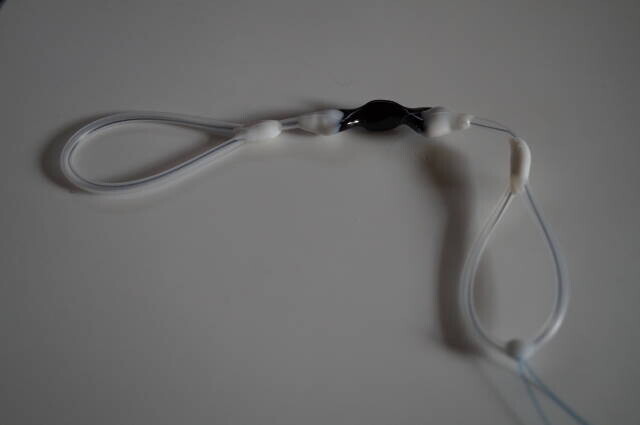
Hybrid lock-on followed discontinued cord designs with broken stainless wire
An entry published in February 2025 says earlier cord products reinforced with 0.3mm stainless-steel wire had all been discontinued after breakage reports. Mr. Okada introduced hybrid lock-on (a retaining assembly combining cord and springy wire) using 0.3mm shape-memory wire instead.
The design combined the cord's defined form with the wire's ability to recover its shape. Cord and wire shared fixed ends, while intermediate supports allowed some movement between them. Mr. Okada cautioned that the new spring-supported design needed further length testing.
(Source: ok-lab's diary, published February 2025)
https://ok-lab.hatenablog.com/entry/2025/02/01/122912
Hybrid lock-on pain was traced to a hardened thread projection
In an entry published in February 2025, Mr. Okada attributed the previous prototype's pain to a pointed nylon-thread projection. Epoxy (the hardening material at that connection) had held the thread upright.
The next prototype used rubber at the thread connection, and he reported that the source of pain was removed. He described the overall assembly as springy but more resistant to deformation than ordinary cord. Mr. Okada advised matching the hybrid's shape to the urethra.
(Source: ok-lab's diary, published February 2025)
https://ok-lab.hatenablog.com/entry/2025/02/08/122932
An electrode lock-on request prompted a warning about cable strain
In an entry published in May 2026, a customer wanted a retaining assembly for an electrode chip (a chip carrying an electrical contact). The request followed cable-breakage concerns with a previously purchased electrode chip. OK Lab's staff advised against ordinary lock-on connections, saying they strained vibrating-chip cables and made breakage more likely.
Staff instead pointed to an April 2025 prototype with separate wire-loop and power-cord sections. Mr. Okada made an electrode version and reported stable placement with less cable strain; the customer's subsequent experience is not recorded. The diary recommends that separate-loop design for the cable concern.
(Source: ok-lab's diary, published May 2026)
https://ok-lab.hatenablog.com/entry/2026/05/16/122906
Adjustable hybrid lock-on required more parts and difficult fabrication
In an entry published in August 2026, Mr. Okada described a successful adjustable hybrid prototype after several failed attempts. Its 2-hole stoppers, about 5mm wide, supported the wire. The tax-excluded quote listed 2 4-hole stoppers at ¥1,500 (about $10 at ¥156 = $1, rate as of 2026-09-04) each, 3 2-hole stoppers at ¥1,000 (about $6 at ¥156 = $1, rate as of 2026-09-04) each, and ¥3,000 (about $19 at ¥156 = $1, rate as of 2026-09-04) for connection.
He said fabrication involved substantially more work than the connection charge reflected. He described the quoted price as temporary. Mr. Okada warned that high order volumes could force him to stop offering this design.
(Source: ok-lab's diary, published August 2026)
https://ok-lab.hatenablog.com/entry/2026/08/29/122931
The maker's answer to prostate chip slipping
Mr. Okada's proposals depend on the assembly's shape, manufacturing limits, and the strain placed on its cable.
Lock-on wire dimensions were approximate, and custom parts carried surcharges
In an entry published in November 2024, the silicone-covered wire lock-on cost the chip price plus ¥4,000 (about $26 at ¥156 = $1, rate as of 2026-09-04), excluding tax. A mesh stopper (a mesh part intended to limit movement) could occupy the chip-to-loop gap for ¥2,000 (about $13 at ¥156 = $1, rate as of 2026-09-04), excluding tax.
The mesh option had S, M, and L sizes and was the only stopper offered for that gap. A requested 20mm distance could be roughly 15–25mm, with around 10 degrees of angular error. Mr. Okada advised treating specified lengths and angles as approximate.
(Source: ok-lab's diary, published November 2024)
https://ok-lab.hatenablog.com/entry/2024/11/16/122924
Hybrid lock-on pricing accompanied a narrower range of proposed lengths
In an entry published in February 2025, Mr. Okada recommended a hybrid length of 4cm to 5cm. He said the curved portion required about 2cm, limiting how short the complete assembly could be.
The same paragraph refused requests of 4cm or less, despite including 4cm in the recommended range. The published price was the chip price plus ¥5,000 (about $32 at ¥156 = $1, rate as of 2026-09-04) excluding tax. Mr. Okada's guidance favored shorter hybrid assemblies within those manufacturing limits.
(Source: ok-lab's diary, published February 2025)
https://ok-lab.hatenablog.com/entry/2025/02/08/122932
A vibrating lock-on prototype required separate supports and extra charges
In an entry published in April 2025, a customer requested wire-supported retention for a short ceramic vibrating chip. Staff initially said the proposed cable-and-wire combination was difficult, but Mr. Okada built a prototype with connections only at the loop's ends.
Historical charges, excluding tax, were ¥1,000 (about $6 at ¥156 = $1, rate as of 2026-09-04) above the ordinary vibrating-chip price, ¥4,000 (about $26 at ¥156 = $1, rate as of 2026-09-04) for the loop, and ¥1,000 (about $6 at ¥156 = $1, rate as of 2026-09-04) for its 2 cord connections. The entry priced the minimum short-ceramic configuration at ¥11,000 (about $70 at ¥156 = $1, rate as of 2026-09-04) and the fully equipped prototype at ¥16,500 (about $106 at ¥156 = $1, rate as of 2026-09-04), both excluding tax.
The diary does not record how the completed design felt to that customer. Mr. Okada cautioned that this design required a longer rear connection section.
(Source: ok-lab's diary, published April 2025)
https://ok-lab.hatenablog.com/entry/2025/04/26/122909

How prostate chip slipping changed over time
| Published | What the diary said then |
|---|---|
| Nov 2024 | Silicone-covered wire prototypes had approximately 45mm loops and 110–120 degree bends. |
| Dec 2024 | Initial rough sensations from the ceramic double-loop prototype faded within hours. |
| Jan 2025 | Double-loop ceramic retention proved less stable than the same-sized chipless arrangement in Mr. Okada's comparison. |
| Feb 2025 | An early hybrid prototype exceeded 70mm; Mr. Okada planned further length tests. |
| Feb 2025 | Mr. Okada reported little hybrid deformation under urethral pressure or urination pressure. |
| Apr 2025 | The vibrating prototype's rear resin section grew from 5–7mm to about 15mm. |
| Jul 2026 | Spaced stopper plates allowed more bending than the closely joined arrangement, according to Mr. Okada. |
| Aug 2026 | Stopper widths became S: 6–7mm, M: 7–8mm, and L: 8–9mm. |
| Aug 2026 | Adjustable hybrid fabrication remained difficult; heavy demand could lead to withdrawal. |
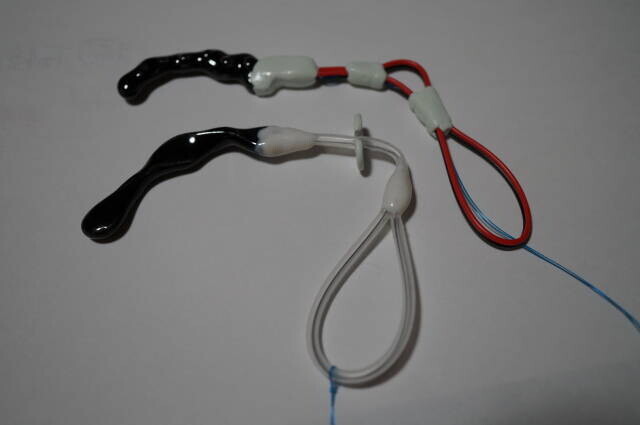
OK Prostate Chip products related to prostate chip slipping
The current list confirms the requested short ceramic vibrating base chip; its price does not describe the custom retaining assembly.
Products that appear in these entries
| Product (official name) | Price incl. tax | Relation to this topic |
|---|---|---|
| Short ceramic vibrating chip (OKプロステート核振チップ 陶器素材ショートタイプ) | ¥5,500 (about $35 at ¥156 = $1, rate as of 2026-09-04) | In April 2025, a customer requested this as the base for a wire-supported vibrating prototype. |
The short ceramic vibrating chip is sold through OK Lab's own online store.
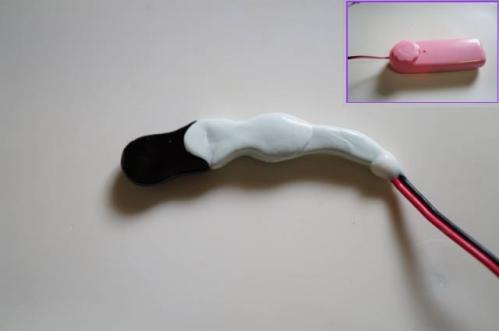
(Source: ok-lab's diary, published April 2025)
https://ok-lab.hatenablog.com/entry/2025/04/26/122909
Products the diary mentioned as alternatives
The diary names no alternative.
Custom retaining assemblies, chipless devices, and the ceramic double-loop prototype:
No matching product can be confirmed on the current list.
Common worries about prostate chip slipping
"Can lock-on wire join different thicknesses in one design?"
In an entry published in April 2025, a separate customer requested 0.4mm wire for the bend and 0.3mm elsewhere. The proposed bend was 15–20mm long at 90 degrees.
Mr. Okada declined because joining shape-memory wires exceeded OK Lab's technical capabilities. He also described attaching other materials alongside that wire as generally impractical. Mr. Okada advised against assuming ordinary wire-joining ideas were feasible with this material.
(Source: ok-lab's diary, published April 2025)
https://ok-lab.hatenablog.com/entry/2025/04/26/122909
"Could adjustable lock-on replace a bulky cylindrical cord stopper?"
In an entry published in July 2026, a customer wanted a strong cylindrical stopper behind a paired aluminum electrode assembly. Mr. Okada judged a 10mm-long cord passage impractical to manufacture and proposed 3 separate stopper plates instead. His prototype led to adjustable lock-on (a retaining loop whose shape depends on cord lengths between stoppers).
The published price was ¥1,500 (about $10 at ¥156 = $1, rate as of 2026-09-04) per 4-hole stopper, with a simple minimum assembly quoted at ¥5,000 (about $32 at ¥156 = $1, rate as of 2026-09-04), excluding tax. The diary does not record the customer's experience with the finished arrangement. Mr. Okada cautioned that unusually short cord specifications might be impossible to make.
(Source: ok-lab's diary, published July 2026)
https://ok-lab.hatenablog.com/entry/2026/07/25/123012
"Can adjustable lock-on guarantee against movement toward the bladder?"
In an entry published in August 2026, a customer reported that stoppers passed inward despite their intended retaining role. Mr. Okada said easily bending designs offered little resistance, while chipless loops could also flatten under sufficient force.
He favored an adjustable lock-on loop too large for that customer's sphincter (a muscle ring gripping between device sections) to pass. The diary does not record whether the customer tried that proposal or how it performed. Mr. Okada stressed that his suggestion was theoretical and could fail depending on the customer's anatomy.
(Source: ok-lab's diary, published August 2026)
https://ok-lab.hatenablog.com/entry/2026/08/01/122916
Buying from outside Japan

OK Lab ships internationally to countries covered by Japan Post's EMS courier service. Overseas orders are paid in advance by PayPal. Each order carries a ¥400 (about $3 at ¥156 = $1, rate as of 2026-09-04) handling fee, and EMS shipping is charged on top. These terms come from OK Lab's official sales-terms page (written here as plain text, not a link: ok-lab.net/docs/law), checked on September 7, 2026; confirm them on the official store before you order, because they can change.
Summary of this article
| What you wanted to know | The answer |
|---|---|
| What is the short answer? | Mr. Okada reports improved shape recovery, with movement still possible. |
| What is the product? | A urethral device made and sold by OK Lab in Japan. |
| What do the terms describe? | Retaining loops, supporting wire, cord, and parts intended to limit movement. |
| Can a supported chip still shift? | The ceramic double-loop prototype moved outward during Mr. Okada's test. |
| What did the maker propose? | Different shapes, shorter hybrid lengths, and separate cable supports. |
| What changed over time? | Development progressed from covered-wire loops to hybrid and adjustable structures. |
| Which current product is confirmed? | The requested short ceramic vibrating base chip, ¥5,500 (about $35 at ¥156 = $1, rate as of 2026-09-04) including tax. |
| Is inward movement prevented? | Mr. Okada gave a theoretical proposal without a guarantee. |
| Can customers order internationally? | The stated terms specify EMS coverage, advance PayPal payment, and additional fees. |
| What does the article establish overall? | The diary records development claims and limitations, with several customer outcomes unrecorded. |
Source: ok-lab's diary (Okada Comfortable Life Laboratory). The original entries are in Japanese; quotations on this page are translated. Photos and videos are on the original entries.
This article is a summary of the maker's development diary. The product is not a medical device and no result is guaranteed. If anything feels wrong or worries you, see a doctor. Prices, specifications and cautions change, so confirm the latest information on the official blog and the official site. Questions about ordering and shipping go to the seller.