![Can the chip stay inside with no thread sticking out? | Movement and retrieval remain concerns [OK Prostate Chip]](/img/a/T0024/eyecatch.svg)
This page is based on entries from "ok-lab's diary" (https://ok-lab.hatenablog.com/), the Japanese development diary written by Mr. Okada, founder of OK Lab, a small company in Japan (Okada Comfortable Life Laboratory). Only the entries about "keeping the device fully inside without an exposed thread" are summarized here, in order of publication. Past prices and sizes are as written at the time. Current prices come from the official product list (retrieved September 4, 2026). Quotations are translated from Japanese.
Note: This page is a personal reading log by someone with no connection to the maker or the seller. It reflects the source entries as of their publication dates and makes no guarantee of accuracy or safety. The product is not a medical device; talk to a doctor about any health decision. Check the official site for current information. This page contains advertising.
In short
A hidden thread does not guarantee that a chip stays put or remains easy to retrieve.
Mr. Okada proposed backup threads and revised internal loops, while acknowledging limits to fully internal retention.
The current list includes backup thread; matching listings for the thread-free builds cannot be confirmed.
If you see blood in your urine, even a small amount or for the first time, do not wait and see. See a urologist right away. If you suddenly cannot urinate, or the device cannot be removed, do not try to fix it yourself. Go to a medical facility, including emergency care, immediately.
About this product

The OK Prostate Chip is a small device that is placed in the urethra (the urine passage) so that it acts on the prostate; the maker sells it in several shapes, sizes and materials. It is made and sold by OK Lab (Okada Comfortable Life Laboratory), a small company in Japan, through its own online store, and prices are in Japanese yen (JPY).
The maker's development diary, "ok-lab's diary", is written in Japanese. This page is an English summary of it, and every quotation is translated.
OK Lab ships internationally, so readers outside Japan can order (see "Buying from outside Japan" below). Product names on this page are plain-English descriptions. The official Japanese product name is shown once in the product table so you can find the same item in the store.
Before you read: key terms
| Term | Plain-English meaning |
|---|---|
| Urethra | The urine passage, which carries urine and is where the device's components are retained. |
| Fully internal retention | Keeping the device and its thread inside the urine passage, so no thread protrudes outside. |
| Auxiliary chip | An additional internal component intended to help retain the main chip or provide a retrieval connection. |
| Retrieval loop | A loop of thread or wire intended to provide access for retrieval when no thread protrudes. |
| External backup thread | An extension reaching outside the body, intended to preserve access to the device. |
| Shape-memory wire | Wire described as returning toward its original shape after bending, used to support loops and extensions. |
| Wire-frame chip | The design called chipless in the diary, made from shape-memory wire and silicone tubing for internal retention. |
| Bladder loop | A loop intended to reach the bladder; Mr. Okada proposed it to limit further inward movement. |
| Ultrasound and X-rays | Imaging examinations Mr. Okada named for showing a doctor a metal device's position and shape. |
What happens: thread-free prostate chips
The OK Prostate Chip is a small device placed in the urethra to act on the prostate. Fully internal retention keeps the assembly and any thread inside the urine passage, with nothing protruding from the penis. Auxiliary chips (additional internal retaining components) and retrieval loops (loops providing retrieval access) serve different roles in that arrangement. Mr. Okada's designs aim to avoid exposed thread while preserving access; his reports also describe movement and retrieval difficulties.
Fully internal chips lost quick thread access in the earliest account
In an entry published in October 2017, Mr. Okada described a design with the auxiliary chip also deep inside the urethra. He claimed this isolated the assembly from outside air and could permit one week of continuous retention. He presented this as protection against bacteria, alongside his view that urine flowing around the device helped carry bacteria away.
However, the design had no exposed thread for immediate access. Its retrieval depended on the internal auxiliary component. Mr. Okada cautioned that this arrangement could not be withdrawn quickly.
(Source: ok-lab's diary, published October 2017)
https://ok-lab.hatenablog.com/entry/20171011/1507687119
Fully internal chips still shifted outward during the maker's December test
In an entry published in December 2020, Mr. Okada reported that urine flow pushed an auxiliary screw outward inside the penis. Replacing that component with a ring reduced the movement in his test but did not stop it. The ring reached the area just before the penis tip, leaving some retrieval loop exposed.
He also reported that paired nylon strands forming a loop stayed straighter inside than a single strand. His screw-based arrangement nevertheless required manual restraint during urination, limiting its ability to stay inside unaided. Mr. Okada's report cautions that hiding the thread did not eliminate outward movement.
(Source: ok-lab's diary, published December 2020)
https://ok-lab.hatenablog.com/entry/2020/12/12/124126

A fully internal chip came out despite its hidden thread
In an entry published in March 2021, a customer reported difficult placement with a 6mm main stainless-steel chip and 5.6mm auxiliary chip. The customer warned of possible injury if placement was forced and reported that the assembly came out during urination. The customer questioned whether this fully internal arrangement suited only certain users.
Mr. Okada replied that fully internal meant no exposed thread, without promising resistance to expulsion. He described an auxiliary chip 2-3cm from the main chip as the component intended to resist outward movement. His reply cautioned that this arrangement still depended on manual restraint during urination.
(Source: ok-lab's diary, published March 2021)
https://ok-lab.hatenablog.com/entry/2021/03/06/125456
A fully internal chip stayed put during one limited loop test
In an entry published in August 2024, Mr. Okada described a flexible cord loop shaped like a keyring. He thought a soft, springy loop could resist outward movement better than rigid components near the penis tip. He reported about one day of retention in his personal test, without expulsion during urination.
That test involved his particular arrangement with the penis held retracted beneath fabric. He made a version for use without that arrangement but reported no personal test of it. Mr. Okada limited his favorable conclusion to the conditions he had actually tested.
(Source: ok-lab's diary, published August 2024)
https://ok-lab.hatenablog.com/entry/2024/08/17/122842
The thread-free chip replaced floppy nylon with an elastic wire loop
In an entry published in March 2025, Mr. Okada explained his concern about short internal threads. He said they could fold and move toward deeper urethral sections, making urgent retrieval uncertain. His proposed replacement used shape-memory wire (wire that returns toward its original shape after bending), ending in a small loop.
The extension was designed around a 6mm straw serving as a placement and retrieval tool. He also acknowledged that engagement between the tool and internal loop could be difficult. Mr. Okada cautioned that a short hidden thread did not provide reassurance when quick retrieval mattered.
(Source: ok-lab's diary, published March 2025)
https://ok-lab.hatenablog.com/entry/2025/03/29/122912
A thread-free chip example cost ¥9,000 (about $58 at ¥156 = $1, rate as of 2026-09-04) in March 2025
In the March 2025 entry, a wire-frame chip (the wire-and-silicone design called chipless) cost ¥6,000 (about $38 at ¥156 = $1, rate as of 2026-09-04), tax excluded. The terminal-loop extension cost ¥4,000 (about $26 at ¥156 = $1, rate as of 2026-09-04), tax excluded, and the diary gave ¥10,000 (about $64 at ¥156 = $1, rate as of 2026-09-04), tax excluded, before the thread deduction. It then specified a ¥1,000 (about $6 at ¥156 = $1, rate as of 2026-09-04) deduction for omitting nylon thread, giving ¥9,000 (about $58 at ¥156 = $1, rate as of 2026-09-04), tax excluded, for the illustrated example.
Mr. Okada offered 20cm of temporary nylon thread free for people awaiting confidence in retention. He cautioned that this temporary thread lacked permanent fixation.
(Source: ok-lab's diary, published March 2025)
https://ok-lab.hatenablog.com/entry/2025/03/29/122912
A fully internal chip design still escaped despite several screws
In an entry published in November 2025, Mr. Okada reported testing several auxiliary screws along an integrated wire loop. Even with several screws, the assembly suddenly slipped out when the passage was very slippery and restraint was light. He then reported repeated urination without expulsion from a revised arrangement in which the loop and screws interacted.
He also found the four-strand version harder to retrieve than the two-strand version. Mr. Okada proposed an external backup thread (an extension preserving outside access) for people who remained uneasy.
(Source: ok-lab's diary, published November 2025)
https://ok-lab.hatenablog.com/entry/2025/11/01/122937
The maker's answer to thread-free prostate chips
Mr. Okada proposed backup threads, more accessible internal loops, and a bladder-loop design to address different concerns.
Hidden retrieval thread designs came with an external backup recommendation
In an entry published in January 2021, Mr. Okada recommended retaining external thread until reliable retention was established. He also treated large or unusually shaped chips that were already difficult to retrieve as reasons to retain that backup. His proposed extension was nylon thread with a loop at each end.
He favored ring or screw auxiliary components over the flat component in his original concept. Mr. Okada advised against fully internal retention for people whose chips readily moved into the bladder.
(Source: ok-lab's diary, published January 2021)
https://ok-lab.hatenablog.com/entry/2021/01/16/124800
An internal retrieval loop gained a cage shape for easier access
In an entry published in August 2021, Mr. Okada described a nylon retrieval loop that opened into a small cage. He said an ordinary loop could lie against the urethral wall and become difficult to access. He proposed the cage shape because it remained open within the available space.
The custom work was restricted to two-strand thread and priced at ¥2,000 (about $13 at ¥156 = $1, rate as of 2026-09-04), tax excluded, as published that month. Mr. Okada proposed this shape as an alternative to the flat internal loop.
(Source: ok-lab's diary, published August 2021)
https://ok-lab.hatenablog.com/entry/2021/08/07/125807
Thread-free chips gained a bladder loop to address inward migration fears
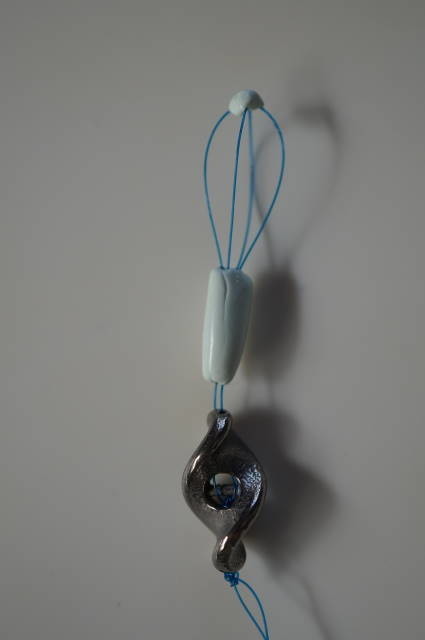
In the March 2025 entry, Mr. Okada acknowledged that individual differences could allow a wire-frame chip to move into the bladder. He proposed a bladder loop (a loop intended to reach that organ) for people concerned about inward movement.
He said that configuration approached 20cm overall and claimed its length physically prevented the whole assembly from falling into the bladder. Mr. Okada recommended the bladder-loop version specifically for this concern.
(Source: ok-lab's diary, published March 2025)
https://ok-lab.hatenablog.com/entry/2025/03/29/122912
If you see blood in your urine, even a small amount or for the first time, do not wait and see. See a urologist right away. If you suddenly cannot urinate, or the device cannot be removed, do not try to fix it yourself. Go to a medical facility, including emergency care, immediately.
How thread-free prostate chips changed over time
| Published | What the diary said then |
|---|---|
| May 2019 | Mr. Okada proposed shorter cable connecting two chips so both could remain completely inside. |
| Dec 2020 | Clothing snags on exposed thread prompted a fully internal ring-chip trial. |
| Jan 2021 | Mr. Okada identified fully internal retention as his original patent design. |
| Aug 2024 | Keyring connections were described as compatible with ceramic, resin, blue, and stainless-steel chips. |
| Mar 2025 | Mr. Okada reported about 20 hours with a thread-free wire-frame chip. |
| Nov 2025 | Mini-screws cost ¥1,000 (about $6 at ¥156 = $1, rate as of 2026-09-04) each, tax excluded; larger screws cost ¥2,000, (about $13 at ¥156 = $1, rate as of 2026-09-04) tax excluded. |

OK Prostate Chip products related to thread-free prostate chips
The current list confirms the recommended backup thread, without confirming matching listings for the thread-free assemblies.
Products that appear in these entries
| Product (official name) | Price incl. tax | Relation to this topic |
|---|---|---|
| Nylon thread with loops at both ends (両端ループナイロン糸) | ¥550 (about $4 at ¥156 = $1, rate as of 2026-09-04) | In January 2021, Mr. Okada included this extension in his proposed fully internal system as temporary external backup. |
(Source: ok-lab's diary, published January 2021)
https://ok-lab.hatenablog.com/entry/2021/01/16/124800
Products the diary mentioned as alternatives
The diary names no alternative.
No matching product can be confirmed on the current list.
Common worries about thread-free prostate chips
Readers asked about cord length, concealed loops, and retrieval; the diary records limited customer follow-up.
"Can fully internal chips have long support cords?"
In an entry published in April 2022, a customer wanted a fully internal cord after difficulty retrieving an earlier custom chip. Mr. Okada initially rejected 22-23cm, warning that the firm cord could protrude when the penis shortened. The request then changed to 18cm, followed by 14cm or 13cm; 14cm was made.
After his own test, Mr. Okada reconsidered: 17-18cm might have worked for that customer. The diary does not record how the completed version felt in use. For that customer, Mr. Okada suggested considering a longer version next time.
(Source: ok-lab's diary, published April 2022)
https://ok-lab.hatenablog.com/entry/2022/04/09/123458
"Could fully internal chips include concealed retrieval loops?"
In an entry published in August 2024, a customer asked about keeping an assembly entirely inside, including its thread. Staff initially said they had no experience making products intended to stay in the penis tip and requested clarification. After further correspondence, Mr. Okada made the requested custom assembly.
The specification placed the auxiliary screw 140mm from the bladder component, with 250mm overall length and approximately 220mm around the thread loop. The diary does not record whether it stayed concealed in the customer's use. Mr. Okada presented the auxiliary screw as a proposed check on the retained position.
(Source: ok-lab's diary, published August 2024)
https://ok-lab.hatenablog.com/entry/2024/08/03/122758
"Could a thread-free chip become impossible to retrieve?"
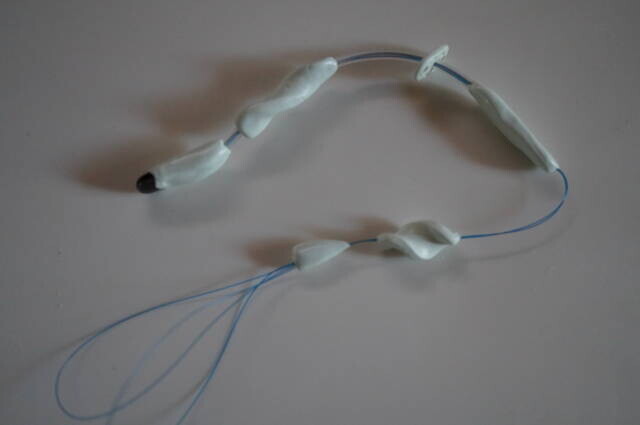
In an entry published in April 2025, a reader asked about prolonged retention, toilet use, and losing access to the device. Staff first requested fewer questions; Mr. Okada later presented the thread-free wire-frame design as permitting continued retention, urination, bowel movements, and retrieval. He acknowledged that someone with limited dexterity might still be unable to retrieve it.
He said ultrasound and X-rays (medical imaging examinations) could show a doctor the metal device's position and shape. The entry records his reply, without a subsequent report of this reader using that design. Mr. Okada offered it as an alternative to solid chips while acknowledging that it was not a perfect retaining device.
(Source: ok-lab's diary, published April 2025)
https://ok-lab.hatenablog.com/entry/2025/04/05/122932
Buying from outside Japan

OK Lab ships internationally to countries covered by Japan Post's EMS courier service. Overseas orders are paid in advance by PayPal. Each order carries a ¥400 (about $3 at ¥156 = $1, rate as of 2026-09-04) handling fee, and EMS shipping is charged on top. These terms come from OK Lab's official sales-terms page (written here as plain text, not a link: ok-lab.net/docs/law), checked on September 7, 2026; confirm them on the official store before you order, because they can change.
Summary of this article
| What you wanted to know | The answer |
|---|---|
| What is the short answer? | No exposed thread does not guarantee stable retention or easy retrieval. |
| What is the product? | A device made by OK Lab in Japan that sits in the urethra and acts on the prostate. |
| What do the terms mean? | Auxiliary components address retention; loops and backup threads address retrieval access. |
| What happened in the accounts? | The diary describes outward movement, difficult access, and limited personal prototype tests. |
| What did the maker propose? | External backup, more accessible loops, and a bladder-loop option for inward movement concerns. |
| What changed over time? | Designs progressed from internal threads and auxiliary chips to cord loops and wire-based assemblies. |
| What current product is confirmed? | Nylon thread with loops at both ends costs ¥550 (about $4 at ¥156 = $1, rate as of 2026-09-04) including tax on the supplied list. |
| What worries did readers raise? | Concealment, cord length, toilet use, and whether retrieval could fail. |
| How are overseas orders handled? | Advance PayPal payment, a ¥400 (about $3 at ¥156 = $1, rate as of 2026-09-04) handling fee, and additional EMS shipping charges. |
Source: ok-lab's diary (Okada Comfortable Life Laboratory). The original entries are in Japanese; quotations on this page are translated. Photos and videos are on the original entries.
This article is a summary of the maker's development diary. The product is not a medical device and no result is guaranteed. If anything feels wrong or worries you, see a doctor. Prices, specifications and cautions change, so confirm the latest information on the official blog and the official site. Questions about ordering and shipping go to the seller.