![How do gatekeeper straps keep it in place? | The original tightening design was abandoned [OK Prostate Chip]](/img/a/T0033/eyecatch.svg)
This page is based on entries from "ok-lab's diary" (https://ok-lab.hatenablog.com/), the Japanese development diary written by Mr. Okada, founder of OK Lab, a small company in Japan (Okada Comfortable Life Laboratory). Only the entries about "keeping a gatekeeper in place" are summarized here, in order of publication. Past prices and sizes are as written at the time. Current prices come from the official product list (retrieved September 4, 2026). Quotations are translated from Japanese.
Note: This page is a personal reading log by someone with no connection to the maker or the seller. It reflects the source entries as of their publication dates and makes no guarantee of accuracy or safety. The product is not a medical device; talk to a doctor about any health decision. Check the official site for current information. This page contains advertising.
In short
Early gatekeeper straps allowed movement, while tighter arrangements brought skin discomfort and other problems.
Mr. Okada abandoned the original testicle-tightening design and explored separate support components.
The supplied entries end with further strap testing in January 2023; they do not establish a finished fastening method.
If you see blood in your urine, even a small amount or for the first time, do not wait and see. See a urologist right away. If you suddenly cannot urinate, or the device cannot be removed, do not try to fix it yourself. Go to a medical facility, including emergency care, immediately.
About this product

The OK Prostate Chip is a small device that is placed in the urethra (the urine passage) so that it acts on the prostate; the maker sells it in several shapes, sizes and materials. It is made and sold by OK Lab (Okada Comfortable Life Laboratory), a small company in Japan, through its own online store, and prices are in Japanese yen (JPY).
The maker's development diary, "ok-lab's diary", is written in Japanese. This page is an English summary of it, and every quotation is translated. OK Lab ships internationally, so readers outside Japan can order (see "Buying from outside Japan" below).
Product names on this page are plain-English descriptions. The official Japanese product name is shown once in the product table so you can find the same item in the store.
Before you read: key terms
| Term | Plain-English meaning |
|---|---|
| Urethra | The urine passage; the chip occupies part of this passage in the diary's arrangements. |
| Gatekeeper | An external holding plate intended to maintain the penis in a pushed-in, or buried, position. |
| Glans | The head of the penis; the gatekeeper bears against it to maintain that position. |
| Urethral rod | A rod-shaped component tested inside the urine passage to support the buried position. |
| Sphincter | The muscle discussed in connection with stopping urine flow; some experimental components contacted it. |
| Epoxy resin | The hard material used to form the gatekeeper body. |
| Silicone | A flexible material used for protective coatings and connecting tubes. |
| Floating four-wire connector | A flexible connection between the prostate chip and gatekeeper. |
What happens: keeping a gatekeeper in place
The OK Prostate Chip is a small device placed in the urethra (the urine passage) to act on the prostate. In these entries, a gatekeeper is an external holding plate intended to maintain the penis in a pushed-in, or buried, position. It sits against the glans (the head of the penis), while straps hold the plate against the body. The diary examines several ways of supporting that plate as the surrounding tissues change position.
Early gatekeeper straps failed when the testicles changed position
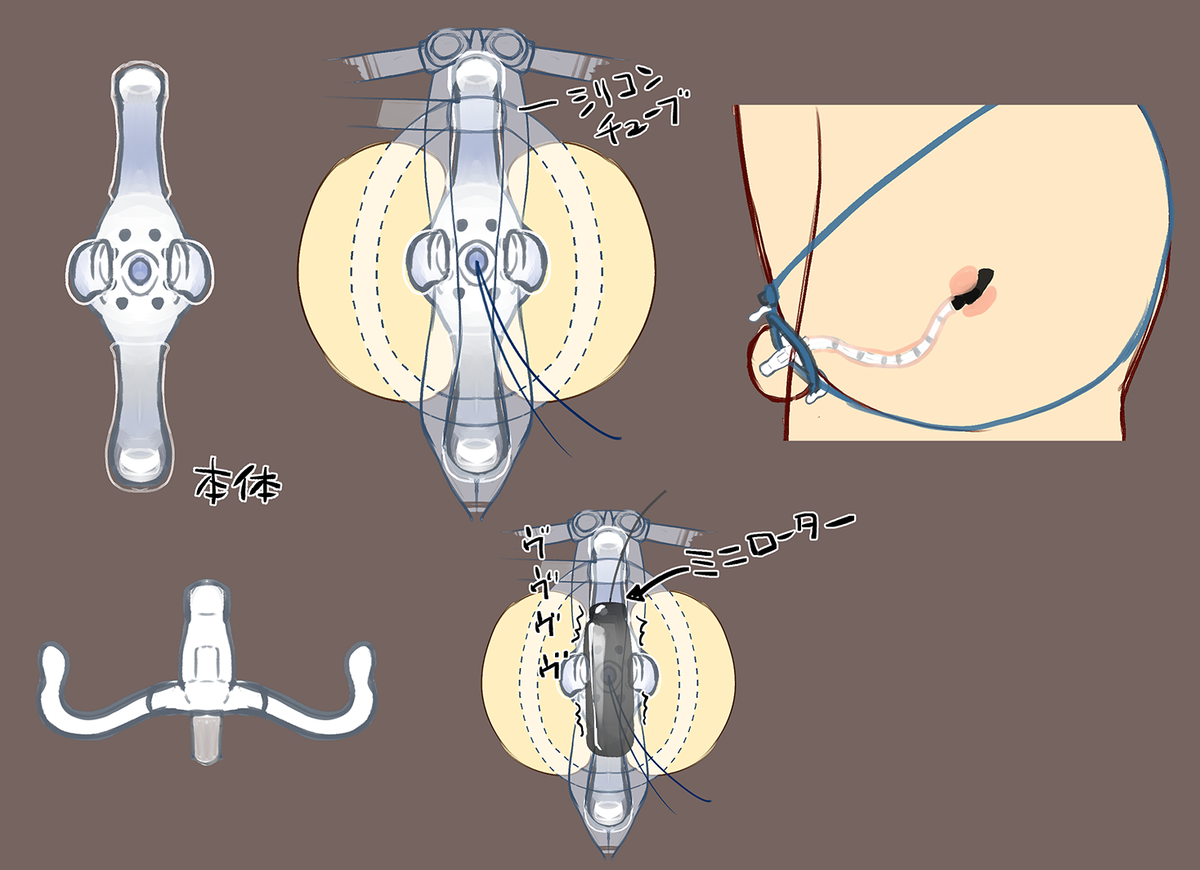
In an entry published in November 2022, Mr. Okada reports that vertical tubing and pressure from the plate did not hold reliably. The testicles retracted unexpectedly, and the buried portion emerged again. He attributed that movement to a loss of support.
The replacement plan had 2 vertical tubes and 2 horizontal tubes about 5 cm apart, connected to a ring behind the testicles. This grid surrounded the penis head and held the gatekeeper against it. His later recommendation was to abandon fastening based on testicle constriction.
(Source: ok-lab's diary, published November 2022)
https://ok-lab.hatenablog.com/entry/2022/11/05/122757
(Source: ok-lab's diary, published November 2022)
https://ok-lab.hatenablog.com/entry/2022/11/26/122622
Gatekeeper skin discomfort appeared after several days of testing
In an entry published in November 2022, Mr. Okada describes earlier prolonged tests with a ring fixed around the testicle base. He reports that mild skin irritation consistently appeared after about 3 days of continuous wear. He wondered whether his own skin sensitivity contributed.
In the grid tests, he also reports skin becoming trapped painfully against the tubing or gatekeeper. He says petroleum jelly allowed the skin to slide free more readily. His advice at that stage focused on reducing friction with petroleum jelly.
(Source: ok-lab's diary, published November 2022)
https://ok-lab.hatenablog.com/entry/2022/11/05/122757
Crossed gatekeeper straps reduced tilting but complicated toilet use
In an entry published in November 2022, Mr. Okada describes abandoning an intermediate plate arrangement because it tilted sideways. He changed to crossed fastening while retaining the gatekeeper body used for the grid design. He reports improved stability with that arrangement.
However, he says urine could travel outside the toilet bowl during seated urination. The hanging testicles also obstructed washing with the toilet's water spray, making hand assistance necessary. For discomfort around the testicle base, he favored greater separation between the rear belt attachments.
(Source: ok-lab's diary, published November 2022)
https://ok-lab.hatenablog.com/entry/2022/11/19/122516
Separating gatekeeper components still caused pain in December testing
In an entry published in December 2022, Mr. Okada reports testing a prostate chip separately from a urethral rod (an internal supporting component). Pain around the prostate began after a few hours. A separation of about 1-2cm between the components did not resolve it.
He reports that the pain continued until the prostate chip was removed. He suspected pressure from the compressed tissues, while acknowledging that other conditions might have contributed. He said further testing under different conditions was needed.
(Source: ok-lab's diary, published December 2022)
https://ok-lab.hatenablog.com/entry/2022/12/03/122846
Rigid gatekeeper components were linked to bleeding during testing
In an entry published in December 2022, Mr. Okada reports continuing a rigid-rod test despite mild pain, followed by bleeding. He suspected excessive stimulation of the sphincter (the muscle involved in stopping urine flow). He paused buried retention for about one and a half days.
In the same entry, he reports no prostate-area pain with a separate chip and a softer pushing assembly. That assembly included a short ceramic tip, 3 cm of tubing, and an overall length of about 6 cm. He also suggested that a prostate chip alone could provide enough stimulation for someone sufficiently sensitive.
(Source: ok-lab's diary, published December 2022)
https://ok-lab.hatenablog.com/entry/2022/12/10/123048
Experimental gatekeeper rods caused urine leakage during the maker's trial
In an entry published in December 2022, Mr. Okada reports leakage during tests of a rod assembly with a ridged section. He thought the sphincter could not close completely when it gripped that section. He judged the arrangement unsuitable for his own continuous wear.
The subsequent design had 8 holes, with 4 at each end, to stabilize its thread connections. He announced that sales of the experimental rods would begin the following year. For buried retention, he favored the revised arrangement with separate chip and rod components.
(Source: ok-lab's diary, published December 2022)
https://ok-lab.hatenablog.com/entry/2022/12/24/122944
January gatekeeper straps changed again after pressure caused pain
An entry published in January 2023 describes a layout keeping the testicles apart and abandoning thin fastening wire. Mr. Okada considered that wire dangerous where it pressed against the surrounding skin. A crossbar on the testicle side also caused pain after about half a day of skin contact.
Its length changed from 6 cm to about 4 cm. Clothing straps were proposed to reduce visibility under thin clothes, but he found them more likely to slip against skin. He said holding strength needed fresh testing and suggested tubing might still be necessary for firm fastening.
(Source: ok-lab's diary, published January 2023)
https://ok-lab.hatenablog.com/entry/2023/01/14/122952
The maker's answer to keeping a gatekeeper in place
Mr. Okada moved away from testicle constriction, while continuing to revise contact materials and the relationship between internal components.
Silicone coatings were the maker's preference for prolonged gatekeeper contact
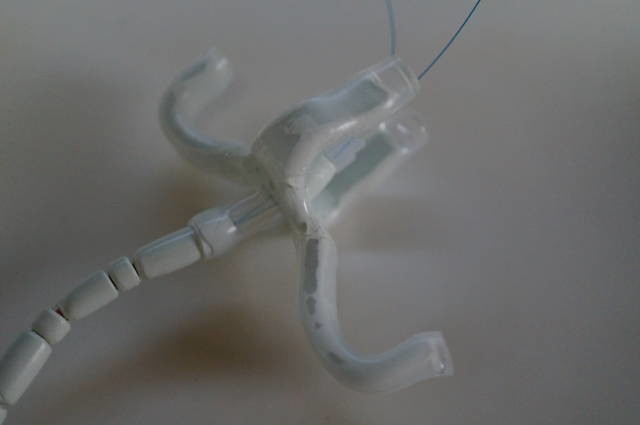
In an entry published in November 2022, the full-specification gatekeeper combined epoxy resin (the hard body material) with silicone (a flexible coating). The coating covered areas contacting the testicles. Mr. Okada considered it kinder to skin during prolonged contact.
Chip connections had 2 forms: silicone tubing and a floating four-wire connector (a flexible link between chip and gatekeeper). As published in November 2022, tubing was effectively free; the floating four-wire connection cost ¥6,000 (about $38 at ¥156 = $1, rate as of 2026-09-04) tax excluded. He advised choosing according to preference, acknowledging advantages and drawbacks in both connections.
(Source: ok-lab's diary, published November 2022)
https://ok-lab.hatenablog.com/entry/2022/11/12/122932
Avoiding testicle constriction became the maker's answer for gatekeeper fastening
In an entry published in November 2022, Mr. Okada explains why he stopped prototyping the original grid arrangement. He had explored it when he thought tightening around the testicles was necessary to maintain the buried position. Once an approach without that tightening became possible, he changed direction.
He considered testicle constriction risky because he could not predict what might happen. He recommended a method without that tightening, which he regarded as the safer direction.
(Source: ok-lab's diary, published November 2022)
https://ok-lab.hatenablog.com/entry/2022/11/26/122622
Separate internal components were proposed to address gatekeeper instability
In an entry published in November 2022, a customer asked about a sliding chip connection inside gatekeeper tubing. Staff said the design was not ready to supply; the customer replied that they would wait. Mr. Okada thought a flexible connection near the opening could make the held position unstable.
He proposed separate parts: a prostate-positioned chip and a pushing chip supporting the buried position. The diary does not record whether that customer's proposed order was completed. He recommended separating those roles rather than relying on a movable connection near the urethral opening.
(Source: ok-lab's diary, published November 2022)
https://ok-lab.hatenablog.com/entry/2022/11/26/122622
If you see blood in your urine, even a small amount or for the first time, do not wait and see. See a urologist right away. If you suddenly cannot urinate, or the device cannot be removed, do not try to fix it yourself. Go to a medical facility, including emergency care, immediately.
How keeping a gatekeeper in place changed over time
| Published | What the diary said then |
|---|---|
| Nov 2022 | A grid arrangement followed failures of vertical tubing and plate pressure alone. |
| Nov 2022 | Silicone coating was selected for prolonged skin contact; two connection types were described. |
| Nov 2022 | Crossed fastening addressed sideways tilting but introduced toilet difficulties. |
| Nov 2022 | Testicle-tightening prototypes were abandoned; separate internal support roles were proposed. |
| Dec 2022 | The maker's separated-component test still produced pain after several hours. |
| Dec 2022 | Bleeding during rigid-rod testing led to a pause in buried retention. |
| Dec 2022 | Leakage made the ridged rod unsuitable for the maker's continuous wear. |
| Jan 2023 | Mr. Okada reports improved stability after changing from 4 to 6 attachment points. |
| Jan 2023 | Thin fastening wire was abandoned; clothing straps required renewed testing. |
The diary does not say what the current state is.
OK Prostate Chip products related to keeping a gatekeeper in place
The short ceramic chip and short stainless ring chip appear on the current product list.
Products that appear in these entries
| Product (official name) | Price incl. tax | Relation to this topic |
|---|---|---|
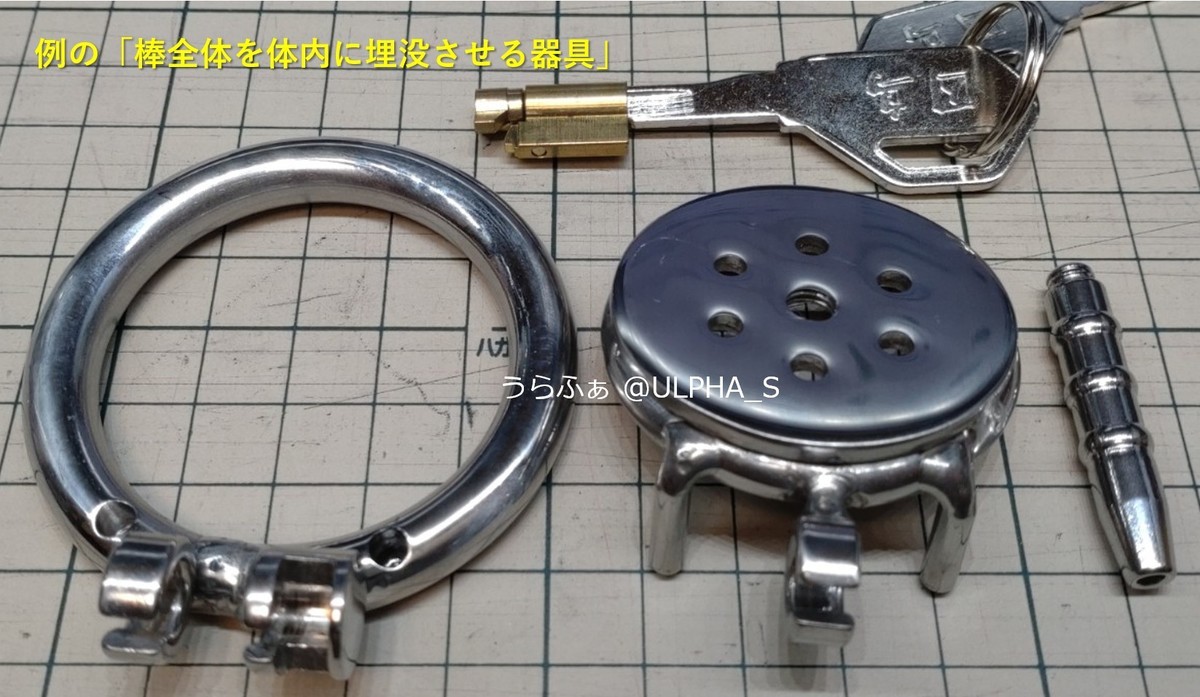
| Short stainless ring chip (OKプロステートチップ ステンレスリング ショートタイプ) | ¥3,300 (about $21 at ¥156 = $1, rate as of 2026-09-04) | In December 2022, a customer proposed it as a pushing component; Mr. Okada raised concerns about friction. |
| Short ceramic chip (OKプロステートチップ 陶器素材ショートタイプ) | ¥3,300 (about $21 at ¥156 = $1, rate as of 2026-09-04) | In December 2022, this component formed the tip of Mr. Okada's separate pushing assembly. |
(Source: ok-lab's diary, published December 2022)
https://ok-lab.hatenablog.com/entry/2022/12/03/122846
(Source: ok-lab's diary, published December 2022)
https://ok-lab.hatenablog.com/entry/2022/12/10/123048
Products the diary mentioned as alternatives
The diary names no alternative.
Historical gatekeeper and rod prototypes: No matching product can be confirmed on the current list.
Common worries about keeping a gatekeeper in place
Readers asked about clothing, changing internal length, and interchangeable components while the designs were still being developed.
"Will gatekeeper straps look flat under underwear?"
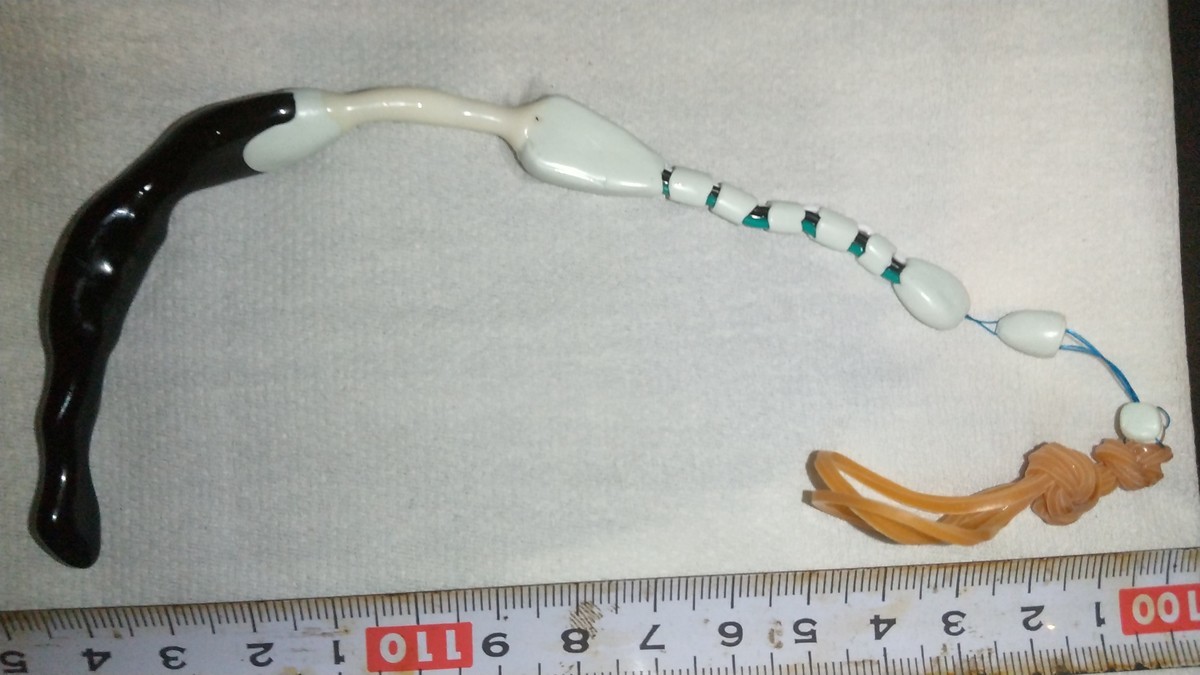
In an entry published in November 2022, a reader asked how the grid gatekeeper would look under women's underwear. Mr. Okada replied that underwear with a narrow crotch could leave part of the testicles exposed. He also thought increased testicle fullness could lift the fabric.
The reader replied that the photographs clarified these limits. Mr. Okada's eventual recommendation in that exchange favored a redesign without testicle constriction.
(Source: ok-lab's diary, published November 2022)
https://ok-lab.hatenablog.com/entry/2022/11/19/122516
"Can gatekeeper fit be based on one length measurement?"
In an entry published in November 2022, a customer asked how the distance between gatekeeper and chip would be measured. Staff said the prototype was not ready and declined the proposed customer testing arrangement. Mr. Okada believed internal tissue movement and changes in size could alter the required length.
He suggested that the buried penis could bend painfully when it had no room to move inward or outward. The diary does not record a settled sizing method for that reader. Mr. Okada favored separating support for the buried position from the prostate chip.
(Source: ok-lab's diary, published November 2022)
https://ok-lab.hatenablog.com/entry/2022/11/26/122622
"Can gatekeeper parts be ordered in different combinations?"
In an entry published in December 2022, a reader proposed a short stainless ring component and asked about interchangeable connections. Mr. Okada thought the ring's friction could make it difficult unless the urethra was already substantially widened. He said custom threaded fittings or requested hole sizes might be possible, depending on demand.
However, his tests with a separate prostate chip had caused pain that woke him during sleep. The diary does not record a completed order from this exchange. He supported flexible combinations in principle, while stressing that his own results with the combined arrangement remained unsatisfactory.
(Source: ok-lab's diary, published December 2022)
https://ok-lab.hatenablog.com/entry/2022/12/03/122846
Buying from outside Japan

OK Lab ships internationally to countries covered by Japan Post's EMS courier service. Overseas orders are paid in advance by PayPal. Each order carries a ¥400 (about $3 at ¥156 = $1, rate as of 2026-09-04) handling fee, and EMS shipping is charged on top. These terms come from OK Lab's official sales-terms page (written here as plain text, not a link: ok-lab.net/docs/law), checked on September 7, 2026; confirm them on the official store before you order, because they can change.
Summary of this article
| What you wanted to know | The answer |
|---|---|
| What is the short answer? | The original tightening approach was abandoned, and later fastening designs remained under revision. |
| What is this product? | A urethral device made by OK Lab in Japan, with prices in Japanese yen. |
| What does gatekeeper mean? | An external plate intended to maintain the penis in a buried position. |
| What went wrong during testing? | Mr. Okada reported movement, skin irritation, pain, bleeding, and urine leakage across different arrangements. |
| What did the maker propose? | Avoiding testicle constriction and separating internal support roles, with continuing tests. |
| How did the design change? | The entries follow grid fastening, crossed fastening, and further plate and strap revisions. |
| What current products appear here? | Short ceramic and stainless ring chips, each listed at ¥3,300 (about $21 at ¥156 = $1, rate as of 2026-09-04) including tax. |
| What did readers ask? | Whether clothing would look flat, how length worked, and whether components could be combined. |
| How do overseas orders work? | Advance PayPal payment, a ¥400 (about $3 at ¥156 = $1, rate as of 2026-09-04) handling fee, and additional Japan Post EMS shipping charges. |
Source: ok-lab's diary (Okada Comfortable Life Laboratory). The original entries are in Japanese; quotations on this page are translated. Photos and videos are on the original entries.
This article is a summary of the maker's development diary. The product is not a medical device and no result is guaranteed. If anything feels wrong or worries you, see a doctor. Prices, specifications and cautions change, so confirm the latest information on the official blog and the official site. Questions about ordering and shipping go to the seller.