![Can I change chip position later? | Some parts slide; flexible joints bend [OK Prostate Chip]](/img/a/T0025/eyecatch.svg)
This page is based on entries from "ok-lab's diary" (https://ok-lab.hatenablog.com/), the Japanese development diary written by Mr. Okada, founder of OK Lab, a small company in Japan (Okada Comfortable Life Laboratory). Only the entries about "three-hole position adjustment and flexible joints" are summarized here, in order of publication. Past prices and sizes are as written at the time. Current prices come from the official product list (retrieved September 4, 2026). Quotations are translated from Japanese.
Note: This page is a personal reading log by someone with no connection to the maker or the seller. It reflects the source entries as of their publication dates and makes no guarantee of accuracy or safety. The product is not a medical device; talk to a doctor about any health decision. Check the official site for current information. This page contains advertising.
In short
Three-hole attachments allow spacing changes; flexible joints allow the chip itself to bend.
Mr. Okada developed adjustable designs but warned that stoppers and flexible joints cannot guarantee protection against inward movement.
Three-hole attachments remain on the current product list; the flexible-joint charges below were published in January 2026.
If you see blood in your urine, even a small amount or for the first time, do not wait and see. See a urologist right away.
If you suddenly cannot urinate, or the device cannot be removed, do not try to fix it yourself. Go to a medical facility, including emergency care, immediately.
About this product

The OK Prostate Chip is a small device that is placed in the urethra (the urine passage) so that it acts on the prostate; the maker sells it in several shapes, sizes and materials. It is made and sold by OK Lab (Okada Comfortable Life Laboratory), a small company in Japan, through its own online store, and prices are in Japanese yen (JPY).
The maker's development diary, "ok-lab's diary", is written in Japanese. This page is an English summary of it, and every quotation is translated. OK Lab ships internationally, so readers outside Japan can order (see "Buying from outside Japan" below).
Product names on this page are plain-English descriptions. The official Japanese product name is shown once in the product table so you can find the same item in the store.
Before you read: key terms
| Term | Plain-English meaning |
|---|---|
| Three-hole attachment | A small part with three thread holes, allowing its position along the chip's thread to change. |
| Auxiliary chip | An extra piece behind the main chip, intended to help move or retain it. |
| Sphincter stopper | A part intended to resist movement past a urinary sphincter, the muscle discussed in the diary. |
| Sliding screw | A twisted auxiliary chip that can move along its supporting thread or wire, allowing spacing changes. |
| Flexible joint | A bendable connection between chip sections, allowing their shape to change. |
| Nitinol | The shape-memory wire used to support flexible connections and loops. |
| Resin | The coating and bonding material used to secure threads and connections. |
| Reinforcement | Wire support along ceramic sections, intended to keep pieces connected if the ceramic breaks. |
| Safety chip | An external thread-end component; its three-hole version allows position adjustment. |
| Silicone rubber | The covering around flexible joints, used to contain and limit movement of the wire. |
What happens: chip position adjustment
The OK Prostate Chip sits in the urethra, the urine passage, to act on the prostate. Three-hole attachments (small parts with three thread holes) have adjustable positions along the thread connected to the main chip. They include internal support pieces and external stoppers, allowing the distance between parts to change. Later flexible joints (bendable links between chip sections) let the device change shape, while sliding attachments change their spacing.
Coating failures preceded the move toward adjustable chip spacing
In an entry published in February 2018, Mr. Okada reported 2 cases of peeling resin (the coating around thread connections) on linked chips. He attributed the problem to thread forces acting in the opposite direction during insertion. February shipments received thicker coatings, although he said these could still fail.
Mr. Okada offered replacement after photographic confirmation for affected January 2018 shipments. The diary does not record whether replacements were sent. He cautioned that repeated peeling would not qualify for another replacement.
(Source: ok-lab's diary, published February 2018)
https://ok-lab.hatenablog.com/entry/20180214/1518601774
A tester reported bleeding before adjustable chip spacing was introduced
In an entry published in June 2018, a tester reported a little bleeding and discomfort, which they attributed to the stopper rubbing inside. The tester stopped that attempt and later reported successful placement, but also an unfamiliar, nearly painful sensation. Mr. Okada acknowledged that his own tests had missed the possibility of injury. He said he would consider changes before formal sale.
(Source: ok-lab's diary, published June 2018)
https://ok-lab.hatenablog.com/entry/20180609/1528523953
Another bleeding report prompted a revised adjustable stopper
The same June 2018 entry contains a separate tester's report of initial comfort followed by bleeding during prolonged use. That tester found a rough edge on the stopper. Mr. Okada apologized and suspected that additional coating had introduced the defect. His response was a revised connection with finished edges and adjustable spacing, which he expected to improve manufacturing consistency.
(Source: ok-lab's diary, published June 2018)
https://ok-lab.hatenablog.com/entry/20180609/1528523953
Three-hole attachments made previously fixed positions adjustable along the thread
In an entry published in June 2018, Mr. Okada announced a patent application for the through-hole arrangement. Its 3 holes allowed the safety chip (the external thread-end component) to change position. The auxiliary chip (an extra piece behind the main chip) could also move along the thread.
Previously, their fixed positions could leave the thread too long or too short for the user. Mr. Okada pointed readers seeking position adjustment toward the three-hole options.
(Source: ok-lab's diary, published June 2018)
https://ok-lab.hatenablog.com/entry/20180630/1530342059
Twelve-hole adjustable stoppers brought greater resistance and separate prices
In an entry published in July 2023, Mr. Okada introduced 12-hole sphincter stoppers (supports near the urinary muscle) for four-thread assemblies. He said they remained adjustable but resisted sliding much more than the three-hole or six-hole versions. Published prices were ¥3,000 (about $19 at ¥156 = $1, rate as of 2026-09-04) excluding tax for the M or L sphincter stopper and ¥2,500 (about $16 at ¥156 = $1, rate as of 2026-09-04) excluding tax for the external stopper. Mr. Okada offered them as additions to pending custom orders, with a possible delivery delay.
(Source: ok-lab's diary, published July 2023)
https://ok-lab.hatenablog.com/entry/2023/07/15/123004
Sliding screws retained their spacing while the entire assembly escaped
In an entry published in November 2025, Mr. Okada tested sliding screws (twisted auxiliary chips) on looped nitinol (shape-memory wire). He reported that screw spacing could change after the main chip was in place. Individual screws generally kept their spacing during urination and removal, according to his account. That did not mean the whole assembly stayed inside.
When the urine passage was very slippery, he reported the assembly shooting out despite light pressure holding it. After a four-thread prototype proved difficult to remove, Mr. Okada favored a fixed screw nearest the end loop.
(Source: ok-lab's diary, published November 2025)
https://ok-lab.hatenablog.com/entry/2025/11/01/122937
An adjustable loop needed a different attachment position to stay put
In an entry published in November 2025, Mr. Okada tested an adjustable end loop attached to the main wire. The initial arrangement slipped out easily during urination. A changed attachment position stayed in place during his tests, and he reported easier removal with a retrieval thread.
He nevertheless found the revised arrangement slower to insert than the ordinary multi-screw design. Mr. Okada offered the revised loop connection for an additional ¥1,000 (about $6 at ¥156 = $1, rate as of 2026-09-04) excluding tax, as published in November 2025.
(Source: ok-lab's diary, published November 2025)
https://ok-lab.hatenablog.com/entry/2025/11/08/122932
Flexible joints added bending, with charges depending on chip type
In an entry published in January 2026, Mr. Okada introduced flexible joints between ceramic chip sections. The gap was about 15 mm, including resin-supported ends and a rubber-covered middle of about 5 mm.
Short and mid-length ceramic chips carried an additional ¥4,000 (about $26 at ¥156 = $1, rate as of 2026-09-04) excluding tax processing charge. The double-twist, multi-bulge and long ceramic types carried an additional ¥5,000 (about $32 at ¥156 = $1, rate as of 2026-09-04) excluding tax, as published in January 2026. Mr. Okada limited these options to versions without raised bumps.
(Source: ok-lab's diary, published January 2026)
https://ok-lab.hatenablog.com/entry/2026/01/17/122907

The maker's answer to chip position adjustment
Mr. Okada changed coatings, connections and flexibility while acknowledging limits to how securely the devices stayed in place.
Adjustable stoppers still could not reliably prevent movement toward the bladder
In an entry published in June 2018, Mr. Okada described a stopper with selectable dimensions and adjustable spacing. He reported favorable experiences in his own tests. However, he said customer reports showed that the stopper could not reliably prevent movement into the bladder. Mr. Okada cautioned readers against expecting too much from that feature.
(Source: ok-lab's diary, published June 2018)
https://ok-lab.hatenablog.com/entry/20180616/1529136608
Flexible joints replaced an effectively discontinued nylon-core bent connection
In an entry published in January 2026, a customer requested an older bent connection. Mr. Okada replied that it was effectively discontinued because its soft nylon core was unstable, its rubber peeled easily, and angles were difficult to control.
He then made a wire-supported prototype, priced at an additional ¥3,000 (about $19 at ¥156 = $1, rate as of 2026-09-04) excluding tax over the ordinary screw-assisted chip. The diary does not record whether the customer's order was completed. Mr. Okada also offered plain rubber coating when no particular angle was required.
(Source: ok-lab's diary, published January 2026)
https://ok-lab.hatenablog.com/entry/2026/01/24/122909
Flexible joints changed the core after earlier linked-chip breakages
In an entry published in January 2026, Mr. Okada revisited a curved two-chip design (sea-slug version 5). He reported earlier connection breakages and said reports stopped after he limited the bend to about 45 degrees.
The redesign replaced the cord inside the connection with nitinol wire and reduced the resin thickness. Mr. Okada specified reinforcement (wire support along the ceramic) as standard, while also offering reinforcement limited to the connection area.
(Source: ok-lab's diary, published January 2026)
https://ok-lab.hatenablog.com/entry/2026/01/31/122917
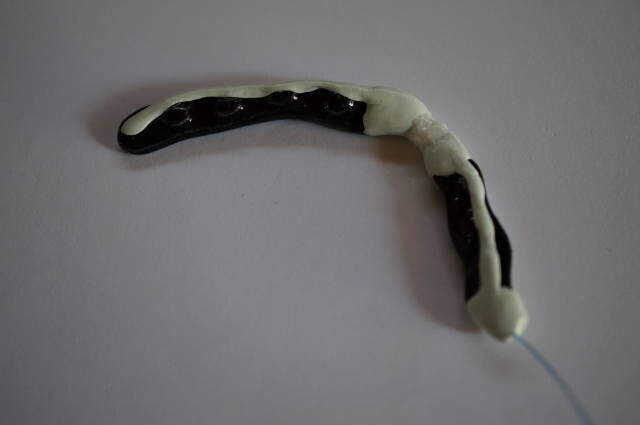
Stiff flexible joints prompted a thinner rubber-covered prototype
In an entry published in February 2026, customer feedback led Mr. Okada to acknowledge that existing flexible joints could be too stiff. Some users struggled with insertion or removal. He tested a thinner rubber covering over a narrow tube and reported easier bending in his own trial.
His shorter version retained a 15 mm gap with about 5 mm of flexible rubber. Mr. Okada offered the easier-bending version at the previous price, while noting reduced pressure and sensation.
(Source: ok-lab's diary, published February 2026)
https://ok-lab.hatenablog.com/entry/2026/02/07/122919
If you see blood in your urine, even a small amount or for the first time, do not wait and see. See a urologist right away.
If you suddenly cannot urinate, or the device cannot be removed, do not try to fix it yourself. Go to a medical facility, including emergency care, immediately.
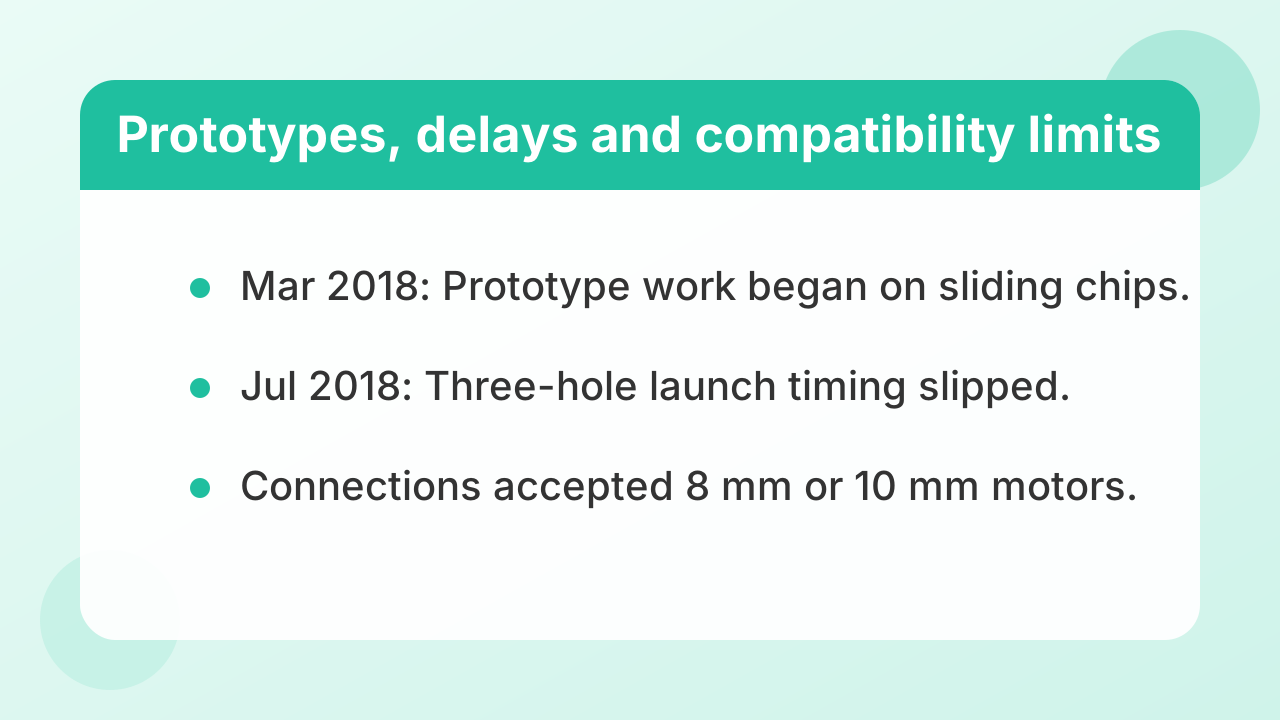
How chip position adjustment changed over time
| Published | What the diary said then |
|---|---|
| Mar 2018 | Prototype work began on sliding second chips with separate threads. |
| Jul 2018 | Three-hole launch timing slipped because orders for the newly released chip occupied production. |
| Aug 2023 | Cable-specific stoppers required attachment before delivery, but their positions remained adjustable. |
| Mar 2025 | A request for three sliding M-size screws prompted an experimental assembly. |
| Feb 2026 | Flexible vibrating connections accepted 8 mm or 10 mm motors; 6 mm was excluded. |
OK Prostate Chip products related to chip position adjustment
The current list includes three-hole attachments; the custom flexible-joint charges above are historical quotations.
Products that appear in these entries
| Product (official name) | Price incl. tax | Relation to this topic |
|---|---|---|
| Three-hole sphincter stopper (三穴方式オプションチップ(括約筋ストッパーチップ)) | ¥1,650 (about $11 at ¥156 = $1, rate as of 2026-09-04) | The July 2018 entry explained this stopper as part of the adjustable three-hole arrangement. |
| Three-hole auxiliary chip (三穴方式オプションチップ(補助チップ)) | ¥1,650 (about $11 at ¥156 = $1, rate as of 2026-09-04) | The July 2018 entry showed this additional chip within the system for changing attachment positions. |
| Three-hole external stopper (三穴方式オプションチップ(亀頭外側ストッパーチップ)) | ¥1,100 (about $7 at ¥156 = $1, rate as of 2026-09-04) | The July 2018 entry identified this external component in its explanation of adjustable attachments. |
| Three-hole safety chip (三穴方式オプションチップ(セーフティチップ)) | ¥550 (about $4 at ¥156 = $1, rate as of 2026-09-04) | The July 2018 entry included this thread-end component in the position-adjustment system. |
(Source: ok-lab's diary, published July 2018)
https://ok-lab.hatenablog.com/entry/20180707/1530947332
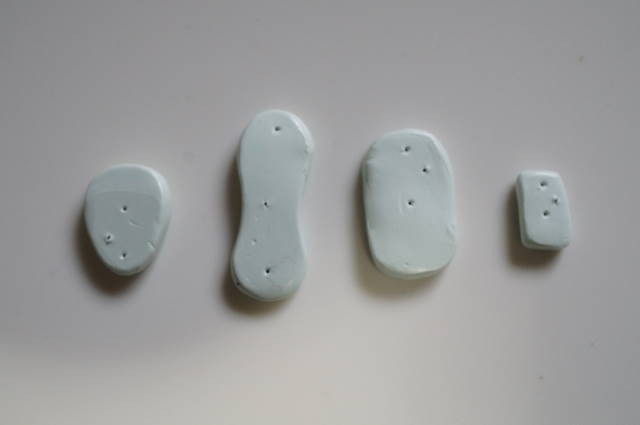
Products the diary mentioned as alternatives
The diary names no alternative.
The other builds include twelve-hole stoppers and custom assemblies with sliding screws, adjustable loops, flexible joints, or chipless wire loops. No matching product can be confirmed on the current list.
Common worries about chip position adjustment
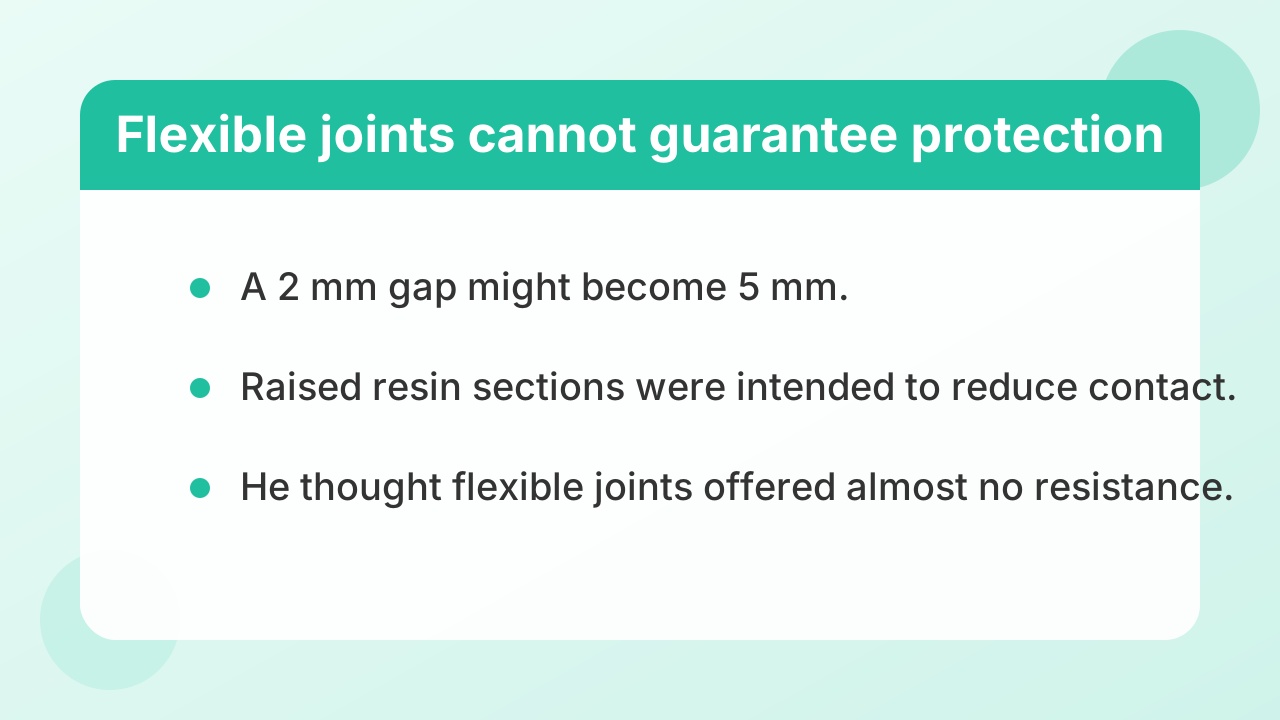
The replies distinguish adjustable spacing, contact with rubber, and resistance to inward movement.
"Can sliding screws have three holes?"
In an entry published in November 2019, a customer asked for an adjustable screw-shaped auxiliary chip and changes to its thickness. Mr. Okada said combining 3-hole construction with twisting was beyond his manufacturing method; he also saw functional problems with the thread arrangement. Thickness changes were possible within manufacturing limits.
He offered an unfixed screw instead, but warned that a 2 mm gap might become 5 mm by removal. The diary does not record a resulting order or user trial. Mr. Okada made the offer conditional on accepting that possible movement.
(Source: ok-lab's diary, published November 2019)
https://ok-lab.hatenablog.com/entry/2019/11/23/162919
"Can flexible joints reduce contact with the rubber?"
In an entry published in January 2026, Mr. Okada revisited a customer's request for a long, thin chip. The customer had also reported that silicone (the joint's rubber material) did not suit their skin.
His prototype used raised resin sections beside the rubber joint, intended to reduce contact with the lining of the urine passage. He showed a mid-length S prototype; the diary does not record that customer's response to it. Mr. Okada presented the design for people concerned about contact with the rubber section.
(Source: ok-lab's diary, published January 2026)
https://ok-lab.hatenablog.com/entry/2026/01/24/122909
"Can flexible joints stop movement toward the bladder?"
In an entry published in August 2026, a customer reported inward movement despite a stopper and asked about softer joints or chipless designs. Mr. Okada first asked whether the device moved inward without deliberate pushing. He thought flexible joints offered almost no resistance to movement toward the bladder because they readily followed the urine passage.
He considered chipless wire loops more resistant to shape changes, but said sufficient force could still flatten them. He thought an adjustable locking loop might work best, while stressing that this was theoretical. Mr. Okada cautioned that these suggestions might fail for this customer; the diary does not record a later trial.
(Source: ok-lab's diary, published August 2026)
https://ok-lab.hatenablog.com/entry/2026/08/01/122916
Buying from outside Japan

OK Lab ships internationally to countries covered by Japan Post's EMS courier service. Overseas orders are paid in advance by PayPal. Each order carries a ¥400 (about $3 at ¥156 = $1, rate as of 2026-09-04) handling fee, and EMS shipping is charged on top. These terms come from OK Lab's official sales-terms page (written here as plain text, not a link: ok-lab.net/docs/law), checked on September 7, 2026; confirm them on the official store before you order, because they can change.
Summary of this article
| What you wanted to know | The answer |
|---|---|
| In short: can positions change? | Some attachments slide; flexible joints change shape. |
| About this product: who makes it? | OK Lab in Japan makes the urethral device; prices are in JPY. |
| Key terms: what is adjustable? | Attachment spacing and joint flexibility describe different features. |
| What happens: what problems appeared? | Reports included peeling coatings, bleeding, unwanted movement and difficult removal. |
| The maker's answer: what changed? | Connections and coatings changed, but the maker acknowledged limits to how securely devices stayed in place. |
| Changes over time: was development continuous? | The entries record separate prototypes, release delays and compatibility limits. |
| Related products: what is listed today? | Three-hole attachments appear on the supplied current list. |
| Common worries: does flexibility prevent inward movement? | Mr. Okada said it offered almost no resistance to that movement. |
| Buying abroad: what are the terms? | Advance PayPal payment, a ¥400 (about $3 at ¥156 = $1, rate as of 2026-09-04) handling fee and additional EMS shipping. |
Source: ok-lab's diary (Okada Comfortable Life Laboratory). The original entries are in Japanese; quotations on this page are translated. Photos and videos are on the original entries.
This article is a summary of the maker's development diary. The product is not a medical device and no result is guaranteed. If anything feels wrong or worries you, see a doctor. Prices, specifications and cautions change, so confirm the latest information on the official blog and the official site. Questions about ordering and shipping go to the seller.