![Will leaving a chip in strain my sphincter? | Thinner connections were the maker's approach, with setbacks [OK Prostate Chip]](/img/a/T0023/eyecatch.svg)
This page is based on entries from "ok-lab's diary" (https://ok-lab.hatenablog.com/), the Japanese development diary written by Mr. Okada, founder of OK Lab, a small company in Japan (Okada Comfortable Life Laboratory). Only the entries about reducing sphincter strain while a chip stays in place are summarized here, in order of publication. Past prices and sizes are as written at the time. Current prices come from the official product list (retrieved September 4, 2026). Quotations are translated from Japanese.
This article is about muscle strain while a small device stays in the urine passage, and summarizes design changes and reported problems. It also describes current products, reader questions, what remains unknown, and buying from outside Japan.
Note: This page is a personal reading log by someone with no connection to the maker or the seller. It reflects the source entries as of their publication dates and makes no guarantee of accuracy or safety. The product is not a medical device; talk to a doctor about any health decision. Check the official site for current information. This page contains advertising.
In short
Sphincter strain featured in reports of injury, discomfort, and difficulty closing the urine passage.
Mr. Okada proposed thinner connections and support farther from the sphincter to reduce strain.
Current listings include established chips, while several later custom designs have no confirmed product match.
If you see blood in your urine, even a small amount or for the first time, do not wait and see. See a urologist right away. If you suddenly cannot urinate, or the device cannot be removed, do not try to fix it yourself. Go to a medical facility, including emergency care, immediately.
About this product

The OK Prostate Chip is a small device that is placed in the urethra (the urine passage) so that it acts on the prostate; the maker sells it in several shapes, sizes and materials. It is made and sold by OK Lab (Okada Comfortable Life Laboratory), a small company in Japan, through its own online store, and prices are in Japanese yen (JPY). The maker's development diary, "ok-lab's diary", is written in Japanese. This page is an English summary of it, and every quotation is translated. OK Lab ships internationally, so readers outside Japan can order (see "Buying from outside Japan" below). Product names on this page are plain-English descriptions. The official Japanese product name is shown once in the product table so you can find the same item in the store.
Before you read: key terms
| Term | Plain-English meaning |
|---|---|
| Urethra | The urine passage; it carries urine and houses the chip. |
| Urinary sphincters | Muscles closing the urine passage; the diary also describes them holding chips. |
| Internal urinary sphincter | The muscle at the bladder end of the prostate; it helps close the urine passage. |
| Bulbar urethra | The wider passage beyond the external sphincter; some designs anchor chips there. |
| Screw add-on | A twisted retaining piece connected to a chip; it provides additional support. |
| Tail | Tubing covering retrieval thread, intended to reduce thread pressure. |
| Chipless loop | A wire loop used instead of a solid chip; it provides support and prostate stimulation. |
| Guide loop | A small leading wire loop intended to help chipless devices pass the sphincter. |
| Balloon catheter | A urine-drainage tube held by a balloon in the bladder; urine passes through the tube. |
What happens: sphincter strain
The OK Prostate Chip is a small device placed in the urethra (urine passage) to act on the prostate. These entries concern urinary sphincters (muscles that close the urine passage) around the prostate and pressure from a device left there. Mr. Okada's designs replace bulky sections there with thinner thread, tubing, or wire, while other parts help keep the chip in place.
Sphincter strain reports led to restrictions on the early long chip
In an entry published in December 2017, Mr. Okada reported sphincter injury during a monitor's long-chip test. His own testing had included nightly breaks, unlike the monitor's continuous wear. He suspected the longer device could place excessive force on the sphincter when its position changed.
He developed linked chips with thread between their solid parts to reduce that force. The diary does not record the injured monitor's recovery. Mr. Okada restricted the long chip's sale to short-duration use.
(Source: ok-lab's diary, published December 2017)
https://ok-lab.hatenablog.com/entry/20171231/1514712104
A longer narrow section was proposed to ease sphincter strain
In an entry published in December 2019, Mr. Okada introduced an extended-neck twist chip ahead of its planned release. The announced price was ¥6,000 (about $38 at ¥156 = $1, rate as of 2026-09-04) excluding tax. He expected its long narrow section to accommodate different prostate sizes. Mr. Okada presented that shape as an option for reducing sphincter strain.
(Source: ok-lab's diary, published December 2019)
https://ok-lab.hatenablog.com/entry/2019/12/28/131319
A short resin chip's claimed reduction in sphincter strain came with expulsion
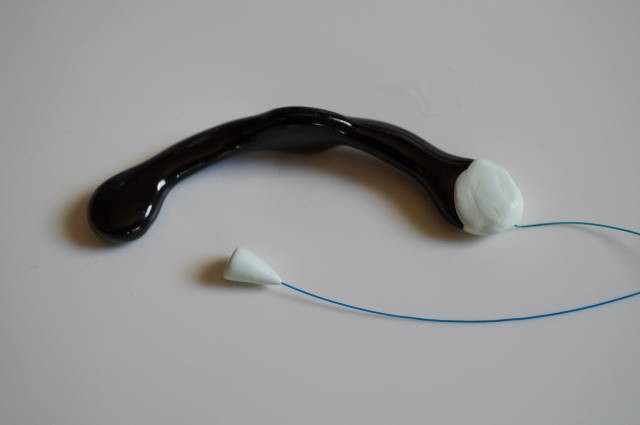
In an entry published in September 2021, Mr. Okada described a 15mm blue-resin chip that sat entirely within the prostate region. He claimed this avoided loading the sphincters on either side. The published chip price was ¥3,500 (about $22 at ¥156 = $1, rate as of 2026-09-04) excluding tax, with its guiding wire priced at ¥500 (about $3 at ¥156 = $1, rate as of 2026-09-04).
The chip came in 4 sizes: SS, S, M, and L. The entry also acknowledged that the guiding wire could catch the chip and bring it out unintentionally. Mr. Okada warned that ordinary urination could eject the chip into the toilet.
(Source: ok-lab's diary, published September 2021)
https://ok-lab.hatenablog.com/entry/2021/09/04/125843
Low sphincter strain during retention did not prevent painful removal
In an entry published in February 2024, Mr. Okada described an arrow-shaped prototype with very thin sections beside its wider parts. He reported little strain when it sat correctly, but removing it proved difficult.
After difficult removal, he reported mild pain during about 2 subsequent urinations. He had not observed bleeding in those tests. Mr. Okada nevertheless warned of possible bleeding and described the design as dangerous.
(Source: ok-lab's diary, published February 2024)
https://ok-lab.hatenablog.com/entry/2024/02/10/123023
Thicker wire raised concerns about sphincter strain and incomplete closure
In an entry published in February 2025, Mr. Okada compared a customer's requested 0.4mm wire design with a 0.3mm version. These chipless loops (wire loops replacing solid chips) resisted flattening more when made with the thicker wire. He warned that an overly long loop could prevent the sphincter from closing fully.
A later February entry announced his intention to sell the thicker-wire design. Mr. Okada favored a shorter prostate loop to address the closure concern.
(Source: ok-lab's diary, published February 2025)
https://ok-lab.hatenablog.com/entry/2025/02/15/122943
(Source: ok-lab's diary, published February 2025)
https://ok-lab.hatenablog.com/entry/2025/02/22/122939
Flexible motor connections targeted sphincter strain, with a separate vibration caution
In an entry published in February 2026, Mr. Okada introduced a vibrating ceramic chip with a flexible connection. The connection between motor and chip could measure 3mm to 5mm across. He expected less strain where a sphincter surrounded this narrow part.
Published processing charges were ¥4,000 (about $26 at ¥156 = $1, rate as of 2026-09-04) for short or semi-long ceramic chips, excluding tax. The gently contoured and long ceramic chips carried a ¥5,000 (about $32 at ¥156 = $1, rate as of 2026-09-04) processing charge, excluding tax. Mr. Okada cautioned that prolonged bladder vibration might be harmful.
(Source: ok-lab's diary, published February 2026)
https://ok-lab.hatenablog.com/entry/2026/02/14/121602
Later sphincter strain experiments were not planned for sale
In another entry published in February 2026, Mr. Okada presented experimental ceramic and blue-resin designs. He aimed for a connector width of about 2mm to minimize noticeable strain. Both designs combined two nylon threads with two wires to help hold their structures together. He described their feel positively but said neither prototype was planned for sale at that time.
(Source: ok-lab's diary, published February 2026)
https://ok-lab.hatenablog.com/entry/2026/02/28/122912
The maker's answer to sphincter strain
Mr. Okada's recurring approach was to reduce bulk at the sphincter and give other parts more responsibility for support.
Sphincter strain returned during longer tests of direct thread connections
In an entry published in November 2023, Mr. Okada favored gently contoured chips for direct thread connections to a bottle-shaped urethral support. He mentioned the gently contoured blue-resin model, while warning that testing had been brief. A later November entry reported strain after about a day with the direct connection.
He then described a tail (tubing covering retrieval thread) between the chip and support. Its 2.5mm tube replaced exposed thread around the sphincter. Mr. Okada preferred a tube connection for reducing strain in that area.
(Source: ok-lab's diary, published November 2023)
https://ok-lab.hatenablog.com/entry/2023/11/11/122638
(Source: ok-lab's diary, published November 2023)
https://ok-lab.hatenablog.com/entry/2023/11/18/122841
An adjustable screw addressed spacing associated with sphincter strain
In an entry published in December 2023, Mr. Okada introduced a screw add-on (a twisted retaining piece) for the tube-covered tail. An initial 2.5mm inner hole allowed unwanted slipping when wet; a 10mm gap could become 20mm. A revised 2mm inner hole held the 2.5mm tube more firmly.
The historical screw price was ¥3,000 (about $19 at ¥156 = $1, rate as of 2026-09-04) excluding tax. The tail cost ¥2,000 (about $13 at ¥156 = $1, rate as of 2026-09-04) excluding tax for lengths up to 10cm. Mr. Okada presented adjustable spacing as a way to explore more comfortable retention.
(Source: ok-lab's diary, published December 2023)
https://ok-lab.hatenablog.com/entry/2023/12/02/122648
Guide-loop comparisons separated easier passage from lower sphincter strain
In an entry published in February 2025, Mr. Okada compared two guide loops (small leading wire loops) for chipless designs. He reported easier passage beyond the sphincter with both.
The bladder-style guide measured about 15mm and cost ¥3,000 (about $19 at ¥156 = $1, rate as of 2026-09-04) excluding tax. The direct guide measured about 20mm, including its connection, and cost ¥2,000 (about $13 at ¥156 = $1, rate as of 2026-09-04) excluding tax. Mr. Okada favored the bladder-style guide for lower strain during retention, although the direct version felt easier to pass.
(Source: ok-lab's diary, published February 2025)
https://ok-lab.hatenablog.com/entry/2025/02/22/122939
The apple-shaped stopper moved support away from bladder-side sphincter strain
In an entry published in December 2025, Mr. Okada described an apple-shaped stopper anchored in the bulbar urethra (the wider passage beyond the external sphincter). He proposed this as an alternative to a balloon catheter (a urine-drainage tube held by a balloon). His aim was to eliminate balloon-related pressure on the internal urinary sphincter (the muscle at the bladder end).
Both separate and integrated stoppers cost ¥4,000 (about $26 at ¥156 = $1, rate as of 2026-09-04) excluding tax; the dedicated positioning support cost ¥2,000 (about $13 at ¥156 = $1, rate as of 2026-09-04) excluding tax. He described greater flexibility with the separate version, while the integrated version held more firmly but could strain the urethra. Mr. Okada warned that both versions could be difficult to remove.
(Source: ok-lab's diary, published December 2025)
https://ok-lab.hatenablog.com/entry/2025/12/20/123000
If you see blood in your urine, even a small amount or for the first time, do not wait and see. See a urologist right away. If you suddenly cannot urinate, or the device cannot be removed, do not try to fix it yourself. Go to a medical facility, including emergency care, immediately.
How sphincter strain changed over time
| Published | What the diary said then |
|---|---|
| May 2019 | Mr. Okada reported stable positioning with a larger, less slippery short ceramic prototype. |
| Oct 2020 | Mr. Okada reported no sphincter discomfort with a partly spring-sided prototype. |
| May 2022 | Customer feedback prompted an explanation of support from a larger second screw. |
| Jun 2022 | An extended ceramic prototype and thicker cable support felt milder to Mr. Okada. |
| Jun 2023 | Bendable prototypes placed narrow wire-supported sections between raised bumps. |
| Feb 2024 | Mr. Okada reported that a spherical bladder prototype completely blocked urine flow. |
| Mar 2024 | Mr. Okada reported that a wire-connected chip migrated completely into his bladder. |
| Apr 2024 | Flexible wire connections moved support farther from the sphincter. |
| Dec 2024 | Loops supported a short ceramic chip without solid sections spanning either sphincter, Mr. Okada reported. |
| Jul 2026 | A wider-gap prototype addressed a customer's pressure complaint; no follow-up use was recorded. |
The diary does not say what the current state is.
OK Prostate Chip products related to sphincter strain
Current listings include the short ceramic twist chip and gently contoured resin chip discussed in these entries.
Products that appear in these entries
| Product (official name) | Price incl. tax | Relation to this topic |
|---|---|---|
| Short ceramic twist chip (OKプロステートチップ 陶器素材ショートタイプ ツイスト) | ¥4,400 (about $28 at ¥156 = $1, rate as of 2026-09-04) | In June 2021, a customer reported pain with this chip and a tightly spaced screw add-on. |
(Source: ok-lab's diary, published June 2021)
https://ok-lab.hatenablog.com/entry/2021/06/26/125926
Products the diary mentioned as alternatives
| Product (official name) | Price incl. tax | Relation to this topic |
|---|---|---|
| Gently contoured resin chip (OKプロステートチップ 覚醒タイプ(生体適合樹脂)) | ¥8,800 (about $56 at ¥156 = $1, rate as of 2026-09-04) | In November 2023, Mr. Okada suggested its gentle contours over complex profiles for direct connections, with reservations about prolonged wear. |
(Source: ok-lab's diary, published November 2023)
https://ok-lab.hatenablog.com/entry/2023/11/11/122638
Historical custom designs and options: the extended-neck launch version, very short resin chip and guiding wire, titanium chip, tube-tail options, arrow-shaped and bladder-anchored prototypes. No matching product can be confirmed on the current list.
Later custom designs and options: chipless loops, guide loops, apple-shaped stopper and support, flexible motor connection, and experimental ceramic and resin builds. No matching product can be confirmed on the current list.
Common worries about sphincter strain
The reader questions concerned pain during prolonged wear, thin-part strength, and designs intended to reduce pressure.
"Can a screw add-on cause sphincter strain within hours?"
In an entry published in June 2021, a customer wanted prolonged wear but reported muscle pain after about 3 hours. Their short ceramic twist chip had a screw add-on with a 0mm gap. Mr. Okada estimated sphincter thickness at 5-6mm and said firm clamping might only be tolerable for a few hours.
He favored thinner sphincter sections for prolonged retention, with recess widths of 4mm for sensation or 6-7mm for stability. He reported almost no fatigue during nearly a week testing a titanium chip with a 2mm narrow section. The diary does not record later relief; Mr. Okada advised treating comfortable retention and strong stimulation as separate aims.
(Source: ok-lab's diary, published June 2021)
https://ok-lab.hatenablog.com/entry/2021/06/26/125926
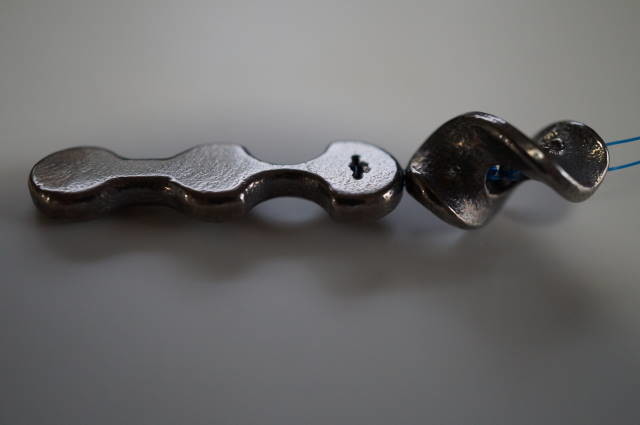
"Could a thin neck reduce sphincter strain without breaking?"
In an entry published in February 2024, a reader asked about the bladder-anchored prototype's release and whether its thin neck might break. Mr. Okada wanted further research and a material resistant to breaking. The diary does not record a completed strength test or confirmed release date in that reply. Mr. Okada asked readers to allow more time before its debut.
(Source: ok-lab's diary, published February 2024)
https://ok-lab.hatenablog.com/entry/2024/02/24/122947
"Could double loops reduce sphincter strain inside the prostate?"
In an entry published in January 2025, a customer proposed double loops with one loop remaining inside the prostate to reduce strain. Mr. Okada replied that OK Lab could not create the requested wire shape and doubted its stability. The version he launched had a secondary parallel loop about 2mm shorter than the main loop.
The published prostate-only price was ¥6,000 (about $38 at ¥156 = $1, rate as of 2026-09-04) + ¥2,000 (about $13 at ¥156 = $1, rate as of 2026-09-04), excluding tax. The bladder version was ¥10,000 (about $64 at ¥156 = $1, rate as of 2026-09-04) + ¥2,000 (about $13 at ¥156 = $1, rate as of 2026-09-04), excluding tax; the diary does not record this customer's experience with it. Mr. Okada offered staggered parallel loops as a feasible alternative to the requested structure.
(Source: ok-lab's diary, published January 2025)
https://ok-lab.hatenablog.com/entry/2025/01/18/123007
Buying from outside Japan

OK Lab ships internationally to countries covered by Japan Post's EMS courier service. Overseas orders are paid in advance by PayPal. Each order carries a ¥400 (about $3 at ¥156 = $1, rate as of 2026-09-04) handling fee, and EMS shipping is charged on top. These terms come from OK Lab's official sales-terms page (written here as plain text, not a link: ok-lab.net/docs/law), checked on September 7, 2026; confirm them on the official store before you order, because they can change.
Summary of this article
| What you wanted to know | The answer |
|---|---|
| In short: can strain occur? | Injury and discomfort appear alongside proposed improvements. |
| About this product: what is it? | A urethral device from Japan, priced in yen. |
| Key terms: what holds it in place? | Solid parts, thread, tubing, wire loops, and retainers. |
| What happens during retention? | Comfort claims coexisted with removal problems and closure concerns. |
| The maker's answer: what changed? | Thinner connections, adjustable spacing, and support outside the bladder. |
| Changes over time: was development finished? | The latest prototype lacks feedback on use. |
| Related products: what is listed now? | Short ceramic twist: ¥4,400 (about $28 at ¥156 = $1, rate as of 2026-09-04); gently contoured resin chip: ¥8,800, (about $56 at ¥156 = $1, rate as of 2026-09-04) including tax. |
| Common worries: what remains unknown? | Later outcomes, completed strength tests, and release dates. |
| Buying internationally: how does it work? | Japan Post EMS, advance PayPal payment, and a ¥400 (about $3 at ¥156 = $1, rate as of 2026-09-04) handling fee. |
Source: ok-lab's diary (Okada Comfortable Life Laboratory). The original entries are in Japanese; quotations on this page are translated. Photos and videos are on the original entries.
This article is a summary of the maker's development diary. The product is not a medical device and no result is guaranteed. If anything feels wrong or worries you, see a doctor. Prices, specifications and cautions change, so confirm the latest information on the official blog and the official site. Questions about ordering and shipping go to the seller.