![Can I pee or ejaculate with a prostate chip inside? | The maker reports both, with limits [OK Prostate Chip]](/img/a/T0022/eyecatch.svg)
This page is based on entries from "ok-lab's diary" (https://ok-lab.hatenablog.com/), the Japanese development diary written by Mr. Okada, founder of OK Lab, a small company in Japan (Okada Comfortable Life Laboratory). Only the entries about "peeing and ejaculating with the chip left inside" are summarized here, in order of publication. Past prices and sizes are as written at the time. Current prices come from the official product list (retrieved September 4, 2026). Quotations are translated from Japanese.
Note: This page is a personal reading log by someone with no connection to the maker or the seller. It reflects the source entries as of their publication dates and makes no guarantee of accuracy or safety. The product is not a medical device; talk to a doctor about any health decision. Check the official site for current information. This page contains advertising.
In short
Mr. Okada reports urination and ejaculation during wear, but also describes blockage, displacement, and difficult removal.
The maker changed shapes and urine passages, while warning against force when a shifted chip resisted movement.
Current listings include curved ceramic chips and screw-shaped auxiliaries; several historical designs have no confirmed match.
If you see blood in your urine, even a small amount or for the first time, do not wait and see. See a urologist right away.
If you suddenly cannot urinate, or the device cannot be removed, do not try to fix it yourself. Go to a medical facility, including emergency care, immediately.
About this product

The OK Prostate Chip is a small device that is placed in the urethra (the urine passage) so that it acts on the prostate; the maker sells it in several shapes, sizes and materials. It is made and sold by OK Lab (Okada Comfortable Life Laboratory), a small company in Japan, through its own online store, and prices are in Japanese yen (JPY).
The maker's development diary, "ok-lab's diary", is written in Japanese. This page is an English summary of it, and every quotation is translated. OK Lab ships internationally, so readers outside Japan can order (see "Buying from outside Japan" below). Product names on this page are plain-English descriptions. The official Japanese product name is shown once in the product table so you can find the same item in the store.
Before you read: key terms
| Term | Plain-English meaning |
|---|---|
| Urethra | The urine passage; it carries urine outside the body and contains the chip during wear. |
| Auxiliary chip | A secondary retaining part; it is intended to help prevent the main device being expelled. |
| Urinary sphincter | A muscle that closes the urine passage; its opening and closing help control urine flow. |
| Bulbar urethra | The wider section nearer the prostate; the diary describes it as a location for an auxiliary chip. |
| Ceramic twin | Two stacked ceramic chips joined with resin; gaps between them provide passages for fluid. |
| Urethral sound | An instrument placed within the urine passage; the gourd-shaped design is intended to hold that passage open. |
| Gatekeeper | A retaining accessory; Mr. Okada describes it as helping prevent outward movement during urination. |
| Hollow auxiliary chip | A secondary part containing a urine passage; its rigid hole is intended to remain open under pressure. |
What happens: peeing with a prostate chip
The OK Prostate Chip is a small device placed within the urethra (the urine passage) to act on the prostate. Mr. Okada describes urine and semen passing through spaces around the device, or through holes in certain designs. Flat bodies, twisted shapes, and hollow parts represent different approaches to keeping a route open. They sit within the urine passage, where he reports that urine flow can also move the device.
Peeing with a prostate chip depended on space beside its flat body
In an entry published in October 2017, Mr. Okada described a small, flat chip about 30 mm long. He reported strong urine flow along both sides of its body.
He also wrote that urine pressure could move the device outward, so an open passage did not mean it stayed put. His proposed safeguard was an auxiliary chip (a secondary retaining part) intended to limit expulsion.
(Source: ok-lab's diary, published October 2017)
https://ok-lab.hatenablog.com/entry/20171008/1507448709
A hollow prostate chip allowed urine through but became difficult to remove
In an entry published in February 2018, Mr. Okada tested a prototype containing two hollow chips. He reported that urine flowed internally, continued under pressure, and did not expel the device. After about half a day, however, he found it difficult to remove.
He suspected the outer surface had dried and stuck to the urethral wall. He also reported that his doctor declined to call chip use safe despite a normal examination. He would not consider selling the hollow design until the drying problem was resolved.
(Source: ok-lab's diary, published February 2018)
https://ok-lab.hatenablog.com/entry/20180228/1519809422
A stuck prostate chip required hospital removal and prompted longer first chips
In an entry published in March 2018, a customer reported that two linked chips had become tangled and required hospital removal. Mr. Okada said this was his first report of such an incident. The diary does not record further clinical details or the customer's recovery.
He suspected the first chip, then about 25-28 mm long, had reversed direction. He announced that future first chips would measure 30 mm or more. He cautioned that even a 30 mm chip might reverse because anatomy differs.
(Source: ok-lab's diary, published March 2018)
https://ok-lab.hatenablog.com/entry/20180310/1520672565
Peeing with a prostate chip shaped the ceramic twin design
In an entry published in February 2021, Mr. Okada introduced ceramic twins (two stacked ceramic chips joined with resin). He said gaps between the pieces allowed urination and ejaculation during wear. The design retained the single chip's width and length, with approximately 1 mm gaps for urine.
The published price was 2 single-chip prices plus ¥1,000 (about $6 at ¥156 = $1, rate as of 2026-09-04) excluding tax for joining. A basic short ceramic twin cost ¥7,000 (about $45 at ¥156 = $1, rate as of 2026-09-04) excluding tax in that entry. His precaution was a separate thread attached to each chip in case the joining resin cracked.
(Source: ok-lab's diary, published February 2021)
https://ok-lab.hatenablog.com/entry/2021/02/20/130830
Peeing with a gourd-shaped sound did not guarantee it stayed inside
In an entry published in November 2023, Mr. Okada answered questions from a patent attorney about a gourd-shaped urethral sound. This instrument occupied the urine passage and was intended to hold it open; urine travelled between its tubes, not through their hollow interiors.
Mr. Okada reported nearly the same urination speed with the sound present as without it. His explanation warned that urine pressure could expel it without a gatekeeper, a retaining accessory.
(Source: ok-lab's diary, published November 2023)
https://ok-lab.hatenablog.com/entry/2023/11/11/122638
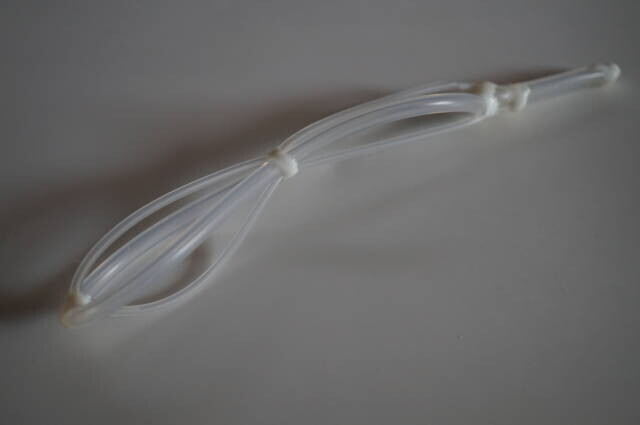
The maker's answer to peeing with a prostate chip
Mr. Okada's replies address urine passages, outward movement, and the risk of a design preventing normal closure.
Peeing with a prostate chip could move it from its earlier position
In an entry published in November 2019, a customer wanted longer wear after a single glass chip came out during urination. Mr. Okada explained that urination opens the urinary sphincter (the muscle controlling closure), allowing some downward movement.
His reply addressed movement into the bulbar urethra (the wider section nearer the prostate) and difficulty returning to the earlier position. He linked that difficulty to a lack of natural moisture; the diary does not record a later result for this customer. Mr. Okada advised against force when the device resisted movement.
(Source: ok-lab's diary, published November 2019)
https://ok-lab.hatenablog.com/entry/2019/11/09/132111
A screw-shaped auxiliary could preserve urine flow better than a curved section
In an entry published in January 2020, a customer considering a medium-length curved ceramic chip asked about screw-shaped auxiliaries and discomfort. Mr. Okada described a screw-shaped chip as a twisted flat body that leaves fluid passages. He said its auxiliary version did not completely obstruct urine under firm pressure.
He contrasted this with the curved section, which he said could stop urine under strong pressure. The customer subsequently confirmed payment, but the diary does not record how this purchase felt in use. Mr. Okada favoured the screw-shaped auxiliary for preserving flow while limiting expulsion, without guaranteeing painless wear.
(Source: ok-lab's diary, published January 2020)
https://ok-lab.hatenablog.com/entry/2020/01/25/150127
A rigid prostate chip pee hole preserved flow but introduced slipping
In an entry published in December 2023, Mr. Okada introduced a hollow auxiliary chip with a 4 mm internal urine passage. He reported fast flow through this rigid opening, which retained its shape under external pressure. Its published price was ¥3,000 (about $19 at ¥156 = $1, rate as of 2026-09-04) excluding tax.
He presented it as an alternative to a screw-shaped auxiliary near the tip of the penis, where pressure could restrict the screw's passages. However, he said its smooth surface made it liable to slide out of position. Mr. Okada also cautioned that the new part had received little testing.
(Source: ok-lab's diary, published December 2023)
https://ok-lab.hatenablog.com/entry/2023/12/23/122035
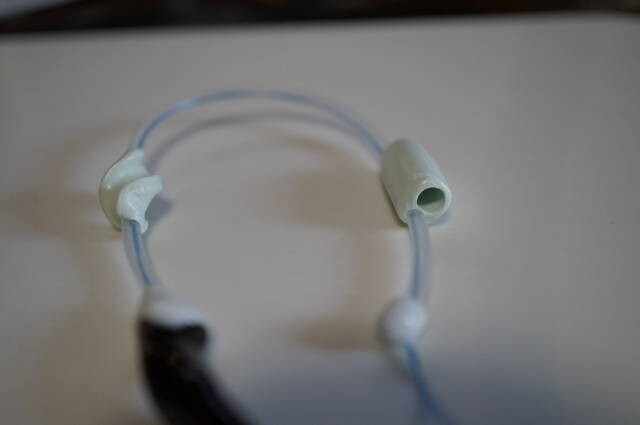
A bladder-retaining prostate chip blocked urine before its head gained openings
In an entry published in February 2024, Mr. Okada reported that a spherical prototype head completely blocked urine at the bladder. He then developed a head with at least 2 urine openings because a single opening gave poor flow.
He reported no sign of expulsion during urination with a revised head about 7 mm thick and 9 mm wide. However, he considered smaller heads more liable to slip out and larger heads more burdensome.
(Source: ok-lab's diary, published February 2024)
https://ok-lab.hatenablog.com/entry/2024/02/17/123013
A twisted prostate chip could preserve flow while preventing sphincter closure
In another entry published in February 2024, a customer requested a custom ceramic arrangement of twisted chips. Mr. Okada replied that ceramic construction was difficult and suggested resin or stainless-steel versions instead. The diary does not record a completed custom build for this request.
He said a twist could hold a short section open without obstructing urine. The bladder-retaining prototype therefore used a twist at the prostate and very thin sections at the sphincters. Mr. Okada considered a twist unsuitable at a sphincter because it could prevent the user from stopping urine.
(Source: ok-lab's diary, published February 2024)
https://ok-lab.hatenablog.com/entry/2024/02/24/122947
If you see blood in your urine, even a small amount or for the first time, do not wait and see. See a urologist right away.
If you suddenly cannot urinate, or the device cannot be removed, do not try to fix it yourself. Go to a medical facility, including emergency care, immediately.
How peeing with a prostate chip changed over time

| Published | What the diary said then |
|---|---|
| Oct 2017 | Mr. Okada described urine and semen flowing outside the solid chip and its thread. |
| Jul 2018 | Mr. Okada contrasted screw-shaped passages with tightly fitting tapered rods that blocked outside flow. |
| Dec 2018 | Mr. Okada reported urination and ejaculation while his vibrating chip remained active. |
| Jan 2020 | Mr. Okada associated smaller, shifting contact areas on screw shapes with less sticking. |
| Feb 2021 | A roughly 7-8.5 mm semi-long ceramic twin approached Mr. Okada's personal size limit. |
| Jul 2022 | Mr. Okada identified long wear and urination during wear as original design requirements. |
| Dec 2023 | A custom paired resin build incorporated gaps intended to preserve urine passages. |
| Dec 2023 | Hollow auxiliary specifications: approximately 15 mm long; M cross-section approximately 8.5 mm by 6.5 mm. |
OK Prostate Chip products related to peeing with a prostate chip

The current list includes products involved in these questions, but does not confirm the historical prototypes as current options.
Products that appear in these entries
| Product (official name) | Price incl. tax | Relation to this topic |
|---|---|---|
| Single glass chip (OKプロステートチップ ガラス素材1チップタイプ) | ¥3,300 (about $21 at ¥156 = $1, rate as of 2026-09-04) | In November 2019, a customer reported expulsion during urination and asked about longer wear. |
| Short vibrating resin chip (OKプロステート核振チップ 樹脂素材ショートタイプ) | ¥4,400 (about $28 at ¥156 = $1, rate as of 2026-09-04) | In November 2019, a prospective customer considering this model asked about motor shape and vibration. |
| Medium-length curved ceramic chip (OKプロステートチップ 陶器素材セミロング勾玉タイプ) | ¥5,500 (about $35 at ¥156 = $1, rate as of 2026-09-04) | A January 2020 question about this model prompted a comparison of urine flow around curved and screw-shaped parts. |
(Source: ok-lab's diary, published November 2019)
https://ok-lab.hatenablog.com/entry/2019/11/09/132111
(Source: ok-lab's diary, published January 2020)
https://ok-lab.hatenablog.com/entry/2020/01/25/150127
Products the diary mentioned as alternatives
| Product (official name) | Price incl. tax | Relation to this topic |
|---|---|---|
| Screw-shaped auxiliary addition (スクリュー型補助チップ追加オプション) | ¥3,300 (about $21 at ¥156 = $1, rate as of 2026-09-04) | In January 2020, Mr. Okada considered this more effective than a curved section for limiting expulsion while preserving urine flow. |
(Source: ok-lab's diary, published January 2020)
https://ok-lab.hatenablog.com/entry/2020/01/25/150127
Historical designs discussed here include the small flat chip, hollow two-chip prototype, ceramic twins, and December 2018 vibrating design. They also include the gourd-shaped sound, hollow auxiliary, custom paired resin build, and bladder-retaining prototype.
No matching product can be confirmed on the current list.
Common worries about peeing with a prostate chip

The diary's questions distinguish urine flow, motor shape, and the release status of unfinished designs.
"Can peeing with a prostate chip limit motor choices?"
In an entry published in November 2019, a customer in the United States wanted vibration closer to the prostate. The customer was considering the short vibrating resin chip and asked about cylindrical motors.
The diary does not record whether the order was completed. Mr. Okada ruled out cylindrical motors because urination during wear was a basic design requirement, limiting his consideration to flat motors.
(Source: ok-lab's diary, published November 2019)
https://ok-lab.hatenablog.com/entry/2019/11/09/132111
"Does a prostate chip pee hole carry all the urine?"
In an entry published in November 2022, a customer mentioned a hollow metal urethral sound while asking about a proposed design. The customer described an internal passage that allowed urination, but the diary does not record a test establishing where all the urine went. Mr. Okada cautioned that much of the urine might pass internally without all of it doing so.
(Source: ok-lab's diary, published November 2022)
https://ok-lab.hatenablog.com/entry/2022/11/26/122622
"When will the prostate chip with pee holes be released?"
In an entry published in February 2024, a customer asked when the bladder-retaining prototype would launch and whether its thin neck could break. Mr. Okada replied that he intended to restart development from the beginning after his latest experiences.
He said release would take more time; the diary does not record a release date in this reply. In response to the customer's concern, Mr. Okada said he wanted a material that would resist breakage.
(Source: ok-lab's diary, published February 2024)
https://ok-lab.hatenablog.com/entry/2024/02/24/122947
Buying from outside Japan

OK Lab ships internationally to countries covered by Japan Post's EMS courier service. Overseas orders are paid in advance by PayPal. Each order carries a ¥400 (about $3 at ¥156 = $1, rate as of 2026-09-04) handling fee, and EMS shipping is charged on top. These terms come from OK Lab's official sales-terms page (written here as plain text, not a link: ok-lab.net/docs/law), checked on September 7, 2026; confirm them on the official store before you order, because they can change.
Summary of this article
| What you wanted to know | The answer |
|---|---|
| In short: can both functions happen? | Mr. Okada reports both, alongside cases of displacement, obstruction, and difficult removal. |
| What is the product? | A small urethral device made by OK Lab in Japan. |
| Which terms matter? | Auxiliary parts retain the device; gaps and holes provide possible fluid passages. |
| What happened in the diary? | Successful flow sometimes accompanied sticking, movement, or other problems. |
| What was the maker's answer? | Different shapes addressed different problems; he warned against force and unsuitable sphincter placement. |
| What changed over time? | The diary explored outside channels, stacked chips, rigid holes, and bladder-retaining designs. |
| Which products are currently listed? | The tables identify listed models and prices separately from historical designs. |
| What remained uncertain? | Internal holes did not establish complete internal drainage; an unfinished prototype lacked a release date. |
| How do overseas orders work? | Advance PayPal payment, a ¥400 (about $3 at ¥156 = $1, rate as of 2026-09-04) handling fee, and additional EMS shipping. |
| What does the overall account establish? | The maker reports both functions; his diary also records serious problems. |
Source: ok-lab's diary (Okada Comfortable Life Laboratory). The original entries are in Japanese; quotations on this page are translated. Photos and videos are on the original entries.
This article is a summary of the maker's development diary. The product is not a medical device and no result is guaranteed. If anything feels wrong or worries you, see a doctor. Prices, specifications and cautions change, so confirm the latest information on the official blog and the official site. Questions about ordering and shipping go to the seller.