![Can a prostate chip stay in place? | Stoppers have limits [OK Prostate Chip]](/img/a/T0020/eyecatch.svg)
This page is based on entries from "ok-lab's diary" (https://ok-lab.hatenablog.com/), the Japanese development diary written by Mr. Okada, founder of OK Lab, a small company in Japan (Okada Comfortable Life Laboratory). Only the entries about "sphincter stoppers and urethral gatekeepers" are summarized here, in order of publication. Past prices and sizes are as written at the time. Current prices come from the official product list (retrieved September 4, 2026). Quotations are translated from Japanese.
Note: This page is a personal reading log by someone with no connection to the maker or the seller. It reflects the source entries as of their publication dates and makes no guarantee of accuracy or safety. The product is not a medical device; talk to a doctor about any health decision. Check the official site for current information. This page contains advertising.
In short
- Stoppers target inward movement, outward slipping, or both, depending on their design.
- Mr. Okada changed designs after testing and a bleeding report; he did not offer one universal accessory recommendation.
- The current list includes older accessory types, but later custom stopper designs have no confirmed matching listings.
If you see blood in your urine, even a small amount or for the first time, do not wait and see. See a urologist right away.
If you suddenly cannot urinate, or the device cannot be removed, do not try to fix it yourself. Go to a medical facility, including emergency care, immediately.
About this product

The OK Prostate Chip is a small device that is placed in the urethra (the urine passage) so that it acts on the prostate; the maker sells it in several shapes, sizes and materials. It is made and sold by OK Lab (Okada Comfortable Life Laboratory), a small company in Japan, through its own online store, and prices are in Japanese yen (JPY). The maker's development diary, "ok-lab's diary", is written in Japanese. This page is an English summary of it, and every quotation is translated. OK Lab ships internationally, so readers outside Japan can order (see "Buying from outside Japan" below). Product names on this page are plain-English descriptions. The official Japanese product name is shown once in the product table so you can find the same item in the store.
Before you read: key terms
| Term | Plain-English meaning |
|---|---|
| Urinary sphincter | A muscle that closes the urine passage to control urine flow, as discussed in the leakage test. |
| Bulbar urethra | The wider passage outside the sphincter; the diary places internal stoppers here to resist chip movement. |
| Sphincter stopper | An accessory intended to resist movement through the sphincter toward the bladder. |
| Urethral gatekeeper | In the external designs discussed here, a fitting at the penis tip that holds a device's tube. |
| Screw auxiliary chip | A second chip connected behind the main chip; intended to assist positioning, rather than prevent bladder entry. |
| Mesh stopper | A perforated stopper whose holes are intended to let urine pass while it resists movement. |
| Shape-memory wire | Flexible wire that returns toward its original shape; used to make springy stopper loops. |
| Floating sound | A thread-connected positioning accessory; the diary proposed it to help keep a chip in place. |
| Pushing sound | A slender accessory intended to help position a device; the dedicated version was developed for the Apple stopper. |
What happens: keeping a prostate chip in place
The OK Prostate Chip is a small urethral device intended to act on the prostate. A sphincter stopper is an accessory intended to resist movement past a urinary sphincter (a muscle controlling urine flow). Its intended position is the bulbar urethra (the wider passage outside that muscle). An external urethral gatekeeper instead holds a tube at the penis tip. Later stopper designs also aimed to resist outward movement during urination.
Mr. Okada warned that a trapped sphincter stopper could move inward
In an entry published in July 2018, Mr. Okada described a thread-mounted stopper that acted as a shield against inward movement. His design explanation specified at least 6mm, preferably 10mm or more, between the main chip and stopper. This depended on the stopper having room to change orientation. Mr. Okada warned that a stopper caught halfway through the sphincter could travel lengthways toward the bladder.
(Source: ok-lab's diary, published July 2018)
https://ok-lab.hatenablog.com/entry/20180707/1530947332
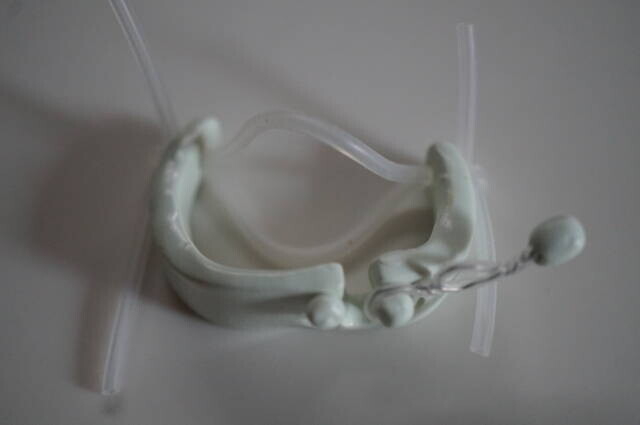
An external urethral gatekeeper gained simpler connections and a lower price
An entry published in October 2023 introduced a gatekeeper with a side opening for different cable connections. Its silicone support surrounded the rim of the penis tip, while the central fitting held the tube. Removing the previous cotton-pearl ring reduced the historical price by ¥1,000 (about $6 at ¥156 = $1, rate as of 2026-09-04), to ¥4,000 (about $26 at ¥156 = $1, rate as of 2026-09-04) excluding tax. Mr. Okada cautioned that the support tubing could come out of its connection holes.
(Source: ok-lab's diary, published October 2023)
https://ok-lab.hatenablog.com/entry/2023/10/21/123054
Urine pressure prompted Mr. Okada to develop a mesh stopper
In an entry published in November 2023, Mr. Okada reported that a tube-mounted solid stopper stayed upright during urination. He found urine pressure tended to push it outward, prompting a mesh stopper (a plate with urine-flow holes). Historical prices were ¥2,000 (about $13 at ¥156 = $1, rate as of 2026-09-04) excluding tax for the fixed-fit mesh stopper and ¥2,500 (about $16 at ¥156 = $1, rate as of 2026-09-04) excluding tax for the removable version.
The 2.5mm tube tail cost ¥2,000 (about $13 at ¥156 = $1, rate as of 2026-09-04) excluding tax for lengths up to 10cm. Mr. Okada favored the fixed-fit version closest to the chip because it could not detach.
(Source: ok-lab's diary, published November 2023)
https://ok-lab.hatenablog.com/entry/2023/11/25/122934
A ribbon-style urethral gatekeeper traded its locking gate for tunnels
An entry published in January 2024 described a simpler gatekeeper inspired by a customer's request. The ribbon-style design removed the locking gate and replaced tube-connection holes with small tunnels. Savings from removing the gate were offset by the tunnels' construction, giving a historical price of ¥6,000 (about $38 at ¥156 = $1, rate as of 2026-09-04) excluding tax. Mr. Okada said buyers seeking only a simpler gatekeeper could choose the existing S, M or L sizes.
(Source: ok-lab's diary, published January 2024)
https://ok-lab.hatenablog.com/entry/2024/01/27/123012
A wire-mounted chip prompted another sphincter stopper after inward migration
In an entry published in March 2024, Mr. Okada described a test involving an approximately 30mm chip attached to elastic wire. After several hours, about 15mm of its tip had entered the bladder. At around 5 hours, the entire chip had moved there.
Mr. Okada suspected the wire contributed to this movement. He doubted a screw auxiliary chip (a second chip behind the main one) would stop it. Mr. Okada proposed a mesh stopper designed for the wire.
(Source: ok-lab's diary, published March 2024)
https://ok-lab.hatenablog.com/entry/2024/03/30/122958
An integrated sphincter stopper aimed to resist movement in both directions
An entry published in October 2025 described a stopper attached directly to a chip's rear. It used 0.15mm shape-memory wire (flexible wire that returns toward its original shape). Mr. Okada reported stable positioning in his test with a small semi-long chip.
The historical option price was ¥3,000 (about $19 at ¥156 = $1, rate as of 2026-09-04) excluding tax for the rear stopper, including the required reinforcement or side attachment. A configuration with both front and rear stoppers cost ¥5,000 (about $32 at ¥156 = $1, rate as of 2026-09-04) excluding tax. Mr. Okada required reinforcement of ceramic chips for this option.
(Source: ok-lab's diary, published October 2025)
https://ok-lab.hatenablog.com/entry/2025/10/04/122910
The maker's answer to keeping a prostate chip in place
Mr. Okada changed materials and attachments, but the diary still records irritation, loose wire, and difficult removal.
Thinner petal stopper wire reduced irritation in Mr. Okada's tests
An entry published in April 2025 described a wire-loop accessory with three petals (the petal stopper). Its historical price was ¥1,000 (about $6 at ¥156 = $1, rate as of 2026-09-04) excluding tax per petal, or ¥3,000 (about $19 at ¥156 = $1, rate as of 2026-09-04) excluding tax for three. Mr. Okada reported no strong sphincter irritation during about 5 days of testing.
He nevertheless thought force could make the petals reverse and cross the muscle. Mr. Okada chose 0.2mm over 0.3mm wire after finding the thicker wire too irritating for prolonged wear.
(Source: ok-lab's diary, published April 2025)
https://ok-lab.hatenablog.com/entry/2025/04/26/122909
A bleeding report prompted changes to integrated sphincter stopper attachments
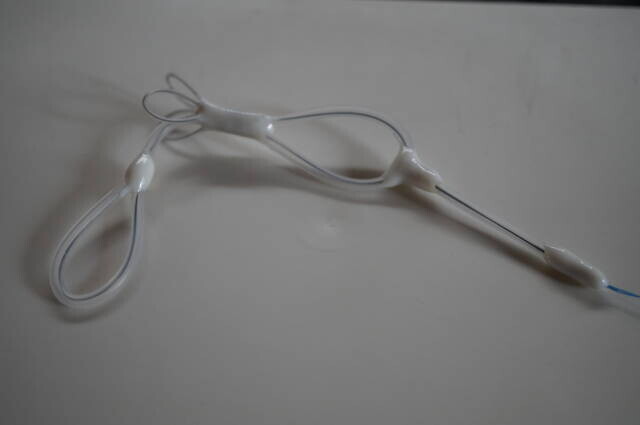
In an entry published in November 2025, a customer reported first-time bleeding and later found protruding wire during inspection after boiling disinfection. Mr. Okada explained that the rear wire was only hooked through a hole and tied, so sufficient force could pull it free. He offered a refund because the problem could recur; the diary does not record whether it was completed.
He changed the ceramic version's rear attachment to a bonded design and added safeguards to pending figure-eight loop orders. Mr. Okada said repeated reports could lead to a sales halt; the entry did not announce discontinuation. He asked customers to report any loosening.
(Source: ok-lab's diary, published November 2025)
https://ok-lab.hatenablog.com/entry/2025/11/29/122908
Mr. Okada reported difficult removal with the Apple stopper
An entry published in December 2025 described a rounded wire-loop design (the Apple stopper) intended to resist inward and outward movement. Mr. Okada reported that an integrated test build stayed fixed, while a separate attachment allowed some movement. Both versions cost ¥4,000 (about $26 at ¥156 = $1, rate as of 2026-09-04) excluding tax at publication.
A dedicated pushing sound (a slender positioning tool) cost ¥2,000 (about $13 at ¥156 = $1, rate as of 2026-09-04) excluding tax. Mr. Okada described both stopper versions as difficult to remove, although the separate version was easier. He cautioned that the integrated design's fixed position could put strain on the urine passage.
(Source: ok-lab's diary, published December 2025)
https://ok-lab.hatenablog.com/entry/2025/12/20/123000
If you see blood in your urine, even a small amount or for the first time, do not wait and see. See a urologist right away.
If you suddenly cannot urinate, or the device cannot be removed, do not try to fix it yourself. Go to a medical facility, including emergency care, immediately.
How keeping a prostate chip in place changed over time
| Published | What the diary said then |
|---|---|
| Dec 2022 | Leakage during Mr. Okada's ribbed floating-sound test ruled out continuous wear for him. |
| Dec 2022 | An eight-hole floating sound combined accessory functions; sales were planned for the following year. |
| Oct 2023 | Gatekeeper urine openings increased from two to three, with reinforcing wire added. |
| Mar 2024 | Mr. Okada found a 10mm–12mm gap more comfortable with the wire-mounted mesh stopper. |
| Nov 2025 | Continuous-wire loops eliminated separate petal connections in a new prototype. |
| Dec 2025 | A heart-shaped prototype used four loops per side; Mr. Okada said testing remained incomplete. |
| Dec 2025 | Only ceramic chips supported integrated Apple stoppers; blue and stainless-steel chips required separate attachments. |
The supplied entries end in December 2025. The diary does not say what the current state is.

OK Prostate Chip products related to keeping a prostate chip in place

The current list includes a three-hole stopper and screw auxiliary with different intended roles.
Products that appear in these entries
| Product (official name) | Price incl. tax | Relation to this topic |
|---|---|---|
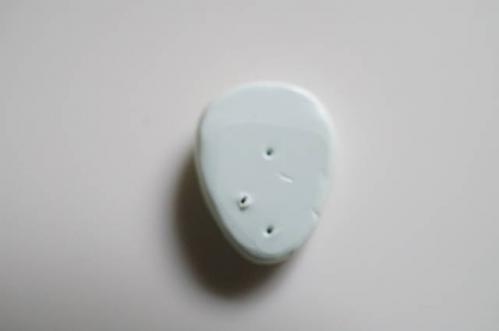
| Three-hole sphincter stopper (三穴方式オプションチップ(括約筋ストッパーチップ)) | ¥1,650 (about $11 at ¥156 = $1, rate as of 2026-09-04) | In January 2020, a customer asked about this stopper for keeping a chip in place without a long model. |
The three-hole sphincter stopper is listed in OK Lab's own online store.
(Source: ok-lab's diary, published January 2020)
https://ok-lab.hatenablog.com/entry/2020/01/18/132849
Products the diary mentioned as alternatives
| Product (official name) | Price incl. tax | Relation to this topic |
|---|---|---|
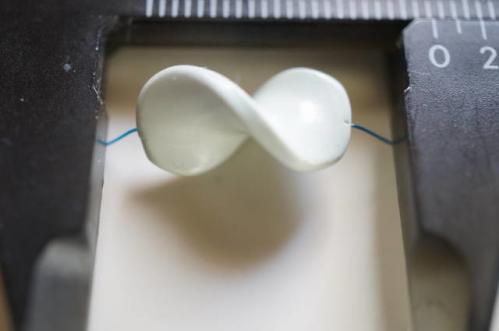
| Screw auxiliary chip (スクリュー型補助チップ追加オプション) | ¥3,300 (about $21 at ¥156 = $1, rate as of 2026-09-04) | In December 2024, Mr. Okada suggested a screw auxiliary for positioning difficulty with the main chip alone, while noting limited bladder-entry protection. |
The screw auxiliary chip is listed in OK Lab's own online store.
(Source: ok-lab's diary, published December 2024)
https://ok-lab.hatenablog.com/entry/2024/12/28/122907
Historical gatekeeper versions, mesh and petal stoppers, integrated-wire builds, floating sounds, and Apple accessories:
No matching product can be confirmed on the current list.
Common worries about keeping a prostate chip in place

Readers asked about outward slipping, inward movement, and beginner difficulty; Mr. Okada treated these as different questions.
"Can two sphincter stoppers keep a chip from slipping out?"
In an entry published in May 2019, a customer reported less outward slipping during urination with two stoppers. They asked whether others used a similar arrangement. Mr. Okada saw possible benefit, but had expected both stoppers to remain outside the muscle. He could not actively recommend this customer's arrangement because it placed one stopper beyond that intended boundary.
(Source: ok-lab's diary, published May 2019)
https://ok-lab.hatenablog.com/entry/2019/05/18/150144
"Can screw auxiliary chips also work as sphincter stoppers?"
In an entry published in January 2020, a customer asked which accessory might hold a chip without a long model. Mr. Okada explained that the three-hole stopper was intended to prevent crossing the sphincter; the screw auxiliary had no bladder-entry prevention function. He said inward pulling varied between individuals, preventing a universal recommendation.
The customer continued weighing options, and the diary records a later custom order without identifying that build in this paragraph. Mr. Okada advised choosing according to the intended function.
(Source: ok-lab's diary, published January 2020)
https://ok-lab.hatenablog.com/entry/2020/01/18/132849
"Will a sphincter stopper make first-time use more difficult?"
In an entry published in December 2024, a beginner wondered whether adding accessories would make insertion or removal harder. Staff offered to pause production while the customer considered the explanation. The diary does not record whether the order was changed.
Mr. Okada thought an external stopper at the penis tip might be easier to understand, although its usefulness depended on knowing the passage's length. He said beginners could initially forgo a sphincter stopper because understanding its internal position was difficult.
(Source: ok-lab's diary, published December 2024)
https://ok-lab.hatenablog.com/entry/2024/12/28/122907
Buying from outside Japan

OK Lab ships internationally to countries covered by Japan Post's EMS courier service. Overseas orders are paid in advance by PayPal. Each order carries a ¥400 (about $3 at ¥156 = $1, rate as of 2026-09-04) handling fee, and EMS shipping is charged on top. These terms come from OK Lab's official sales-terms page (written here as plain text, not a link: ok-lab.net/docs/law), checked on September 7, 2026; confirm them on the official store before you order, because they can change.
Summary of this article
| What you wanted to know | The answer |
|---|---|
| What is the main concern? | Different designs target inward movement, outward slipping, or both. |
| What is the product? | A small urethral device made by OK Lab in Japan. |
| What do the terms mean? | Internal stoppers and external gatekeepers hold devices at different locations. |
| What happened in the diary? | Designs changed after migration, urine-flow problems, and testing. |
| What did the maker change? | Wire thickness and attachments changed; bleeding and difficult removal remained important reports. |
| How did development progress? | The diary moved from thread-mounted shields toward mesh and flexible wire designs. |
| What current products appear? | The listed three-hole stopper costs ¥1,650 (about $11 at ¥156 = $1, rate as of 2026-09-04); the screw auxiliary costs ¥3,300, (about $21 at ¥156 = $1, rate as of 2026-09-04) both including tax. |
| What did customers ask? | They asked about two stoppers, accessory functions, and beginner difficulty. |
| How do overseas orders work? | Advance PayPal payment, a ¥400 (about $3 at ¥156 = $1, rate as of 2026-09-04) handling fee, and additional EMS shipping. |
Source: ok-lab's diary (Okada Comfortable Life Laboratory). The original entries are in Japanese; quotations on this page are translated. Photos and videos are on the original entries.
This article is a summary of the maker's development diary. The product is not a medical device and no result is guaranteed. If anything feels wrong or worries you, see a doctor. Prices, specifications and cautions change, so confirm the latest information on the official blog and the official site. Questions about ordering and shipping go to the seller.