![Can I combine a urethral sound with a chip? | Connections changed after pain and leakage [OK Prostate Chip]](/img/a/T0590/eyecatch.svg)
This page is based on entries from "ok-lab's diary" (https://ok-lab.hatenablog.com/), the Japanese development diary written by Mr. Okada, founder of OK Lab, a small company in Japan (Okada Comfortable Life Laboratory). Only the entries about "combining a urethral sound with a chip" are summarized here, in order of publication. Past prices and sizes are as written at the time. Current prices come from the official product list (retrieved September 4, 2026). Quotations are translated from Japanese.
Note: This page is a personal reading log by someone with no connection to the maker or the seller. It reflects the source entries as of their publication dates and makes no guarantee of accuracy or safety. The product is not a medical device; talk to a doctor about any health decision. Check the official site for current information. This page contains advertising.
In short
- Chip-and-sound combinations produced pain, leakage, and connection problems in Mr. Okada's tests.
- Mr. Okada favored flexible connections, while acknowledging limits in comfort, length, and compatibility.
- Related chips and accessories appear on the September 2026 product list.
If you see blood in your urine, even a small amount or for the first time, do not wait and see. See a urologist right away.
If you suddenly cannot urinate, or the device cannot be removed, do not try to fix it yourself. Go to a medical facility, including emergency care, immediately.
About this product

The OK Prostate Chip is a small device that is placed in the urethra (the urine passage) so that it acts on the prostate; the maker sells it in several shapes, sizes and materials. It is made and sold by OK Lab (Okada Comfortable Life Laboratory), a small company in Japan, through its own online store, and prices are in Japanese yen (JPY).
The maker's development diary, "ok-lab's diary", is written in Japanese. This page is an English summary of it, and every quotation is translated.
OK Lab ships internationally, so readers outside Japan can order (see "Buying from outside Japan" below). Product names on this page are plain-English descriptions. The official Japanese product name is shown once in the product table so you can find the same item in the store.
Before you read: key terms
| Term | Plain-English meaning |
|---|---|
| Urethral sound, or bougie | A rod-like device used in the urine passage to support a connected chip. |
| Sphincter | A closing muscle discussed here as holding urine and gripping components around the chip. |
| Bulbous urethra | The section before the sphincter; an endpoint in the maker's rigid-sound designs. |
| Blue safety connector | A small part joining a chip and sound through a flexible connection. |
| Screw assist | An extra component intended to help advance and retain the main chip. |
| Flat assist | An auxiliary chip component used in the September 2024 connection proposal. |
| Electrode | An electrically connected chip component. The diary does not explain this. |
| Gatekeeper | An external holder for stabilizing a sound or chip assembly. |
What happens: using a urethral sound with a chip
The OK Prostate Chip is a small urethral device that Mr. Okada describes as stimulating the prostate. A urethral sound, or bougie (a rod-like device), supports a connected chip within the urine passage. These entries explore a chip beyond the sound's tip, joined through thread, tubing, or a small connector. He tested these combinations for stable positioning with a joint that could bend.
Combining a chip and sound caused pain despite separation in December 2022
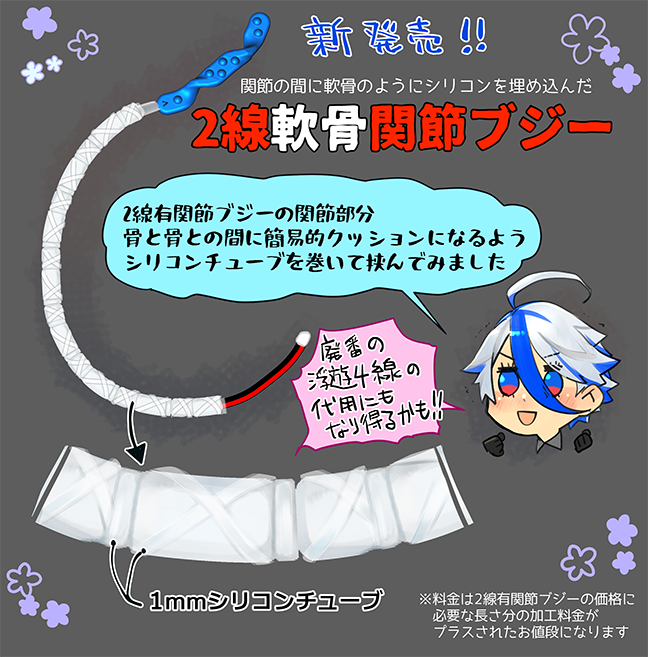
In an entry published in December 2022, Mr. Okada tested a chip with only retrieval thread alongside a sound. He reported pain around the prostate after several hours. A gap of 1-2cm between the parts did not resolve it; the pain persisted until the chip was out. Mr. Okada suspected pressure from surrounding tissue but said other conditions might have contributed and further testing was needed.
(Source: ok-lab's diary, published December 2022)
https://ok-lab.hatenablog.com/entry/2022/12/03/122846
A chip connection through the sound still lacked good results
The December 2022 entry also records a customer's proposal involving a short stainless-ring chip. Mr. Okada reported testing sounds with the chip's thread running inside them, but had not obtained good results.
Mr. Okada also described unresolved pain during his overnight tests of thread-connected chips. He cautioned that friction from the stainless ring could make the proposed design difficult.
(Source: ok-lab's diary, published December 2022)
https://ok-lab.hatenablog.com/entry/2022/12/03/122846
The floating urethral sound leaked during Mr. Okada's December 2022 test
In another entry published in December 2022, Mr. Okada reported leakage with the floating sound. He wrote that his sphincter (the closing muscle discussed here) could not close fully around its ridged section. He considered a directly attached chip unsuitable for continuous use in his case.
The replacement concept separated the chip and sound through an eight-hole connection. Mr. Okada presented that arrangement as his preferred proposal for the compressed position he was testing.
(Source: ok-lab's diary, published December 2022)
https://ok-lab.hatenablog.com/entry/2022/12/24/122944
Flat urethral sound prices depended on length in February 2023
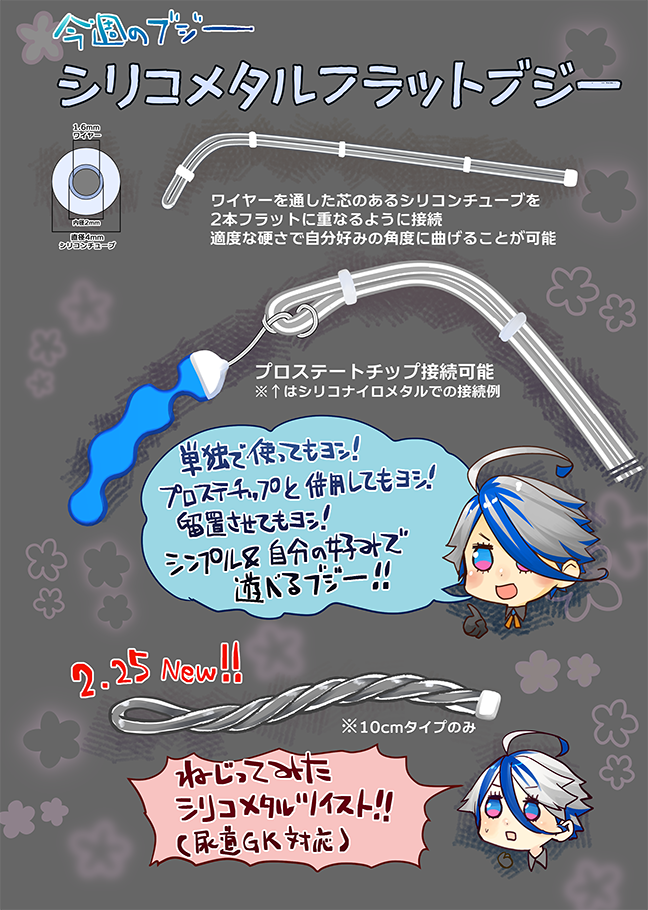
In the February 2023 entry, Mr. Okada introduced a flat sound with parallel silicone-covered wires. The gap between its tubes allowed a connection with chip thread or cord.
Prices published then, before tax, were ¥2,500 (about $16 at ¥156 = $1, rate as of 2026-09-04) for 10cm, ¥4,500 (about $29 at ¥156 = $1, rate as of 2026-09-04) for 20cm, and ¥5,500 (about $35 at ¥156 = $1, rate as of 2026-09-04) for 25cm. Mr. Okada recommended the flat model as a standalone sound and considered thicker connecting cords better suited to its chip connection.
(Source: ok-lab's diary, published February 2023)
https://ok-lab.hatenablog.com/entry/2023/02/18/122910
Rigid and soft urethral sound sections had separate June 2023 prices
In the June 2023 entry, Mr. Okada presented a sound combining a rigid section with a soft section. He wanted rigidity deeper inside and flexibility along the exposed penis. A chip-connected version also appeared.
The rigid section, up to 10cm, cost ¥2,500 (about $16 at ¥156 = $1, rate as of 2026-09-04) before tax, or ¥3,000 (about $19 at ¥156 = $1, rate as of 2026-09-04) before tax for the twisted version. The soft section cost ¥500 (about $3 at ¥156 = $1, rate as of 2026-09-04) before tax per 1.5cm. Mr. Okada specified a 22cm maximum combined length for custom requests.
(Source: ok-lab's diary, published June 2023)
https://ok-lab.hatenablog.com/entry/2023/06/03/121955
A direct chip connection caused strain after about one day
In the November 2023 entry, Mr. Okada reported that the gourd-shaped sound's direct thread connection strained his sphincter after about 1 day. He then described a chip with a tube tail about 15mm long and 2.5mm across. A dedicated six-hole connector joined that tail to the sound.
He reported less thread sensation with the revised design. Mr. Okada nevertheless said testing remained short and the best arrangement still needed investigation.
(Source: ok-lab's diary, published November 2023)
https://ok-lab.hatenablog.com/entry/2023/11/18/122841
Gourd-shaped urethral sound orders resumed under limits in March 2024
In the March 2024 entry, Mr. Okada explained that he had paused orders because consistent shapes and sizes were difficult to produce. He announced that production would resume at about 2 per week, with waiting required beyond that capacity.
He also warned that the pictured chip-connected arrangement could be demanding. Mr. Okada suggested the sound alone could be easier for someone interested mainly in the sound's effect.
(Source: ok-lab's diary, published March 2024)
https://ok-lab.hatenablog.com/entry/2024/03/30/122958
The maker's answer to using a urethral sound with a chip
Mr. Okada's proposals favored a flexible chip connection, with limits determined by the sound's construction and the individual arrangement.
The blue safety connector became Mr. Okada's preferred chip connection
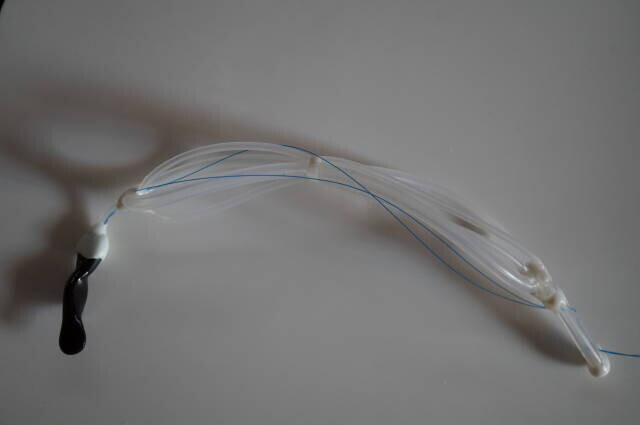
In the March 2023 entry, Mr. Okada proposed a blue safety connector (a small intermediate part) between the chip and sound. He considered the resulting joint flexible because the nylon thread stretched and the silicone had elasticity. Assembly was difficult because the closely positioned chip obscured the threading holes.
For this connection, the threading charge increased to ¥1,000 (about $6 at ¥156 = $1, rate as of 2026-09-04) before tax. The published connection price, including the blue safety part, became ¥2,500 (about $16 at ¥156 = $1, rate as of 2026-09-04) before tax. Mr. Okada favored this intermediate connector over a direct nylon knot.
(Source: ok-lab's diary, published March 2023)
https://ok-lab.hatenablog.com/entry/2023/03/04/123042
Chip connection length depended on anatomy in an April 2023 reply
The April 2023 entry records a customer asking about a prototype hook, then about a flat sound connected to a contoured ceramic chip. OK Lab declined to promise a prostate-positioning effect because the hook's shape would not reliably fit another body. Mr. Okada said the sound in a chip-connected design needed to reach only the sphincter.
Custom lengths up to about 12cm received 10cm pricing; longer builds received 20cm pricing. The diary does not record whether the customer completed an order. Mr. Okada advised treating the required length as individual because the depth varied substantially.
(Source: ok-lab's diary, published April 2023)
https://ok-lab.hatenablog.com/entry/2023/04/08/122508
A flexible chip connection was favored beyond the rigid sound
In another entry published in April 2023, Mr. Okada favored a rigid sound ending at the bulbous urethra (the section before the sphincter). His proposed design continued beyond it through a flexibly connected chip. He discussed a screw assist (an additional supporting chip component) and a long ceramic four-point twist chip as possible responses. Mr. Okada favored less curved chip shapes because he thought a sharply curved chip could face the wrong direction.
(Source: ok-lab's diary, published April 2023)
https://ok-lab.hatenablog.com/entry/2023/04/15/123038
An exposed wire fell outside September 2023 flat urethral sound specifications
The September 2023 entry records a customer proposing a bead chip continuous with the sound's wire. Mr. Okada explained that his flat sound enclosed the wire completely in silicone tubing. Its defining structure was a central U-shaped bend with parallel sections held together.
He believed that arrangement prevented the wire and tube from shifting relative to each other. The diary does not record whether this proposal was built. Mr. Okada invited alternative designs for consideration but would not guarantee control of wire movement in the proposed construction.
(Source: ok-lab's diary, published September 2023)
https://ok-lab.hatenablog.com/entry/2023/09/16/122723
If you see blood in your urine, even a small amount or for the first time, do not wait and see. See a urologist right away.
If you suddenly cannot urinate, or the device cannot be removed, do not try to fix it yourself. Go to a medical facility, including emergency care, immediately.
How using a urethral sound with a chip changed over time
| Published | What the diary said then |
|---|---|
| Dec 2022 | Development began with stainless steel, silicone, and epoxy resin prototypes. |
| Dec 2022 | Floating and eight-hole floating sounds were announced for sale the following year. |
| Feb 2023 | The flat sound measured about 7,5mm wide and 3.7mm thick. |
| Apr 2023 | Quoted: 10cm twisted sound ¥3,300 (about $21 at ¥156 = $1, rate as of 2026-09-04); M-sized chip ¥5,500 (about $35 at ¥156 = $1, rate as of 2026-09-04); blue safety connection ¥2,750 (about $18 at ¥156 = $1, rate as of 2026-09-04). |
| May 2023 | Mr. Okada reported stable positioning over 3 days, with some movement during erections. |
| Sep 2023 | Cable-to-sound connection was estimated at ¥1,000 (about $6 at ¥156 = $1, rate as of 2026-09-04) before tax, with possible extra charges. |
| Oct 2023 | Mr. Okada reported a rigid/soft flat sound fitting the side-entry Gatekeeper (external holder). |
| Nov 2023 | An interchangeable connection used 0.5mm openings for 0.25mm nylon thread. |
| Sep 2024 | A customer's flat-assist connection proposal received a favorable assessment after assembly. |
(Source: ok-lab's diary, published April 2023)
https://ok-lab.hatenablog.com/entry/2023/04/22/123057
The diary does not say what the current state is.
OK Prostate Chip products related to using a urethral sound with a chip
Related chips and accessories have current listed prices; custom assemblies had separate quotations.
Products that appear in these entries
| Product (official name) | Price incl. tax | Relation to this topic |
|---|---|---|
| Short stainless-ring chip (OKプロステートチップ ステンレスリング ショートタイプ) | ¥3,300 (about $21 at ¥156 = $1, rate as of 2026-09-04) | The December 2022 reply raised a friction concern about this proposed component. |
| Contoured ceramic chip (OKプロステートチップ 陶器素材覚醒タイプ) | ¥5,500 (about $35 at ¥156 = $1, rate as of 2026-09-04) | The April 2023 exchange concerned combining this chip with a flat sound. |
| Short ceramic twist chip (OKプロステートチップ 陶器素材ショートタイプ ツイスト) | ¥4,400 (about $28 at ¥156 = $1, rate as of 2026-09-04) | The November 2023 entry describes Mr. Okada's tube-connected test with a gourd-shaped sound. |
| Six-hole safety part (六穴方式オプションチップ(セーフティチップ)) | ¥1,100 (about $7 at ¥156 = $1, rate as of 2026-09-04) | The November 2023 interchangeable connection initially used this part to secure its thread. |
| Sliding-lock external holder (スライドロック式尿道ゲートキーパー) | ¥6,600 (about $42 at ¥156 = $1, rate as of 2026-09-04) | The November 2023 test paired this holder with the chip-connected gourd-shaped sound. |
| Flat assist component (フラット型補助チップ追加オプション(生体適合樹脂)) | ¥3,300 (about $21 at ¥156 = $1, rate as of 2026-09-04) | The September 2024 entry records its inclusion in the revised connection. |
(Source: ok-lab's diary, published December 2022)
https://ok-lab.hatenablog.com/entry/2022/12/03/122846
(Source: ok-lab's diary, published April 2023)
https://ok-lab.hatenablog.com/entry/2023/04/08/122508
(Source: ok-lab's diary, published November 2023)
https://ok-lab.hatenablog.com/entry/2023/11/04/122744
(Source: ok-lab's diary, published November 2023)
https://ok-lab.hatenablog.com/entry/2023/11/11/122638
(Source: ok-lab's diary, published September 2024)
https://ok-lab.hatenablog.com/entry/2024/09/21/122907
Products the diary mentioned as alternatives
| Product (official name) | Price incl. tax | Relation to this topic |
|---|---|---|
| Long ceramic four-point twist chip (OKプロステートチップ 陶器素材ロングタイプ 4点ツイスト) | ¥7,700 (about $49 at ¥156 = $1, rate as of 2026-09-04) | The April 2023 entry suggested this longer chip instead of a short chip with insufficient reach. |
(Source: ok-lab's diary, published April 2023)
https://ok-lab.hatenablog.com/entry/2023/04/15/123038
Historical sound assemblies, the prototype hook, electrical connection builds, and the dedicated six-hole connector: No matching product can be confirmed on the current list.
Common worries about using a urethral sound with a chip
The diary records limits involving tangling, electrical compatibility, and tube stiffness.
"Can a chip connection eliminate thread tangling?"
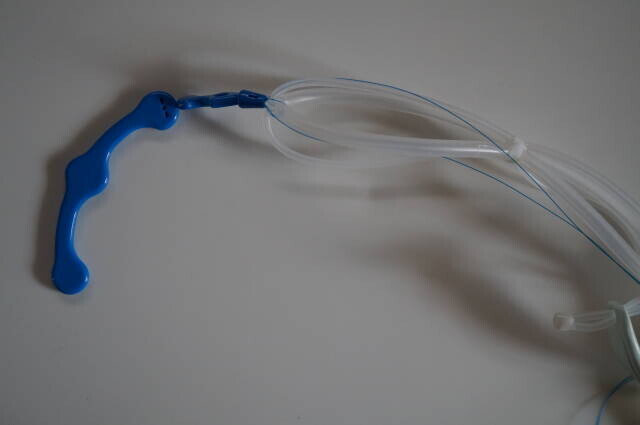
The May 2023 entry records a customer asking which screw-assist arrangement was least likely to become stuck. OK Lab ranked tangling likelihood from lower to higher: no screw assist, 0mm spacing, then a spaced connection with cushioning. It ranked slipping into the bladder in the reverse order.
Mr. Okada acknowledged that he had no statistics establishing the risk for each arrangement. The diary does not record which configuration the customer finally chose. Mr. Okada suggested considering a sound without a thread-connected chip to avoid that particular thread risk.
(Source: ok-lab's diary, published May 2023)
https://ok-lab.hatenablog.com/entry/2023/05/27/122912
"Can an electrode chip connect to any urethral sound?"
The September 2023 entry records a request for a stainless-steel electrode chip (an electrically connected component) combined with a sound. Mr. Okada said the 2-wire jointed cable could not connect to the stainless-steel electrode. At that time, only the cable twisted together with nylon thread could make that electrical connection.
He offered a custom arrangement combining that cable with the flat sound, subject to changes during construction. The diary does not record its performance in use. Mr. Okada warned that construction problems could require a different arrangement.
(Source: ok-lab's diary, published September 2023)
https://ok-lab.hatenablog.com/entry/2023/09/09/122848
"Can a longer chip connection work with thin tubing?"
The September 2024 entry records a customer changing a requested tube connection from 2cm to 3cm. Mr. Okada recalled an earlier 2mm tube connection spanning about 1cm and said longer tubing lacked support. He therefore considered the requested tube connection difficult.
The customer then proposed a chip, flat assist (an auxiliary chip component), blue safety connector, and gourd-shaped sound. Mr. Okada assembled that arrangement and judged it satisfactory, although the diary does not record the customer's experience using it. Mr. Okada's reply emphasized the limited support from longer thin tubing.
(Source: ok-lab's diary, published September 2024)
https://ok-lab.hatenablog.com/entry/2024/09/21/122907
Buying from outside Japan

OK Lab ships internationally to countries covered by Japan Post's EMS courier service. Overseas orders are paid in advance by PayPal. Each order carries a ¥400 (about $3 at ¥156 = $1, rate as of 2026-09-04) handling fee, and EMS shipping is charged on top. These terms come from OK Lab's official sales-terms page (written here as plain text, not a link: ok-lab.net/docs/law), checked on September 7, 2026; confirm them on the official store before you order, because they can change.
Summary of this article
| What you wanted to know | The answer |
|---|---|
| What is the short answer? | Possible connections also produced problems in testing. |
| What is the product? | A Japanese urethral device, priced in yen. |
| What do the terms mean? | Sounds support chips; connectors join parts; holders stabilize assemblies. |
| What happened in testing? | Pain, leakage, and strain prompted design changes. |
| What did the maker propose? | Flexible connections with individual length limits. |
| What changed over time? | Connectors, tube tails, and auxiliary parts were explored. |
| Which related products are listed? | Selected chips and accessories; see current prices above. |
| What worries remain? | Tangling, electrical compatibility, and tube stiffness. |
| How do overseas orders work? | Advance PayPal payment, a ¥400 (about $3 at ¥156 = $1, rate as of 2026-09-04) handling fee, and additional EMS shipping. |
Source: ok-lab's diary (Okada Comfortable Life Laboratory). The original entries are in Japanese; quotations on this page are translated. Photos and videos are on the original entries.
This article is a summary of the maker's development diary. The product is not a medical device and no result is guaranteed. If anything feels wrong or worries you, see a doctor. Prices, specifications and cautions change, so confirm the latest information on the official blog and the official site. Questions about ordering and shipping go to the seller.