![Can a prostate chip rotate? | Custom drills brought unresolved risks [OK Prostate Chip]](/img/a/T0591/eyecatch.svg)
This page is based on entries from "ok-lab's diary" (https://ok-lab.hatenablog.com/), the Japanese development diary written by Mr. Okada.
He founded OK Lab, a small company in Japan (Okada Comfortable Life Laboratory).
Only the entries about "prostate drills and piston drills" are summarized here, in order of publication.
Past prices and sizes are as written at the time. Current prices come from the official product list (retrieved September 4, 2026).
Quotations are translated from Japanese.
Note: This page is a personal reading log by someone with no connection to the maker or the seller. It reflects the source entries as of their publication dates and makes no guarantee of accuracy or safety. The product is not a medical device; talk to a doctor about any health decision. Check the official site for current information. This page contains advertising.
In short
- Early prostate drills raised concerns about uncontrolled travel, broken wires, and inconsistent movement.
- Mr. Okada revised the hardware while warning that the urethra's tolerance remained unknown.
- The supplied current product list has no confirmed match for these custom piston drills.
About this product

The OK Prostate Chip is a small device that is placed in the urethra (the urine passage) so that it acts on the prostate; the maker sells it in several shapes, sizes and materials. It is made and sold by OK Lab (Okada Comfortable Life Laboratory), a small company in Japan, through its own online store, and prices are in Japanese yen (JPY).
The maker's development diary, "ok-lab's diary", is written in Japanese. This page is an English summary of it, and every quotation is translated.
OK Lab ships internationally, so readers outside Japan can order (see "Buying from outside Japan" below). Product names on this page are plain-English descriptions. The official Japanese product name is shown once in the product table so you can find the same item in the store.
Before you read: key terms
| Term | Plain-English meaning |
|---|---|
| Urethra | The urine passage; the chip is intended to act on the prostate from this passage. |
| Piston movement | Back-and-forth movement, intended to move the tip near the prostate. |
| Shaft | The inner wire that carries sliding or rotating movement to the tip. |
| Sheath | The supporting structure around the shaft, intended to guide its movement. |
| Parallel wire stopper | A part added to the early drill, intended to limit its inward travel. |
| Springy wire | Wire that tends to straighten again; the diary discusses its use for connecting tips. |
| Epoxy | A material used for sheath guides and the twin tips' outer seal. The diary does not explain this. |
| External urethral sphincter | The diary does not explain this. |
| Flexible drive shaft | A bendable part of a rotary tool, discussed as a possible way to transmit rotation. |
What happens: prostate chip rotation
The OK Prostate Chip is a small device placed in the urethra (the urine passage) to act on the prostate. These custom prostate drills were intended to transmit movement to a tip near the prostate. The earlier design kept its motor outside the urethra. The later piston drill combined rotation and piston movement (back-and-forth travel), with a wire inside a supporting tube. No matching product can be confirmed on the current list.
The earliest prostate drill could travel dangerously far without a stopper
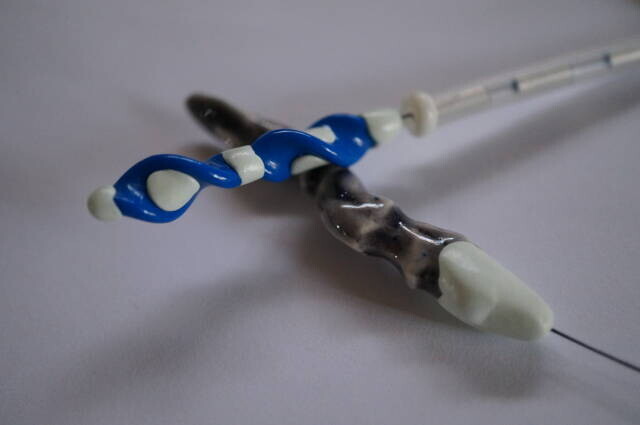
In an entry published in October 2021, Mr. Okada described a customer's failed attempt to alter an 8 mm motor that would not fit. The motor stopped working, and he suspected that its waterproofing had been lost. This prompted a drill design connecting an external motor, wire, and blue resin chip.
His first prototype had no stopper and could travel beyond the prostate, deep into the bladder. He called that design very dangerous. A later demonstration included a parallel wire stopper (a part intended to limit travel), which he said might make it slightly safer.
(Source: ok-lab's diary, published October 2021)
https://ok-lab.hatenablog.com/entry/2021/10/09/125823
The piston drill prototype depended on support around its thin wire
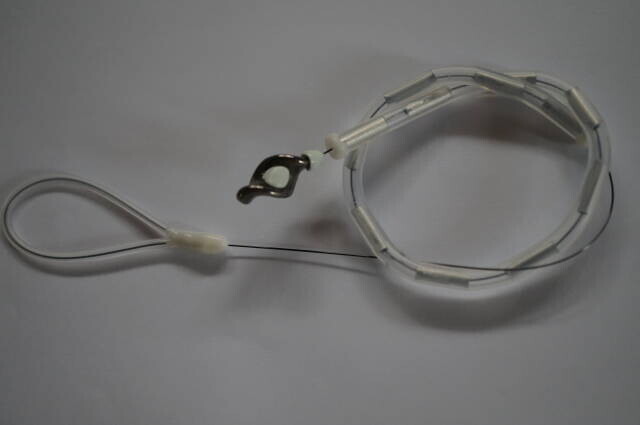
In an entry published in April 2026, Mr. Okada introduced a piston drill built around a sliding, rotating shaft (the inner wire). Its supporting tube measured 4 mm, and the moving wire was 0.4 mm or 0.5 mm. The stainless-steel screw prototype had a 20 cm tube and a 30 cm shaft, excluding its loop.
His blue resin screw prototype had a 25 cm tube and a 35 cm shaft, also excluding its loop. He reported that the wire alone lacked stiffness at the external urethral sphincter (not explained in the diary), making tube support necessary. Production was still too inconsistent for him to set a price.
(Source: ok-lab's diary, published April 2026)
https://ok-lab.hatenablog.com/entry/2026/04/04/122916
A redesigned piston drill sheath reduced reported resistance during bending
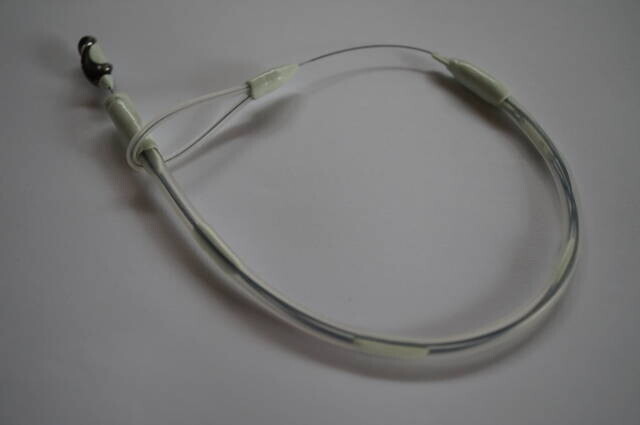
In an entry published in April 2026, a prototype request exposed inconsistent performance in the sheath (the structure guiding the shaft). Mr. Okada found differences between builds, with resistance changing between dry conditions, wet conditions, and different amounts of lubricating jelly. He requested more time, and the customer agreed, acknowledging that the order was for a prototype.
He replaced guides made from epoxy (not explained in the diary) with closely spaced, short aluminum pipes inside the tube. Previously, movement worsened sharply beyond roughly 90–110 degrees of bending; he reported smooth movement at about 180–270 degrees after the change. He still considered the method for securing those pipes unfinished.
(Source: ok-lab's diary, published April 2026)
https://ok-lab.hatenablog.com/entry/2026/04/18/122906
The revised piston drill reached its first completed custom build
In an entry published in April 2026, Mr. Okada reported completing the first requested custom piston drill. It used the aluminum-pipe sheath design described the previous week. The diary does not record how this customer's device felt in use. Mr. Okada warned that a large rise in aluminum costs could affect the product's price.
(Source: ok-lab's diary, published April 2026)
https://ok-lab.hatenablog.com/entry/2026/04/25/122914
The reversible piston drill added another tip and a separate charge
In an entry published in May 2026, Mr. Okada presented a reversible piston drill, with a chip at each end of the sheath. He paired a screw-shaped chip with a more sharply shaped tip, nicknamed the devil chip. He described the screw's shape as milder and the other tip's shape as more demanding.
He intended the prototype as a gift to the illustrator who had supplied the design. Reversible construction added ¥2,000 (about $13 at ¥156 = $1, rate as of 2026-09-04) tax excluded to the single-ended drill price, as published in May 2026. He specified that the chip itself remained an additional charge.
(Source: ok-lab's diary, published May 2026)
https://ok-lab.hatenablog.com/entry/2026/05/02/122917
The maker's answer to prostate chip rotation
Mr. Okada revised the hardware, but explicitly questioned whether the urethra could tolerate the intended activity.
The prostate drill wire warning treated breakage as an expected problem
In an entry published in October 2021, Mr. Okada described a thread opening of about 1 mm in the blue resin tips. That opening could accommodate wire up to about 0.7 mm, but he considered that size too stiff for the urethra. His preference was 0.5 mm or thinner, because he was concerned about strain on the urine passage.
The parallel wire stopper was priced at ¥1,000 (about $6 at ¥156 = $1, rate as of 2026-09-04) tax excluded in October 2021, with the wire diameter required for the order. Because he expected wires eventually to break, he recommended treating them as single-use parts.
(Source: ok-lab's diary, published October 2021)
https://ok-lab.hatenablog.com/entry/2021/10/09/125823
Piston drill warnings left the body's tolerance unresolved
In an entry published in April 2026, Mr. Okada said he did not know whether the human urethra could withstand the activity he envisaged. He also worried that damage near the prostate could remain unnoticed because the area was out of sight. He urged careful judgment about using the device, despite progress in its design.
(Source: ok-lab's diary, published April 2026)
https://ok-lab.hatenablog.com/entry/2026/04/04/122916
The twin-tip piston drill needed a less forceful wire connection
In an entry published in May 2026, Mr. Okada discussed resin tips joined by springy wire (wire tending to straighten again). He warned that a strongly bent 0.4 mm wire could exert enough restoring force on the resin to break the chip. For the custom twin screw-shaped tips, he instead used a 0.2 mm connecting wire.
The connection had epoxy on its surface and rubber adhesive inside, which he believed sealed the tips' thread openings. He considered the resin's limited strength a reason to reject the thicker wire for this connection.
(Source: ok-lab's diary, published May 2026)
https://ok-lab.hatenablog.com/entry/2026/05/09/122904
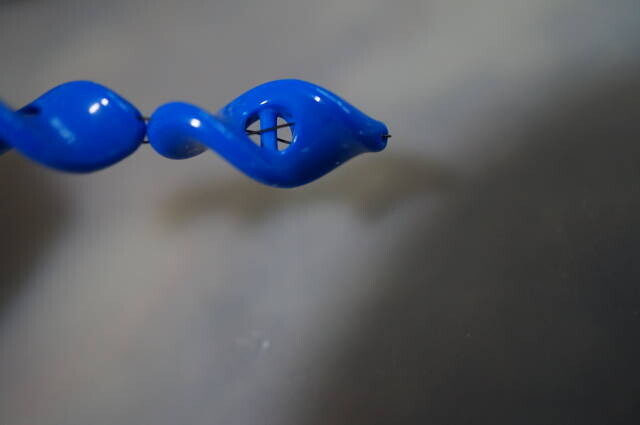
The piston drill sheath still admitted water after further changes
In another part of the entry published in May 2026, Mr. Okada described further changes to the sheath. Its individual aluminum pipes became shorter and more numerous, a design he said could tolerate stronger bends.
He distinguished the potentially sealed twin tips from the sheath, which could not be sealed because the wire needed to move. Water could pass through its interior, so he called for boiling disinfection.
(Source: ok-lab's diary, published May 2026)
https://ok-lab.hatenablog.com/entry/2026/05/09/122904
How prostate chip rotation changed over time
| Published | What the diary said then |
|---|---|
| Oct 2021 | The first drill lacked a stopper and could travel dangerously far inward. |
| Feb 2022 | A request for slow rotation exposed doubts about toy motors' turning force. |
| Apr 2026 | A sliding-and-rotating prototype appeared, without a settled price. |
| Apr 2026 | Aluminum guides replaced epoxy guides after inconsistent sheath performance. |
| Apr 2026 | Planned prices separated the shaft, sheath, and tip. |
| Apr 2026 | The first custom build using the revised sheath was completed. |
| May 2026 | A reversible version introduced tips at both ends and an additional construction charge. |
| May 2026 | Thinner connecting wire addressed concern about resin tips breaking. |
| May 2026 | Shorter, more numerous aluminum guides further changed the sheath's bend tolerance. |
The diary does not say what the current state is.
OK Prostate Chip products related to prostate chip rotation
No current product is directly tied to this topic.
Common worries about prostate chip rotation
The reader requests concerned slow rotation, rubbing, component prices, and custom tip combinations.
"Could prostate drills deliver slow rotation through long shafts?"
In an entry published in February 2022, a reader asked about a motor-driven rod approximately 25 cm long, reaching the prostate. They also asked whether a 5–10 cm version might be more practical if the longer shaft was difficult. Mr. Okada thought very slow rotation with enough turning force would be difficult with a toy motor.
He considered a rotary craft tool's flexible drive shaft (a bendable part transmitting rotation) a possible basis for the idea. His own tool could run very slowly, he wrote, but the diary does not record a completed version of this proposal. He suggested a gently shaped tip for the concept.
(Source: ok-lab's diary, published February 2022)
https://ok-lab.hatenablog.com/entry/2022/02/12/123441
"Would a piston drill reduce rubbing along the urine passage?"
In an entry published in April 2026, a reader wanted a sliding tip that would act near the prostate. The reader believed that enclosing the moving section might reduce rubbing and strain elsewhere in the urine passage. Mr. Okada welcomed the idea and temporarily paused another wire project to develop it.
The diary does not record whether the resulting device reduced rubbing for this customer. Mr. Okada favored a screw-shaped tip for rotation because he considered it the safest and most suitable shape for that purpose.
(Source: ok-lab's diary, published April 2026)
https://ok-lab.hatenablog.com/entry/2026/04/04/122916
"What did a custom piston drill cost?"
In an entry published in April 2026, a prototype request received a component quotation; Mr. Okada subsequently listed planned prices, all tax excluded. For the 20 cm version, a 0.4 mm shaft measuring 30 cm was ¥3,000 (about $19 at ¥156 = $1, rate as of 2026-09-04), and the sheath was ¥5,000 (about $32 at ¥156 = $1, rate as of 2026-09-04). For the 25 cm version, a 0.4 mm, 35 cm shaft was ¥4,000 (about $26 at ¥156 = $1, rate as of 2026-09-04), and the sheath was ¥7,000 (about $45 at ¥156 = $1, rate as of 2026-09-04).
A 0.5 mm shaft carried a ¥1,000 (about $6 at ¥156 = $1, rate as of 2026-09-04) increase: ¥4,000 (about $26 at ¥156 = $1, rate as of 2026-09-04) for 30 cm, or ¥5,000 (about $32 at ¥156 = $1, rate as of 2026-09-04) for 35 cm. These were proposed prices published in April 2026. Mr. Okada specified that the tip would cost extra at its usual price.
(Source: ok-lab's diary, published April 2026)
https://ok-lab.hatenablog.com/entry/2026/04/18/122906
"Could a reversible piston drill have two screw-shaped tips?"
In an entry published in May 2026, a customer requested the reversible model and asked for a price quotation. Staff asked about the opposite tip, explaining that the displayed blue screw-shaped tip was size SS. The customer requested size S and two connected tips with no gap.
Staff initially said the proposed wire connection was difficult, then offered to try another method. The entry shows the completed custom build, but does not record the customer's experience with it.
(Source: ok-lab's diary, published May 2026)
https://ok-lab.hatenablog.com/entry/2026/05/09/122904
Buying from outside Japan

OK Lab ships internationally to countries covered by Japan Post's EMS courier service. Overseas orders are paid in advance by PayPal.
Each order carries a ¥400 (about $3 at ¥156 = $1, rate as of 2026-09-04) handling fee, and EMS shipping is charged on top. These terms come from OK Lab's official sales-terms page (written here as plain text, not a link: ok-lab.net/docs/law), checked on September 7, 2026; confirm them on the official store before you order, because they can change.
Summary of this article
| What you wanted to know | The answer |
|---|---|
| In short: is safety settled? | Mr. Okada described unresolved concerns alongside the design changes. |
| About this product: who makes it? | OK Lab is a small Japanese company selling urethral devices, with prices in JPY. |
| Key terms: what moves? | The shaft carries movement; the sheath supports and guides it. |
| What happens: what did prototypes reveal? | Uncontrolled travel, weak support, and inconsistent movement prompted revisions. |
| The maker's answer: what changed? | Wire choices, connections, and sheath construction changed; his warning about bodily tolerance remained. |
| Changes over time: how did development progress? | The diary moved from an external-motor drill to sliding, rotating, and reversible custom designs. |
| Related products: is there a current match? | No current product is directly tied to this topic. |
| Common worries: what did customers ask? | Their requests concerned rotation, rubbing, price, and tip combinations. |
| Buying abroad: what are the stated terms? | Advance PayPal payment, a ¥400 (about $3 at ¥156 = $1, rate as of 2026-09-04) handling fee, and additional EMS shipping charges. |
Source: ok-lab's diary (Okada Comfortable Life Laboratory). The original entries are in Japanese; quotations on this page are translated. Photos and videos are on the original entries.
This article is a summary of the maker's development diary. The product is not a medical device and no result is guaranteed. If anything feels wrong or worries you, see a doctor. Prices, specifications and cautions change, so confirm the latest information on the official blog and the official site. Questions about ordering and shipping go to the seller.