![Which titanium prostate chip shape is which? | Different shapes served different design aims [OK Prostate Chip]](/img/a/T0595/eyecatch.svg)
This page is based on entries from "ok-lab's diary" (https://ok-lab.hatenablog.com/), the Japanese development diary written by Mr. Okada, founder of OK Lab, a small company in Japan (Okada Comfortable Life Laboratory). Only the entries about "titanium chip shapes" are summarized here, in order of publication. Past prices and sizes are as written at the time. Current prices come from the official product list (retrieved September 4, 2026). Quotations are translated from Japanese.
Note: This page is a personal reading log by someone with no connection to the maker or the seller. It reflects the source entries as of their publication dates and makes no guarantee of accuracy or safety. The product is not a medical device; talk to a doctor about any health decision. Check the official site for current information. This page contains advertising.
In short
- The diary describes ribbed, short sculpted, screw-heavy, and cross-shaped titanium chips with different design aims.
- Mr. Okada discusses shape changes for positioning, flexibility, and stimulation, mainly through his own assessments.
- No matching product can be confirmed on the current list.
About this product
The OK Prostate Chip is a small device that is placed in the urethra (the urine passage) so that it acts on the prostate; the maker sells it in several shapes, sizes and materials. It is made and sold by OK Lab (Okada Comfortable Life Laboratory), a small company in Japan, through its own online store, and prices are in Japanese yen (JPY).
The maker's development diary, "ok-lab's diary", is written in Japanese. This page is an English summary of it, and every quotation is translated. OK Lab ships internationally, so readers outside Japan can order (see "Buying from outside Japan" below).
Product names on this page are plain-English descriptions. The official Japanese product name is shown once in the product table so you can find the same item in the store.
Before you read: key terms
| Term | Plain-English meaning |
|---|---|
| Urethra | The urine passage; it is where the maker describes placing the device. |
| External urethral sphincter | The muscle discussed in relation to holding chip parts in position, including at gaps between shaped sections. |
| Screw-shaped helper | An additional shaped piece behind the main chip; these entries discuss its role in positioning and flexibility. |
| 3D design | Three-dimensional shape design, used here to propose chip forms. The diary does not explain the design process. |
What happens: titanium prostate chip shapes
The OK Prostate Chip is a small device placed in the urethra (the urine passage) to act on the prostate. These titanium designs change the chip's shape, sometimes adding screw-shaped helper pieces behind it. The diary discusses their relationship with the external urethral sphincter (the muscle described as holding parts in place). Mr. Okada connects these choices with positioning, flexibility, and the stimulation he reports.
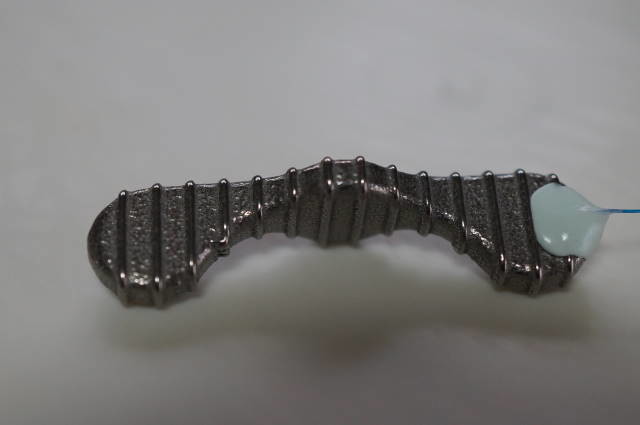
The ribbed titanium chip remained unfinished and untested in April 2021
In an entry published in April 2021, Mr. Okada introduced a ribbed titanium chip whose technical development was still incomplete. He writes that he had not tested it because he was already using another chip.
The entry raises the possibility of stronger stimulation, but gives no test result supporting that comparison. No matching product can be confirmed on the current list.
(Source: ok-lab's diary, published April 2021)
https://ok-lab.hatenablog.com/entry/2021/04/17/125959
The short titanium chip began as an attempt to prevent loss
In June 2021, the diary introduced a short chip proposed by a 3D designer (someone who designs three-dimensional shapes). The designer wanted it to be harder to lose, citing social media discussions after Mr. Okada initially questioned the proposal. Mr. Okada writes that the explanation still puzzled him, but he requested a model because the shape reminded him of medieval weaponry.
The short sculpted titanium chip (prayer titanium chip) reminded Mr. Okada of Mary combined with Christ on a cross. He described the main chip as short and narrow, with relatively little stimulation. No matching product can be confirmed on the current list.
(Source: ok-lab's diary, published June 2021)
https://ok-lab.hatenablog.com/entry/2021/06/05/125933
The screw-heavy titanium chip combined a rigid front with movable sections
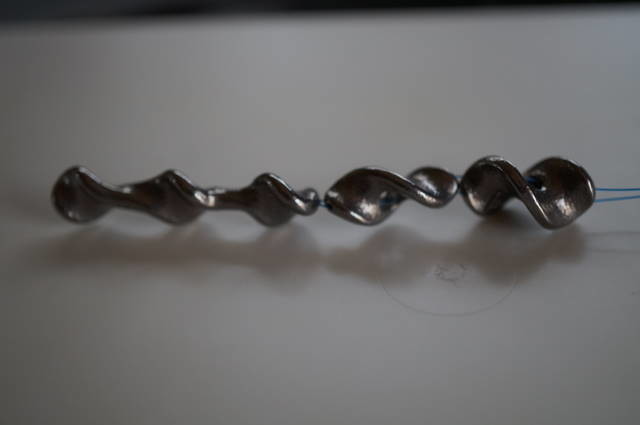
In an entry published in June 2021, a titanium fabricator proposed a leading chip with 2 twisted sections. Mr. Okada added 2 screw-shaped helpers (supporting pieces behind the main chip), producing the screw-heavy titanium chip. He described approximately 30 mm at the front as unable to bend, while the following screw-shaped sections could change direction freely.
Mr. Okada preferred that combination to an arrangement made entirely from helpers, which he thought would provide overly gentle prostate stimulation. No matching product can be confirmed on the current list.
(Source: ok-lab's diary, published June 2021)
https://ok-lab.hatenablog.com/entry/2021/06/19/125845
The cross-shaped titanium chip looked industrial to Mr. Okada in July 2021
In an entry published in July 2021, Mr. Okada presented a titanium fabricator's proposal resembling a Phillips screwdriver. He thought the cross-shaped titanium chip looked like an industrial component and would not be recognized as an adult product.
Mr. Okada found its appearance less interesting than some ceramic designs, whose visual character he thought was difficult to achieve through 3D design. No matching product can be confirmed on the current list.
(Source: ok-lab's diary, published July 2021)
https://ok-lab.hatenablog.com/entry/2021/07/03/125851
The maker's answer to titanium prostate chip shapes
Mr. Okada describes helper sizes, repeated gaps, and a cross-shaped profile as design choices affecting how the chips behave.
The short titanium chip had differently sized helpers and still shifted
The entry published in June 2021 gives separate widths for the short sculpted titanium chip's titanium helpers. The first helper was 9 mm wide, labeled M, and the second was 10 mm wide, labeled L. These measurements belong to the helpers, rather than the main sculpted chip.
In Mr. Okada's account, the external urethral sphincter initially lay between the two helpers. He reported that urination pushed the device outward slightly, changing that arrangement. The muscle then lay between the main chip's rear end and the first helper.
(Source: ok-lab's diary, published June 2021)
https://ok-lab.hatenablog.com/entry/2021/06/05/125933
The screw-heavy titanium chip offered several positions in Mr. Okada's account
In the entry published in June 2021, Mr. Okada described repeated gaps along the screw-heavy titanium chip as useful for positioning. He wrote that the sphincter could be accommodated at any of those gaps, associating the shape with shallow, intermediate, and deep positions.
He also claimed that the long design removed concerns about its orientation during placement. Mr. Okada presented that freedom as a practical advantage of the shape.
(Source: ok-lab's diary, published June 2021)
https://ok-lab.hatenablog.com/entry/2021/06/19/125845
The cross-shaped titanium chip drew claims about pressure and urine flow
In the entry published in July 2021, Mr. Okada said the screwdriver-like profile could spread the prostate in 4 directions. He also described urine passage as good.
These were Mr. Okada's assessments of the proposed design. The diary does not record a customer's experience with this shape.
(Source: ok-lab's diary, published July 2021)
https://ok-lab.hatenablog.com/entry/2021/07/03/125851
How titanium prostate chip shapes changed over time
| Published | What the diary said then |
|---|---|
| Apr 2021 | The ribbed titanium design remained technically unfinished and untested by Mr. Okada. |
| Jun 2021 | A designer proposed a short sculpted chip intended to be harder to lose. |
| Jun 2021 | Mr. Okada reported outward movement during urination, changing the short chip's position. |
| Jun 2021 | A screw-heavy design combined a rigid leading section with freely moving sections behind it. |
| Jul 2021 | Mr. Okada credited a cross-shaped proposal with multidirectional pressure and good urine passage. |
The diary does not say what the current state is.
OK Prostate Chip products related to titanium prostate chip shapes
No current product is directly tied to this topic.
Common worries about titanium prostate chip shapes
(The material contains no questions from readers.)
Buying from outside Japan
OK Lab ships internationally to countries covered by Japan Post's EMS courier service. Overseas orders are paid in advance by PayPal. Each order carries a ¥400 (about $3 at ¥156 = $1, rate as of 2026-09-04) handling fee, and EMS shipping is charged on top. These terms come from OK Lab's official sales-terms page (written here as plain text, not a link: ok-lab.net/docs/law), checked on September 7, 2026; confirm them on the official store before you order, because they can change.
Summary of this article
| What you wanted to know | The answer |
|---|---|
| What is the short answer? | The diary describes several titanium shapes, each with a different design aim. |
| What is the base product? | A small device made by OK Lab in Japan and intended to act on the prostate through the urethra. |
| Which terms matter? | The entries distinguish the main chip, screw-shaped helpers, and the muscle discussed in relation to positioning. |
| Which shapes appear? | Ribbed, short sculpted, screw-heavy, and cross-shaped titanium designs. |
| What does the maker say about their behavior? | He discusses helper widths, movement, flexibility, possible positions, and claimed effects of the cross-shaped profile. |
| What changed over time? | The entries move from an unfinished ribbed design in April 2021 to further proposals and observations through July 2021. |
| Can these designs be matched to current products? | No matching product can be confirmed on the current list. |
| What did readers ask? | The supplied material contains no reader questions. |
| How does overseas buying work? | The stated terms use advance PayPal payment, Japan Post's EMS courier service, and a ¥400 (about $3 at ¥156 = $1, rate as of 2026-09-04) handling fee plus shipping. |
Source: ok-lab's diary (Okada Comfortable Life Laboratory). The original entries are in Japanese; quotations on this page are translated. Photos and videos are on the original entries.
This article is a summary of the maker's development diary. The product is not a medical device and no result is guaranteed. If anything feels wrong or worries you, see a doctor. Prices, specifications and cautions change, so confirm the latest information on the official blog and the official site. Questions about ordering and shipping go to the seller.