![What is the attachment on the penis head? | A gatekeeper intended to control chip movement [OK Prostate Chip]](/img/a/T0584/eyecatch.svg)
This page is based on entries from "ok-lab's diary" (https://ok-lab.hatenablog.com/), the Japanese development diary written by Mr. Okada, founder of OK Lab, a small company in Japan (Okada Comfortable Life Laboratory). Only the entries about "penis head attachments and slit shapes" are summarized here, in order of publication. Past prices and sizes are as written at the time. Current prices come from the official product list (retrieved September 4, 2026). Quotations are translated from Japanese.
Note: This page is a personal reading log by someone with no connection to the maker or the seller. It reflects the source entries as of their publication dates and makes no guarantee of accuracy or safety. The product is not a medical device; talk to a doctor about any health decision. Check the official site for current information. This page contains advertising.
In short
Mr. Okada reports that slit gatekeepers focus pressure around the urine opening and keep the stream from splitting.
The maker revised plates, tubing, straps, and flexible wire parts as problems appeared.
No matching product can be confirmed on the current list.
About this product

The OK Prostate Chip is a small device that is placed in the urethra (the urine passage) so that it acts on the prostate; the maker sells it in several shapes, sizes and materials. It is made and sold by OK Lab (Okada Comfortable Life Laboratory), a small company in Japan, through its own online store, and prices are in Japanese yen (JPY). The maker's development diary, "ok-lab's diary", is written in Japanese. This page is an English summary of it, and every quotation is translated. OK Lab ships internationally, so readers outside Japan can order (see "Buying from outside Japan" below). Product names on this page are plain-English descriptions. The official Japanese product name is shown once in the product table so you can find the same item in the store.
Before you read: key terms
| Term | Plain-English meaning |
|---|---|
| Urethra | The urine passage, where the base chip sits and through which urine leaves the body. |
| Glans | The penis head; it is the area targeted by these retaining attachments. |
| Gatekeeper | An attachment at the urine opening intended to limit chip movement while leaving a urine route. |
| Flat plate | A broad supporting part positioned against the penis head as part of the larger attachment. |
| Silicone tubing | Flexible tubing used to carry urine through the outlet described in December 2022. |
| Resin | The material selected for the replacement tube tip, which had an opening for urine. |
| Shape-memory wire | Thin wire used to form flexible gatekeeper loops and connecting pieces. |
| Adjustable extension | A connecting part with changeable length, linking the gatekeeper with a chip assembly. |
What happens: slit gatekeepers
The OK Prostate Chip is a device kept in the urethra (the urine passage), which Mr. Okada describes as providing prostate stimulation. A gatekeeper (an attachment intended to limit chip movement) sits at the glans (the penis head), around the urine opening. These entries describe versions intended to leave a urine route while controlling the chip's position. The slit version focused pressure around the opening, according to Mr. Okada.
The early gatekeeper aimed to block chip escape while preserving urine flow
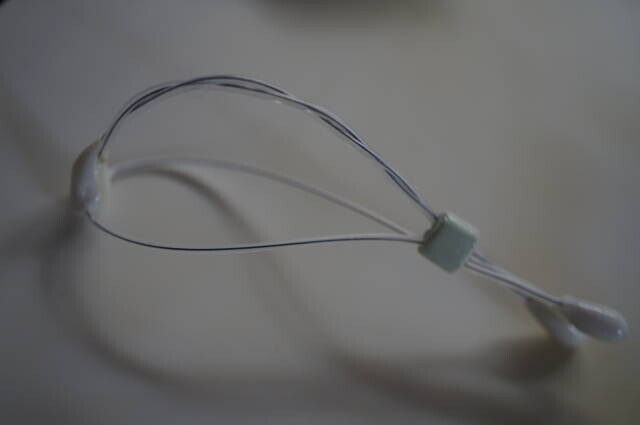
In an entry published in April 2022, Mr. Okada described a structure that left only a passage for urine. The rest of the opening was closed off, with the aim of preventing a chip from coming out. The diary does not record whether a customer tested this version.
Part of the attachment occupied the urethral entrance, while its external structure concentrated pressure on the penis head. Mr. Okada also intended the gatekeeper to limit excessive inward movement, including movement toward the bladder.
(Source: ok-lab's diary, published April 2022)
https://ok-lab.hatenablog.com/entry/2022/04/16/123037
Pain led Mr. Okada to propose a shorter gatekeeper bar
In an entry published in January 2023, Mr. Okada reported pain from a bar near the testicles on his gatekeeper's plate. The discomfort appeared after about half a day when hanging skin contacted the bar.
The diary does not record how the revised bar felt during subsequent extended use. Mr. Okada specified a shorter bar: approximately 4 cm, compared with the earlier 6 cm.
(Source: ok-lab's diary, published January 2023)
https://ok-lab.hatenablog.com/entry/2023/01/14/122952
Mr. Okada reported an unsplit urine stream with his slit gatekeeper
In an entry published in June 2024, Mr. Okada reported that his slit gatekeeper kept the urine stream from splitting. He said he originally expected this cleaner stream to be its main benefit. He also described concentrated, gentle pressure around the opening.
He also reported that the slit gatekeeper helped keep his chip in place. He associated the combined pressure and prostate stimulation with feeling better, while also considering other explanations. The diary does not record how this design felt for a customer.
(Source: ok-lab's diary, published June 2024)
https://ok-lab.hatenablog.com/entry/2024/06/29/123044
A flexible gatekeeper used thin wire inside narrow tubing
In an entry published in July 2025, Mr. Okada described a gatekeeper made from shape-memory wire (thin wire used for flexible parts). The prototype placed 0.2 mm wire inside 1 mm tubing. It combined a loop around the penis head's rim with a lengthwise wire section.
He reported that this design behaved differently from earlier gatekeepers, which pressed with a broad surface. The intended M size had a loop circumference of about 12 cm. Mr. Okada specified an L size with a circumference 2 cm longer.
(Source: ok-lab's diary, published July 2025)
https://ok-lab.hatenablog.com/entry/2025/07/05/122905
Direct gatekeeper connections made adjustable extensions necessary in the maker's prototype
In an entry published in July 2025, Mr. Okada described a problem with connecting a chip extension directly to the gatekeeper. The firm connection left no room for movement, so the extension needed to account for changes in penis length. His answer was an adjustable extension (a connecting part with changeable length).
He said its adjustment accommodated both relaxed and erect states. For lengths beyond 20 cm, Mr. Okada proposed an added extension section.
(Source: ok-lab's diary, published July 2025)
https://ok-lab.hatenablog.com/entry/2025/07/05/122905
A gatekeeper connector offered an alternative to commercially sold jewelry
In an entry published in July 2025, Mr. Okada introduced a wire connector for people uneasy about commercially sold jewelry. He described the shape-memory connector as approximately 4 cm long. Its role was to connect the gatekeeper with an extension.
He had tried a jewelry assortment priced at about ¥1,000 (about $6 at ¥156 = $1, rate as of 2026-09-04) for 10 pieces. Mr. Okada warned that those pieces might break and said he lacked the knowledge to advise on jewelry.
(Source: ok-lab's diary, published July 2025)
https://ok-lab.hatenablog.com/entry/2025/07/05/122905
Gatekeeper accessories received separate prices in July 2025
In an entry published in July 2025, the flexible wire gatekeeper was priced at ¥4,000 (about $26 at ¥156 = $1, rate as of 2026-09-04), tax excluded. The wire connector was ¥2,000 (about $13 at ¥156 = $1, rate as of 2026-09-04), tax excluded. The adjustable extension cost ¥6,000 (about $38 at ¥156 = $1, rate as of 2026-09-04), tax excluded, for lengths up to 20 cm.
These were separate prices for the retaining attachment, its connecting piece, and the adjustable extension. No matching product can be confirmed on the current list.
(Source: ok-lab's diary, published July 2025)
https://ok-lab.hatenablog.com/entry/2025/07/05/122905
The maker's answer to slit gatekeepers
Mr. Okada revised contact surfaces, urine routing, and the parts that held the attachment as development exposed problems.
The gatekeeper plan paired a standard frame with varied plate designs

In an entry published in December 2022, Mr. Okada changed the plan for the gatekeeper's supporting structure. The stainless steel frame would have a standard shape, while the flat plate (the part positioned against the penis head) could vary.
Only 3 plate designs had been prototyped at that point. Mr. Okada described further shapes as possibilities and considered designs that could serve as accessories. He invited design suggestions for additional plates.
(Source: ok-lab's diary, published December 2022)
https://ok-lab.hatenablog.com/entry/2022/12/31/123019
A downward gatekeeper tube changed where most urine drained
In an entry published in December 2022, Mr. Okada described a revised urine outlet using silicone tubing (flexible tubing used to carry urine). In the proposed arrangement, the tube faced downward and was held by the belt beside the testicles.
He reported that most urine traveled through this tube and drained downward. He described this as making seated urination more convenient. For the initial product, Mr. Okada favored a tube layout intended to make the attachment easier to use.
(Source: ok-lab's diary, published December 2022)
https://ok-lab.hatenablog.com/entry/2022/12/31/123019
Resin was chosen to replace the gatekeeper tube's ceramic connection
In an entry published in December 2022, Mr. Okada selected a tube with an opening at its tip for the first release. Earlier diary demonstrations had shown a ceramic chip connected at the tube's end.
The planned release would replace that connection with resin (the material chosen for the replacement tip), also with an opening. Its length within the urethra would be adjustable. Mr. Okada intended this as a general-purpose product for both beginners and experienced users.
(Source: ok-lab's diary, published December 2022)
https://ok-lab.hatenablog.com/entry/2022/12/31/123019
Thin gatekeeper wires were abandoned as hook positions changed
In an entry published in January 2023, Mr. Okada abandoned the flat plate's thin wires. He considered them too narrow and dangerous for pressing against skin around the testicles. The redesigned arrangement used 4 tubes to secure the plate.
The lower fixing points moved from 2 separated hooks toward the center, and the hooks on the pubic side became flat. Only 2 central hooks still projected outward, by about 1 cm. Mr. Okada expected those hooks to remain because they also kept a belt close to the central opening.
(Source: ok-lab's diary, published January 2023)
https://ok-lab.hatenablog.com/entry/2023/01/14/122952
Clothing straps introduced slipping concerns in the revised gatekeeper design
In an entry published in January 2023, Mr. Okada shifted toward an attachment intended to reduce visible bulk beneath thin women's clothing. He planned to replace the mounting tubes with clothing straps, seeking a material that could tolerate getting wet. Transparent bra straps were under consideration; the diary's example used ordinary elastic bra straps.
Later in that entry, he wrote that clothing straps slid readily against skin and therefore tended to shift. He said changing the material meant checking the holding strength again. Mr. Okada thought tubing might still be necessary when firm retention was the aim.
(Source: ok-lab's diary, published January 2023)
https://ok-lab.hatenablog.com/entry/2023/01/14/122952
How slit gatekeepers changed over time
| Published | What the diary said then |
|---|---|
| Apr 2022 | A urine channel remained open while the gatekeeper aimed to prevent chip escape. |
| Dec 2022 | A standard frame and varied plates were planned, along with a resin tube tip. |
| Jan 2023 | Pain and mounting problems prompted changes to bars, hooks, and strap materials. |
| Jun 2024 | Mr. Okada reported an unsplit urine stream with the slit design. |
| Jul 2025 | Flexible wire attachments introduced separate size specifications and adjustable connecting parts. |
The diary does not say what the current state is.
OK Prostate Chip products related to slit gatekeepers
No current product is directly tied to this topic.
Common worries about slit gatekeepers
(The material contains no questions from readers.)
Buying from outside Japan

OK Lab ships internationally to countries covered by Japan Post's EMS courier service. Overseas orders are paid in advance by PayPal. Each order carries a ¥400 (about $3 at ¥156 = $1, rate as of 2026-09-04) handling fee, and EMS shipping is charged on top. These terms come from OK Lab's official sales-terms page (written here as plain text, not a link: ok-lab.net/docs/law), checked on September 7, 2026; confirm them on the official store before you order, because they can change.
Summary of this article
| What you wanted to know | The answer |
|---|---|
| What is the short answer? | Mr. Okada designed gatekeepers to retain chips while leaving a urine route. |
| What is the base product? | A Japanese urethral device made by OK Lab, with prices in JPY. |
| What do the unfamiliar terms mean? | Gatekeepers retain; tubes carry urine; adjustable extensions connect parts. |
| What did the development reports show? | Mr. Okada described changes in contact, fit, and urine flow. |
| What did Mr. Okada change? | He revised frames, plates, tube tips, and straps after design problems. |
| When were these developments published? | The supplied entries run from April 2022 through July 2025. |
| Is a current matching product identified? | No current product is directly tied to this topic. |
| Were reader questions recorded? | The material contains no questions from readers. |
| How do overseas purchases work? | EMS delivery, advance PayPal payment, and separate handling and shipping charges. |
Source: ok-lab's diary (Okada Comfortable Life Laboratory). The original entries are in Japanese; quotations on this page are translated. Photos and videos are on the original entries.
This article is a summary of the maker's development diary. The product is not a medical device and no result is guaranteed. If anything feels wrong or worries you, see a doctor. Prices, specifications and cautions change, so confirm the latest information on the official blog and the official site. Questions about ordering and shipping go to the seller.